Bitcoin vs Ethereum: Which Crypto Should You Actually Buy?
So you're staring at your exchange account, trying to decide where your money should go. Bitcoin or Ethereum? Yeah, you and about a million other people. These two coins alone make up something like...

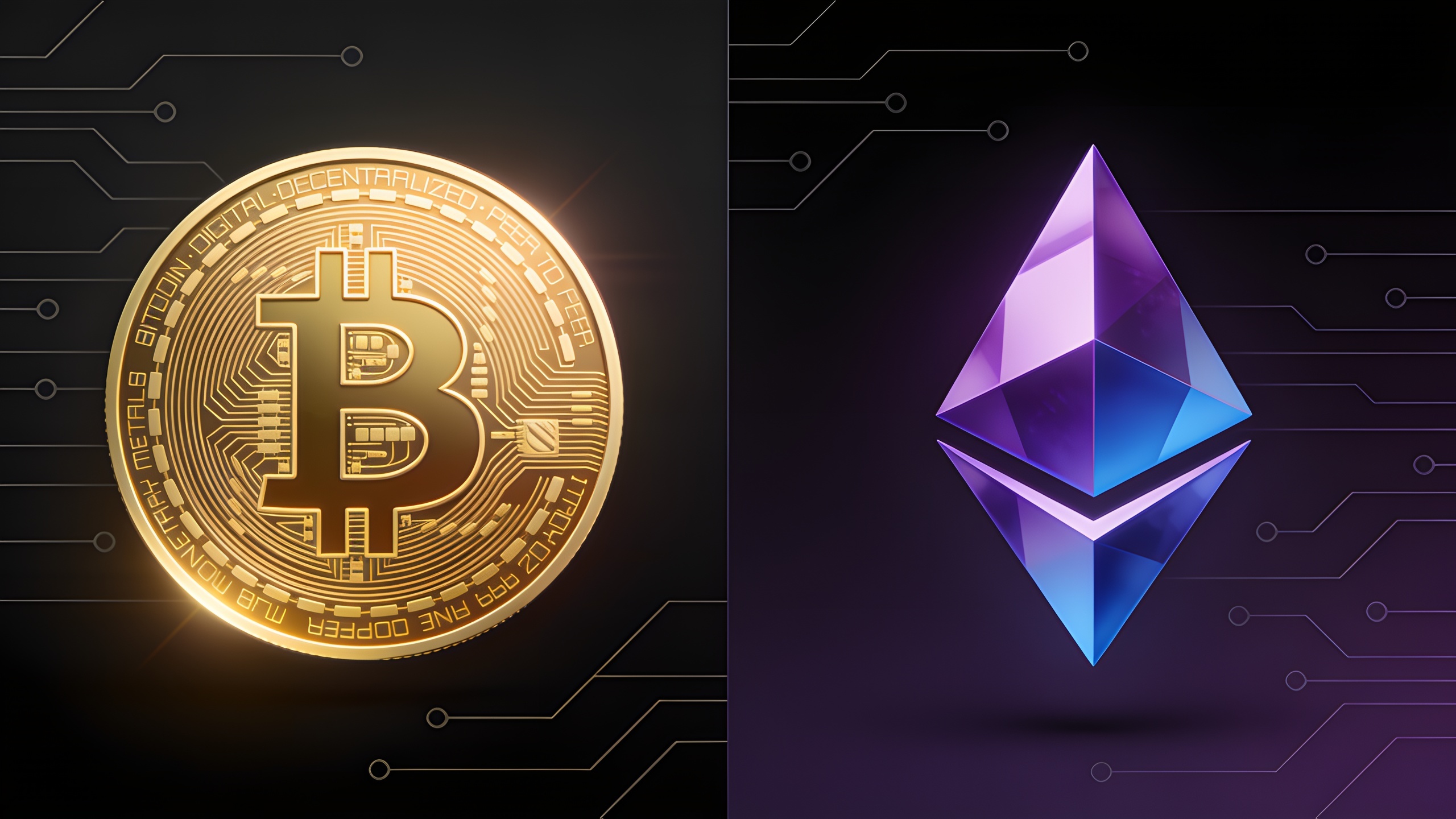
So you're staring at your exchange account, trying to decide where your money should go. Bitcoin or Ethereum? Yeah, you and about a million other people. These two coins alone make up something like 60% of the entire crypto market, and while people lump them together constantly, they're honestly not even trying to do the same thing. Which is exactly why picking between them trips up so many people.
I've watched this debate play out for years, and the truth is most beginners approach it wrong. They ask "which one goes up more?" when they should be asking "which one actually fits what I'm trying to do?" Big difference. Let me walk you through how these two actually differ, and by the end you'll have a much clearer sense of where you land.
Table of Contents
- Where They Came From (And Why It Matters)
- What's Actually Happening Under the Hood
- Digital Gold vs the Everything Machine
- The Scalability Headache
- Which One's the Better Bet?
- Stuff That Could Go Wrong
- Bitcoin vs Ethereum: The Quick Comparison
- Questions People Actually Ask
Where They Came From (And Why It Matters)
Bitcoin showed up in 2009, right in the smoking wreckage of the 2008 financial crisis. Some anonymous person (or group) calling themselves Satoshi Nakamoto dropped a whitepaper describing "peer-to-peer electronic cash" that didn't need banks. And the mission has basically never changed. Bitcoin wants to be money that no government can print more of, censor, or seize. Hard cap of 21 million coins. That's it. That's the whole pitch, and there's something kind of beautiful about how stubborn it is.
Ethereum came along in 2015, cooked up by Vitalik Buterin and a crew of co-founders who looked at Bitcoin and thought, okay, but what if the blockchain could do... more? Instead of just being money, Ethereum built a programmable blockchain that runs smart contracts, which are basically little self-executing agreements baked right into the code. Suddenly the blockchain wasn't just a ledger. It was a whole global computer.
That difference in philosophy is the thing to hold onto. Bitcoin is trying to be digital gold, a hedge when the dollar loses its footing. Ethereum is trying to be the plumbing for an entire new internet: DeFi, NFTs, all the Web3 stuff. Two totally different bets on the future.
What's Actually Happening Under the Hood
How They Agree on What's True
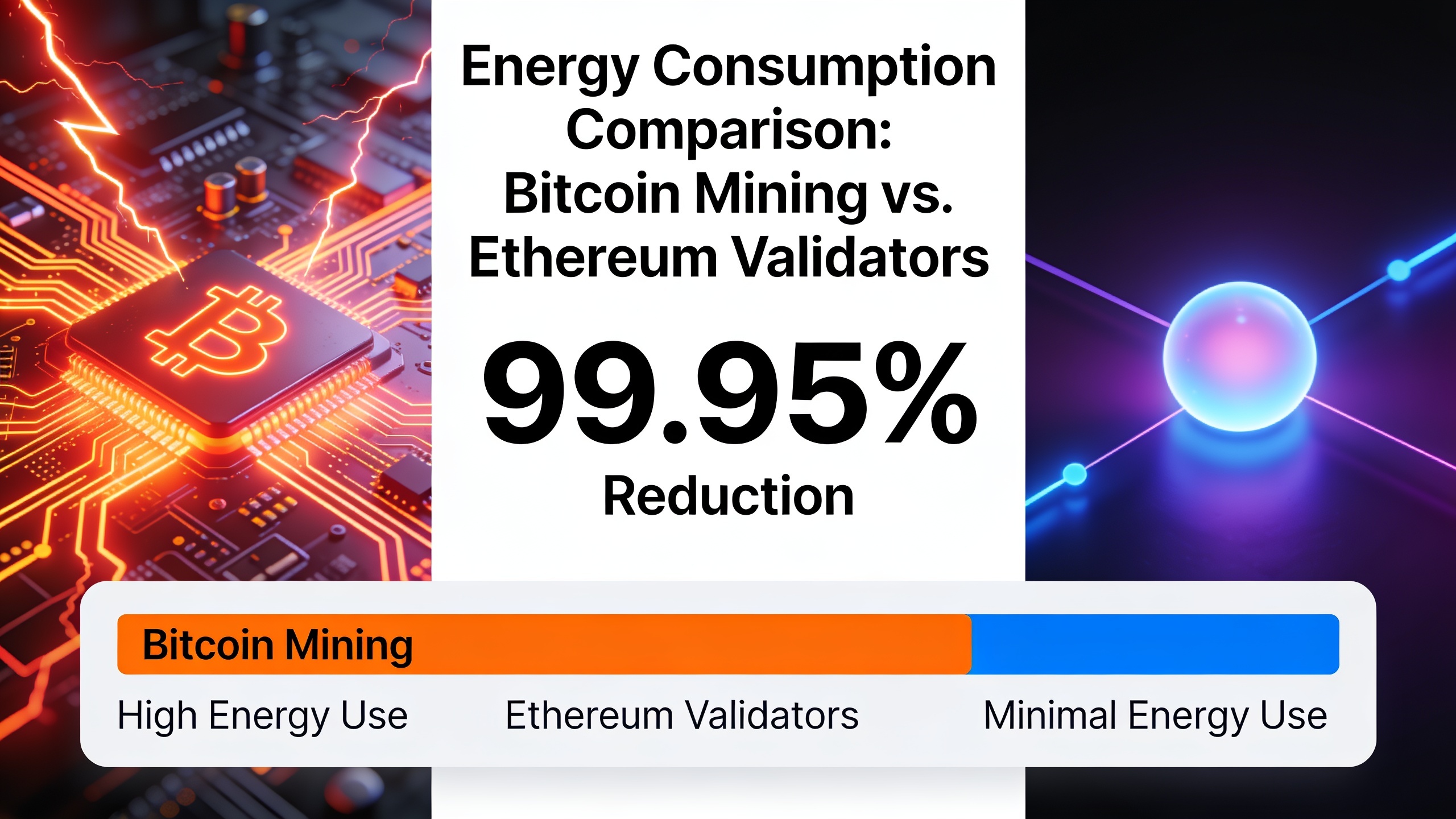
Bitcoin runs on Proof-of-Work. Miners burn through electricity solving pointless math puzzles to earn the right to add the next block. It's secure as hell, nobody's arguing that. But it eats power like crazy. The Cambridge folks who track this stuff put Bitcoin's annual energy use somewhere in the neighborhood of a country like Norway or Argentina. Which, depending on your feelings about the environment, is either a fair price for security or kind of insane.
Ethereum used to work the same way. Then in September 2022 it pulled off "The Merge," switching to Proof-of-Stake. Now instead of miners, you've got validators who lock up their ETH as collateral and get chosen to verify blocks. No more energy arms race. The Ethereum Foundation says this cut the network's power consumption by around 99.95%, which is one of those numbers so big it almost sounds made up. But it happened.
The Smart Contract Thing
Here's where they really split. Bitcoin's scripting language is deliberately basic. Satoshi kept it simple on purpose, because simple means fewer things that can break. Ethereum went the opposite direction with a Turing-complete virtual machine (the EVM) that lets developers build genuinely complicated apps on top of it.
That's why practically every token, DeFi protocol, and NFT marketplace you've heard of lives on Ethereum. Bitcoin's world is growing too, with stuff like the Lightning Network and wrapped BTC letting it dip a toe into DeFi. But let's be real, it's a much smaller sandbox. And I don't think Bitcoin people even want it to be bigger.
Digital Gold vs the Everything Machine
Bitcoin's job is simple to explain: store value, move value, done. The institutions have really run with this. MicroStrategy is sitting on over 226,000 BTC as of early 2024, treating it like a gold bar you can email. And when the SEC finally approved spot Bitcoin ETFs in January 2024, it basically slapped a "grown-ups welcome" sign on the front door for pension funds and financial advisors who'd been too nervous to touch crypto directly.
Ethereum's story is messier, in a good way. It's doing a bunch of things at once. DeFi lending platforms and decentralized exchanges are sitting on tens of billions in locked value. Most NFT trading still happens on Ethereum despite all the newer chains trying to steal that crown. A huge chunk of the stablecoins keeping the whole crypto economy liquid, your USDT and USDC, run on Ethereum rails. And then there's the DAO and enterprise stuff building on Ethereum or its layer-2 cousins.
So Ethereum's got its fingers in a lot of pies. That means more ways to grow, sure, but also more ways to get burned when any one of those sectors takes a hit. Bitcoin's narrower, but that focus is kind of its superpower. It doesn't care if NFTs crash.
The Scalability Headache
Both networks have wrestled with the same ugly problem: they're slow. Really slow, compared to something like Visa. They've just gone about fixing it differently.
Bitcoin does about 7 transactions per second on its base layer. That's baked into its 10-minute block time and the 1MB block size (tweaked a bit by SegWit). To get around this, there's the Lightning Network, a layer-2 that handles most of the activity off-chain and only settles up with the main blockchain occasionally. Fast, cheap, works well for small payments.
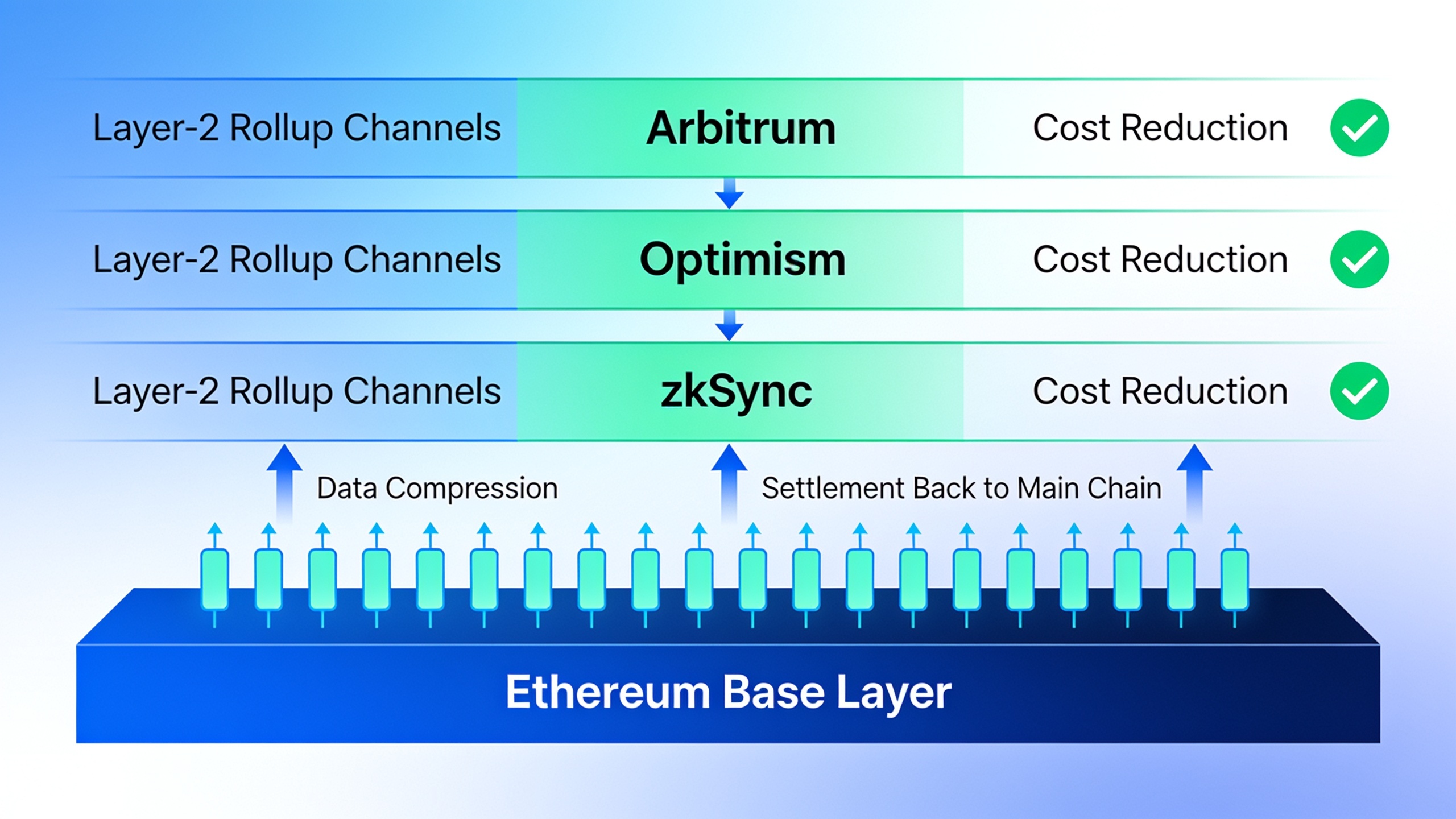
Ethereum's base layer does roughly 15 to 30 TPS, still not exactly blazing. But Ethereum went all-in on rollups, these layer-2 networks like Arbitrum, Optimism, and zkSync that bundle up transactions off-chain and post compressed proofs back to the main chain. You get way more throughput while still borrowing Ethereum's security. After the Dencun upgrade in 2024, layer-2 fees dropped by over 90% in a lot of cases, according to L2Fees.info. That was a big deal for anyone who'd been priced out by ridiculous gas fees.
| Feature | Bitcoin | Ethereum |
|---|---|---|
| Launch Year | 2009 | 2015 |
| Consensus Mechanism | Proof-of-Work | Proof-of-Stake |
| Max Supply | 21 million BTC | No hard cap (deflationary post-EIP-1559) |
| Base Layer TPS | ~7 | ~15-30 |
| Primary Use Case | Store of value, digital gold | Smart contracts, DeFi, NFTs |
| Energy Consumption | High | Low (post-Merge) |
| Scaling Solution | Lightning Network | Rollups (Arbitrum, Optimism, zkSync) |
| Market Position | #1 by market cap | #2 by market cap |
Which One's the Better Bet?
Okay, the part you actually came for. When you look at these purely as investments, a few things matter: how the supply works, who's adopting them, how wild the price swings get, and how they move with the broader market.
Supply and Scarcity
Bitcoin's 21 million cap makes it predictably scarce, and every four years or so the block reward gets cut in half. The last halving was April 2024, dropping miner rewards from 6.25 to 3.125 BTC per block. Historically, halvings have come right before big bull runs. Emphasis on historically. Nobody can promise the pattern repeats, and anyone who does is selling you something.
Ethereum's supply is trickier. Since EIP-1559 in 2021 and then the Merge, Ethereum actually burns some of the ETH used for transaction fees. When the network's busy enough, more ETH gets burned than created, and the supply shrinks. So instead of a fixed schedule like Bitcoin, Ethereum's monetary policy kind of breathes with how much people are using it. Cool concept, honestly, though it makes the "how scarce is this really?" question harder to answer.
The Volatility Question
Both of these will give you whiplash compared to stocks or bonds. Bitcoin's been a bit calmer, historically, mostly because it's bigger and older. Ethereum swings harder, but that cuts both ways. When DeFi and NFTs were on fire in 2021, ETH gained over 400% in a single year. That's the kind of run that makes people quit their jobs (please don't).
The Big Money Moving In
Institutions have piled into both. The spot Bitcoin ETFs pulled in over $12 billion in net inflows in just their first few months of 2024, per Bloomberg. Ethereum ETFs got approved later that year and opened up similar access, though the initial money coming in was noticeably smaller. That gap tells you something: when big institutions dip their toes into crypto, Bitcoin still feels like the "safe" first step. Ethereum's the second-date coin.
Stuff That Could Go Wrong
I'd be doing you a disservice if I skipped the risks, because there are plenty.
Regulation is the big cloud hanging over everything. Governments are still figuring out how to tax this stuff, whether certain tokens count as securities, how to handle DeFi. Ethereum catches more heat here because of all the token issuance and DeFi activity happening on it. Bitcoin's gotten off relatively easy, with most regulators (the SEC included) treating it as a commodity, basically the same bucket as gold or oil.
Then there's technical risk, and it's different for each. Bitcoin's simplicity means fewer places for things to break, but also less room to innovate. Ethereum's complexity is a double-edged sword. All that programmability is powerful, but smart contract bugs have cost people billions over the years. The 2016 DAO hack, all those bridge exploits in 2021 and 2022. When you can build anything, someone can break anything.
And competition? That's really Ethereum's problem, not Bitcoin's. Nobody's seriously challenging Bitcoin for the digital gold throne. But Ethereum's got Solana, Avalanche, Cardano and a dozen others all clawing for developers and DeFi market share. That fight is far from settled, and it's worth watching closely if you're going the ETH route.
Bitcoin vs Ethereum: Which Fits Your Strategy?
Look, this comes down to what you're actually trying to accomplish and how much chaos you can stomach.
Go Bitcoin if you want something simpler. A macro asset that behaves like digital gold, good for people who care about capital preservation, hedging against inflation, and just holding for the long haul without babysitting it. The fixed supply, the institutional backing, the first-mover thing. It's the foundation a lot of people build their crypto around, and for good reason.
Lean Ethereum if you want a seat at the table for all the innovation happening in DeFi, tokenization, and Web3. It rewards people who are actually willing to dig in and understand staking yields, specific protocols, layer-2 ecosystems. More upside, more homework, more heartburn.
And honestly? A lot of advisors and analysts will just tell you to hold both. Bitcoin for the stability, Ethereum for the growth. A 2023 Fidelity Digital Assets survey found that institutional investors holding crypto tended to own both BTC and ETH rather than picking a side, which tells you the pros aren't treating this as an either-or thing either. Maybe you shouldn't either.
Questions People Actually Ask
Is Ethereum actually a better investment than Bitcoin?
Neither one wins across the board, it really depends on what you're after. Bitcoin's got the cleaner scarcity story and the stronger store-of-value case. Ethereum gives you exposure to a way wider set of uses. Most people who've thought about it just hold both and stop stressing about the ranking.
Which one's more volatile?
Ethereum, usually, though it's close and both make traditional investments look like a nap. ETH's price tends to react to DeFi activity and network usage on top of the general macro stuff, so there are just more levers that can yank it around.
Will Ethereum ever pass Bitcoin in market cap?
People have been calling for "the flippening" since 2017 and it still hasn't happened. Ethereum's narrowed the gap during hot bull markets, but Bitcoin keeps holding the top spot. Partly the institutional recognition, partly that its pitch is just easier to explain in one sentence.
Do they move together?
Mostly, yeah. They're highly correlated and tend to rise and fall together with the broader market, driven by stuff like interest rates and liquidity. But specific events can split them apart temporarily, like an Ethereum upgrade or a Bitcoin ETF approval.
If I'm brand new, which should I start with?
Most educators point beginners toward Bitcoin because the story's simpler and the track record's longer. That said, if you're itching to explore DeFi or NFTs or actually mess around with blockchain apps, Ethereum's a more hands-on, interesting place to learn. Depends on your curiosity level.
At the end of it, you don't have to marry one and dump the other. Bitcoin and Ethereum are playing different positions on the same field, and once you actually get their tech, their uses, and their risks, you're in a way better spot to build something that fits you. Whether you're drawn to Bitcoin's stubborn simplicity or Ethereum's do-everything ambition, the real edge is just staying curious and doing the reading. That never stops paying off.
You Might Also Find Useful
- Cryptocoinsjournal - Stay updated with the latest crypto news, market analysis, and investment insights to guide your digital asset decisions.
- LauDib - Discover realistic pencil portrait art and creative drawing tutorials for beginners looking to learn a new artistic skill.
- Vivienda Lista - Explore curated property listings and expert guidance to find your ideal home for purchase or rental.