P2P Crypto Trading vs Centralized Exchanges: Which One's Right for You?
So you want to buy crypto and you've hit that fork in the road: trade peer-to-peer, or use a big centralized exchange? The real question hiding underneath is how much control and privacy you're...


So you want to buy crypto and you've hit that fork in the road: trade peer-to-peer, or use a big centralized exchange? The real question hiding underneath is how much control and privacy you're willing to trade away for pure convenience. With P2P trading, you're buying and selling directly with another actual human, usually through a marketplace that holds the coins in escrow until money changes hands. On a centralized exchange, the platform is the middleman. It matches your order, holds your funds, and executes everything for you.
Neither one wins across the board. I've seen people swear the CEX is the only sane option and others who'd never touch one. Honestly, the right answer depends on where you live, how much you trade, how twitchy you get about handing your money to a company, and whether you need speed or you're fine waiting a bit.
This guide walks through the actual differences that matter (fees, security, liquidity, everyday use) so you can pick based on how you trade, not whatever some YouTuber with a Lambo told you to do.
Table of Contents
- What Is P2P Crypto Trading, and How's It Different from a Regular Exchange?
- Centralized vs P2P Trading: The Quick Comparison
- What About Fees? Which One's Actually Cheaper?
- Security: Who Do You Have to Trust?
- Liquidity and Speed: Which One Fills Your Order Faster?
- When Should You Use Each One?
- Figuring Out Which Fits Your Style
- FAQ: The Stuff People Actually Ask
What Is P2P Crypto Trading, and How's It Different from a Regular Exchange?
P2P crypto trading means you're buying or selling directly with another person, usually through a marketplace that locks the seller's coins in escrow until payment clears, instead of running everything through a company's order book. A centralized exchange (a CEX) does it the opposite way. It pools everyone's buy and sell orders into one big order book, matches them automatically, and holds your funds in its own wallets the whole time.
The thing that really separates them is who's on the other side of your trade. On a CEX, you're basically trading against a giant anonymous soup of liquidity that the platform's matching engine sorts out for you. You never know or care who sold you those coins. On a P2P marketplace, you're dealing with a specific person. Someone who listed an offer, set their own price, decided which payment methods they'll take (bank transfer, mobile wallet, cash, gift cards, whatever), and who has a reputation score you can actually look at.
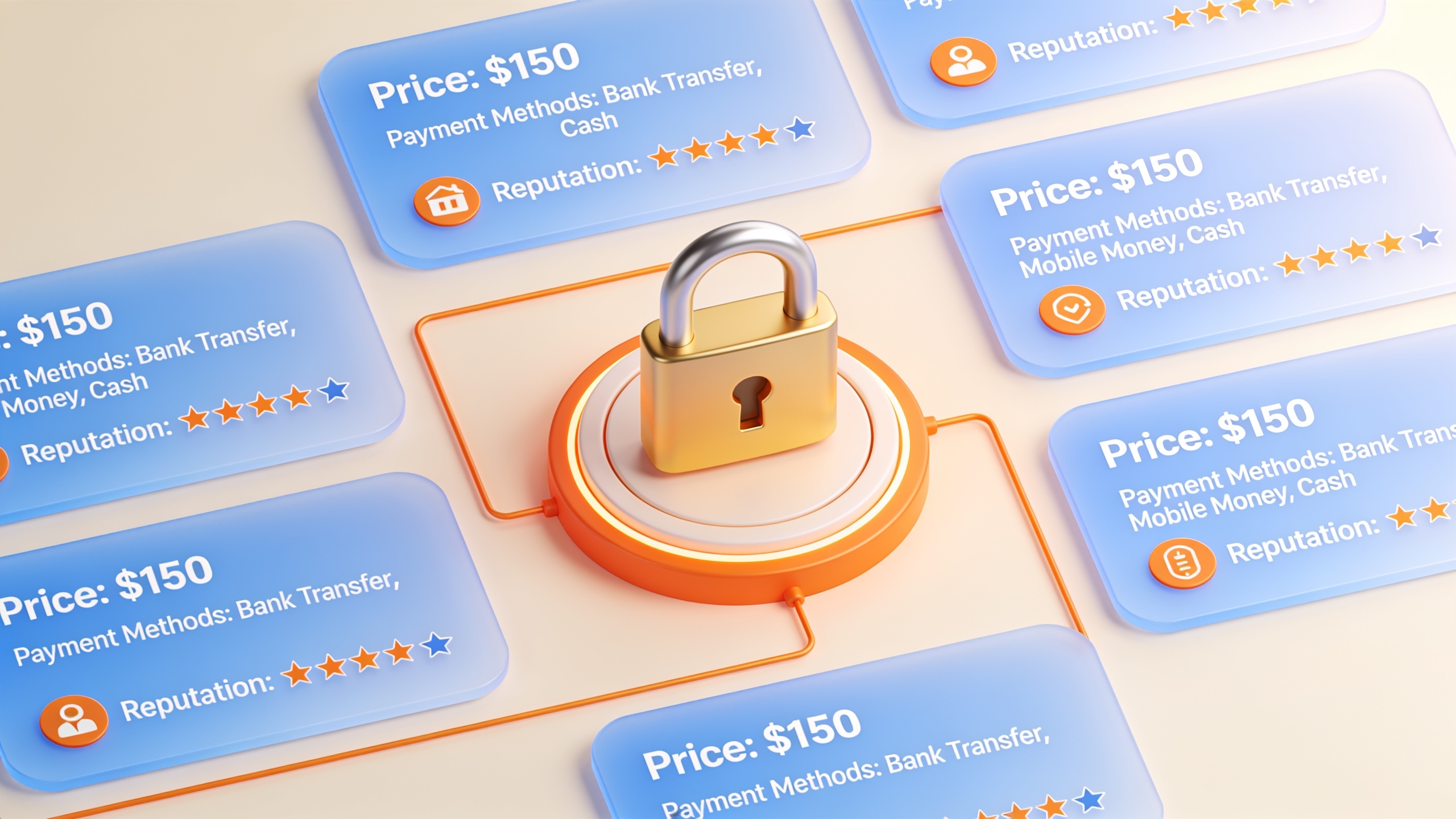
The platform in a P2P setup acts more like a referee than a broker. It locks the crypto in escrow, waits for payment to be confirmed, then releases the funds once everyone agrees the deal's done. It's not setting your price or matching you algorithmically the way a CEX order book does. And that one structural difference? It ripples out into pretty much every other decision below, from fees to custody risk to the weird disputes you can end up in.
Centralized vs P2P Trading: The Quick Comparison
Fastest way to wrap your head around this is to just line them up side by side. Here's how each model typically works, though individual platforms in either camp can differ quite a bit.
| Factor | Centralized Exchange (CEX) | P2P Marketplace |
|---|---|---|
| Who sets the price | Order book / market makers | Individual sellers and buyers |
| Fund custody during trade | Exchange holds funds in its wallets | Escrow holds crypto; fiat moves directly between users |
| Typical fee structure | Trading fee per order (often tiered by volume) | Often lower or zero platform fee, but spread may be wider |
| Payment method variety | Usually limited to card, bank transfer, sometimes wire | Wide range: bank transfer, mobile money, cash, gift cards |
| Speed of execution | Near-instant matching | Depends on counterparty responsiveness and payment confirmation |
| KYC/identity requirements | Typically required, tied to regulatory compliance | Varies by platform and payment method; can be lighter in some regions |
| Best suited for | Active traders, derivatives, high liquidity needs | Users in regions with limited banking access, privacy-conscious buyers |
| Counterparty risk | Minimal (exchange is the counterparty) | Present, mitigated by escrow and reputation systems |
Notice how neither column is flat-out "safer" or "cheaper." A trader moving big sums with a solid bank account in a well-served market is going to find a CEX way more efficient. But someone dealing with capital controls or a thin banking system might find P2P is literally their only way in.
What About Fees? Which One's Actually Cheaper?
Centralized exchanges usually slap an explicit trading fee on every order, while P2P platforms love to advertise "low or no fees" but quietly build the cost into the spread between sellers. Which one's genuinely cheaper depends on how big your trade is, what payment method you're using, and how competitive things are at that exact moment.
On a CEX, the fees are usually laid out for you and tiered. Trade more over a given period, and your percentage fee drops. Market makers (the folks posting limit orders) typically pay less than takers (people filling existing orders instantly), because makers are adding liquidity to the book and the exchange wants to reward that. It's a setup that clearly favors the frequent, high-volume crowd, and at least you can see the exact fee before you hit confirm. No surprises.
P2P is sneakier. Plenty of P2P marketplaces don't charge the buyer any direct commission at all. Instead the cost hides in the price each seller lists. A seller offering coins a bit above the going market rate is charging you a spread, just without calling it a fee. When there's a bunch of sellers competing, that can actually work in your favor. But when listings dry up or demand spikes? You can end up paying a noticeably worse price. Think around a local holiday when bank transfers crawl, or during a sudden pump when sellers widen their margins to cover the volatility risk. Payment method plays into it too. A seller who takes instant bank transfer will usually price better than one accepting something chargeback-prone, because they're baking their own risk into the number.
So which one saves you money? Genuinely, it depends. If you're doing one or two trades a month, you'll barely notice the difference either way. But if you're an active trader running the kind of setups covered in 5 Crypto Trading Strategies for Volatile Markets, those tiered CEX fees will hit you harder, because the percentage compounds across dozens or hundreds of trades. Small numbers add up fast when you're churning.
Security: Who Do You Have to Trust?
The big security trade-off is custodial risk versus counterparty risk. A centralized exchange asks you to trust a company with your money and your personal data. A P2P platform asks you to trust (and verify) some random individual, with an escrow system sitting there as the safety net.
The Custody Problem on Centralized Exchanges
The second you deposit crypto onto a CEX, you don't hold the keys anymore. The exchange does. That's the whole "not your keys, not your coins" thing you've probably heard a hundred times, and there's a reason people keep repeating it. If the exchange gets hacked, mismanages funds, or freezes withdrawals, your assets are technically yours but practically stuck. This is exactly why a lot of seasoned traders only keep money on a CEX while they're actively trading and yank the rest into self-custody afterward. Good exchanges try to soften this with cold storage for most funds, proof-of-reserves reports, and insurance pools. But that underlying dependency on the platform staying honest and solvent? It never fully goes away.
Scams and Sketchy Counterparties on P2P
P2P dodges the single-point-of-custodial-failure issue but hands you a fresh one instead: you're trading with a stranger. The classic P2P scam goes like this. A buyer sends a payment that's reversible or fake, gets the crypto, then disputes the payment afterward. Or a seller leans on the buyer to release funds before the money's actually confirmed. Reputable P2P marketplaces fight this with escrow (crypto stays locked until payment's verified), reputation scores built on real trade history, and built-in chat and dispute tools. All good stuff. But no escrow system fixes human sloppiness. Traders who release funds off a screenshot instead of confirming the transfer actually cleared are still walking straight into fake-payment scams. Verify the money's in your account. Every time.
Before you hand any platform your funds, centralized or P2P, it's worth understanding how it actually built its reputation online, rather than assuming a polished website means it's trustworthy. The digital marketing guides over at Sukhweb break down how platforms use SEO and content strategy to climb search rankings and manufacture an air of authority, which is a surprisingly useful lens. It helps you tell the difference between a platform people genuinely trust and one that just spent a fortune on marketing.
And look, whichever way you go, your own security habits matter as much as anything the platform does. Hardware wallets for long-term storage, two-factor authentication turned on, never ever sharing your seed phrase. None of that changes whether you're on a CEX or closing a P2P deal.
Liquidity and Speed: Which One Fills Your Order Faster?
Centralized exchanges are almost always faster and deeper on liquidity, because they're pulling orders from thousands of users into one constantly-matched order book. P2P trades hinge on finding a specific person willing to deal at your price and payment method. So if you need to jump in or out of a position in seconds, reacting to some sudden market lurch, a CEX order book is basically your only realistic choice.
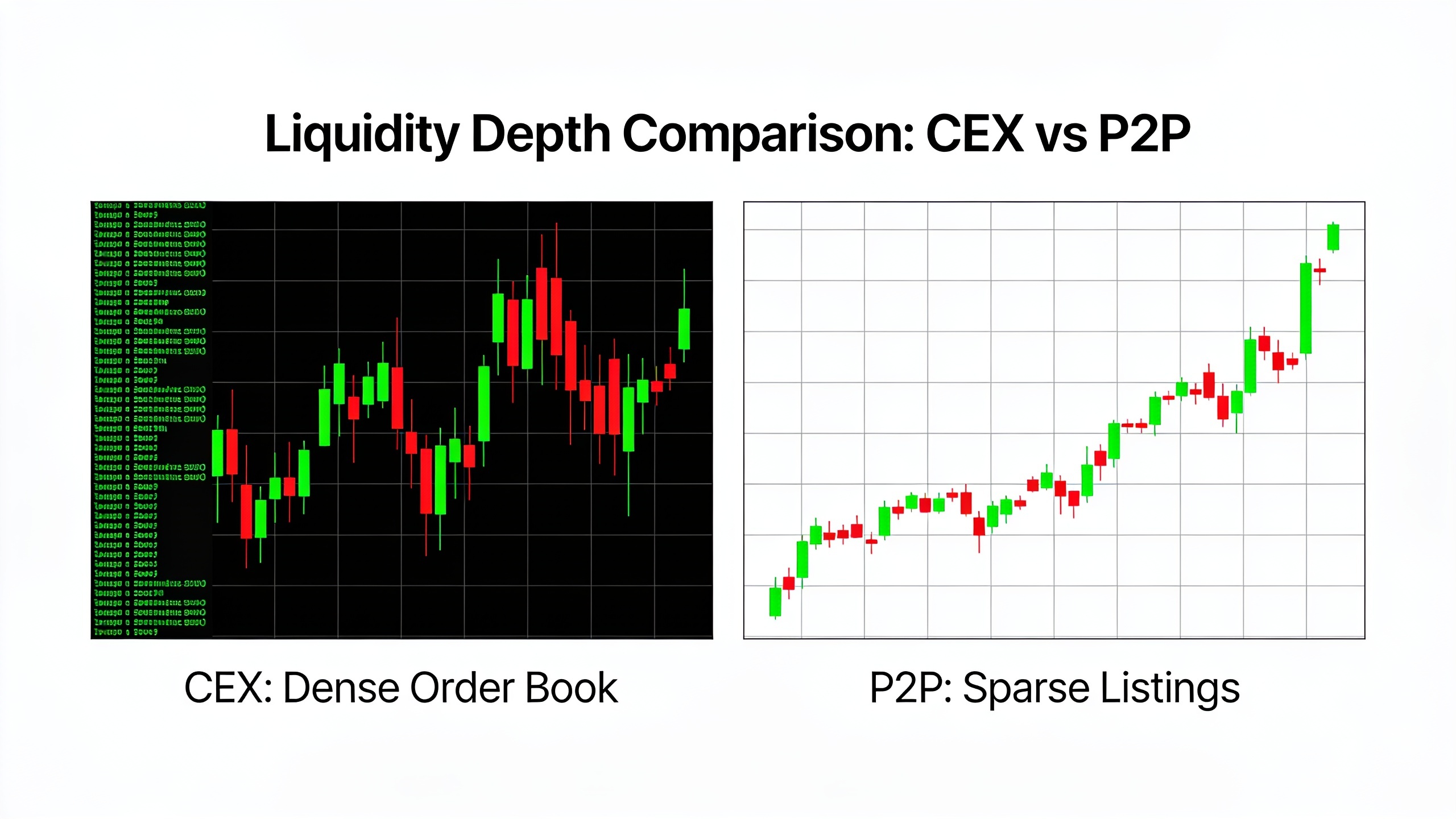
That liquidity on a centralized exchange comes from sheer volume plus professional market makers who get incentivized (usually with lower fees) to keep the bid-ask spread tight. All that depth means big orders get filled without shoving the price around, which matters enormously if you're trading derivatives or running short-term plays. That's a whole rabbit hole covered in Crypto Derivatives Explained: Futures, Options, and Perpetual Swaps. Derivatives especially live and die on deep centralized liquidity pools, which is a big part of why you almost never see them in a true peer-to-peer format.
P2P liquidity is scattered by comparison. It depends entirely on how many people happen to be listing offers that match your price, your payment method, and your region right now. A popular payment method in a big market might have dozens of competitive listings ready to go. A niche one in a smaller market? Maybe one or two sellers, so you either accept a worse price or you wait. And speed leans on human beings actually responding. A bank transfer has to be sent, confirmed, and verified by both sides, which can be anywhere from a few minutes to several hours depending on the payment rail and how attentive your counterparty is. Not great for anything time-sensitive. Perfectly fine for planned, patient transactions.
When Should You Use Each One?
It really comes down to what you're trying to do. Fast, liquid execution points you toward a centralized exchange. Payment flexibility, banking limitations, or privacy concerns point you toward P2P.
A CEX makes more sense when you're trading often and need tight spreads and quick fills, especially for short-term or leveraged stuff. Same goes if you want a big menu of trading pairs, margin, or derivatives all in one spot, or if you're fine with identity verification and honestly prefer letting the exchange deal with custody while you're actively trading. Oh, and if you trade enough to unlock those tiered fee discounts, a CEX rewards you for it.
P2P earns its keep in different situations. If you live somewhere with shaky banking infrastructure, strict currency controls, or banks that block transfers to exchanges, P2P might be your only door in. It also shines when you want to pay with something a CEX just doesn't handle directly, like mobile money, a local instant-payment app, or straight-up cash. And if you'd rather pick exactly who you deal with, and skip parking your money in a custodial exchange wallet altogether, P2P gives you that control. It suits the occasional, planned transaction where you don't mind spending a few minutes vetting someone's reputation before you commit.
Plenty of active traders honestly just use both. A centralized exchange for their regular trading and instant liquidity, and a P2P account sitting in reserve as a backup on-ramp or off-ramp for when the local banking rails get annoying, or when they want to turn crypto into cash without funneling everything through one custodial account.
Figuring Out Which Fits Your Style
Simplest way to decide? Match the tool to your priorities. If speed, liquidity, and fancy trading tools top your list, go centralized. If payment flexibility, banking access, or privacy matter more to you than instant execution, go P2P.
Start with some honest questions about your own habits. How often do you actually trade? Daily, weekly, or just now and then when you feel like adding to a bag? If you're glued to charts and need to react within minutes, the deep liquidity and instant matching of a CEX will beat waiting on some P2P counterparty to confirm a bank transfer, every single time. But if you buy infrequently and your preferred payment method isn't well supported by the exchanges in your country, P2P might be the more practical option. Sometimes the only one.
Then think about custody, because this is the part people underestimate. If keeping your funds off a company's balance sheet is genuinely important to you, P2P (paired with immediately pulling everything into your own wallet) shrinks the window where someone else controls your money. But if you're trading actively and need funds ready to fire instantly, some exchange custody is basically unavoidable. Which means picking a platform with a real security track record and transparent practices matters a lot more.
Finally, scale and strategy. Anyone playing with the volatility-driven approaches in 5 Crypto Trading Strategies for Volatile Markets needs the fast fills and tight spreads a centralized order book gives you. P2P's reliance on individual counterparties adds timing risk that can wreck a strategy built on quick entries and exits. Meanwhile, if you're just converting part of a paycheck into crypto once a month, or cashing out a small position locally, P2P's flexibility probably outweighs the slight speed hit. Different jobs, different tools.
FAQ: The Stuff People Actually Ask
Is P2P crypto trading even legal?
Generally, yeah. It's just one person selling an asset to another, which is legal in most places. But the rules vary a lot by country, especially around tax reporting, anti-money-laundering requirements, and which payment methods you're allowed to use. Check your local regulations before you start, because some countries have restricted or heavily regulated peer-to-peer crypto payments.
Is P2P safer than a centralized exchange?
Neither is inherently safer. They just carry different flavors of risk. Centralized exchanges pile the risk onto custody and platform security. If the exchange gets compromised, your funds are exposed. P2P shifts the risk onto the individual you're dealing with (payment fraud, fake confirmations, scam attempts), which escrow and reputation scores are built to reduce, but never fully wipe out.
Do P2P platforms make you verify your identity?
Depends on the platform and the payment method. Some P2P marketplaces demand verification just like a CEX, especially for higher trade limits. Others let you get away with lighter checks for certain payment methods or smaller amounts. Don't assume "P2P" automatically means "anonymous." Look up the specific platform's verification tiers.
Can I use both a CEX and a P2P platform at once?
Absolutely, and loads of traders do exactly that. It's common to run a centralized exchange for active trading and liquidity, while keeping a P2P account on standby as an alternative on-ramp or off-ramp for when local banking, payment preferences, or privacy concerns make it the smarter move.
Which one has lower fees?
Depends on your trade size and how often you trade. Centralized exchanges charge explicit, usually tiered fees that reward high volume. P2P platforms often skip the direct fee but bake the cost into the spread between sellers' listed prices. Heavy, high-volume traders tend to win with a CEX's volume discounts. Occasional traders may find P2P pricing perfectly fair, depending on how competitive the local listings are.
---
Both centralized exchanges and P2P marketplaces solve the same basic problem, getting you between fiat and crypto, but the way they do it is completely different under the hood, and that shows up in fees, speed, custody, and flexibility. Don't treat this like some permanent either-or decision you make once and lock in forever. Circle back to it every so often as your trading habits, your location, or your risk tolerance shift, and just grab the tool that fits the transaction in front of you.