Stablecoins Explained: How They Keep Crypto Markets Stable
Stablecoins are cryptocurrencies built to hold a steady value, usually pinned one-to-one to the U.S. dollar, so you can move money on blockchain rails without white-knuckling every twitch in...


Stablecoins are cryptocurrencies built to hold a steady value, usually pinned one-to-one to the U.S. dollar, so you can move money on blockchain rails without white-knuckling every twitch in Bitcoin's or Ethereum's price. Think of them as the plumbing of the crypto economy. They're where traders park cash between trades, the rails a growing chunk of cross-border payments now ride on, and increasingly, the bridge between old-school finance and blockchain. If you're trading, investing, or building anything on crypto in 2025, you really do need to understand how these things work, and more importantly, where the bodies are buried.
So that's what this is. I'll walk through what actually keeps the peg in place, compare the three main ways issuers pull it off, and get into why stablecoins have become one of the most important (and most poked-at) corners of the whole market.
Table of Contents
- What Are Stablecoins and How Do Stablecoins Work?
- Stablecoins Explained: The Three Main Collateralization Models
- Fiat-Collateralized Stablecoins: The Market Leaders
- Crypto-Collateralized Stablecoins: Overcollateralization Explained
- Algorithmic Stablecoins: Why They're Considered Riskier
- Why Stablecoins Matter for Trading and Payments
- Risks to Watch: De-Pegging, Reserves, and Regulation
- Stablecoins Explained: Where Regulation Is Headed
- Frequently Asked Questions
What Are Stablecoins and How Do Stablecoins Work?
A stablecoin is a digital asset designed to hold a fixed value against a reference asset, and that reference is almost always the U.S. dollar (though euro- and gold-pegged versions exist too). Bitcoin and Ether float freely, bouncing around on supply and demand. A stablecoin's entire job is to sit still at $1.00, no drama, no matter how ugly the rest of the market gets.
The mechanics come down to a promise backed by a mechanism. For every token floating around out there, there needs to be something of equal value behind it, or a system that automatically tweaks supply to defend the peg. That "something" might be cash and cash equivalents parked in a bank, other crypto locked up in a smart contract, or, in the sketchiest version, nothing but an algorithm and a second token frantically trying to balance supply and demand in real time. (Spoiler: that last one has ended in tears before.)
Three forces do the actual work of holding the peg. First there's the collateral, the assets held in reserve that you could in theory redeem your tokens for. Then there's arbitrage, where traders get paid to buy the coin when it dips under a dollar and sell when it drifts above, which naturally shoves the price back toward $1. And finally there's the redemption mechanism, the ability (for at least some users) to trade the stablecoin directly with the issuer for the underlying collateral. That last piece is what anchors the market price to something real.
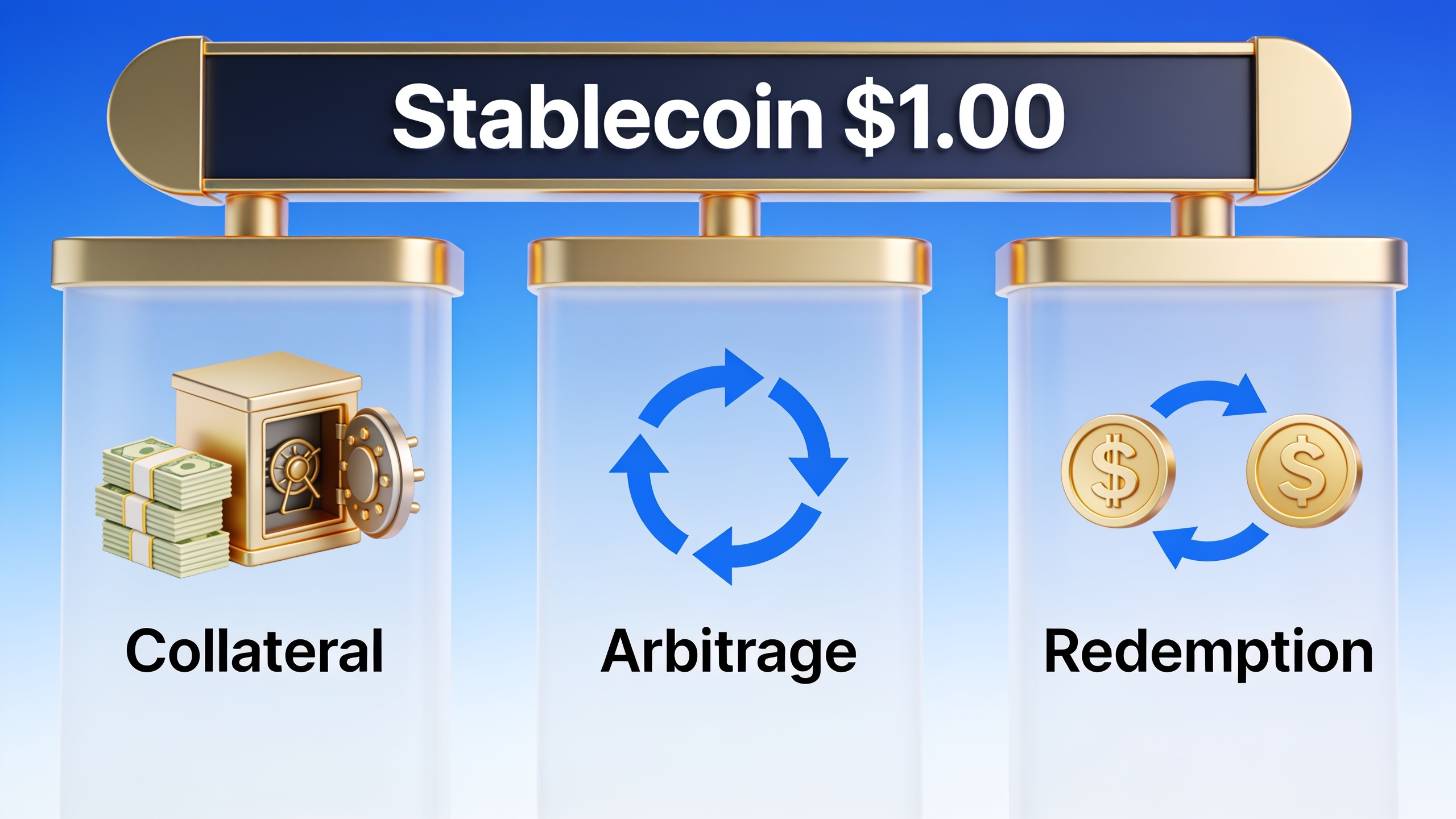
Knock out any one of those legs and the whole stool wobbles. Reserves turn out to be thinner than advertised, or a liquidity crunch kills the arbitrage, or redemptions get frozen. Any of those and the peg starts to slip, and confidence can evaporate scary fast. We've watched it happen. More on that in a bit.
Stablecoins Explained: The Three Main Collateralization Models
There are three broad ways issuers try to keep a stablecoin nailed to a dollar: back it with fiat reserves, back it with a surplus of crypto, or use an algorithm to expand and shrink supply without full backing. Each one makes a different bet, trading off decentralization, capital efficiency, and reliability against each other.
Fiat-backed coins are the simplest and by far the most popular. A company holds dollars (or dollar-adjacent stuff like short-term Treasury bills) in reserve and mints one token per dollar. Easy. Crypto-backed coins flip that idea around, using other cryptocurrencies as collateral instead of cash, but since crypto is itself a rollercoaster, they have to over-collateralize to stay safe. And algorithmic coins try to skip collateral almost entirely, leaning on incentive tricks and a companion token to keep everything balanced. In theory, anyway.
Here's how the three stack up:
| Model | How It's Backed | Examples | Main Advantage | Main Risk |
|---|---|---|---|---|
| Fiat-collateralized | Cash, Treasury bills, and cash equivalents held in reserve, typically 1:1 | USDT (Tether), USDC (Circle) | Simple peg mechanism, deep liquidity, widely accepted on exchanges | Depends on trust in the issuer's reserves and audits; centralized custody |
| Crypto-collateralized | Other cryptocurrencies locked in smart contracts, usually over-collateralized (e.g., $150 in ETH for $100 of stablecoin) | DAI (MakerDAO) | Decentralized, transparent on-chain collateral, no single custodian | Can be forced into rapid liquidations if crypto collateral crashes sharply |
| Algorithmic | No full collateral; supply expansion/contraction and a companion token manage the peg | TerraUSD/UST (collapsed May 2022) | Capital efficient, fully decentralized in theory | Vulnerable to death spirals if confidence and demand drop simultaneously |
None of these is bulletproof. That's exactly why doing your homework on reserve composition, audit history, and governance matters just as much with stablecoins as it does with any other crypto asset. Maybe more, since people wrongly assume "stable" means "safe."
Fiat-Collateralized Stablecoins: The Market Leaders
Fiat-collateralized stablecoins are tokens backed one-to-one (or close to it) by cash and cash-equivalent assets sitting off-chain with a centralized issuer, and they make up the biggest slice of the market by circulating value. Tether's USDT and Circle's USDC are the two you'll bump into constantly on centralized exchanges, and they run on the same basic idea: the issuer holds reserves and mints tokens that are supposed to be redeemable for the dollar value behind them.
The appeal is pretty obvious. Because the backing is (supposedly) just cash or Treasury bills, these coins tend to hold their peg tighter during market chaos than the crypto-backed or algorithmic ones, since the collateral itself isn't riding the crypto rollercoaster. That's why fiat-backed coins dominate trading pairs on basically every exchange. They're the safe harbor traders bolt to when Bitcoin or the altcoins start looking shaky.
The catch? Centralization. You're trusting a private company to actually hold what it says it holds, to handle redemptions fairly, and to publish honest numbers about its balance sheet. That's counterparty risk, plain and simple, and it's exactly the kind of thing big institutional players scrutinize before they'll touch anything. It's part of a bigger story covered in How Institutional Crypto Adoption Is Reshaping Digital Asset Markets, where serious money increasingly demands transparency and regulatory clarity before committing, stablecoins very much included.
Crypto-Collateralized Stablecoins: Overcollateralization Explained
Crypto-collateralized stablecoins are backed by other cryptocurrencies locked into smart contracts instead of cash in a bank, and because that collateral can nosedive at any moment, these systems make you lock up more value than you borrow. MakerDAO's DAI is the classic example. You deposit crypto like ETH into a smart contract vault and mint DAI against it, but only up to a fraction of the collateral's value. You typically need collateral worth quite a bit more than the DAI you get out, and that gap is the whole safety net.
That overcollateralization isn't an accident, it's the entire point. If the price of your locked collateral drops too close to the value of your debt, the smart contract just liquidates you automatically, selling the collateral to cover the outstanding debt before things go under-backed. It's basically a margin call, except enforced by code instead of a nervous risk desk.
The upside here is real decentralization. Nobody's holding your dollars in a vault somewhere. The backing lives on-chain, transparent, verifiable by anyone who cares to look. The downside is complexity plus exposure to crypto's own mood swings. A sudden, violent market-wide crash can trigger a cascade of liquidations faster than the system can chew through them, and that's the nightmare scenario every crypto-collateralized design has to plan around.
Algorithmic Stablecoins: Why They're Considered Riskier
Algorithmic stablecoins try to hold a peg using supply-and-demand mechanics plus a secondary token, without full collateral backing, and honestly, this is the one that's proven most fragile when the market actually tests it. Instead of holding a dollar (or overcollateralized crypto) for every token, these systems mint or burn tokens on the fly. Price goes above the peg, the protocol pumps out more supply to drag it back down. Price falls below, it's supposed to nudge people into buying or burning supply to push it back up.
The big real-world stress test was TerraUSD, better known as UST, paired with a token called LUNA. UST was designed to hold its dollar peg through a mint-and-burn arbitrage dance with LUNA rather than actually holding dollar reserves. Then May 2022 happened. UST lost its peg during a wave of heavy withdrawals and selling, and the arbitrage mechanism that was supposed to save the day instead dumped a flood of new LUNA onto the market. Both tokens cratered in what the industry now grimly calls a "death spiral." It remains the ugliest cautionary tale in stablecoin history, and it's a huge part of why regulators everywhere suddenly got very interested in how these coins are backed and disclosed.
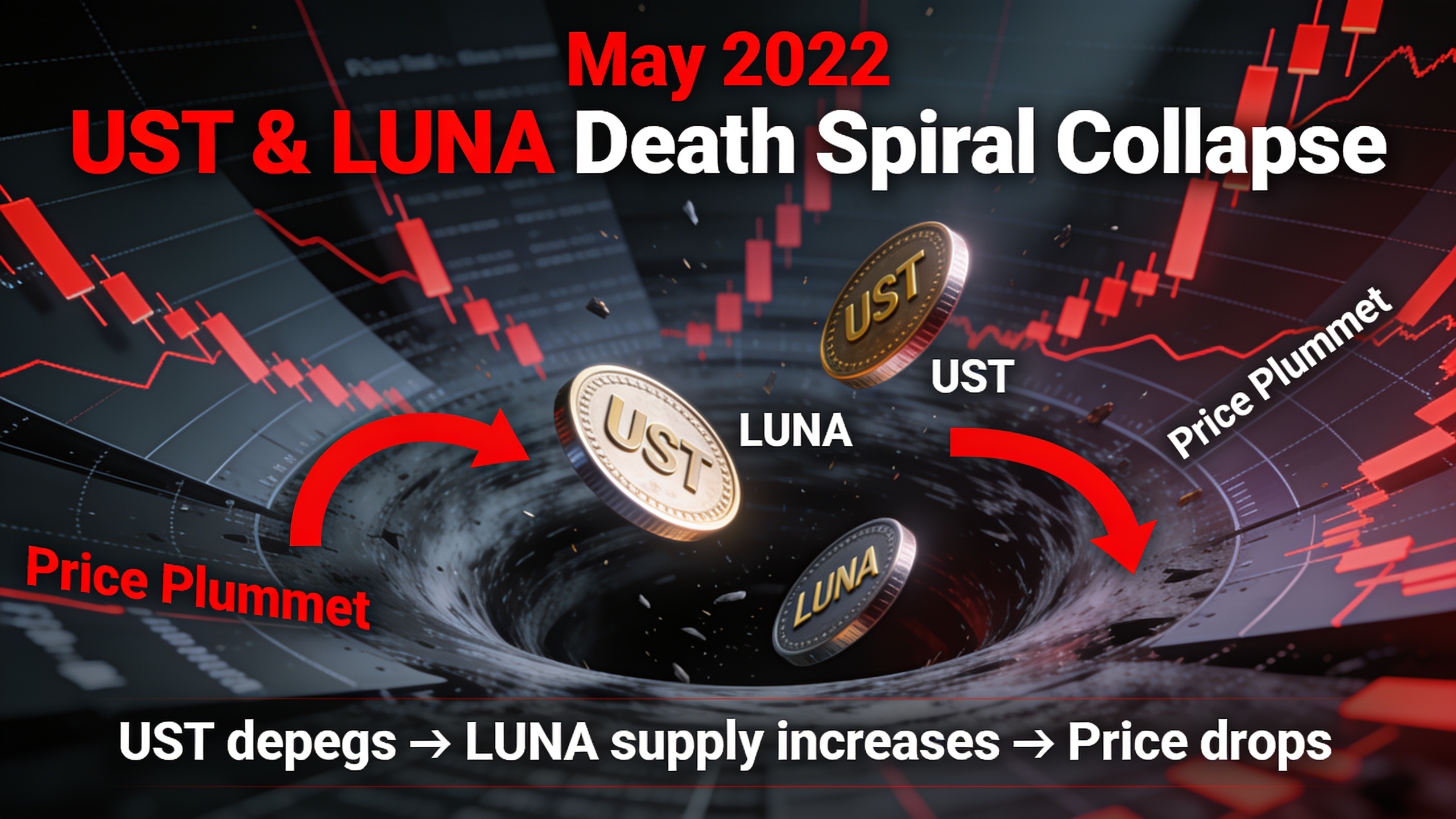
The lesson isn't that algorithmic designs are automatically doomed. Some newer hybrid models mix partial collateral with algorithmic bits to soften exactly this failure mode. But the takeaway is hard to argue with: any stablecoin without hard, verifiable collateral carries a structurally higher chance of a fast, self-feeding collapse the moment confidence cracks. And confidence, it turns out, is a lot more fragile than a spreadsheet.
Why Stablecoins Matter for Trading and Payments
Stablecoins matter because they let traders and businesses move dollar-equivalent value across blockchains instantly, 24/7, without dragging the traditional banking system into every single transaction. For an active trader, that means you can bail out of a volatile position into something stable in seconds instead of waiting on a bank wire, and you get a consistent unit to price your trades against on exchanges that never close and don't care what time zone you're in.
On the payments side, stablecoins pull off something legacy cross-border transfers have always been bad at: speed without the friction. A stablecoin can settle across borders in minutes on-chain, versus the multi-day slog and stacked intermediary fees you get with correspondent banking. That's a big reason they've caught on well beyond crypto traders, showing up with fintech companies, remittance services, and institutions kicking the tires on blockchain settlement. That shift gets more attention in How Institutional Crypto Adoption Is Reshaping Digital Asset Markets, which digs into how corporate and institutional players are folding digital assets into mainstream finance.
There's also a quieter role stablecoins play that most people never think about. They're the primary trading pair on most centralized and decentralized exchanges, which means liquidity for Bitcoin, Ethereum, and thousands of altcoins basically flows through stablecoin markets. So when stablecoin liquidity dries up or a major one wobbles, the ripples spread through altcoin pairs and market-wide liquidity depth. It's a dynamic worth watching next to broader signals like the one covered in Bitcoin Dominance Explained: What It Signals for Altcoins, because capital rotating between Bitcoin, altcoins, and stablecoins is one of the clearest tells of shifting risk appetite out there.
Risks to Watch: De-Pegging, Reserves, and Regulation
The single biggest risk with any stablecoin is a "de-peg," where the token's market price drifts meaningfully off its $1 target, whether that's a temporary wobble during stress or, worst case, a permanent break. And no, even fiat-backed coins aren't safe from this. USDC briefly slipped below $1 in March 2023 after news broke that some of its reserves were parked at a bank that had just failed. It recovered once the dust settled, but that whole episode was a blunt reminder: even the most conservatively built stablecoins carry banking-sector and counterparty risk, not just crypto risk.
Reserve transparency is the second big worry. You have no real way to check an issuer's claims about what it's holding without regular, credible attestations or actual audits. Questions about the exact makeup of reserves have trailed some major issuers for years, and that's precisely why independent attestations, proof-of-reserves reporting, and regulatory oversight keep coming up in these conversations. "Trust me" doesn't cut it when billions are on the line.
Then there's regulatory risk, which rounds things out. Because stablecoins sit right at the crossroads of banking, payments, and crypto, they've grabbed the attention of lawmakers and regulators worldwide who want rules around reserve requirements, redemption rights, and issuer licensing. Shifts in that landscape can directly decide which stablecoins stay available on major exchanges in a given country.
The practical version of all this: not every "stable" coin carries the same risk, and treating them as interchangeable cash is a mistake. Collateral quality, transparency, and regulatory standing genuinely differ from one to the next.
Stablecoins Explained: Where Regulation Is Headed
Stablecoin regulation is heading toward requiring issuers to hold high-quality, liquid reserves, disclose them regularly, and in a lot of proposals, get specific licenses to operate at all. The whole point is to prevent another UST-style implosion, or a fiat-backed issuer quietly fumbling its reserves. Regulators in the U.S., the EU, and elsewhere have spent the last few years drafting (and in some cases actually passing) frameworks aimed specifically at stablecoins rather than throwing them in with the rest of crypto.
The core concerns keep repeating across jurisdictions: what counts as acceptable reserve collateral, how often reserves need to be disclosed and audited, what happens to holders if an issuer goes insolvent, and whether algorithmic models should even get the same freedom as fully collateralized ones. The EU's Markets in Crypto-Assets framework (MiCA) is a good example, laying out specific reserve and disclosure requirements for stablecoin issuers operating in the bloc.
For regular users and traders, the likely upshot of tighter rules is a more consolidated market over time. Better-capitalized, more transparent issuers grab share as compliance costs and disclosure demands climb, and the fly-by-night operators get squeezed out. That consolidation is worth watching right alongside other structural shifts, including how the bigger financial institutions are circling digital assets more broadly.
Frequently Asked Questions
So are stablecoins actually risk-free?
Nope. They cut your exposure to crypto price swings, sure, but they bring their own baggage: issuer counterparty risk, reserve quality risk, smart contract risk for the on-chain ones, and regulatory risk. A coin trading at $1 today is no guarantee it'll still be at $1 during a liquidity crunch or a banking shock. Don't confuse "stable" with "guaranteed."
What's the difference between a stablecoin and a central bank digital currency (CBDC)?
A stablecoin is usually issued by a private company or a decentralized protocol and isn't legal tender. A CBDC is a digital currency issued straight from a country's central bank, carrying the full backing of that government. Stablecoins run on public or permissioned blockchains built by private entities, while CBDCs are the government-controlled alternative to physical cash. Different beasts entirely.
Can a stablecoin actually lose its peg for good?
Yes, and TerraUSD (UST) is the textbook case. That algorithmic stablecoin lost its $1 peg in May 2022 and never came back, collapsing right alongside its companion token LUNA. Fiat- and crypto-collateralized coins have had brief de-pegging scares too, but most of those recovered once the underlying problem (like a banking disruption) got sorted out.
Why do traders bother with stablecoins instead of just holding cash on an exchange?
Because stablecoins let you shuffle value between exchanges, wallets, and blockchains without going through a bank every time, and they let you stay "in crypto," ready to jump back into a position instantly, instead of cashing out to fiat with all its delays and fees. Think of them as the crypto market's version of a money-market parking spot.
How do I figure out whether a specific stablecoin is trustworthy?
Look at what actually backs it (cash and Treasuries versus crypto collateral versus algorithmic tricks), whether the issuer publishes regular reserve attestations or full audits, how long it's held its peg through rough patches, and whether it operates under any real regulatory framework or licensing regime. If the answers are vague, that tells you something.
Bringing It Together
Stablecoins are the quiet infrastructure holding a lot of the crypto market together. They're the asset traders retreat to, the pair most tokens get priced against, and increasingly a legit tool for cross-border payments that have nothing to do with trading at all. But "stable" is a design goal, not a promise, and the mechanism behind that stability (fiat reserves, overcollateralized crypto vaults, or algorithmic incentives) is what decides how a coin behaves when things get rough. Knowing the difference between these models, and keeping one eye on reserve transparency and regulatory moves, is really what separates a clued-in stablecoin user from someone who just assumes every "$1 token" is the same. They're not.