Layer 2 Scaling Solutions: A Beginner's Guide to Faster Blockchains
You know that sinking feeling when you try to send an Ethereum transaction during a busy stretch and the fee estimate creeps up to $30? Then $50? Congratulations, you've met the exact problem that...

You know that sinking feeling when you try to send an Ethereum transaction during a busy stretch and the fee estimate creeps up to $30? Then $50? Congratulations, you've met the exact problem that layer 2 scaling solutions were invented to solve. In plain terms, a layer 2 is a separate network or protocol that runs "on top of" a base blockchain. It processes transactions away from the main chain, then reports the results back, so you get speed and cheap fees without throwing away the security of the network underneath. This guide walks through why these things exist, how the big approaches actually differ, and which networks are currently doing the real work for Ethereum and Bitcoin.
Think of it as a practical scalability guide, not a whitepaper. My goal is to get you comfortable with the vocabulary, help you spot the trade-offs between different designs, and give you a sense of what to look at before you bridge funds, poke around a dApp, or size up a project you're thinking of investing in.
Table of Contents
- What Are Layer 2 Scaling Solutions?
- Why Do Blockchains Need Layer 2 Scaling in the First Place?
- How Do Layer 2 Networks Actually Work?
- What Are the Main Types of Layer 2 Scaling Solutions?
- Leading Layer 2 Networks Worth Knowing
- Layer 2 vs. Layer 1: A Side-by-Side Comparison
- Risks and Trade-Offs of Using Layer 2 Networks
- Frequently Asked Questions
What Are Layer 2 Scaling Solutions?
Layer 2 scaling solutions are protocols built on top of an existing blockchain (the "layer 1") that handle transaction processing off the main chain while still leaning on that base chain for final security and settlement. The name is honestly pretty literal. Layer 1 is the foundational blockchain, something like Ethereum or Bitcoin. Layer 2 is anything you build to extend its capacity without rewriting the core rules.
The idea underneath it is simple enough. Instead of every single transaction getting verified, ordered, and stored by every node on the main network, a layer 2 bundles a bunch of activity together, processes it more efficiently, and then checkpoints the outcome back to layer 1 every so often. The base chain stays the ultimate source of truth, and the layer 2 does the sweaty work of moving transactions quickly and cheaply.
And this isn't some Ethereum-only trick. Bitcoin has its own take on the same idea, and one of the earliest and most famous examples is the Lightning Network. It's a payment protocol built on top of Bitcoin that lets you send and receive bitcoin almost instantly for a fraction of a cent, instead of waiting several minutes and paying a much fatter on-chain fee. If you want to really get under the hood of that one, Cryptocoinsjournal's guide to the Lightning Network goes deep. The philosophy is the same everywhere, though: get the traffic off the crowded main road, settle the important bits later. Bitcoin, Ethereum, doesn't matter. Same instinct.
Why Do Blockchains Need Layer 2 Scaling in the First Place?
Blockchains need layer 2 scaling because their base layers were deliberately built to put security and decentralization ahead of raw throughput, and that choice creates congestion and rising fees the moment demand spikes. Ethereum, for instance, needs thousands of independent nodes scattered around the world to agree on every transaction. That agreement takes time and computing power, and it puts a hard ceiling on how many transactions the network can chew through per second.
Now, this isn't a bug. It's a trade-off somebody made on purpose. Spreading trust across a huge crowd of participants instead of one company or one server is exactly what makes these networks censorship-resistant and genuinely hard to tamper with. But that same spreading-out means a base layer can't just "spin up more servers" the way Visa can when things get busy. When demand for block space outruns supply, users start bidding against each other with higher and higher fees. Which is precisely what you see during a hyped NFT mint, a big token launch, or a sudden market panic.
For a regular person, that shows up as unpredictable costs and slow confirmations at the worst possible time. Usually right when you desperately want to move money fast, like when a price is dropping off a cliff. For an industry that keeps saying it wants mainstream adoption, that kind of friction is a real problem. Layer 2s exist to soak up all that demand, handling way more activity than the base chain ever could on its own, while still borrowing the base chain's security.
How Do Layer 2 Networks Actually Work?
Layer 2 networks work by shifting most of the transaction execution off the main blockchain and then periodically committing a compressed summary, or a cryptographic proof, back to the base layer. So the main chain doesn't have to grind through every individual transaction one at a time anymore. It just has to confirm that the summarized batch is legit.
A few tricks show up again and again. The first is batching. Rather than firing each transaction at the base layer separately, a layer 2 rounds up hundreds or thousands of them and submits them as one compact package. Since the base chain charges for the data and computation it processes, cramming all those actions into a single submission spreads the cost across everyone in the batch. That's where the dramatic price drop per transaction comes from.
Then there's off-chain execution. The actual number-crunching, checking balances, running smart contract logic, updating the state, all of that happens on the layer 2's own infrastructure, which is usually faster and a lot less clogged than the base chain.
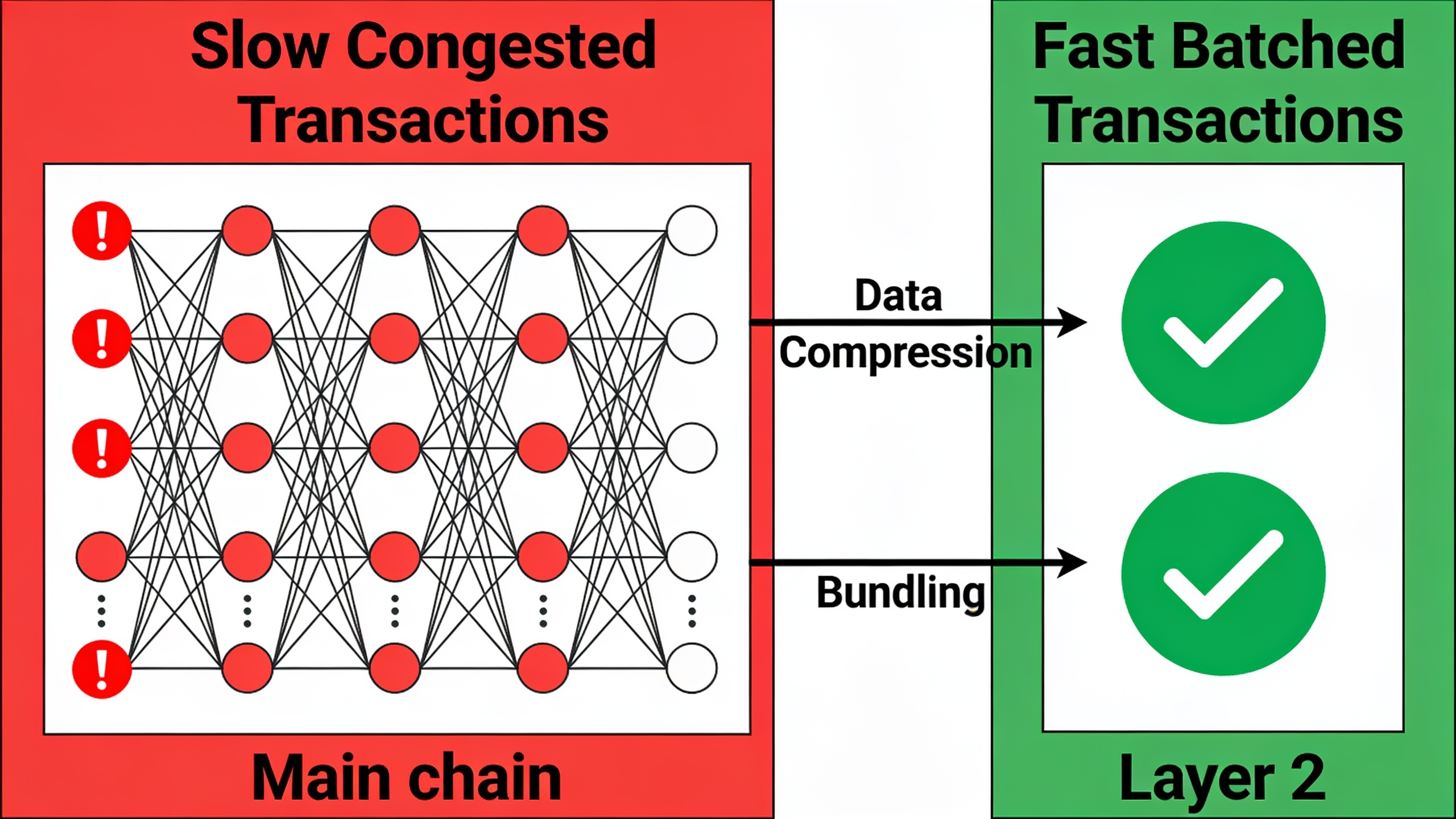
And finally, data or proof posting. Depending on the design, the layer 2 sends either the raw transaction data, a cryptographic proof that everything checks out, or both, back down to the base layer. This is the part that lets the base chain act as a safety net. If something goes sideways on the layer 2, users can generally point back to the data or proofs sitting on the more secure, more decentralized layer 1.
This is why people say layer 2s "inherit" the security of their base chain rather than running a whole separate trust model. Though, as you'll see below, how much security they actually inherit varies a lot depending on the architecture. That distinction matters more than most beginner guides let on.
What Are the Main Types of Layer 2 Scaling Solutions?
There's no single blueprint for a layer 2. Several distinct designs have emerged, each striking a different balance between speed, cost, security, and complexity. Getting a feel for these categories is honestly the fastest way to make sense of any specific project you stumble across.
Rollups
Rollups run transactions off the main chain and then post transaction data (and, in some designs, cryptographic proofs) back to the base layer. Right now this is the dominant approach for scaling Ethereum, and it comes in two main flavors.
Optimistic rollups assume transactions are valid by default and only bother running a full verification if someone disputes a result during a set challenge window. This tends to be simpler to build and plays very nicely with existing Ethereum smart contracts. The catch? There's usually a waiting period before you can pull your funds back to the base chain, because the network has to leave the door open for anyone who wants to raise a challenge.
Zero-knowledge (ZK) rollups take a different route. They generate a cryptographic proof, often called a validity proof, that mathematically shows a batch of transactions was processed correctly, and that proof gets verified right on the base chain. Since the proof itself confirms everything's above board, ZK-rollups generally skip the dispute window optimistic rollups need. The trade-off has historically been complexity. This stuff is genuinely hard to build, especially for general-purpose smart contracts, though it's been getting easier.
Sidechains
Sidechains are independent blockchains running in parallel to a main chain, connected through a bridge, but they keep their own consensus rules and their own set of validators instead of relying on the base layer's security. That can make them fast and cheap. But here's the thing you can't ignore: you're trusting a different, sometimes much smaller, validator set rather than inheriting the full security of the base chain. That's a meaningful difference, not a technicality.
State Channels
State channels let two or more parties transact back and forth off-chain, only touching the main blockchain to open and close the channel. The Lightning Network is the poster child here, applied to Bitcoin, letting people swap tons of payments instantly and cheaply before settling the net result on-chain.
Plasma and Validium
Plasma chains and Validium are older or more specialized designs that also process transactions off-chain, but they differ in how much data they actually publish back to the base layer, generally posting less than rollups do. Skimping on data can make things more efficient, but it also shifts more responsibility onto users or operators to guard their own funds, since there's less information sitting on the base chain to fall back on if something breaks.
Leading Layer 2 Networks Worth Knowing
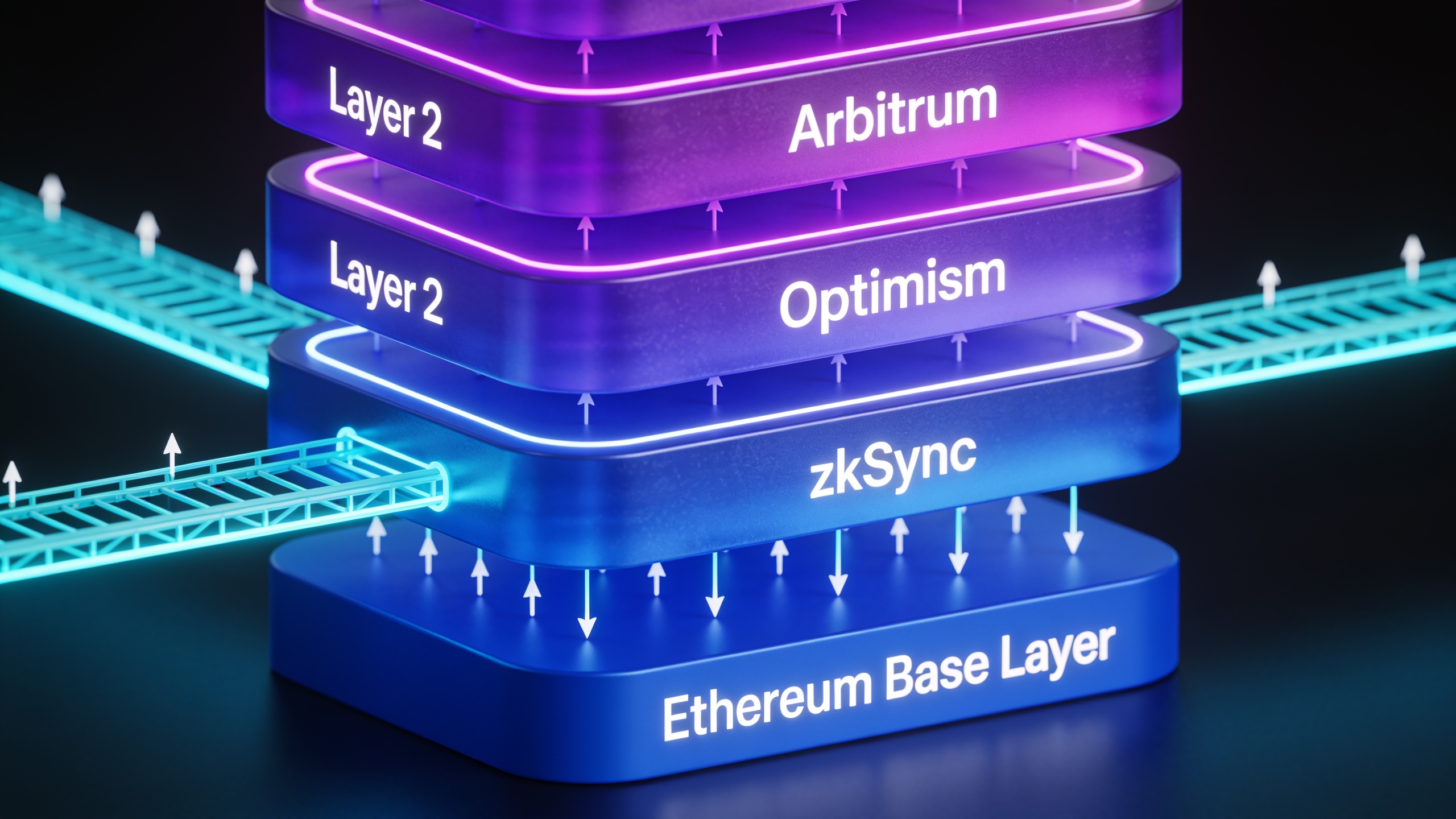
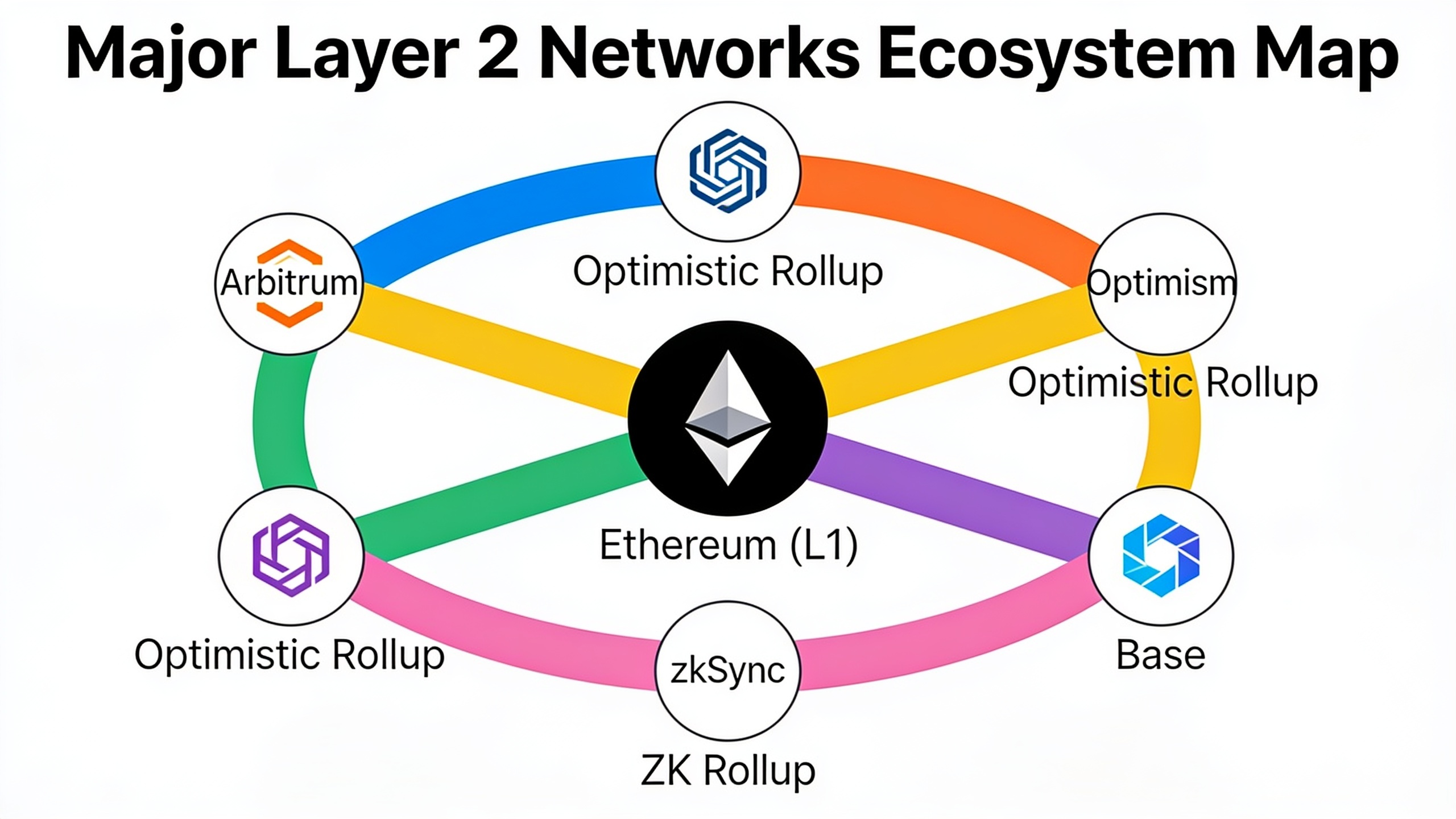
A handful of layer 2 networks have become household names in the Ethereum world, each one built around one of the designs above. Arbitrum and Optimism are two of the most established optimistic rollups, both built to let existing Ethereum smart contracts run with lower fees and faster confirmations while staying compatible with the tools developers already use. Base is a rollup incubated by Coinbase that also follows the optimistic model. Over on the zero-knowledge side, networks like zkSync and Starknet are chasing validity-proof-based scaling, trying to pair strong cryptographic guarantees with lower long-term costs as the proving tech keeps maturing. Polygon started life as a sidechain-style network and has since sprawled into a much broader ecosystem that includes rollup products too.
Let me be straight with you here. Exact performance numbers, fee levels, and adoption stats for these networks bounce around constantly with market conditions and upgrades. So instead of quoting figures that'll be stale by the time you read this, do yourself a favor and check a network's own live stats or a solid blockchain analytics dashboard before you make any decision based on speed or cost claims. What doesn't change is the philosophy underneath. Every one of these exists to let you transact cheaper and faster than you could straight on Ethereum's base layer, while still settling back to it.
On the Bitcoin side, the flagship equivalent is still the Lightning Network. And if payments are what you actually care about, rather than smart contracts, this breakdown of how the Lightning Network delivers faster, cheaper Bitcoin payments makes a good companion read to this one.
Layer 2 vs. Layer 1: A Side-by-Side Comparison
The table below lays out the general structural differences between a typical layer 1 base chain and the major categories of layer 2. Since specific fees and speeds swing around with demand and upgrades, this focuses on architecture rather than numbers that'd go stale fast.
| Feature | Layer 1 (Base Chain) | Optimistic Rollup | ZK-Rollup | Sidechain | State Channel |
|---|---|---|---|---|---|
| Where transactions are executed | Directly on the main chain | Off-chain, with data posted to layer 1 | Off-chain, with validity proofs posted to layer 1 | On an independent chain | Off-chain between participants |
| Security model | Full base-layer consensus | Inherits base-layer security via dispute mechanism | Inherits base-layer security via cryptographic proof | Own separate validator set | Backed by base chain only at open/close |
| Typical use case | Final settlement, high-value transfers | General smart contracts, DeFi, NFTs | General smart contracts, privacy-sensitive apps | Gaming, high-frequency apps | Repeated payments between known parties |
| Withdrawal characteristics | N/A (native chain) | Often involves a challenge/waiting period | Generally faster finality once proof is verified | Depends on bridge design | Instant once channel is closed |
| Compatibility with existing smart contracts | N/A | Generally high | Historically more limited, improving over time | Varies by chain | Not designed for general smart contracts |
Risks and Trade-Offs of Using Layer 2 Networks
Layer 2s cut your fees and speed things up, but they come with their own baggage that you really want to understand before you move serious money. The biggest risk category, by a mile, involves bridges. That's the software that shuttles assets between a base chain and a layer 2, or between two different layer 2s. Bridges have been getting hacked over and over across the whole crypto industry, mostly because they tend to pile enormous amounts of locked value into a single smart contract or cluster of contracts, which makes them an irresistible target. Any decent security guide is worth reading before you trust a specific bridge, and the same kind of caution baked into Cryptocoinsjournal's overview of warning signs of a crypto scam applies here more broadly across the industry.
Withdrawal delays are another thing to plan around, especially with optimistic rollups, where the challenge period is deliberately built in so disputes can surface before your funds count as final on the base chain. Some networks and third-party services will let you withdraw faster for a fee, but you should know the native timeline before you build any plans around it.
Then there's centralization of certain components, which is an ongoing conversation across the whole industry. A lot of rollups currently lean on a single operator or a small handful of them, sometimes called sequencers, to order transactions before they settle to the base chain. Plenty of teams have talked publicly about roadmaps toward more decentralized sequencing down the line. It's a structural trade-off to keep in mind, not a defect specific to any one project.
And because the layer 2 space is so crowded with competitors, do some basic homework before you commit funds anywhere. How long has the network actually been live? Is the code open source, and has it been audited? How much value is already locked on it? These are the exact same questions that apply across crypto investing generally, and they pair well with the kind of tokenomics evaluation covered elsewhere on Cryptocoinsjournal if you're sizing up a layer 2's native token as an investment.
Frequently Asked Questions
Is a layer 2 as secure as the base blockchain it's built on?
Depends on the design, and I mean that literally. Rollups are generally built to inherit a real chunk of security from their base chain because they post transaction data or cryptographic proofs back to it. Sidechains lean on their own independent validator sets, so they carry a different risk profile entirely. And the bridges connecting all of this have been favorite targets for hackers industry-wide. So no, a network calling itself a "layer 2" doesn't automatically mean its security matches the base chain.
Do I need to buy a separate token just to use a layer 2?
Not necessarily to use the network itself, though plenty of layer 2 projects have launched their own native tokens, often for governance, staking, or paying fees on that specific network. Whether you actually need one comes down to the particular network and app you're using. Some layer 2s happily let you pay fees in the base chain's native asset.
How do I move funds from Ethereum to a layer 2?
Usually through a bridge, a specialized smart contract that locks up your assets on the base chain and then mints or unlocks a matching representation on the layer 2. The mechanics, fees, and withdrawal times differ from network to network, so read each project's own docs before you transfer anything you'd hate to lose.
Are layer 2 scaling solutions only an Ethereum thing?
Nope. Most of the current layer 2 buzz clusters around Ethereum, sure, but the core idea travels. The clearest example outside Ethereum is Bitcoin's Lightning Network, which uses state channels to enable fast, cheap payments without shoving every transaction directly onto the Bitcoin base chain.
Will layer 2s eventually replace layer 1 blockchains?
Not in the sense of making them obsolete. The prevailing view across the industry is that layer 1 and layer 2 are partners, not rivals. The base chain handles security, decentralization, and final settlement. The layer 2 takes on the high-volume day-to-day stuff that would be way too slow or expensive to run directly on the base layer.
Bringing It All Together
Layer 2 scaling solutions have quietly become one of the most practical answers to blockchain congestion, letting networks like Ethereum and Bitcoin keep their decentralized, security-first base layers intact while shoving the everyday transaction volume somewhere else. Whether it's a rollup squeezing thousands of Ethereum transactions into a single proof or the Lightning Network settling instant Bitcoin payments through off-chain channels, the goal never really changes: make blockchains usable at scale without asking people to give up the very properties that made decentralized networks worth building. As you go explore specific networks, hang onto the fundamentals from this guide. Check the architecture, understand the withdrawal mechanics, and treat every bridge with the same suspicion you'd give any other high-value smart contract. That last one especially. It's usually where people get burned.