How to Evaluate Tokenomics Before Buying Any Cryptocurrency
If I had to name the one skill that separates people who actually make money in crypto from people who just donate it to strangers, it'd be this: knowing how to read tokenomics. A price chart tells...

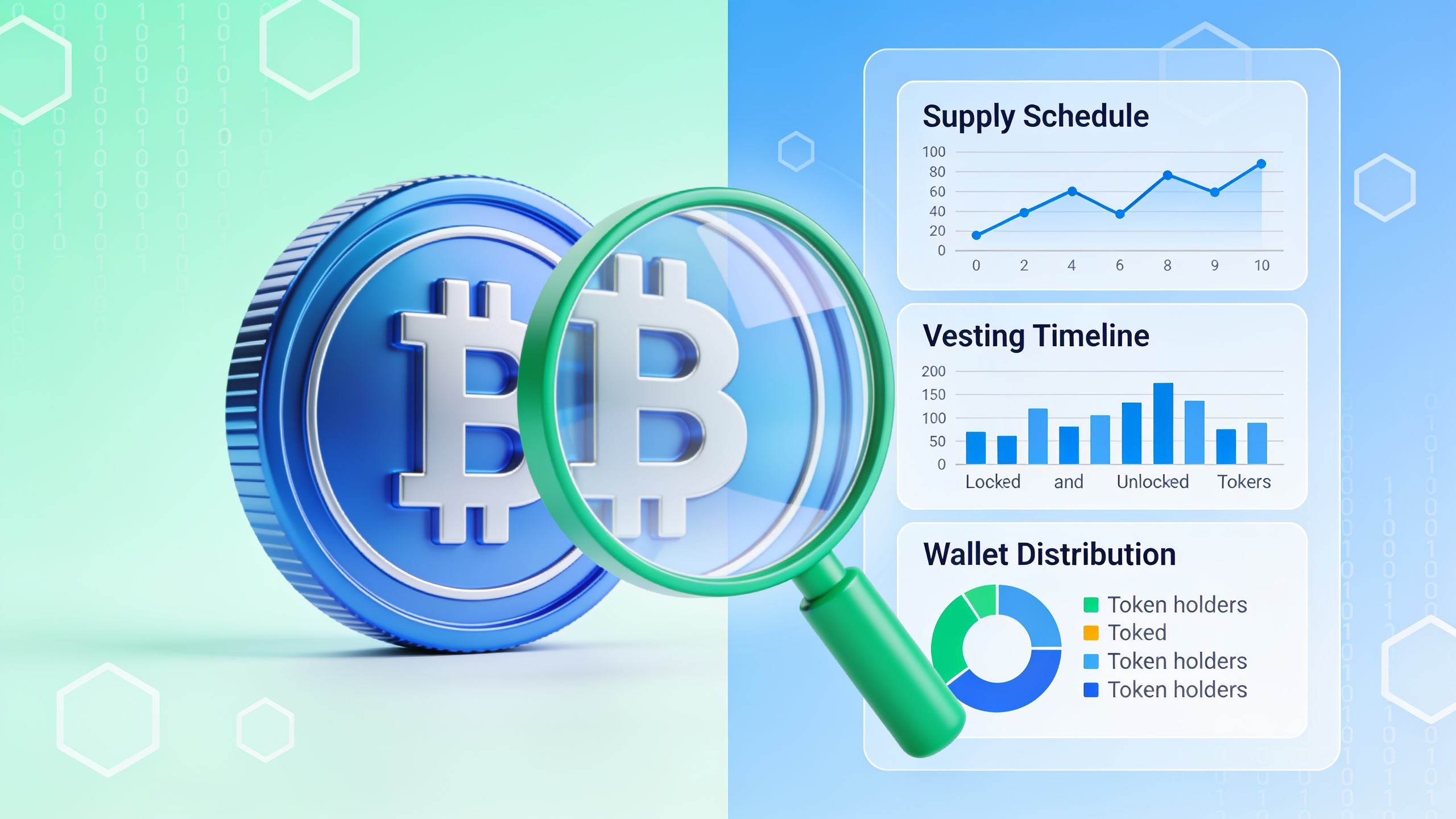
If I had to name the one skill that separates people who actually make money in crypto from people who just donate it to strangers, it'd be this: knowing how to read tokenomics. A price chart tells you almost nothing about whether a coin makes economic sense. Tokenomics does. It's the mashup of "token" and "economics," and it covers all the boring-but-crucial stuff: how many tokens exist, who holds them, when those holders can dump, and whether the token actually does anything.
Learn to read this, and you'll start spotting the difference between projects built to last and projects engineered to make a handful of insiders rich while everyone who buys later holds the bag.
This guide is the practical version. No fluff about "the future of finance." Just how to actually pull apart supply schedules, utility claims, vesting terms, and distribution so you can make decisions based on real cryptocurrency fundamentals research instead of whatever's trending on Crypto Twitter that afternoon.
Table of Contents
- What Is Tokenomics and Why Does It Matter?
- How to Evaluate Tokenomics: Start With Supply Metrics
- Analyzing Token Utility and Real Demand
- Vesting Schedules and Insider Allocations
- Distribution Models: Who Actually Holds the Tokens?
- How to Evaluate Tokenomics Red Flags
- Comparing Tokenomics Frameworks Across Project Types
- Putting It All Together: A Practical Checklist
- Frequently Asked Questions
What Is Tokenomics and Why Does It Matter?
Tokenomics is basically the rulebook that decides how many tokens exist, how new ones show up, who controls them, and what the thing is actually for. And it matters way more than most people realize, because a coin's long-term behavior is shaped by these structural mechanics far more than by any narrative or marketing push.
Think of it like reading a company's balance sheet and shareholder structure before you buy the stock. A public company has to tell you its shares outstanding, insider ownership, dilution risk from options, where the revenue comes from. It's all in the filings. Crypto? Not so much. There's rarely any mandatory disclosure, which means the work falls on you. You've got to dig through whitepapers, poke around block explorers, and read vesting contracts to piece the picture together yourself.
Every token has answers to four basic questions. Sometimes those answers are public and easy to find. Sometimes they're buried on page 34 of a whitepaper nobody reads. But they're there. How many tokens will ever exist, and on what schedule do new ones appear? What can the token actually do, and does that use create real demand? Who got tokens early, and when are they allowed to sell? And how concentrated is ownership, because concentration is manipulation risk waiting to happen.
Get comfortable answering those four, and you've got a skill that works on every token launch you'll ever run into. Layer 1, DeFi protocol, meme coin wearing a utility costume. Doesn't matter. The questions stay the same.
How to Evaluate Tokenomics: Start With Supply Metrics
Start with three numbers: circulating supply, total supply, and maximum supply. These tell you how much of a token's eventual dilution has already happened and how much is still barreling toward you.
Circulating supply is what's actually out there right now, tradable in the market. Total supply is that plus everything that's been created but is locked up, reserved, or waiting to be released. Maximum supply is the hard ceiling, the most that can ever exist. Bitcoin's famous 21 million cap is the classic example. Plenty of other projects have no cap at all and try to manage inflation through other means.
Here's where it gets interesting. The gap between those three numbers is your dilution warning. Say a token shows 100 million circulating but a total supply of 1 billion. That means roughly 90% of the eventual pile hasn't hit the market yet. And depending on when those 900 million tokens unlock, holders could get steamrolled by new supply even while the project itself is doing great. Growing demand doesn't help you much if it's swimming against a tidal wave of unlocks.
Inflationary vs. Deflationary Models
A token's supply model is either inflationary, deflationary, or some hybrid mutt of the two, and it changes everything about how the thing holds value over time.
Inflationary tokens keep minting new units, usually to pay validators, miners, or liquidity providers. You see this a lot in proof-of-stake networks where staking rewards come straight out of freshly created supply. The trade-off is pretty honest: inflation pays for network security and keeps people participating, but it dilutes existing holders unless demand grows faster than the new supply shows up. Sometimes it does. Often it doesn't.
Deflationary tokens go the other way, shrinking supply through burning (permanently torching tokens, often funded by transaction fees) or tapering issuance schedules like Bitcoin's halvings. Now, a shrinking supply doesn't magically pump the price. Anyone telling you otherwise is selling something. But it does kill off one source of built-in sell pressure, and that's worth something.
Emission Schedule and Halving Mechanics
The emission schedule is just the timetable for how fast new tokens hit circulation. Some projects drip them out at a steady linear rate. Others use step-downs, which are scheduled cuts to issuance. Bitcoin's halving is the poster child here, chopping the mining reward in half roughly every four years.
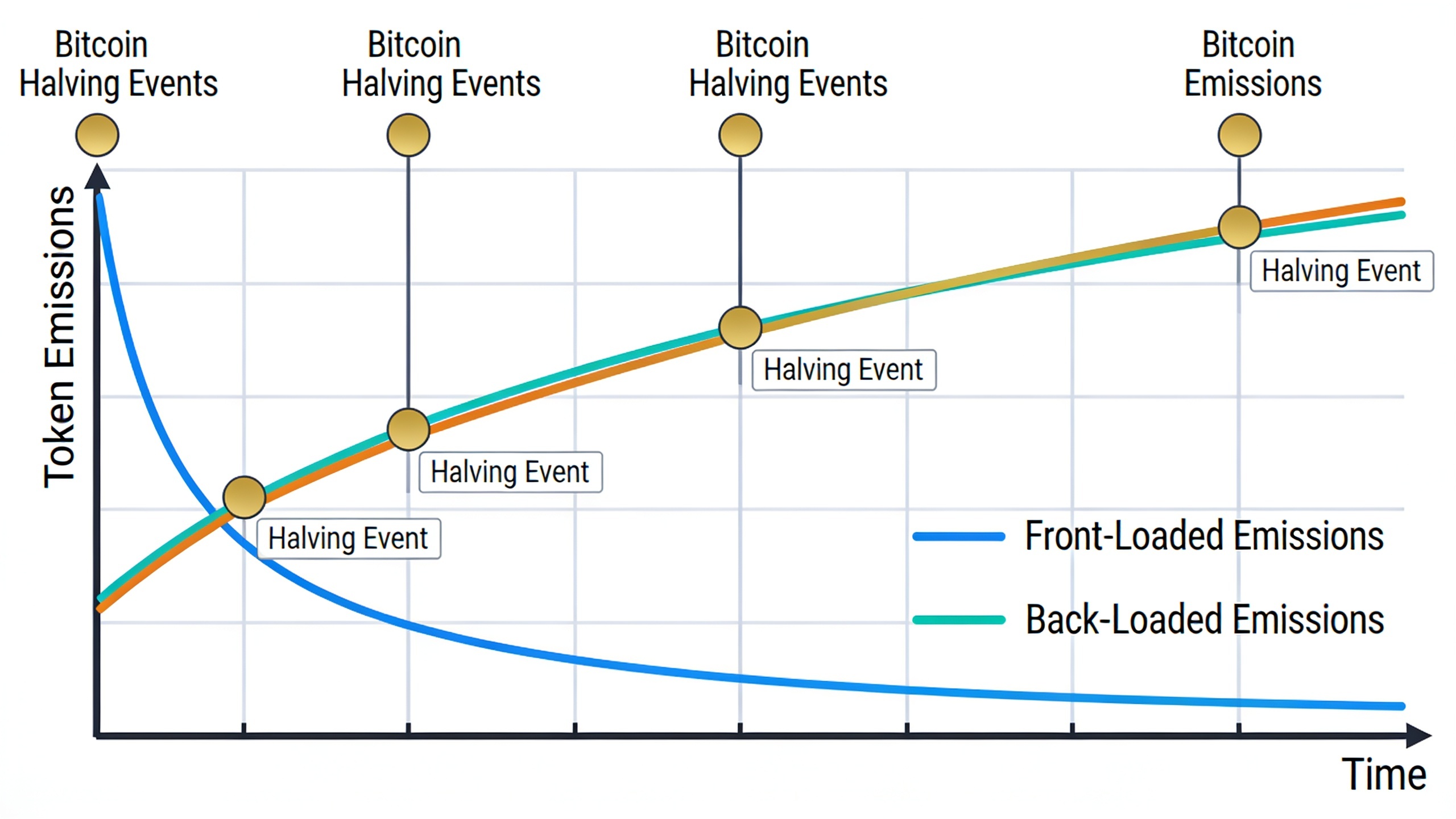
When you're researching a new token, the thing to watch for is whether emissions are front-loaded or back-loaded. Front-loaded means big amounts dumped early, usually to reward early investors and the team, and that tends to pile on selling pressure in a project's first stretch of life. Back-loaded means issuance keeps going, or even ramps up, over many years. Done badly, that creates what people call "supply overhang," this constant weight on the price that can drag on for years. Neither is automatically bad. But you want to know which one you're walking into.
Analyzing Token Utility and Real Demand
Utility is what the token actually does inside its own ecosystem, and it's the single biggest tell for whether demand is organic or pure hopium. If the only use case is "buy it and pray it goes up," that's not utility. That's gambling with extra steps.
Real utility usually shows up in one of a few flavors. There's gas or transaction fees, where you need the token to pay for computation or transfers on a chain, like ETH on Ethereum. There's governance, where holding the token gets you a vote on protocol decisions, treasury spending, that kind of thing. There's staking and security, where holders lock up tokens to help secure a proof-of-stake network and earn rewards. There's access, where the token unlocks features or discounts or services. And there's collateral, where you can deposit the token into lending or derivatives protocols to borrow against it.
The real question, though, is whether demand for the token grows automatically as the platform grows, or whether the two are basically strangers to each other. A decentralized exchange that uses its native token for governance but not for actual trading has way weaker built-in demand than one where the token is the mandatory fee for every single transaction. In the first case, people can use the whole platform without ever touching the token. That's a problem.
One more thing, and honestly this is where a lot of people get burned. There's a huge difference between utility that exists today and utility that's promised for some future roadmap milestone. Whitepapers are wish lists by nature. Tons of projects describe these elaborate future use cases while the token, right now, does absolutely nothing but sit in a wallet looking pretty. My rule: if you can't point to a live, working mechanism that requires the token today, treat every utility claim as speculation, not fact.
Vesting Schedules and Insider Allocations
A vesting schedule is the timeline that says when team members, advisors, and early investors are allowed to sell the tokens they got before the public ever showed up. This stuff matters enormously, because it tells you when big blocks of supply become sellable. And these are held by exactly the people with the lowest cost basis and the least emotional attachment to sticking around.
Most legit projects use a "cliff and linear release" setup. The cliff is a waiting period, usually six to twelve months, where nothing vests at all. After the cliff, tokens unlock gradually, monthly or quarterly, over another one to four years. The whole point is to keep insiders' interests tied to the project's success instead of letting them speedrun a dump the second it lists on an exchange.
When you're checking vesting, a few things actually matter. Look at the cliff length, because shorter cliffs (under six months) mean insiders can start selling fast. Look at total vesting duration, since anything under a year jams all the dilution risk into a tiny window. Look at how big the combined team, advisor, and VC allocation is as a slice of total supply. And watch out for unlock cliffs stacking up, where a project has multiple categories (seed, private sale, team, advisors) that all happen to expire around the same date. That's a supply shock waiting to detonate.
A big, badly scheduled unlock is one of the most predictable price killers in all of crypto. It just floods the market with sellers who bought at a fraction of today's price. So before buying anything, go check the project's published vesting schedule or a token-unlock tracker and see what's landing in the next few months. A wall of unlocks dropping right after you buy is a real, concrete risk. And it doesn't care how brilliant the technology is.
This overlaps a lot with sniffing out flat-out fraud, by the way. If a project gets cagey about vesting, won't tell you the team allocation, or dangles guaranteed returns tied to lockups, those are the exact same behaviors we cover in our breakdown of warning signs of a crypto scam before you invest. Doesn't matter how polished the rest of the pitch looks. That kind of evasion should put you on high alert.
Distribution Models: Who Actually Holds the Tokens?
The distribution model is how the total supply got carved up at the start, across buckets like team, investors, community, treasury, and public sale. It's one of the clearest signals of concentration risk you'll find. If a few wallets control a huge chunk of supply, those holders can jerk the market around with a single transaction, and you're along for the ride whether you like it or not.
You can check the real-world version yourself using a block explorer for whatever network the token lives on. Etherscan for Ethereum-based tokens, for example. It'll show you the top holder addresses and what percentage of supply each one controls. As a rough rule, most cryptocurrency fundamentals research treats heavy concentration among the top 10 to 20 non-exchange wallets as a caution flag. It usually means shallow market depth and a handful of "whales" who could send the price flying by selling.
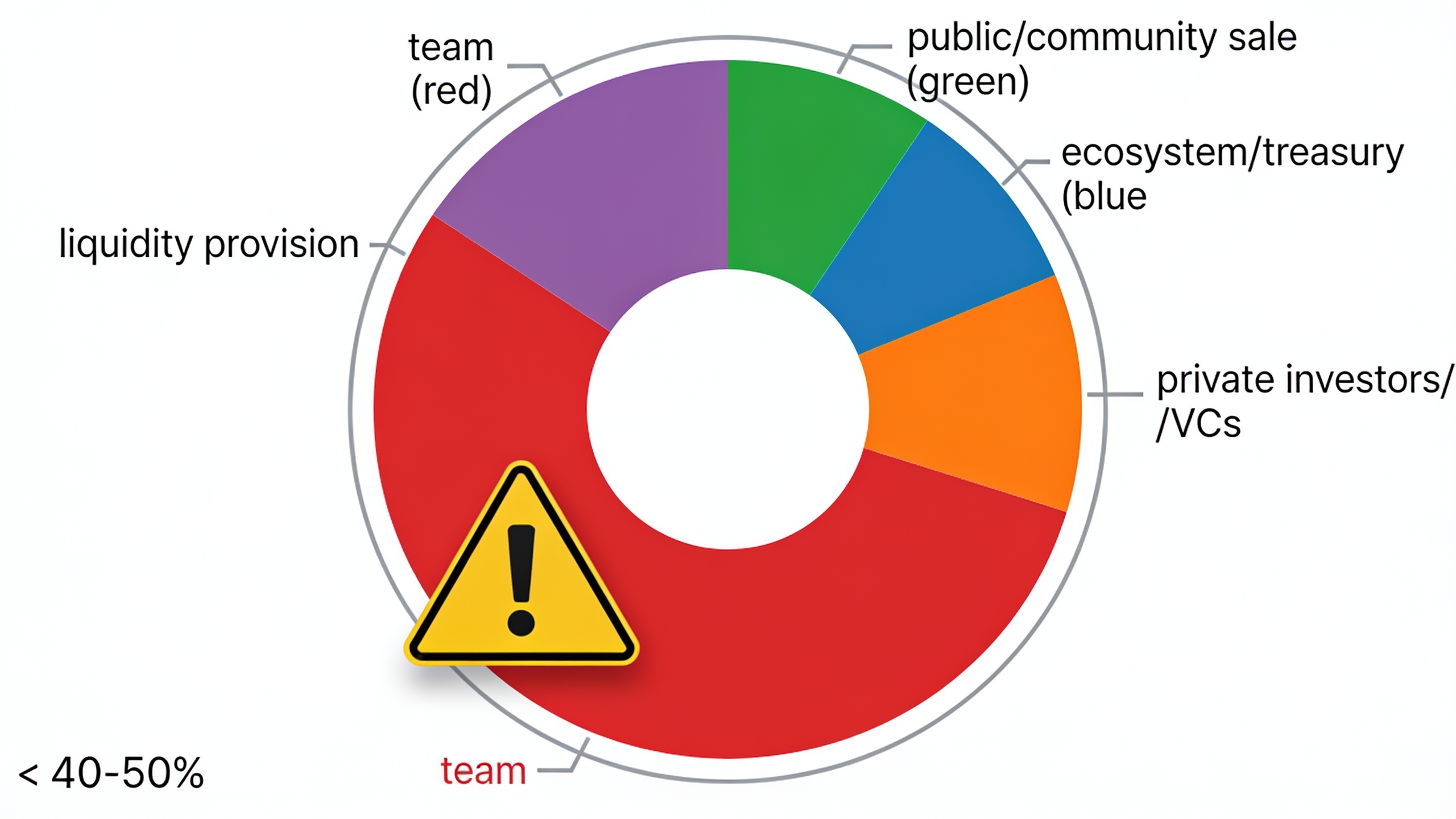
The allocation buckets worth eyeballing are the usual suspects: public or community sale (tokens sold or given straight to retail), team and founders, private investors and VCs (who bought at a discount before you could), the ecosystem or treasury fund (parked for grants, partnerships, development), and liquidity provision (set aside to seed exchange pools).
There's no magic "correct" split. But when insiders (team plus private investors) control more than roughly 40-50% of total supply, that's your cue to go read the vesting terms very, very carefully, because that combo decides how much future sell pressure is bottled up in a tiny number of hands.
How to Evaluate Tokenomics Red Flags
Some tokenomics patterns show up over and over in projects that flop, and learning to spot them is honestly the whole point of this exercise. No single one of these is a death sentence on its own. But when they start stacking up, that's your signal to dig deeper or just walk away.
The ones I always watch for:
- Uncapped or fuzzy maximum supply paired with vague hand-waving about inflation control. If nobody can tell you how many tokens exist in five years, that's a real problem.
- Barely-there or nonexistent vesting for team and private investors, especially anything that lets them sell within the first 90 days of listing.
- Utility that lives entirely on paper, a roadmap stuffed with "will enable" and "planned integration" and zero live product using the token today.
- Opaque distribution, where the project won't say what the team and early backers hold, or where on-chain data shows big concentration in mystery wallets that aren't labeled exchanges.
- Reflexive tokenomics that need a constant stream of new buyers, reward structures that only work if the price keeps climbing or fresh money keeps pouring in. Structurally? That's a pyramid scheme wearing a whitepaper.
Because these tend to travel together with genuinely deceptive projects, it's worth cross-checking anything sketchy against a broader fraud checklist like our guide to key crypto scam red flags, which covers the behavioral and marketing tells that so often ride shotgun with bad tokenomics.
Comparing Tokenomics Frameworks Across Project Types
Different kinds of crypto projects structure their tokenomics differently, and seeing them side by side helps you understand what "normal" looks like for each category before you go labeling any single project an outlier.
| Project Type | Typical Supply Model | Common Utility | Typical Insider Vesting | Key Risk to Watch |
|---|---|---|---|---|
| Layer 1 blockchain (e.g., proof-of-stake network) | Often uncapped, moderate ongoing inflation for staking rewards | Gas fees, staking, governance | 1-4 year linear vesting after 6-12 month cliff | Inflation outpacing network adoption |
| DeFi protocol token | Fixed or capped max supply, front-loaded liquidity mining emissions | Governance, fee sharing, collateral | Often shorter (1-2 years), varies widely by project | Heavy early emissions causing rapid dilution |
| Meme coin | Usually very large or unlimited fixed supply minted at launch | Minimal to none beyond speculation and community | Frequently little to no formal vesting | No structural demand driver beyond sentiment |
| Exchange utility token | Fixed or deflationary via periodic burns | Fee discounts, launchpad access, staking | Team allocations vary; some publish burn schedules | Dependent on the health of a single centralized platform |
| Enterprise/infrastructure token | Fixed max supply, scheduled unlocks tied to milestones | Network fees, node operation, data access | Often longer (3-4 years) due to institutional backers | Slow real-world adoption relative to token unlocks |
Obviously this table is a generalization to set your expectations, not gospel. Always verify the actual terms of whatever specific token you're looking at instead of assuming it plays nice with its category's typical pattern. Plenty don't.
Putting It All Together: A Practical Checklist
Doing this well means bundling supply analysis, utility verification, vesting review, and distribution checks into one research pass before you ever hit buy. And it doesn't have to be a big production. Once you know where to look, 30 to 60 minutes per project is plenty. The goal is to make it a habit that runs before every purchase, not some special ritual you only bust out for the big positions.
Here's roughly how a research pass goes:
- Grab the circulating, total, and maximum supply straight from the project's own docs or a reputable data aggregator, not from some hype thread on social media.
- Read the whitepaper's utility section with a skeptical eye, and check whether the use case is actually live on mainnet or still stuck on the roadmap.
- Find the official vesting schedule and jot down the upcoming unlock dates for team, investor, and advisor allocations.
- Pull up a block explorer, look at top holder concentration, and figure out whether the big wallets are labeled exchanges, foundations, or anonymous private addresses.
- Run the project's behavior and marketing claims against known fraud patterns before you commit a single dollar.
None of this is really crypto-specific in spirit. It's the same discipline you'd bring to any investment, just retooled for crypto's particular quirks: supply schedules, smart-contract-enforced vesting, on-chain transparency. Treat tokenomics as a non-negotiable step. Not a replacement for evaluating the team, the tech, and the competition, but a step you never skip.
Frequently Asked Questions
What's the actual difference between circulating supply and total supply?
Circulating supply is what's trading and available right now. Total supply is that plus everything minted but still locked, reserved for the team, or sitting in treasury. The gap between the two is your future dilution, the stuff that hasn't hit the open market yet but eventually will.
Is a cheap token price a sign of good value?
Nope. Price on its own tells you nothing, because it's a function of both market cap and total supply. A token at $0.001 with 500 billion in supply can have a way bigger market cap (and be far more "expensive" in relative terms) than a token at $50 with only 10 million floating around. Don't let a low sticker price fool you.
How do I find a project's vesting schedule?
Usually it's in the whitepaper, on the tokenomics page, or in the investor docs. There are also several third-party token-unlock trackers that gather this data across tons of projects so you can see upcoming unlocks at a glance. And if a project publishes no vesting info at all? Treat that silence as a red flag all by itself.
Does a capped max supply automatically make a token a better buy?
Not automatically, no. A hard cap kills one source of dilution risk, sure, but it does nothing for demand, utility, or fair distribution. A capped token with 80% of its supply parked in a few insider wallets still carries brutal concentration risk despite that fixed ceiling. The cap is one box checked, not the whole picture.
How does tokenomics research help me dodge scams?
Bad or deliberately hidden tokenomics (undisclosed insider allocations, no real vesting, utility claims with no live product behind them) overlaps heavily with the deceptive stuff in our guide to warning signs of a crypto scam. Honestly, running a tokenomics check is one of the most effective ways to catch a fraud before it catches your wallet.
Look, tokenomics analysis won't tell you where the price is headed next Tuesday. Nobody can. But it will tell you whether the incentives baked underneath a project are built for the long haul or just short-term extraction. Make this your first move, before the charts, before the sentiment threads, before anything, and you'll filter out the weak projects early. That leaves your attention and your capital free for the tokens that actually have sound fundamentals underneath them. Which, in this market, is a shorter list than you'd hope.