How Institutional Crypto Adoption Is Reshaping Digital Asset Markets
Remember when putting Bitcoin on a corporate balance sheet was something only a few eccentric hedge funds would even consider? That era is over. What started as a fringe experiment has quietly turned...


Remember when putting Bitcoin on a corporate balance sheet was something only a few eccentric hedge funds would even consider? That era is over. What started as a fringe experiment has quietly turned into a structural shift, with corporations, asset managers, and even pension funds now treating digital assets as something that legitimately belongs in a portfolio.
Over the last four years or so, we've watched publicly traded companies, regulated ETF issuers, and multi-billion-dollar asset managers go from cautiously watching the sidelines to actually putting money on the table (and disclosing it). And this matters more than most people realize, because it changes who's actually setting the price of Bitcoin. It also quietly rewires how regular investors think about the risk of the whole asset class.
So let me walk you through how we got here, who the big players are, and what it all means if you're an everyday investor trying to make sense of the noise.
Table of Contents
- What Is Institutional Crypto Adoption, and Why Is It Happening Now?
- Corporate Bitcoin Investment: How Companies Are Building Balance Sheet Positions
- Hedge Funds and Asset Managers: From Skepticism to Strategic Allocation
- How Do Spot Bitcoin ETFs Fit Into Institutional Crypto Adoption?
- Comparing Institutional Entry Points Into Crypto
- What Does Institutional Crypto Adoption Mean for Retail Investor Confidence?
- Risks and Open Questions Institutions Still Face
- Frequently Asked Questions
What Is Institutional Crypto Adoption, and Why Is It Happening Now?
Institutional crypto adoption is the process by which big, regulated organizations (corporations, hedge funds, asset managers, insurers, pension funds) put real money into digital assets like Bitcoin and Ethereum, whether by holding them directly, buying regulated products, or getting exposure through derivatives and stocks. The difference between this and retail buying? Paperwork. Lots of it. We're talking disclosed filings, custody arrangements, board approvals, compliance reviews. That's exactly why institutional adoption tends to happen quietly, while retail hype is out there screaming on Twitter.
The timeline is actually pretty easy to trace. It kicked off with a handful of corporate treasurers back in 2020 who were fed up with bond yields hovering near zero while the money supply kept ballooning. Then asset managers started paying attention as the regulatory picture got clearer. And then things really took off once U.S. regulators approved spot Bitcoin ETFs in January 2024. Each step made it a little easier for the next group to jump in. Custody solutions got better, auditors got comfortable, and eventually institutions didn't even have to touch a private key themselves.
Three things are really pushing this current wave. First, regulatory clarity. The SEC's approval of spot Bitcoin ETFs in January 2024 handed institutions a compliant, familiar wrapper (a listed fund) instead of forcing them to figure out how to custody crypto themselves. Second, there's the macro angle. Ongoing worries about currency debasement and government deficits have nudged some treasurers to start treating Bitcoin like a scarce, non-sovereign reserve asset, basically the way gold has been used forever. And third, the infrastructure finally grew up. Institutional-grade custodians, insured cold storage, audited proof-of-reserves. That stuff barely existed a decade ago, and its absence is exactly what scared compliance officers away.
Corporate Bitcoin Investment: How Companies Are Building Balance Sheet Positions
Corporate bitcoin investment is when a company (public or private) buys Bitcoin directly and holds it on its balance sheet as a treasury reserve, instead of just letting excess cash sit in bonds or a bank account. The textbook example is MicroStrategy, now rebranded as Strategy, which became the first major public company to try this in August 2020. It disclosed an initial $250 million Bitcoin purchase, framed as a hedge against the depreciation risk of holding plain old cash.
That call, made by co-founder Michael Saylor, snowballed into a years-long strategy of buying more and more, funded through a mix of cash flow, convertible notes, and equity offerings. Every purchase showed up in SEC filings, which is how Strategy became one of the most-watched corporate proxies for Bitcoin exposure on public equity markets. Plenty of investors who want indirect Bitcoin exposure through a Nasdaq-listed stock have used Strategy shares as a stand-in. The catch? That stock carries leverage and volatility on top of Bitcoin's own wild swings. So it's not exactly a clean substitute.
And Strategy wasn't alone. In December 2020, MassMutual, one of the big U.S. life insurers, disclosed a $100 million Bitcoin purchase for its general investment account. That one raised eyebrows, because insurance companies are usually the most conservative allocators on the planet, hemmed in by strict capital requirements. Then in February 2021, Tesla disclosed a $1.5 billion Bitcoin buy as part of its treasury program, calling it a way to diversify cash and squeeze out better returns. Tesla later sold a chunk of it in 2022, which is a useful reminder that corporate bitcoin investment isn't some permanent, one-way vow. Companies adjust based on liquidity needs and market conditions, like anyone else.
What ties all these examples together is disclosure. Because these are publicly traded companies, their crypto buys and sells surface in SEC filings and earnings calls. That's a big part of why institutional adoption feels so "quiet." It doesn't roll out with a marketing blitz. It shows up buried in a quarterly filing that analysts and crypto media then have to dig out and decode for everyone else.
Hedge Funds and Asset Managers: From Skepticism to Strategic Allocation
Hedge funds and big asset managers have gone from writing off Bitcoin as an unregulated novelty to building entire digital asset desks, and the main reason is boring but important: custody infrastructure and regulated products finally let them get exposure without breaking their compliance mandates. Ten years ago, most global macro or multi-strategy funds wouldn't touch crypto, mostly because their prime brokers, auditors, and fund administrators had no clue how to custody or value the stuff. That's changed. Specialized custodians, crypto-native prime brokers, and even Big Four accounting firms have built out services aimed squarely at institutional digital asset clients.
Fidelity was ahead of the curve here. It launched Fidelity Digital Assets back in 2018 to offer custody and trade execution for institutional clients, years before most of Wall Street would admit crypto was worth taking seriously. That early bet on infrastructure is exactly what let Fidelity roll out its own spot Bitcoin ETF once regulators finally opened the gates.
Hedge funds have generally taken one of three routes. They'll take direct spot positions through regulated custodians, trade crypto derivatives like CME Bitcoin futures, or grab exposure through equity in crypto-adjacent companies (miners, exchanges, or corporate treasuries like Strategy). The type matters for market structure, and this is a nuance a lot of people miss. Derivatives-based exposure doesn't necessarily push the spot price the way direct accumulation does. Figuring out which kind of institutional flow is dominant at any given moment is part of reading the broader market, including how Bitcoin's slice of the total crypto pie shifts around. If you're trying to work out what happens to everything else when big money piles into Bitcoin, it's worth reading Bitcoin Dominance Explained: What It Signals for Altcoins, because institutional buying tends to concentrate in Bitcoin first before it spreads (if it spreads at all) into other tokens.
How Do Spot Bitcoin ETFs Fit Into Institutional Crypto Adoption?
Spot Bitcoin ETFs are exchange-traded funds that hold actual Bitcoin as their underlying asset and trade on regular stock exchanges, so both institutions and retail investors can get price exposure through an ordinary brokerage account, no crypto wallet or exchange required. Their approval was the single biggest turning point in institutional crypto adoption so far, and it's not close. It basically demolished the operational wall that had kept pension funds, registered investment advisors, and cautious asset managers away from owning crypto directly.
On January 10, 2024, the SEC approved a batch of spot Bitcoin ETF applications all at once, including BlackRock's iShares Bitcoin Trust (ticker IBIT) and Fidelity's Wise Origin Bitcoin Fund (ticker FBTC), among others. Trading kicked off the next day, January 11, 2024. Grayscale's existing Bitcoin Trust (GBTC), which had traded as a closed-end trust since all the way back in 2013, also converted into a spot ETF structure in the same wave, finally giving its long-time holders a redemption mechanism they'd never had before.
BlackRock's involvement is the part that really made people sit up. It's the world's largest asset manager, and when it filed for a Bitcoin ETF in mid-2023, the crypto industry read it as a loud signal: demand for regulated Bitcoin exposure had gotten serious enough that the biggest names in traditional finance were now competing for it. Once the SEC waved the applications through, financial advisors who'd never been allowed to recommend crypto to clients (because it sat outside their firm's approved product list or their regulatory comfort zone) suddenly had a familiar, custodied, exchange-listed vehicle they could actually use.
Here's a distinction I think retail investors really need to sit with, though: buying shares of a spot Bitcoin ETF is not the same as buying Bitcoin on an exchange. ETF holders don't control private keys, can't move the underlying Bitcoin, and pay fund expense ratios. What they get in return is the simplicity of their existing brokerage setup and the psychological comfort of a regulated product. Whether that trade-off is worth it depends entirely on what you actually want.
Comparing Institutional Entry Points Into Crypto
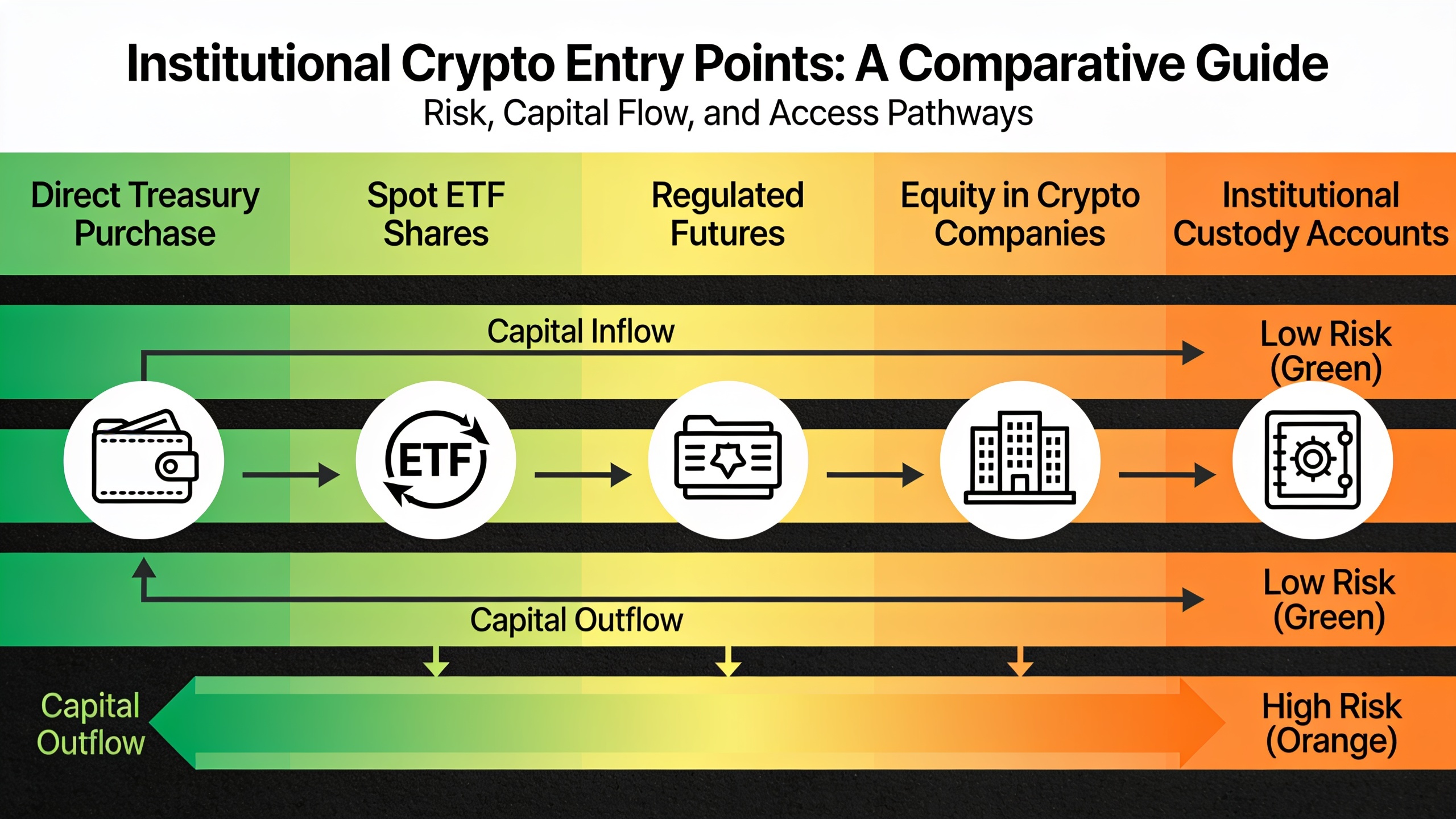
Institutions have several different ways to get exposure to digital assets, and each one comes with its own mix of control, regulatory friction, and market impact. Here's a breakdown of the main entry points corporations, hedge funds, and asset managers actually use.
| Entry Point | Example | Direct Bitcoin Ownership? | Typical User | Key Trade-Off |
|---|---|---|---|---|
| Direct treasury purchase | Strategy (MicroStrategy) | Yes | Public/private corporations | Full custody responsibility; requires internal or third-party cold storage |
| Spot ETF shares | BlackRock IBIT, Fidelity FBTC | No (fund holds it) | Asset managers, RIAs, retail brokerage accounts | Simplicity and regulation, but no direct control of the underlying asset |
| Regulated futures/derivatives | CME Bitcoin futures | No | Hedge funds, macro traders | Exposure to price movement without custody, but subject to roll costs and margin requirements |
| Equity in crypto-adjacent companies | Public miners, exchanges, Strategy stock | No (indirect) | Institutional and retail equity investors | Added company-specific and leverage risk beyond Bitcoin's own volatility |
| Institutional custody accounts | Fidelity Digital Assets clients | Yes (via custodian) | Hedge funds, family offices | Requires vetting custodian security and insurance coverage |
Notice that each of these paths grew up alongside the others rather than one killing off the rest. That's a big reason total institutional exposure to digital assets is so hard to pin down with a single tidy number. The capital is scattered across balance sheets, funds, derivatives, and equities all at the same time.
What Does Institutional Crypto Adoption Mean for Retail Investor Confidence?
Institutional crypto adoption generally boosts retail investor confidence because it sends a message: regulated, risk-averse organizations with fiduciary duties have done their own homework and decided the asset class is worth holding, even if it's just a sliver of the portfolio. When a life insurer like MassMutual or an asset manager the size of BlackRock slaps its name on a crypto product, a lot of retail investors treat it as third-party validation. It's a mental shortcut. Not a guarantee of future returns, but a shortcut all the same.
But that relationship swings both ways, and it's worth being honest about that. Institutional buying can iron out some of the extreme volatility that defined Bitcoin's earlier, retail-driven cycles, mostly because big allocators trade on longer horizons and rebalance far less often than a retail trader reacting to whatever's trending. On the flip side, institutional selling can spook people. When Tesla liquidated part of its treasury position in 2022, plenty of retail investors read it as the smart money signaling something ominous about where things were headed. Whether that read was fair is another question entirely.
This whole dynamic has fed into a bigger retail trend. Instead of trying to personally decode every institutional filing or on-chain flow (which, let's be real, is exhausting), a lot of newer investors are just choosing to follow or automatically mirror the trades of people with more experience. That's part of why there's been growing interest in tools like the ones covered in Best Copy Trading Platforms for Crypto Investors in 2025: A Complete Guide to Copy Trading Crypto, which let retail traders copy strategies from people with actual track records rather than just reacting to headlines about what some hedge fund or corporation did.
Let me be precise about what institutional adoption does and doesn't prove, though, because this gets muddled constantly. It shows that a growing number of regulated organizations are comfortable holding or facilitating crypto exposure inside their compliance frameworks. That's it. It does not predict short-term price direction, and it sure doesn't make the volatility disappear.
Risks and Open Questions Institutions Still Face
Institutional crypto adoption still comes with real risks that even the biggest allocators haven't fully cracked, including custody security, accounting treatment, regulatory reversals, and plain old concentration risk in a young asset class. And these aren't just retail worries. They're the exact concerns sitting in the due-diligence memos hedge funds and corporate boards pore over before signing off on any allocation.
Custody and Security
Even now, with insured, audited custodians serving institutional clients, digital asset custody is a fundamentally different beast from custody of traditional securities. A hacked exchange or a compromised custodian can wipe out your principal entirely, which is a whole lot rarer with a traditional brokerage account protected by SIPC insurance. Institutions try to guard against this with multi-signature cold storage, third-party audits, and insurance. But here's the uncomfortable part: those protections vary wildly between providers and aren't standardized across the industry. Not even close.

Accounting and Regulatory Treatment
Accounting rules for digital assets have gotten better. The Financial Accounting Standards Board (FASB) updated its guidance in recent years to let companies report crypto holdings at fair value, rather than only booking impairment losses. That old approach had genuinely discouraged some corporate treasurers, since the accounting optics made holding Bitcoin look worse than it actually was. But regulatory treatment can still shift under everyone's feet, and institutions stay nervous about the chance that future rule changes at the SEC, CFTC, or overseas regulators could change how they're allowed to hold or report crypto.
Concentration and Volatility
Bitcoin and other digital assets are still way more volatile than the asset classes institutions are used to, like investment-grade bonds or blue-chip stocks. So even allocators who are true believers in the long-term thesis usually keep their positions to a small slice of the overall portfolio rather than making it a core holding. That's actually why those big corporate bitcoin investment announcements, splashy as they are, often represent a pretty modest chunk of a company's total treasury. It's rarely a wholesale swap out of cash. More like a toe in the water.
Frequently Asked Questions
So what actually counts as "institutional crypto adoption"?
It's when regulated organizations (public and private companies, hedge funds, asset managers, insurers, pension funds) put capital into digital assets through direct purchases, custody accounts, derivatives, or regulated products like ETFs. Usually with public disclosure through SEC filings or fund prospectuses.
Which companies were the first to make a corporate bitcoin investment?
MicroStrategy (now Strategy) was the first major public company to hold Bitcoin as a treasury reserve, disclosing an initial $250 million purchase in August 2020. MassMutual followed in December 2020 with a $100 million allocation, and Tesla disclosed a $1.5 billion Bitcoin purchase in February 2021.
How are spot Bitcoin ETFs different from just buying Bitcoin?
A spot Bitcoin ETF holds actual Bitcoin for its shareholders and trades on a stock exchange, so you get price exposure through your brokerage account without managing private keys or dealing with a crypto exchange. Direct ownership means you (or a custodian) actually hold the asset yourself.
Does institutional buying guarantee Bitcoin's price will go up?
Nope. Institutional participation adds a new source of demand and can dampen some volatility over time, but it doesn't erase market risk or promise gains. Corporations and funds have sold portions of their holdings too, like Tesla did in 2022, which shows these positions can move in both directions.
Why does any of this matter for retail investors?
Because regulated products and disclosed corporate holdings give regular investors easier, lower-friction ways to get exposure, and because large-scale institutional participation is widely seen as a sign the asset class is earning real legitimacy inside traditional finance.
Institutional crypto adoption has gone from a handful of contrarian treasury bets in 2020 to a sprawling, multi-pronged pattern spanning corporate balance sheets, hedge fund allocations, and regulated ETFs run by the biggest asset managers on earth. None of this makes the volatility or the risk go away. But it does mark a durable shift in who's actually playing in these markets. And that shift, honestly, is going to keep shaping how both institutions and everyday investors approach crypto for years to come.