Best Copy Trading Platforms for Crypto Investors in 2025: A Complete Guide to Copy Trading Crypto
Copy trading crypto lets everyday investors automatically mirror the trades of experienced traders in real time, using their own money but someone else's brain. Instead of staring at charts for hours...


Copy trading crypto lets everyday investors automatically mirror the trades of experienced traders in real time, using their own money but someone else's brain. Instead of staring at charts for hours or agonizing over when to pull the trigger, you park some capital behind a "lead trader" or strategy, and the platform copies that person's buys, sells, and position sizing proportionally into your own account. And in 2025, this isn't some fringe thing anymore. It's baked into major exchanges as a feature, it's the entire business model of dedicated social trading platforms, and it's even showing up as a wallet-based, on-chain function inside some DeFi protocols.
What I want to do here is walk through how this actually works, the different flavors of platforms out there, how the fees and transparency tend to shake out across them, and the specific stuff you really ought to check before you wire your money to someone else's strategy. One caveat up front: fees, minimums, and available markets shift constantly and vary wildly by region and regulatory jurisdiction. So rather than hand you a fixed ranking that'll be stale in three months, I'm giving you a framework you can actually reuse. Always confirm the current terms on the provider's own site before committing real money. Seriously.
Table of Contents
- What Is Copy Trading Crypto?
- How Do Social Trading Platforms for Crypto Work?
- What Types of Copy Trading Platforms Exist in 2025?
- How Much Does Copy Trading Crypto Cost?
- How to Evaluate Transparency and Performance Tracking
- Risk Management for Crypto Copy Trading
- Is Copy Trading Crypto Right for You?
- How to Get Started Safely
- Frequently Asked Questions
What Is Copy Trading Crypto?
Copy trading crypto is an automated setup where your account, wallet, or sub-account replicates the open positions of a trader you've chosen, usually scaled to fit however much capital you've allocated. People often call it "mirror trading" because the trades pop up in your account almost the instant the lead trader executes their own.
The concept isn't new at all. Copy trading has been floating around forex and stock brokerages for well over a decade. But crypto is a different beast. The markets never close, the volatility is brutal, and liquidity is scattered across a dozen exchanges. That combination has made copy trading genuinely appealing for retail investors who want exposure without babysitting price charts all night. You typically set a maximum allocation, maybe a stop-loss, and then the platform handles the grunt work: opening, adjusting, and closing positions in lockstep with the trader you're copying.
Now, one thing people mix up constantly. Copy trading is not "signal following." A signal service just pings you with buy/sell alerts that you still have to act on yourself. Real copy trading platforms execute the trades for you the moment you opt into a strategy. That automation is exactly why doing your homework on execution quality and fee transparency matters so much. You're handing over the steering wheel.
How Do Social Trading Platforms for Crypto Work?
Social trading platforms are the bigger bucket that copy trading tools live inside. They bolt a social network layer onto the trade-copying machinery. Think trader profiles, follower counts, comment sections, leaderboards. The "social" bit is what lets you actually size up a trader's public history, their risk appetite, and their reputation before you throw money at them.
On a typical setup, lead traders opt in to make their strategy public, and they usually earn a performance fee or a slice of subscription revenue from the people copying them. As a follower, you scroll through ranked leaderboards, filter by things like historical return, maximum drawdown, or how many people are already copying a trader, and then allocate capital to one or several of them at once. Most platforms let you pause or unfollow instantly, and a lot of them cap how much of your total balance can go to any single trader as a built-in guardrail. Which is a nice touch, honestly.
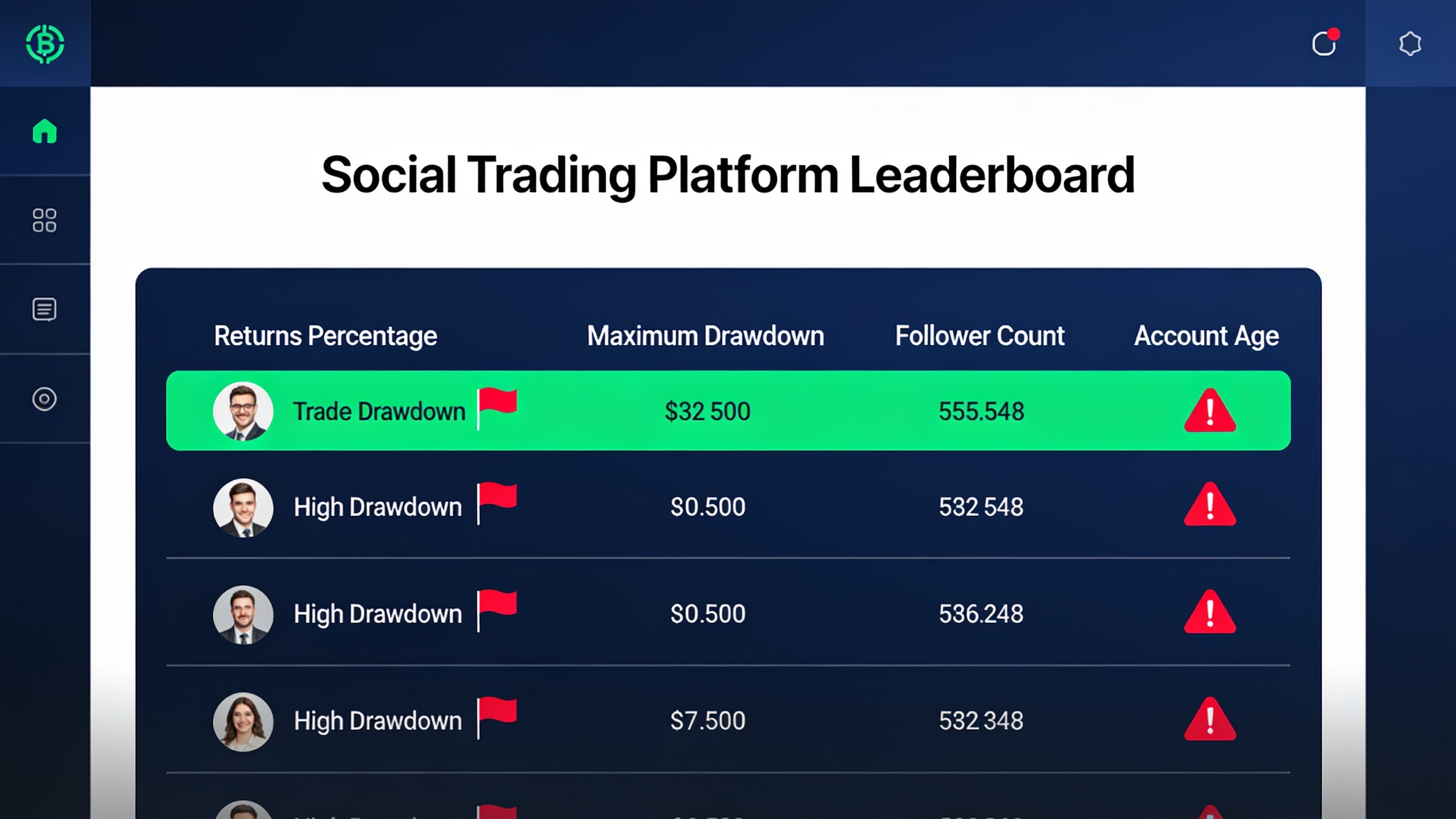
Here's my gripe, though. The whole "social" layer is only as good as the data the platform actually shows you. A leaderboard means nothing if it's just raw percentage returns with no context. Without drawdown, position sizing, or account age sitting right next to those numbers, three weeks of dumb luck looks identical to years of genuine skill. And that's a problem.
What Types of Copy Trading Platforms Exist in 2025?
There are three broad categories you'll run into today: exchange-integrated copy trading, standalone social trading platforms, and on-chain or DeFi-based tools. They differ in who holds your money, how they charge you, and how transparent they are. So comparing them by category makes a lot more sense than pretending they all behave the same way.
Exchange-integrated copy trading is a feature built right into a centralized exchange's existing app. Because it lives inside the exchange, your funds generally never leave the exchange's custody, and everything executes on that exchange's own order book. Low friction if you already trade there.
Standalone social trading platforms are dedicated products. Sometimes these are actual brokers rather than crypto-native exchanges, and their whole reason for existing is connecting followers with lead traders across multiple asset classes. Crypto is often just one option sitting next to stocks, forex, and commodities.
On-chain or DeFi copy trading protocols are the new kids. They run through smart contracts, letting your self-custodied wallet automatically replicate another wallet's on-chain trades (say, on a decentralized perpetuals exchange) without any centralized middleman touching your funds.
| Platform Type | Custody Model | Typical Fee Structure | Transparency Level | Best Suited For |
|---|---|---|---|---|
| Exchange-integrated copy trading | Custodial (exchange holds funds) | Often profit-sharing with the lead trader plus standard exchange trading fees | Usually shows historical performance and follower counts within the exchange's own app | Users who already trade on that exchange and want a low-friction add-on |
| Standalone social trading platform | Custodial (broker/platform holds funds) | Varies by provider — subscription fees, spreads, and/or performance fees are common models | Often includes leaderboards, risk scores, and public trade history, though depth varies by provider | Investors who want to compare traders across multiple markets, not just crypto |
| DeFi/on-chain copy trading protocol | Non-custodial (user's own wallet) | Gas fees plus protocol fees; performance-fee models are emerging but not universal | Trade history is verifiable on-chain, but user-friendly analytics tools are less mature | Self-custody-focused users comfortable managing their own wallet security |
Quick reminder: the exact fee percentages, minimums, and supported markets differ by provider and change over time. Treat that table as a directional map of the categories, not a quote for any one platform.
How Much Does Copy Trading Crypto Cost?
Copy trading crypto usually costs you money in one of three ways, and often more than one at a time: a performance fee skimmed off your profitable trades, a flat subscription for access to top-ranked traders, or wider spreads and trading fees quietly baked into every order. When a platform screams "free to copy," that usually just means they've buried the cost in the spread instead of showing it as a line item. It's not charity.
Performance fees mean the lead trader (and sometimes the platform too) takes a cut of your realized gains, usually a percentage of profit rather than a percentage of your total capital. I actually kind of like this model because it aligns incentives. The trader only gets paid when you make money. Subscriptions, on the other hand, charge you a recurring fee no matter what happens, which can work out cheaper if you're allocating a big chunk of capital but stings if you're just dipping a toe in with a small balance. And spread- or fee-based models are the sneaky ones, because the cost isn't itemized anywhere. It's hiding in the execution price.
Whatever model you land on, don't forget that any profit you make copy trading is still a taxable event in most places. And because this stuff is automated, it can spit out an absurd number of individual trades that all need reporting. Keeping clean records across every single copied trade becomes a genuine headache come tax season, which is exactly the kind of reconciliation nightmare covered in this comparison of leading crypto tax software platforms. Trust me, logging hundreds of auto-executed trades by hand is not something any active copy trader actually does.
How to Evaluate Transparency and Performance Tracking
The single best way to size up a copy trading platform is to check whether its performance data is independently verifiable rather than just self-reported, and whether it shows you risk metrics beyond the shiny headline return. A platform that only flashes a trader's total percentage gain, with no drawdown history, no position sizing, no account age, is handing you half a story. And the missing half is usually where the risk hides.
Track Record Verification
Look for platforms that timestamp and log trades as they happen, rather than letting traders cherry-pick which results get shown off. Account age matters a lot here too. A three-month winning streak during a raging bull run tells you almost nothing about how that same trader handles a nasty downturn. Check whether you can filter the leaderboard by time period (30 days, 90 days, a full year) instead of only seeing all-time or hand-picked windows. Short lookback periods are basically a survivorship-bias factory.
Risk Metrics to Check
Beyond raw returns, the numbers that actually tell you how a trader behaves when things go sideways are maximum drawdown (the biggest peak-to-trough drop in their account), average position size relative to total capital, how much leverage they're using, and how many people are currently copying them. A trader piling high leverage onto concentrated positions might post jaw-dropping short-term gains while sitting on a much higher chance of a big, fast wipeout. Flashy isn't the same as safe.
Red Flags to Watch For
Be wary of any setup that rushes you into allocating fast, hides its fee structure until after you've connected funds, or shows a suspiciously spotless track record with zero losing stretches. Every real strategy has drawdowns. Every single one. A leaderboard that shows nothing but uninterrupted gains is far more likely to be selectively reporting than genuinely that good.
Risk Management for Crypto Copy Trading
Copy trading crypto does not make risk disappear. It just hands the decision-making to someone else while your capital stays fully on the hook for that person's strategy, mistakes and all. The most effective thing you can do to protect yourself is diversify across several lead traders with different styles, instead of dumping everything into one "top-ranked" account and hoping.
A few practical habits go a long way. Set a max allocation per trader. Use whatever stop-loss or drawdown limit the platform offers. And check in periodically to see whether a trader's recent performance still matches the risk profile you originally signed up for, because people drift. It's also worth burning this into your brain: past performance on any leaderboard, no matter how well documented, guarantees nothing about the future. Regulators in traditional finance have been shouting this for decades, and it applies to crypto social trading just as much.
Custodial risk is its own separate thing, and it's just as important. On exchange-integrated or standalone platforms, your funds are usually held by the platform, which means you're carrying the exact same risks as any centralized exchange user: hacks, exploits, insolvency, withdrawals frozen during a panic. This is where a lot of investors start poking around into how crypto insurance products compare in protecting digital assets, since coverage (where you can even get it) might reimburse you if the custodial platform holding your copy-trading funds gets compromised. Go the DeFi or on-chain route instead and you dodge a lot of that custodial exchange risk because you keep control of your wallet. But you swap it for smart contract risk, where a bug or an exploit in the protocol itself could still drain your funds. There's no free lunch here.
Is Copy Trading Crypto Right for You?
Copy trading crypto tends to fit investors who want market exposure and want to learn from watching experienced traders make calls, but who don't have the time, experience, or frankly the interest to manage positions themselves. It's a bad fit for anyone expecting guaranteed returns or some kind of hands-off passive income machine, because even the most consistent lead traders go through rough patches, and copied losses hit your account just as hard as copied gains do.
Before you fund anything, be honest with yourself about a few questions. How much of your portfolio are you actually comfortable handing to a strategy you don't control? Do you understand the fee model well enough to work out your real net return after costs? And are you prepared to actually monitor and occasionally reallocate away from underperformers, rather than treating this as fully "set and forget"? The people who do best generally treat copy trading as one piece of a broader, diversified crypto strategy instead of betting the whole farm on it. They're the ones who can ride out the inevitable drawdowns without panicking.
How to Get Started with Copy Trading Crypto Safely
Getting started safely begins with verifying the platform's transparency and fee disclosures before you fund an account, not after you've already handed over your money and started sweating. A sensible order of operations: dig into the platform's regulatory status and where it's actually licensed to operate, read the fee documentation in full so you know exactly how performance fees, subscriptions, or spreads hit your account, and review several lead traders' complete historical data instead of just grabbing whoever's sitting at the top of the leaderboard.
From there, start small. Really small. Use an amount you're genuinely prepared to lose, spread it across a handful of traders with different strategies and risk levels rather than piling into one, and decide ahead of time when you'll reduce or unfollow someone. Set a specific drawdown threshold as your trigger, not a gut reaction to a bad Tuesday. Oh, and keep your own records of every copied trade alongside whatever export tools the platform gives you. That history matters both for judging how you're actually doing and for tax reporting down the line.
Frequently Asked Questions
Does copy trading crypto actually make money?
Depends entirely on the trader you're copying, the fees involved, and the overall market. There's no universal answer, sorry. Some followers do great during strong trending markets while others get hammered, especially if they pile into high-leverage strategies during volatile stretches or forget to diversify across multiple traders.
Is copy trading crypto legal?
Copy trading itself is legal in most places, but the specific platform offering it may or may not be licensed depending on where it operates and where you live. Regulatory treatment of copy and social trading platforms varies a lot by country, so it's worth confirming a platform's licensing status and whether it's even allowed to serve users in your jurisdiction before you sign up.
Do I need trading experience to use one of these platforms?
Technically no, since the platform executes trades for you automatically. But a basic grasp of leverage, drawdown, and position sizing will make a huge difference in figuring out which traders are genuinely worth following, versus which ones just have a pretty return number that's about to blow up.
What's the difference between copy trading and a managed crypto fund?
Copy trading usually keeps funds in your own account (custodial or self-custodied, depending on the platform), and you can typically unfollow a trader or withdraw whenever you want. A managed fund pools everyone's capital together under a fund manager's control, with its own subscription and redemption terms. Structurally very different, with different liquidity and custody implications.
Can I copy several traders at once?
Yep, most platforms let you spread capital across multiple lead traders at the same time. And that's generally the smarter move, since it stops any single trader's bad stretch from tanking your whole balance.
Copy trading crypto has grown up. It went from a niche add-on to a mainstream feature living across exchanges, dedicated social platforms, and even DeFi protocols, and there are more ways than ever to ride along with experienced traders. The platforms will keep tinkering with their fee models and transparency tools. But the fundamentals of not getting burned don't change: verify track records, actually understand what you're paying, spread your risk across traders, and never lose sight of who's holding your funds. Do that, and whichever category you pick, you'll be in decent shape.