Lightning Network Explained: Faster, Cheaper Bitcoin Payments
The Lightning Network is a "layer 2" payment protocol built on top of Bitcoin that lets you send and receive bitcoin almost instantly for a fraction of a cent, instead of waiting minutes and coughing...

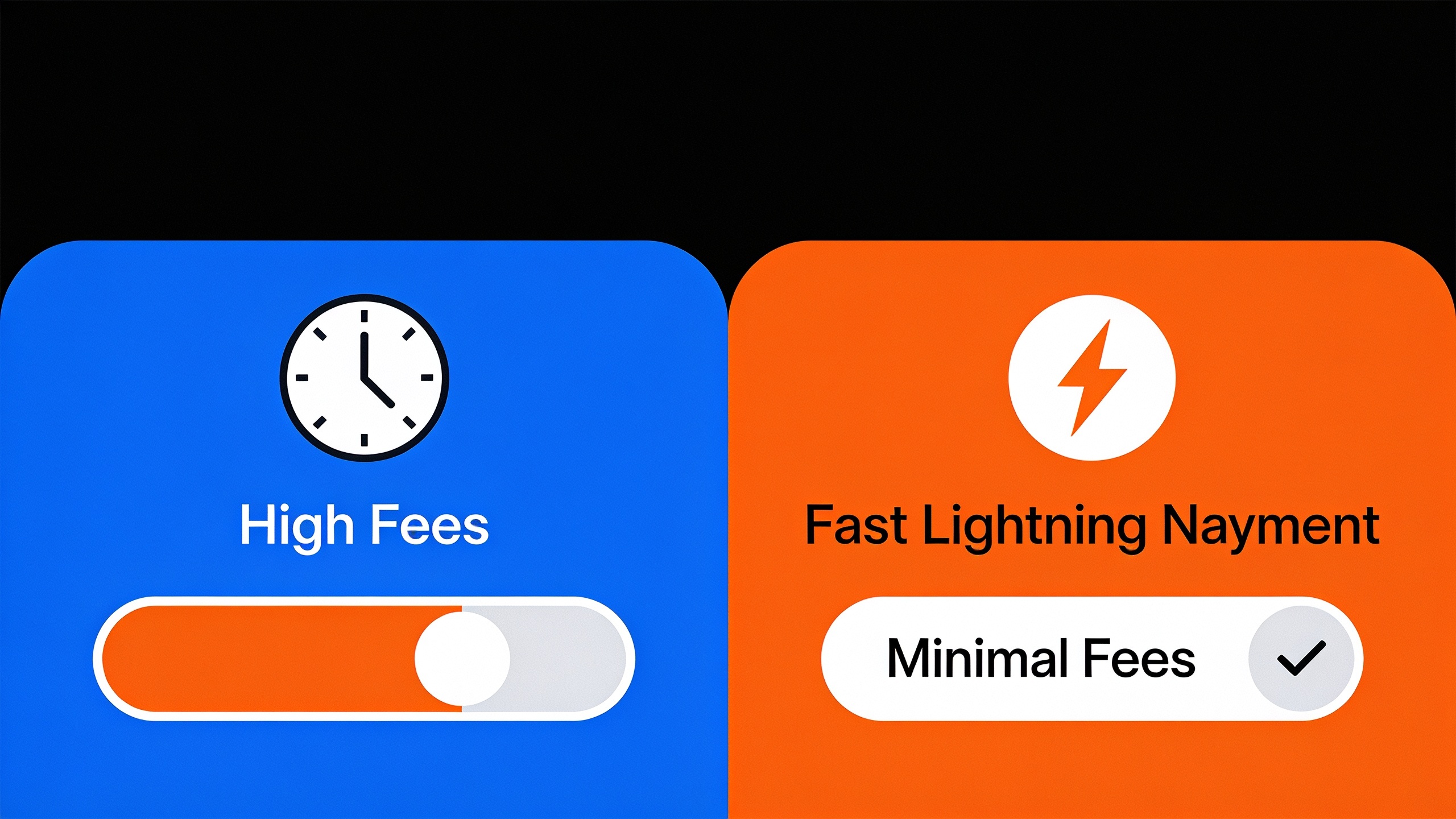
The Lightning Network is a "layer 2" payment protocol built on top of Bitcoin that lets you send and receive bitcoin almost instantly for a fraction of a cent, instead of waiting minutes and coughing up on-chain fees for every single transaction. The trick is that it moves most payments off Bitcoin's main blockchain and into a web of private payment channels, only settling the net result back to the chain when you actually need to. If you've ever tried to buy a coffee with bitcoin and watched the fee eat half your purchase, congratulations, you've met the exact problem Lightning was built to solve.
So this guide walks through how the thing actually works, how to open your first payment channel, what it's genuinely good for, and where it still falls flat in 2025. Because it does fall flat sometimes. More on that later.
Table of Contents
- What Is the Lightning Network?
- How Does the Lightning Network Work?
- How Do You Open a Lightning Channel?
- What Can You Use the Lightning Network For?
- Lightning Network vs. On-Chain Bitcoin Transactions
- Is the Lightning Network Safe? Risks and Limitations
- How Much Does the Lightning Network Cost to Use?
- Lightning Network vs. Other Scaling Approaches
- FAQ: Common Questions About the Lightning Network
- Final Thoughts
What Is the Lightning Network?
The Lightning Network is a decentralized network of two-way payment channels that runs on top of the Bitcoin blockchain, letting people transact directly with each other off-chain and only touch the main Bitcoin ledger to open or close a channel. It first showed up as a 2015 whitepaper from Joseph Poon and Thaddeus Dryja, and after a few years of grinding protocol work by several independent teams, an early mainnet version went live in 2018.
The core idea is dead simple, even though the cryptography holding it together absolutely is not. Instead of shouting every payment to the entire Bitcoin network (slow, and pricey when things get busy), two people lock up some bitcoin in a shared channel and then update the balance between themselves privately, as many times as they want, at basically no cost. Only the opening and closing transactions ever hit Bitcoin's base layer.
And because Lightning payments don't wait around for block confirmations, they settle in a second or two rather than the roughly ten minutes it takes to mine a fresh Bitcoin block. That's the whole reason micropayments become possible. Tipping a creator a few cents, paying per article, splitting a tab with friends, stuff that would be economically absurd on the base chain once you factor in fees. On Lightning, it just works.
How Does the Lightning Network Work?
The short version: two parties fund a shared multi-signature Bitcoin address (the "channel"), then repeatedly swap signed, updated balance statements between themselves instead of broadcasting every change to the blockchain. What keeps everyone honest is that either party can close the channel whenever they want and force the latest agreed-upon balance onto the chain. Nobody can cheat you out of the current state.
Payment Channels
A payment channel is essentially a smart contract between two people that locks up a set amount of bitcoin and lets them slide that balance back and forth in private. Say Alice opens a channel with Bob and puts in 0.01 BTC. The two of them can now send fractions of that back and forth thousands of times, and not a single one of those updates touches the blockchain. Only the initial funding transaction and the eventual closing transaction ever get broadcast on-chain. Everything in between is just Alice and Bob, quietly rewriting who owns what.
Routing Across the Network
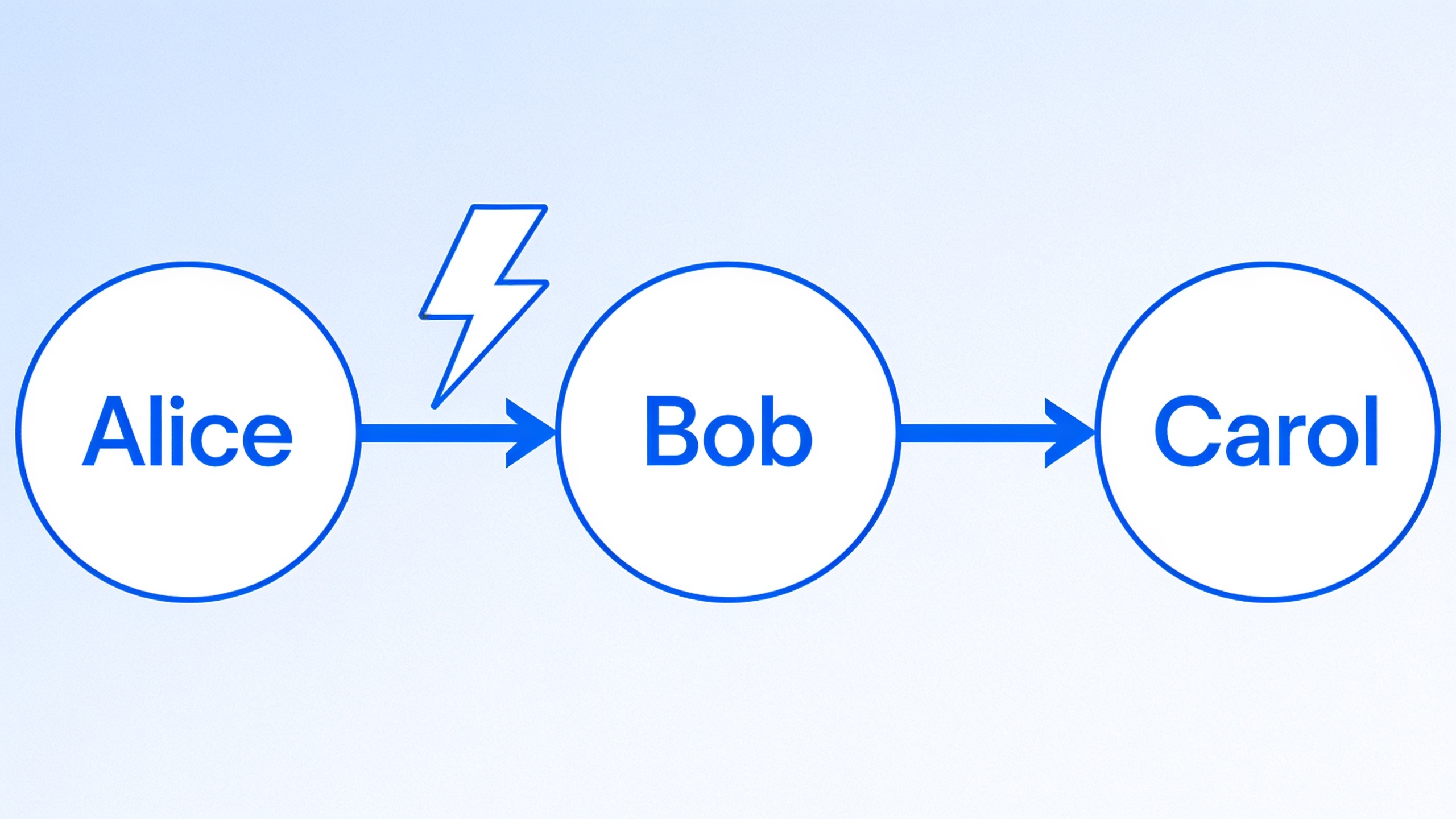
Here's where it gets clever: you don't need a direct channel with everyone you want to pay. Lightning is a mesh. If Alice has a channel with Bob, and Bob has a channel with Carol, then Alice can pay Carol by routing the payment through Bob's node, even though Alice and Carol have never opened anything between them. The nodes doing this routing can charge tiny routing fees, which is basically the incentive that keeps operators willing to park liquidity on the network in the first place. No fees, no reason to help move anyone's money.
Hashed Timelock Contracts (HTLCs)
Routed payments are held together by something called Hashed Timelock Contracts, or HTLCs. It's a type of smart contract that only releases funds if the recipient can produce a cryptographic proof (a "preimage") within a set window of time, and otherwise just hands the money back to the sender. This is the mechanism that lets a payment safely hop across several nodes: either the whole chain of hops completes and everyone gets paid, or it fails and nobody's funds get stuck or stolen. It's all-or-nothing, and it's trustless, and honestly that's one of the genuinely elegant things about Lightning compared to the crude off-chain IOU systems people tried before it.
How Do You Open a Lightning Channel?
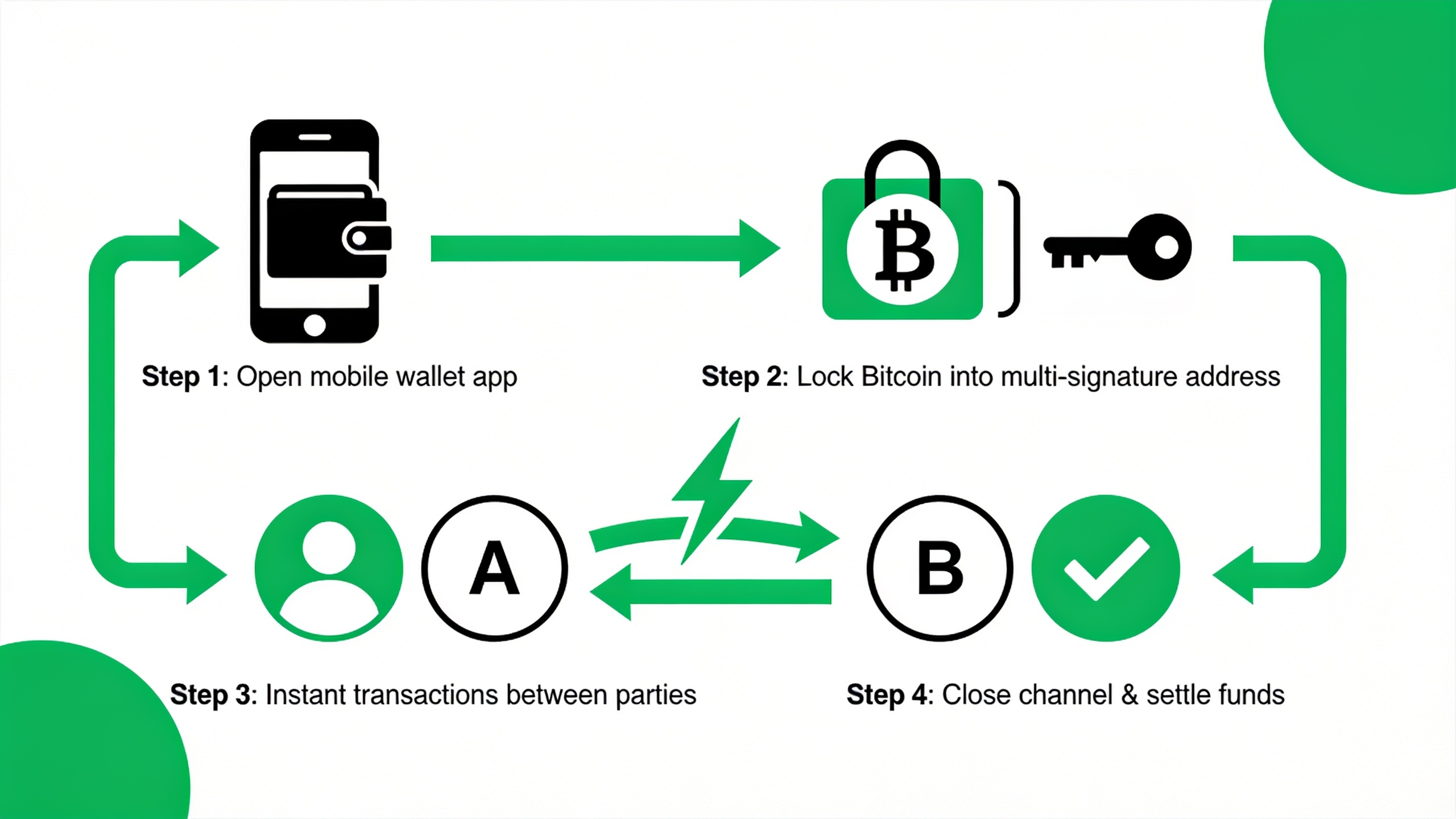
Opening a channel means broadcasting one on-chain Bitcoin transaction that locks funds into a 2-of-2 multi-signature address shared with your channel partner. Once that transaction confirms, you can transact instantly and repeatedly without touching the blockchain again until you decide to close. For most people these days, all of this is tucked away behind a clean app interface, so you never have to think about multisig or funding transactions at all.
Option 1: Use a Lightning-Enabled Wallet (No Node Required)
The fastest way in is a mobile wallet that handles channels for you. Phoenix, Breez, Muun, and Wallet of Satoshi are all widely used examples, and any of them will have you receiving bitcoin over Lightning within minutes of installing the app. Some are non-custodial, meaning the app opens and manages channels on your behalf while you keep control of your keys. Others, like Wallet of Satoshi, are custodial, which means the company holds the funds and does all the channel wrangling in exchange for a dead-simple experience. There's also Strike, built by Jack Mallers, which is another well-known name that runs on Lightning rails under the hood to shuffle bitcoin and settle payments fast.
The trade-off is exactly what you'd expect. Custodial wallets are easier out of the gate but you're trusting a third party with your money. Non-custodial wallets give you real control, but you'll have to learn a bit about backups and channel liquidity to use them well. Neither is "right," it just depends on how much you care about holding your own keys versus not thinking about it.
Option 2: Run Your Own Lightning Node
If you're the technical type, you can run dedicated node software like LND, Core Lightning, or Eclair, usually paired with a device running a full Bitcoin node (Umbrel and myNode are the popular pre-packaged bundles for this). Running your own node generally goes something like this:
- Set up a Bitcoin full node. Lightning nodes need a synced Bitcoin node to verify the blockchain.
- Install Lightning node software and let it generate a node identity and an on-chain wallet address.
- Fund the node's on-chain wallet with the bitcoin you plan to use in channels.
- Open a channel by picking a peer node and broadcasting a funding transaction that commits an agreed amount.
- Wait for confirmations (usually a handful of blocks) before the channel's ready for bigger payments.
- Manage inbound and outbound liquidity over time, because a channel can only send funds in the direction it actually has balance.
And when you want to close a channel later, you've got two options: a cooperative close, which is fast, cheap, and requires both parties to agree, or a unilateral force close, which is slower and involves a timelock. You'll only really need the force close if your counterparty goes dark or starts acting shady.
What Can You Use the Lightning Network For?
Lightning is at its best with fast, low-value, repeated payments. Basically the exact category where on-chain fees and confirmation times make the base Bitcoin chain a nonstarter. It hasn't replaced on-chain Bitcoin and it was never meant to. Instead it's carved out a handful of specific niches where it genuinely shines.
The obvious one is micropayments: paying per article, per API call, per minute of streaming, or tipping a few cents to a few dollars. This only works because Lightning fees are a tiny fraction of a cent rather than a flat fee that might dwarf the payment itself. Then there's point-of-sale and retail. Merchants in some regions take Lightning at checkout because it settles near-instantly, so nobody's standing there waiting for a confirmation while the line backs up. Cross-border remittances are another big one, since sending value over Lightning skips the traditional bank rails entirely and settles directly between connected parties.
You'll also see it in content monetization, where some podcasts and platforms have played with "value for value" tipping, letting listeners stream tiny amounts of bitcoin in real time as they listen. And developers use it for in-app and API payments, requesting and settling small amounts programmatically through Lightning invoices. Pay-per-use digital services, that kind of thing.
All of this sits inside the broader boom in programmable crypto tools. Investors who want exposure to Bitcoin's price without actually moving the underlying asset tend to look at instruments covered in Crypto Derivatives Explained: Futures, Options, and Perpetual Swaps, which is a completely different corner of the market from Lightning's payment-settlement world. But it points at the same trend: so much of crypto now is about making Bitcoin more usable and more tradable, rather than just sitting on it.
Lightning Network vs. On-Chain Bitcoin Transactions
The main difference comes down to speed and cost at small scale. Lightning payments settle in roughly one to a few seconds for near-zero fees, while on-chain Bitcoin transactions need block confirmation time (about ten minutes per block, often longer when the network's congested) plus fees that bounce around depending on demand for block space. That said, on-chain is still the right call for big transfers and final settlement, precisely because every transaction gets permanently recorded and secured by Bitcoin's full mining network.
| Feature | Lightning Network | On-Chain Bitcoin |
|---|---|---|
| Typical settlement time | Roughly 1–5 seconds | ~10 minutes per block, sometimes longer under congestion |
| Typical fee for a small payment | Fractions of a cent to a few cents | Can range from cents to several dollars depending on network demand |
| Best suited for | Bitcoin micropayments, tipping, frequent small transfers | Large transfers, final settlement, cold storage withdrawals |
| Privacy of individual payments | Routed payments are not recorded on the public blockchain | Every transaction is permanently visible on the public ledger |
| Setup requirement | Requires an open channel (via wallet or node) | No setup beyond a wallet address |
| Liquidity constraint | Payment size limited by channel balance | No channel-balance limitation |
| Finality | Final once the channel is closed and settled on-chain | Final after sufficient block confirmations |
The table makes the point better than I can: Lightning isn't a replacement for the Bitcoin blockchain, it's a complement. The base chain stays the ultimate settlement and security layer. Lightning just makes the small, everyday stuff practical.
Is the Lightning Network Safe? Risks and Limitations
Lightning inherits Bitcoin's cryptographic security, but it brings a fresh set of operational headaches around channel management, liquidity, and node uptime that you'll never deal with on a plain on-chain transaction. Worth understanding these before you move serious money into channels, because a couple of them genuinely trip people up.
Liquidity Limitations
A channel can only send bitcoin in the direction it has balance. So if you open a channel and push most of your funds out, you might not be able to receive payments back through that same channel until the liquidity gets rebalanced. This one catches new users off guard constantly, because everyone assumes Lightning behaves like a normal wallet that works both ways by default. It doesn't. Not out of the box, anyway.
Watchtower and Uptime Risk
Because a unilateral channel close involves a timelock during which your counterparty could theoretically try to broadcast an old, outdated channel state, Lightning nodes need to stay online (or lean on third-party "watchtower" services) to catch and dispute any fraud attempts. If you run your own node and disappear offline for weeks, that monitoring job falls more heavily on you.
Custodial Trade-offs
Custodial wallets take all the channel-management pain away, sure. But they also mean the provider holds the keys and the liquidity, not you, which quietly reintroduces exactly the counterparty risk that self-custodied Bitcoin was invented to eliminate. It's a convenience-versus-control thing, and only you can decide where you land on it.
Routing Failures on Large Payments
Big payments can be a pain to route, because they might exceed the available liquidity on any single path between you and the recipient. Sometimes the payment gets split across multiple routes, and sometimes it just fails outright if there's no viable path. For the small everyday payments Lightning was built for? Basically a non-issue. But if you're trying to shove a large sum through, it's a real limitation you'll bump into.
How Much Does the Lightning Network Cost to Use?
Lightning fees are usually a tiny fraction of a cent per payment, made up of a routing fee charged by the intermediary nodes along the payment's path. That's separate from the one-time on-chain fee you pay when a channel is first opened or finally closed. This fee structure is the whole reason micropayments of a few cents actually make sense on Lightning when they'd be laughable on the base layer.
There are really two cost layers to keep straight. First, the on-chain fees, which you only pay once when you open a channel and once when you close it. These follow the normal Bitcoin network fee dynamics, so they can swing a lot with congestion. Second, the routing fees you pay per payment to the nodes forwarding your money across the network. Operators set their own rates, usually a tiny base fee plus a proportional cut based on payment size, and the competition between routing nodes tends to keep these dirt cheap for typical amounts.
The upshot is that most of your cost is concentrated in those infrequent open and close transactions, not in each individual payment. So the more you actually use a channel for repeated small transactions, the cheaper each one gets on average. Open once, close once, transact a thousand times in between. That's the deal.
Lightning Network vs. Other Scaling Approaches
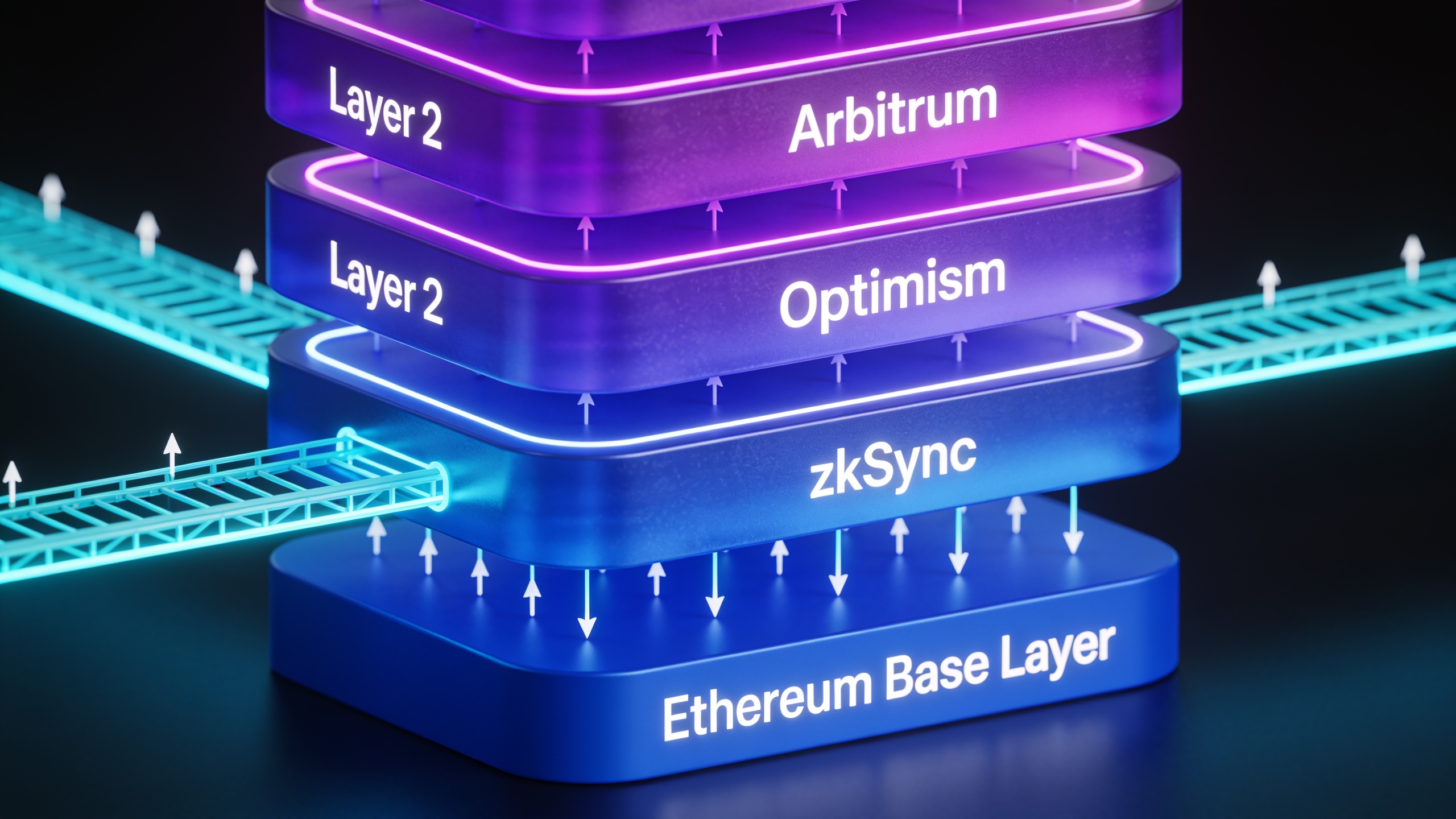
Lightning is one specific flavor of layer 2 scaling, a payment-channel network, but it's not the only way the blockchain world attacks the same underlying problem of high fees and slow settlement. Ethereum's ecosystem, for instance, has gone down a totally different road built around rollups instead of payment channels.
If you want the fuller picture on how other chains handle this, Layer 2 Blockchain Solutions Explained: Scaling Ethereum and Beyond covers rollups, sidechains, and the rest of the toolkit used across the wider market. The key difference is architectural. Lightning routes individual payments through a network of bilateral channels, while a lot of Ethereum layer 2 rollups batch and compress huge numbers of transactions and then post a summary back to the main chain. Same goal, cheaper and faster transactions, but they get there with different trust and liquidity models tuned to their respective base chains.
FAQ: Common Questions About the Lightning Network
Is the Lightning Network the same as Bitcoin?
Nope. Lightning is a separate protocol layer built on top of the Bitcoin blockchain. It leans on Bitcoin for its ultimate security and settlement, but it handles the vast majority of individual payments off-chain through payment channels instead of recording every last transaction on the base layer.
Do I need to run a full Bitcoin node to use the Lightning Network?
Not at all. Wallets like Phoenix, Breez, Muun, and Wallet of Satoshi let you send and receive Lightning payments without running any infrastructure yourself. Running your own node (with software like LND, Core Lightning, or Eclair) gives you more control and privacy, but you'll need to sync a Bitcoin node and actively babysit your channel liquidity.
Can I lose money using the Lightning Network?
The funds locked in a channel are protected by Bitcoin's cryptography, but there are risks around node uptime, liquidity mismanagement, and trusting a custodial provider if you go that route. Stick to well-established, widely used wallets and keep your channel balances in line with how comfortable you are with the tech, and you'll dodge most of the real-world risk.
What is the smallest payment the Lightning Network can handle?
Lightning was built specifically to make very small payments work, which is the whole basis for its use in micropayments like content tipping and pay-per-use services. These are the kinds of few-cent payments that would be completely impractical on Bitcoin's base chain thanks to on-chain fees.
How is the Lightning Network different from a centralized payment app?
Unlike a centralized app, Lightning is decentralized and permissionless. Anyone can open a channel and route payments without asking a central operator for permission, and non-custodial wallets let you keep control of your own funds instead of parking them with a single company.
Final Thoughts
Lightning doesn't replace Bitcoin. It stretches what Bitcoin can actually be used for, taking a settlement system built for security and finality and giving it the ability to handle instant, everyday, low-value payments too. For investors and traders who mostly follow Bitcoin as an asset, this stuff still matters, because payment utility keeps creeping further into the long-term story around Bitcoin's relevance, right alongside the derivatives markets and the layer 2 scaling debates shaping the rest of crypto.
And whether you're opening your first channel through a mobile wallet or just squinting at the Lightning QR code that suddenly appeared at your local coffee shop's register, the mechanics all come down to one idea. Fewer trips to the blockchain, faster payments, and fees small enough that sending a few cents actually makes sense.