5 Crypto Trading Strategies for Volatile Markets
Crypto can move 10% or more in a single day, which is exactly why flying by the seat of your pants will eventually gut your account. A good trading strategy won't make risk disappear (nothing does),...

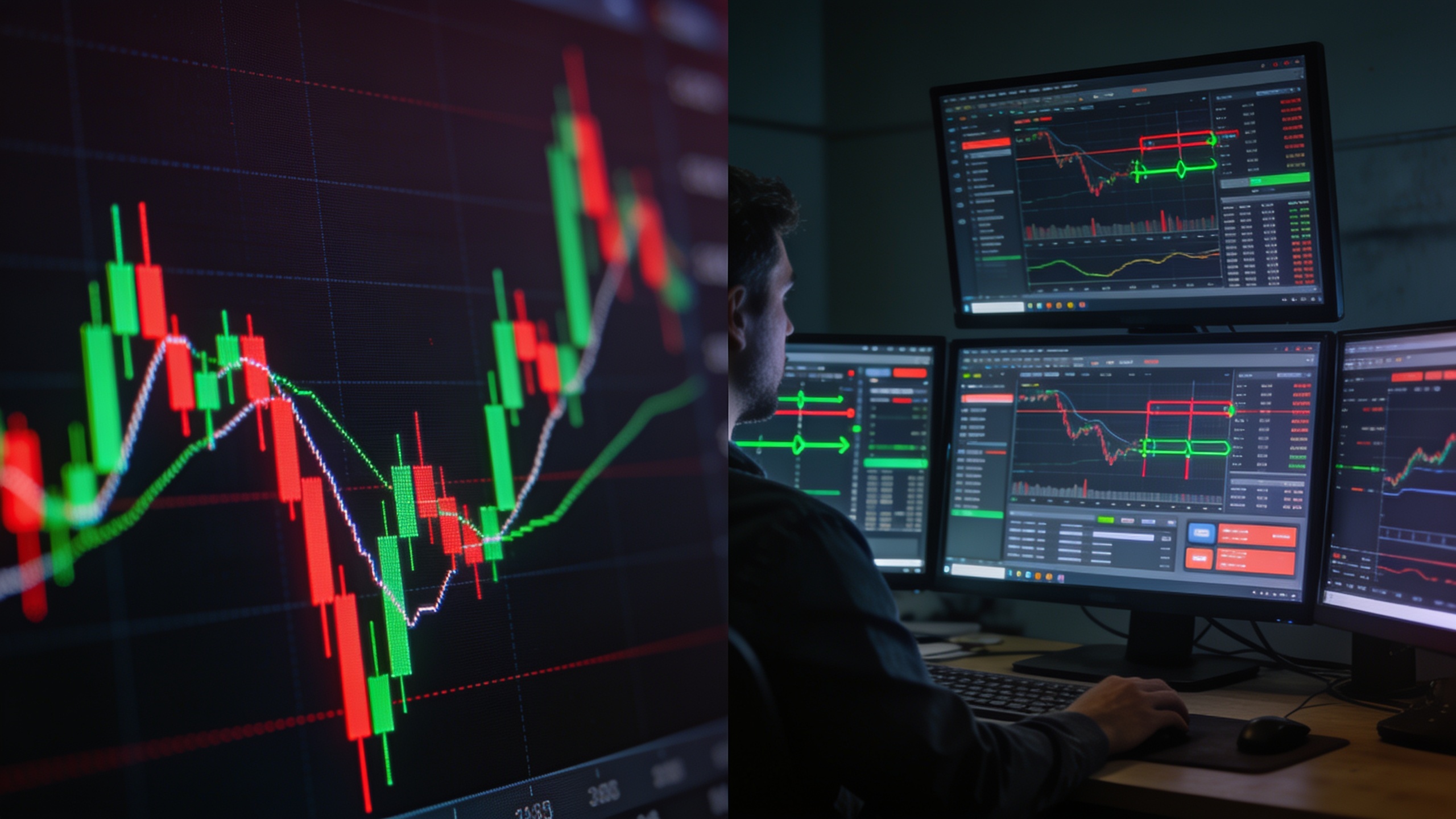
Crypto can move 10% or more in a single day, which is exactly why flying by the seat of your pants will eventually gut your account. A good trading strategy won't make risk disappear (nothing does), but it gives you a repeatable way to make decisions when fear or greed would otherwise be steering the ship. So this piece walks through five approaches people actually use in choppy markets, plus the risk management and timing stuff that separates disciplined traders from the folks basically gambling with extra steps.
Bitcoin's own history tells you everything about the stakes. It fell from an all-time high near $69,000 in November 2021 to below $16,500 by November 2022, according to CoinMarketCap historical data. That's more than a 75% drop. And on March 12, 2020 (people still call it "Black Thursday"), Bitcoin lost roughly 50% in a single day as pandemic panic tore through global markets. These aren't freak accidents. Volatility is a permanent feature of digital assets, not some bug that'll get patched out.
Table of Contents
- What Makes Crypto Markets So Volatile?
- 5 Core Crypto Trading Strategies for Volatile Markets
- How Do You Manage Risk in Volatile Crypto Markets?
- Comparing Crypto Trading Strategies: Capital, Risk, and Time Commitment
- How to Time Your Trades in Volatile Crypto Markets
- Common Mistakes That Undermine Crypto Trading Strategies
- Frequently Asked Questions
What Makes Crypto Markets So Volatile?
Crypto markets are volatile because they mash together thin liquidity, round-the-clock trading, absurd amounts of available leverage, and prices that react to every rumor, regulation, and mood swing, all without the circuit breakers or centralized oversight that keep traditional stock exchanges from spiraling. Volatility, if you want the textbook version, just means how much and how fast an asset's price bounces around over a given stretch of time.
Think about the difference. The New York Stock Exchange shuts for 16.5 hours a day and literally halts trading during extreme moves. Crypto exchanges? Never close. So one big sell order dropped at 3 a.m. on a Sunday, when barely anyone's trading, can shove prices around way more than the exact same order would at noon on a Tuesday. Then add the fact that a lot of altcoins have tiny market caps compared to blue-chip stocks, and suddenly it makes sense why a $10 million trade can move some altcoin by double digits while barely making a dent in a large-cap equity.
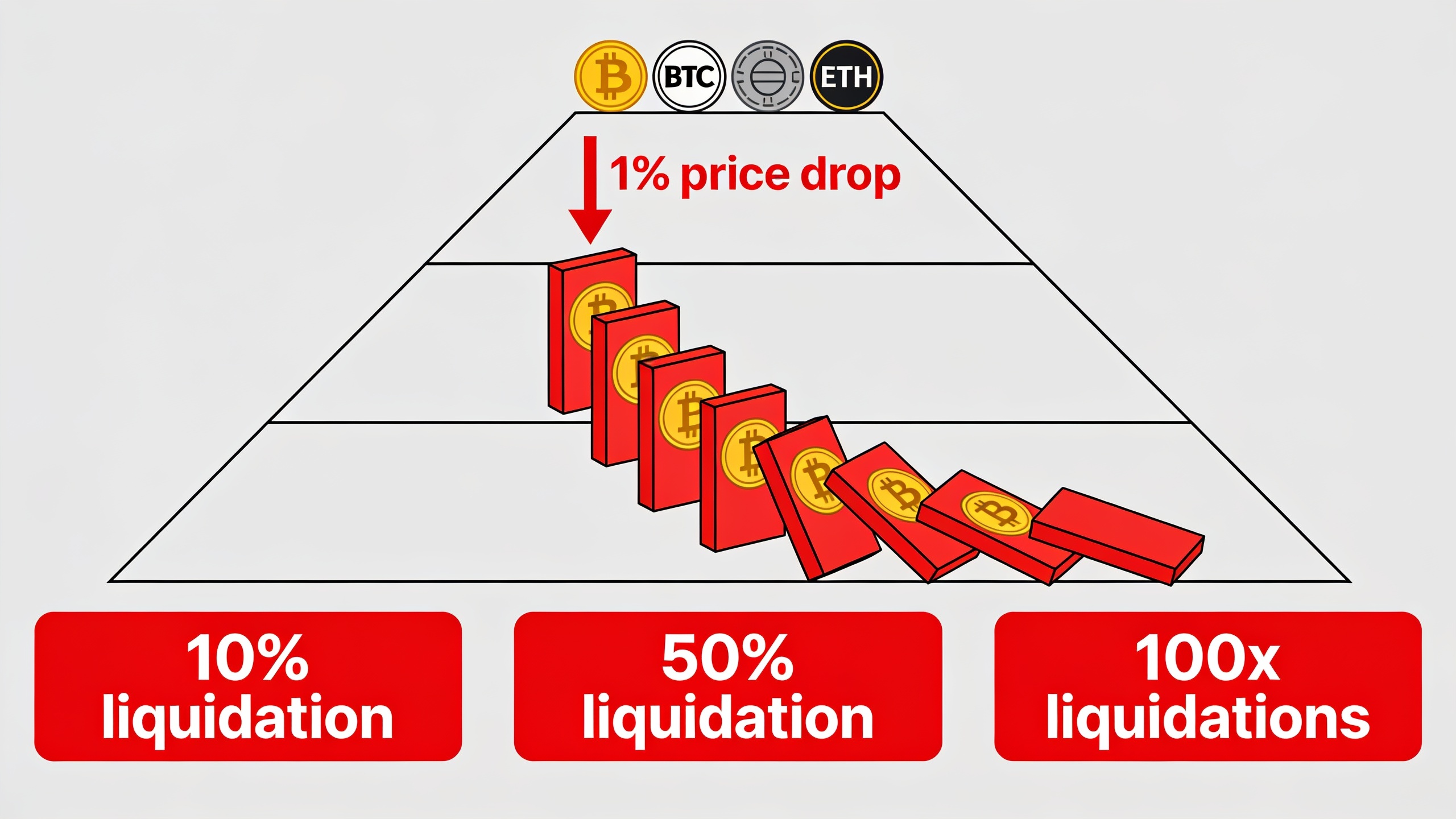
Leverage is where things really get spicy. A bunch of crypto derivatives platforms have historically offered up to 100x leverage, which means a 1% move against your position can wipe you out completely. And when a ton of leveraged positions get forced closed all at once (a "liquidation cascade"), prices can crash or spike far past anything the fundamentals would justify. The November 2022 collapse of FTX, once valued at roughly $32 billion, kicked off exactly that kind of contagion and dragged token prices down across the whole market inside of a few days.
5 Core Crypto Trading Strategies for Volatile Markets
The best crypto trading strategies for volatile markets all share one thing: they nail down your entry, exit, and position size before your emotions get a vote. Here are five that traders lean on, each fitting a different appetite for risk, time, and stress.
1. Dollar-Cost Averaging (DCA) Through Turbulence
Dollar-cost averaging means putting a fixed dollar amount into an asset at regular intervals no matter the price, instead of agonizing over one "perfect" moment to buy. Bitcoin drops 20% one week and rips 15% the next? A DCA investor just keeps buying through both, which smooths out the average price over time and, honestly, takes a huge weight off your shoulders because you're not trying to call the bottom.
This one's really for long-term holders more than day traders, but it shines in wild markets precisely because it kills the urge to chase pumps or panic-dump on the way down. Traders who want something built to endure rather than flash-and-fizzle often think about it the way Oak Castle Furniture approaches solid oak furniture, made for the long haul instead of a shiny thing that falls apart in a year. Will DCA beat a perfectly timed buy? No. But historical backtests on Bitcoin's price since 2013 generally show consistent weekly or monthly buyers coming out ahead of the people who try (and usually flub) timing the bottom.
2. Swing Trading With Technical Indicators
Swing trading means holding a position for several days to a few weeks to catch a "swing" in price, leaning on technical indicators like the Relative Strength Index (RSI), moving averages, and support/resistance levels to figure out when to get in and out. It lives somewhere between long-term investing and full-on day trading, which makes it a favorite for people who can't stare at charts all day but still want skin in the game.
Here's a setup you'll see a lot: a trader waits for RSI to dip below 30 (the "oversold" signal) near a support level that's held up before, then buys with a stop-loss parked just under that support. If the price bounces back toward resistance, they take partial profits instead of getting greedy and holding for some mythical top. The catch with swing trading is you need patience and a stomach for overnight and weekend gaps, because crypto never sleeps and a nasty move can absolutely happen while you're passed out at 4 a.m.
3. Scalping and Short-Term Momentum Trades
Scalping is a high-frequency style where traders jump in and out of positions within minutes to grab tiny price moves, usually watching order-book depth, volume spikes, and momentum indicators instead of doing any fundamental analysis. It's easily one of the most demanding strategies on this list, since it eats your time and attention alive.
Because scalping spits out a mountain of taxable events, anyone doing it should keep obsessive records. Seriously, the guide on crypto tax reporting and trading obligations is worth a read before you go frequency-trading, because dozens of trades a day can turn tax season into a nightmare of recordkeeping. Scalping also burns through exchange fees fast. Even a 0.1% maker/taker fee stacks up across hundreds of trades, so this one really only makes sense on low-fee exchanges or if you're moving serious volume.
4. Hedging With Derivatives and Stablecoins
Hedging means taking an offsetting position to shave down the risk on something you already hold. Think shorting a futures contract on an asset you also own in spot form, or shifting a chunk of your portfolio into stablecoins like USDC or USDT when you expect a rough patch. It lets you stay in the game long-term while softening the blow of a short-term drop.
Say you're holding Ethereum going into a big network upgrade. You might buy a put option or open a small short futures position to guard against a nasty surprise, all without selling your actual ETH. Stablecoin rotation is the simpler, cheaper cousin of this: moving 20-30% of your portfolio into stablecoins during high-uncertainty stretches (like right before a Federal Reserve rate decision) keeps dry powder ready to buy back cheaper if prices fall, and caps your downside if they don't. And just like diversifying any financial portfolio cuts concentrated risk, some traders go all the way outside crypto. Real estate platforms like Viviendalista are a decent example of how people look beyond digital assets to spread their bets across things that don't rise and fall in lockstep with Bitcoin.
5. Automated Trading Bots and Algorithmic Strategies
Trading bots are programs that execute trades automatically off preset rules, like grid trading, arbitrage, or trend-following algorithms, stripping human emotion and slow reaction times out of the equation. In a market that runs 24/7, a bot will react to a price trigger at 4 a.m. just as reliably as at 4 p.m., and that's a genuine edge over doing it by hand.
Grid bots, for instance, drop a ladder of buy and sell orders at set intervals above and below the current price, milking the constant back-and-forth you get in choppy, range-bound markets. Arbitrage bots hunt for tiny price gaps for the same asset across different exchanges. If you're eyeing this route, the rundown in Best Crypto Trading Bots Reviewed for 2025 breaks down which platforms hold up for which strategies and risk levels. And it's worth pointing out that automation is quietly eating up the repetitive stuff everywhere, not just in trading. Much like AI-driven platforms such as RobinRank now handle SEO content workflows, algorithmic tools are increasingly taking over the boring, rules-based parts of crypto trading so humans can spend their brainpower on strategy instead of clicking buttons.
How Do You Manage Risk in Volatile Crypto Markets?
Risk management in volatile crypto markets means capping how much any single trade can cost you through position sizing, stop-losses, and diversification. It is not about calling every price move correctly. Even pros with killer track records lose on 40-50% of their individual trades. What keeps them in the black is making sure their winners are bigger than their losers and that no single loss is a knockout punch.
There's an old rule of thumb, the "1% rule," that says risk no more than 1-2% of your total trading capital on any one position. On a $10,000 portfolio, that caps your potential loss on a single trade at $100-$200 with a stop-loss, no matter how sure you feel. Sounds painfully conservative, I know. But that's exactly the thing that stops one bad trade (or one exchange blowing up, like FTX torching customer funds practically overnight in November 2022) from erasing months of hard-won gains.
Diversification across uncorrelated assets is another pillar. Holding a bag of altcoins that all move together in a downturn isn't diversification, it just feels like it. Real risk reduction comes from spreading across asset types that don't all faceplant at the same time. This is also where doing your homework pays off. Before throwing money at some new project, savvy traders check whether the team actually exists online, because scam projects tend to skip the whole "having a professional presence" part. Legit crypto ventures usually invest in decent web design and marketing, the kind of work agencies like Digital Fusion Hub offer, so a project with a sloppy site and zero clear marketing plan is often a red flag worth poking at before you commit a dollar.
And finally, stop-loss and take-profit orders aren't a nice-to-have in volatile markets. They're the thing that actually forces your plan to happen when your hands are shaking. A trader who "plans" to sell at a certain loss but never places the order is way more likely to freeze up mid-crash and white-knuckle it, praying for a bounce that might never come.
Comparing Crypto Trading Strategies: Capital, Risk, and Time Commitment
Picking among these usually boils down to how much time, money, and risk tolerance you've actually got. Here's how the five stack up.
| Strategy | Typical Time Commitment | Risk Level | Capital Needed to Start | Best Suited For |
|---|---|---|---|---|
| Dollar-Cost Averaging (DCA) | Low (set-and-forget) | Low-Moderate | Low ($50-$500/month) | Long-term investors |
| Swing Trading | Moderate (daily chart checks) | Moderate | Moderate ($1,000+) | Part-time active traders |
| Scalping | Very high (constant monitoring) | High | Moderate-High ($2,000+) | Full-time, fee-conscious traders |
| Hedging (derivatives/stablecoins) | Moderate | Moderate | Moderate-High ($1,000+) | Traders protecting existing holdings |
| Automated Bots/Algorithms | Low after setup, high upfront | Moderate-High | Varies (bot fees + capital) | Tech-savvy traders wanting 24/7 coverage |
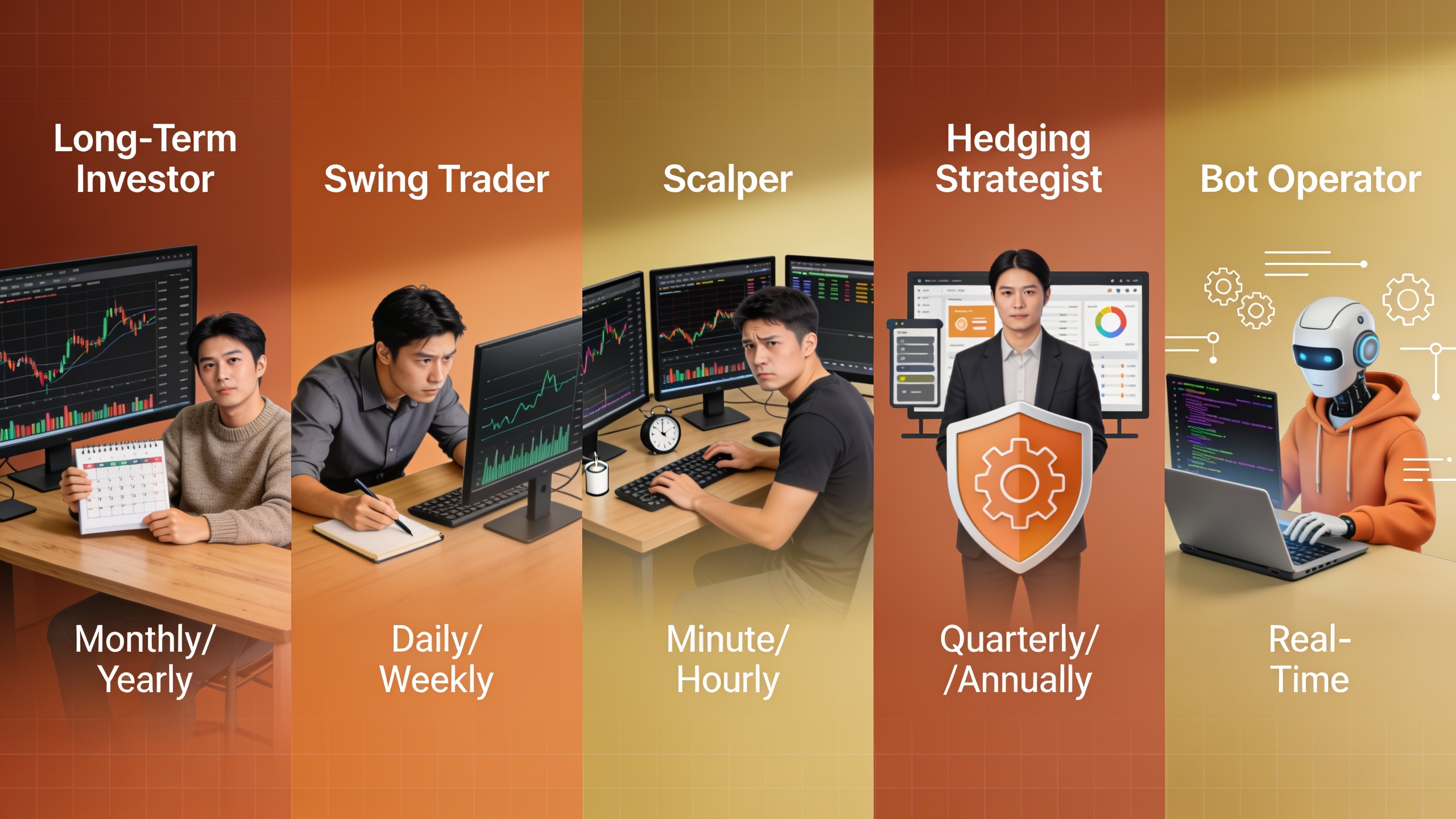
No strategy is objectively "the best," and anyone selling you that is lying. Someone with a full-time job and a low tolerance for pain is almost always better off with DCA or bot-assisted swing trading than manual scalping, which demands the kind of nonstop attention most people just can't (and shouldn't) sustain.
How to Time Your Trades in Volatile Crypto Markets
Timing trades in volatile crypto isn't about nailing the exact top and bottom. It's about lining up your entries and exits with measurable signals like volume, volatility gauges, and macro catalysts instead of your gut. Even the best traders miss the exact top and bottom constantly. The real goal is catching the fat middle of a move reliably, not chasing perfection.
One handy tool is just watching trading volume next to price. A breakout on unusually heavy volume is way more likely to stick than the same breakout on thin volume, which tends to snap back fast (people call it a "fakeout" for a reason). Traders also keep an eye on the Crypto Fear & Greed Index, a sentiment gauge that blends volatility, momentum, social media chatter, and survey data into one number from 0 (extreme fear) to 100 (extreme greed). Historically, readings deep in extreme-fear territory have often come right before recoveries, while extreme greed has tended to precede corrections. Though I'll stress: "tended to" is not "guaranteed to."
Macro catalysts matter every bit as much as the chart stuff. Federal Reserve rate announcements, SEC rulings on crypto ETFs, big exchange or protocol events (Ethereum's network upgrades, for one) routinely move prices harder than any candlestick pattern ever will. Traders who take timing seriously usually build a calendar of known upcoming events and trim their position sizes ahead of the sketchy dates rather than trying to guess how it plays out. This is also a spot where solid digital infrastructure quietly matters for anyone running their own research operation or community. Much like a small business needs a well-built site to look legit to visitors, traders building a public track record or newsletter often lean on professional design help, the same category of work companies like Digital Fusion Hub do, to present their research clearly and earn an audience's trust.
Common Mistakes That Undermine Crypto Trading Strategies
The single most common mistake that torpedoes a trading strategy is bailing on the plan mid-trade out of fear or excitement, not some flaw in the strategy itself. A mediocre strategy applied consistently usually beats a brilliant one applied haphazardly, because consistency is the only thing that lets your edge (assuming you have one) actually show up across enough trades to matter.
Overleveraging is a close runner-up. Sure, 20x or 50x leverage can turn a 5% move into a 100-250% gain, but the exact same leverage turns a 5% move the wrong way into a total liquidation. Liquidation data from the major derivatives exchanges consistently shows leveraged retail traders losing money far more often during high-volatility stretches than in calmer periods, precisely because volatility jacks up the odds of hitting that liquidation line before the trade ever gets room to breathe.
Ignoring fees and taxes is another one that bites people. Frequent traders love to obsess over gross gains while completely spacing on exchange fees, slippage, and taxes that quietly chip away at what they actually keep. Anyone trading actively should get familiar with the requirements laid out in the crypto tax guide on trading and reporting well before April rolls around, because underestimating a tax bill can flip a profitable year into a cash-flow headache. Oh, and one more: plenty of traders never diversify their information, leaning on a single influencer or Telegram group for signals instead of cross-checking against independent sources. That's a great way to get wrecked when your one source turns out to be wrong, biased, or straight-up shilling a scheme.
Frequently Asked Questions
What's the safest crypto strategy if I'm just starting out?
Dollar-cost averaging is generally the safest place to start because it needs zero chart-reading skill, spreads your buys across a bunch of price points, and takes the pressure of timing off your plate entirely. It won't juice your short-term gains, but it drastically limits the emotional and financial damage of buying everything at one terrible price.
How much money do I actually need to start trading crypto?
There's no hard minimum. Plenty of exchanges let you trade as little as $10-$25. But a genuinely workable account for anything beyond basic DCA usually starts around $500-$1,000, because with less than that it's tough to apply proper position sizing (like the 1-2% risk rule) without your trades getting comically tiny.
Can trading bots really beat manual trading in volatile markets?
Sometimes, yeah. Bots can outperform in specific conditions, especially range-bound or highly repetitive volatile markets, because they fire off rules instantly and around the clock with zero emotion. But a bot only knows the logic you gave it. Drop a poorly configured bot into a strongly trending market and it'll happily underperform a skilled human who reads the room and adapts in real time.
Do I owe taxes on every crypto trade, even the small ones?
In most places, the U.S. included, pretty much every crypto-to-crypto or crypto-to-fiat trade counts as a taxable event no matter how small, and it has to be reported even if you barely made or lost anything. Since that creates a mountain of recordkeeping for active traders, it's genuinely worth reading up on crypto trading and tax reporting before you commit to something high-frequency like scalping.
How can I tell if the market's just too volatile to touch right now?
A practical tell is watching short-term realized volatility (basically how big the recent swings are) alongside volume. If prices are whipping around violently on unusually thin volume, that usually signals an unstable, easily-manipulated market rather than a real trend, and shrinking your position size or just stepping aside is almost always the smarter, more disciplined call.
Volatility in crypto isn't going anywhere, and trying to engineer it out of your approach is a fight you'll lose. The traders who actually stick around are the ones who pick a strategy (or some blend of the five here) that fits their time, capital, and temperament, then apply the same boring risk controls trade after trade instead of reacting to every headline like it's the end of the world.