Crypto Tax Guide: What You Need to Know About Trading and Reporting
Crypto used to be a thing your weird cousin wouldn't stop talking about at Thanksgiving. Now it's a legit asset class, and the IRS wants its cut. This guide walks through how digital assets get taxed...


Crypto used to be a thing your weird cousin wouldn't stop talking about at Thanksgiving. Now it's a legit asset class, and the IRS wants its cut. This guide walks through how digital assets get taxed in the US, what you actually have to report, and how to avoid the kind of nasty surprise letter that ruins your April. Doesn't matter if you're sitting on a little Bitcoin in cold storage or firing off trades all week. Knowing where you stand with the taxman is just part of the game now.
Since Notice 2014-21, the IRS has treated crypto as property. Sounds boring, but it matters a lot: selling, swapping, even spending it can all count as a taxable moment. And with new broker reporting rules kicking in and enforcement getting sharper every year, "I didn't know" isn't the shield it used to be.
Table of Contents
- How Is Cryptocurrency Taxed in the United States?
- What Crypto Transactions Trigger a Taxable Event?
- Short-Term vs. Long-Term Capital Gains on Crypto
- How Do You Report Cryptocurrency Taxes?
- Common Crypto Tax Mistakes to Avoid
- Tools and Strategies for Crypto Tax Compliance
- What Happens If You Don't Report Crypto Taxes?
- Frequently Asked Questions
How Is Cryptocurrency Taxed in the United States?
Crypto is taxed as property, not currency, and that one detail shapes everything else. The IRS laid this out back in 2014 and has doubled down since. So every time you sell, trade, or otherwise get rid of a digital asset, you're generally locking in a capital gain or loss based on the gap between what you paid (your cost basis) and what you got when you let it go.
Think of it like stock or real estate, not like swapping dollars for euros. Say you grabbed 1 Bitcoin at $20,000 and later sold it for $45,000. That $25,000 profit? Taxable. But it cuts both ways. Sell at a loss and you can often use that loss to knock down other gains or even shave a bit off your taxable income, within the IRS limits anyway.
Then there's the income side, which trips people up. Mining rewards, staking rewards, airdrops, getting paid in crypto for a gig, all of that counts as ordinary income based on the fair market value the day it landed in your hands. And here's the part folks forget: that income number also becomes your cost basis going forward. So it comes back around when you eventually sell or trade the thing.
State taxes pile on top. Most states with an income tax will happily tax your crypto gains too, though rates and rules are all over the map. If you live somewhere like Texas, Florida, or Wyoming with no state income tax, you dodge that particular bullet. But Uncle Sam still shows up no matter where you live.
What Crypto Transactions Trigger a Taxable Event?
A taxable event happens any time you get rid of crypto in a way that realizes a gain or loss, or any time you receive crypto as income. Figuring out which of your moves actually count is where most of the accuracy comes from.
The Stuff That's Taxable
Selling crypto for actual dollars is the obvious one, but it's honestly just the tip of it. Trading one coin for another, swapping Ethereum for Solana, say, is taxable too. Even though no cash ever hits your bank account. The IRS looks at it as selling the Ethereum and buying the Solana, so you owe gain or loss on the ETH based on what it was worth at the moment of the swap. A lot of people genuinely don't realize this, and it's an expensive thing to learn the hard way.
Buying stuff with crypto counts as well. Grab a laptop with Bitcoin and, in the eyes of the IRS, you sold that Bitcoin at market value and then spent the proceeds. Which means a capital gain or loss on the crypto part. Yeah, buying a coffee with Bitcoin is technically a taxable event. Wild, but true.
And receiving crypto through mining, staking, airdrops, hard forks, or freelance work all lands in the ordinary income bucket, taxed at your marginal rate the second you control the asset.
The Stuff That's Not
Some things won't cost you a dime at tax time. Buying crypto with dollars and just holding it? Not taxable. You only owe when you dispose of it. Moving your own coins between your own wallets, like shifting from an exchange to a hardware wallet, isn't a disposal, so it's fine. Donating crypto to a qualified charity can actually hand you a deduction instead of a bill. And gifting crypto under the annual exclusion threshold usually doesn't create an immediate tax hit for you as the giver.
| Transaction Type | Taxable? | Tax Treatment |
|---|---|---|
| Selling crypto for USD | Yes | Capital gain/loss |
| Trading one crypto for another | Yes | Capital gain/loss |
| Buying goods/services with crypto | Yes | Capital gain/loss on disposed asset |
| Mining or staking rewards | Yes | Ordinary income |
| Receiving an airdrop | Yes | Ordinary income |
| Buying crypto with USD (holding) | No | Not taxed until disposal |
| Transferring between your own wallets | No | Not a disposal |
| Donating to qualified charity | No | Potential deduction |
| Receiving a gift (under exclusion limit) | No | Not immediately taxed to recipient |
Short-Term vs. Long-Term Capital Gains on Crypto
How long you held before selling decides whether your profit gets taxed as short-term or long-term, and the difference is big enough that it's worth actually paying attention to.
Hold for a year or less and it's a short-term gain, taxed at your ordinary income rate. For 2024 that runs anywhere from 10% to 37%, depending on your total income and filing status. Active traders churning through positions tend to rack up mostly short-term gains, including folks running automated strategies like the ones we dug into in our Best Crypto Trading Bots Reviewed for 2025 writeup. Fast trading feels great until the tax bill compared to a lazy buy-and-hold investor lands.
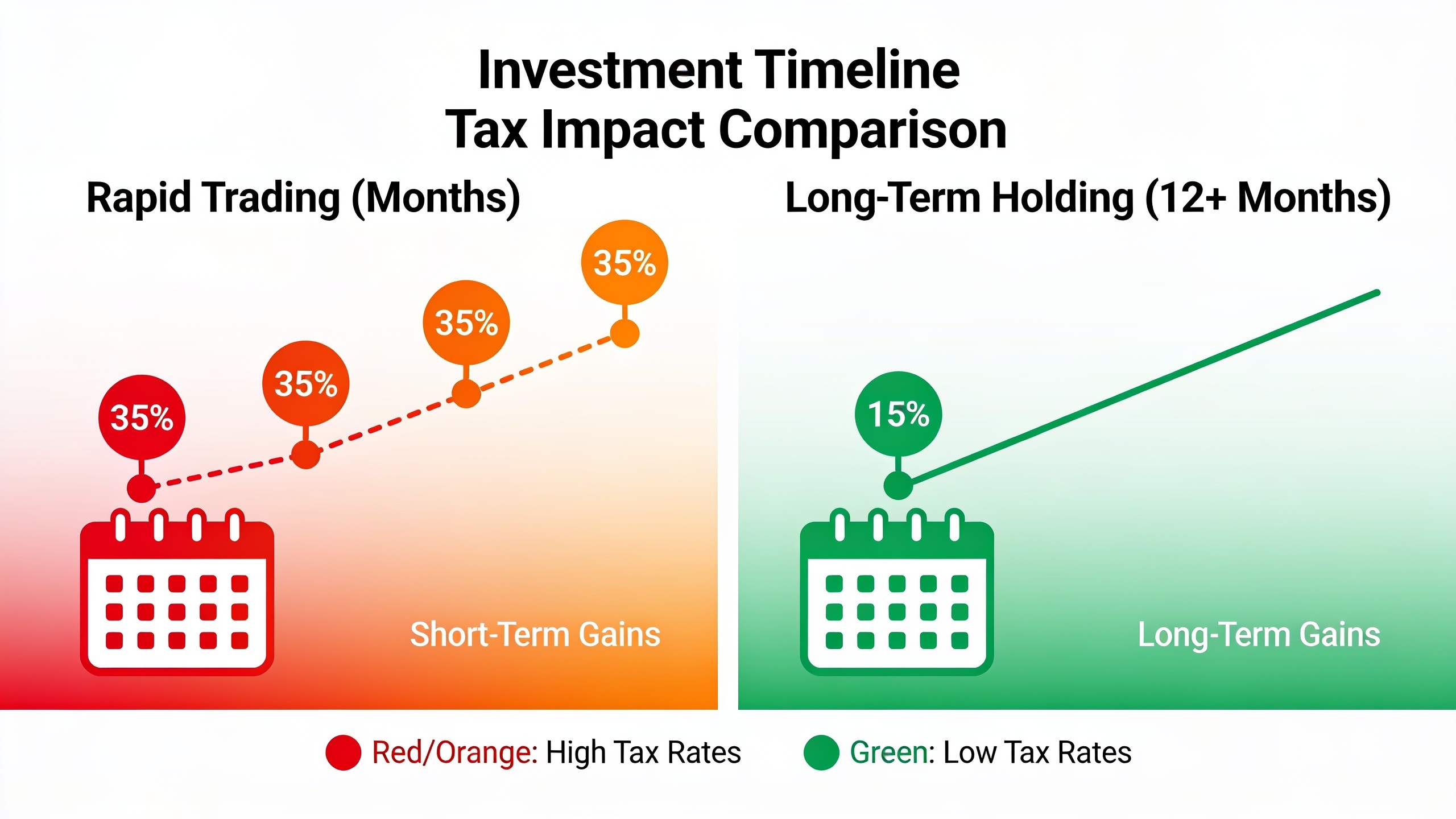
Hold longer than a year and you get the good rates: 0%, 15%, or 20%, based on your income. For plenty of middle-income people, that 15% long-term rate is way friendlier than their ordinary bracket. Which makes holding periods a genuine planning tool, not just a footnote.
| Holding Period | Tax Category | 2024 Federal Tax Rate Range |
|---|---|---|
| 1 year or less | Short-term capital gain | 10% – 37% (ordinary income rates) |
| More than 1 year | Long-term capital gain | 0%, 15%, or 20% |
This gap is exactly why seasoned investors will sometimes sit on their hands a few extra weeks to cross that one-year line. Sure, market swings and cash needs don't always let you wait. But knowing the tax consequences before you hit sell, instead of finding out after, puts you in a much better spot.
How Do You Report Cryptocurrency Taxes?
You report crypto mostly on IRS Form 8949 and Schedule D for capital gains and losses, plus Schedule 1 or Schedule C for any crypto you got as income, depending on whether it's a hobby or a business. And every US taxpayer with crypto activity has to answer that digital asset question sitting right near the top of Form 1040 now.
Form 8949 is where you list out each disposal one by one: date acquired, date sold, proceeds, cost basis, gain or loss. Those totals roll into Schedule D, which sums up your whole capital gains picture for the year. If you pulled in crypto from mining, staking, or payment for services, that income usually goes on Schedule 1 as other income, or Schedule C if you're running it like a business (say, a professional miner).
Starting with the 2025 tax year, the third-party reporting gets a lot beefier. Under rules finalized by the Treasury and IRS, brokers and exchanges have to start issuing Form 1099-DA to report digital asset sales and exchanges, basically the crypto version of the 1099-B stock brokers already send. Translation: the IRS is going to get your transaction data straight from the source. Flying under the radar just got a whole lot harder.
Cost basis tracking is the part that'll make you want to pull your hair out, especially if you're bouncing assets across a bunch of exchanges and wallets. The IRS lets you use specific identification methods (FIFO, first in first out, or specific lot identification) to figure out which coins you sold. But you've got to stick with your chosen method and be able to prove it. Trade across several platforms and this gets messy fast. It's also part of why the regulatory picture matters so much. Our piece on Crypto Regulation News: What New Laws Mean for Investors digs into how the shifting rules mess with your reporting and your strategy.
Common Crypto Tax Mistakes to Avoid
The single most common mistake is skipping transactions that never touched fiat, like crypto-to-crypto trades or spending crypto directly. Tons of people assume that if they never cashed out to actual dollars, there's nothing to report. That's just wrong, and it leads to serious underreporting.
Right up there with it: sloppy or missing cost basis records. When you've been buying across multiple exchanges over several years, rebuilding an accurate cost basis without good records is a nightmare. Lose access to an old account, or forget to export your history before an exchange goes belly-up (which, uh, happened to a few platforms recently), and you're left with holes you can't easily patch after the fact.
People also blow off income from staking and airdrops, mostly because the amounts feel too small to bother with. Here's the annoying truth though: the IRS doesn't set a minimum. Technically a $5 airdrop is reportable income. Ridiculous? Maybe. But it's the rule.
Then there's the wash sale thing, which is genuinely interesting. Unlike stocks, crypto has historically not been subject to the wash sale rule, the one that blocks a tax loss if you rebuy a substantially identical asset within 30 days. So crypto folks have been able to sell at a loss for tax purposes and immediately buy the same coin right back, a move called tax-loss harvesting. But lawmakers keep floating proposals to extend wash sale rules to digital assets, so keep half an eye on this. A change here could blow up your year-end strategy.
Last one, and it's the sneaky one: people wildly underestimate how much time detailed record-keeping eats up, right up until it's too late. It's a bit like how a homeowner might use planning tools from a company like Windows Doors Depot Ltd to map out a renovation before dropping serious cash on it. Sort your tax approach out ahead of time instead of frantically piecing it together in April.
Tools and Strategies for Crypto Tax Compliance
Crypto tax software that auto-imports your transaction data from exchanges and wallets is, hands down, the most reliable way to get accurate reporting you can actually defend. Platforms like CoinTracker, Koinly, and TaxBit hook in via API or CSV, pull all your history together, crunch the cost basis using whatever accounting method you picked, and spit out the forms you need. Honestly, if you trade more than occasionally, just get one.
Actually Keeping Records (Without Losing Your Mind)
Don't wait for tax season. Reconciling your transactions monthly or quarterly is so much more sane, especially if you're an active trader knocking out hundreds of trades a year, whether by hand or through bots. And if you're using algorithmic trading tools, how your platform logs trade history, and whether it plays nice with tax software, should absolutely factor into which one you pick. We get into that more in our guide to trading bot platforms.
Bringing in a Pro
Crypto taxes get complicated enough that a lot of investors, particularly the ones with heavy volume, DeFi activity, or NFT trading, are better off with a CPA or enrolled agent who actually specializes in this stuff. A good one earns their fee in the gray areas: liquidity pool transactions, wrapped tokens, cross-chain bridge transfers, all the places where IRS guidance is still thin or just plain fuzzy.
Retirement Accounts and the Long Game
Some people look into holding crypto inside a self-directed IRA to defer or dodge certain taxes, same idea as running stocks and bonds through a traditional retirement account. It comes with its own custodial requirements and fees though, so weigh it against your actual financial goals. It's not some magic loophole.
The bigger point is that proactive beats reactive every single time. Families planning ahead run into the same lesson elsewhere, like folks sorting out coverage through Super Visa Insurance Calgary when they're sponsoring parents or grandparents visiting Canada. Set it up before you need it. Tax compliance works the same way. Handle it in advance and it's a chore. Handle it after a problem hits and it's a crisis.
Staying informed matters too, since the rules keep shifting. Tools like RobinRank show how AI-driven platforms are reshaping the way financial and educational content gets made, published, and found, including the kind of guidance investors lean on when they're trying to make sense of a moving target.
What Happens If You Don't Report Crypto Taxes?
Skip reporting your crypto income or gains and you're looking at penalties, interest, and in the worst cases, criminal charges for tax evasion. The IRS has seriously cranked up its crypto enforcement lately, including hitting big exchanges like Coinbase and Kraken with "John Doe" summonses to scoop up user transaction data.
On the civil side, underreporting income usually means a failure-to-pay penalty plus interest. And if the IRS decides you were negligent or straight-up ignored the rules, they can tack on an accuracy-related penalty of 20% of the underpayment. Willful evasion is where it gets scary, with possible fines and prison time. That said, that outcome is generally saved for blatant, deliberate cases, not honest mistakes or reasonable good-faith slip-ups.
That digital asset question on Form 1040 isn't just decoration, either. Every filer has to say whether they received, sold, exchanged, or otherwise disposed of a digital asset during the year. Answer it wrong, even if you didn't file any other crypto forms, and that alone can count as a false statement on a federal return. Don't lie on that box.
With Form 1099-DA reporting rolling out and the IRS cozying up to blockchain analytics firms, the old idea that crypto is anonymous and untraceable is basically dead. Filing accurately and on time is dramatically cheaper and less stressful than fighting an audit after the fact. It's not close.

And if you've already fallen behind on past years? You've got options. The IRS Voluntary Disclosure Practice, or just filing amended returns, can get you back into compliance, often with lighter penalties than if you sit tight and wait for the IRS to spot the gap first. Better to raise your hand than get tapped on the shoulder.
Frequently Asked Questions
If I just buy crypto and hold it, do I owe any tax?
Nope. Buying and holding doesn't trigger anything. The tax shows up when you sell, trade, spend, or otherwise dispose of the asset, or when you receive crypto as income through mining, staking, or airdrops.
I swapped one coin for another without ever cashing out. Is that taxable?
Yes, and this catches a lot of people. Trading one crypto for another is a taxable event even without touching dollars. The IRS treats it like you sold the first asset at fair market value and immediately bought the second, so you have to calculate and report any gain or loss.
What's the real difference between short-term and long-term crypto tax rates?
Hold for a year or less and your gains get taxed at your ordinary income rate (10% to 37% for 2024). Hold longer than a year and you qualify for long-term rates of 0%, 15%, or 20%, depending on your income. Crossing that one-year mark can seriously cut what you owe.
Do I still have to report crypto if I lost money?
Yes, and you actually want to. Capital losses can offset your gains and, within IRS limits, knock up to $3,000 a year off your ordinary taxable income, with anything left over carried forward to future years. Skip reporting your losing trades and you're leaving a legit tax break on the table.
Are exchanges going to report my transactions to the IRS?
More and more, yes. Under the new Treasury and IRS rules, brokers and exchanges have to start issuing Form 1099-DA for digital asset sales beginning with 2025 transactions, just like stock brokerages report trades. Which makes it a whole lot easier for the IRS to cross-check what you reported against what you actually did.
Staying Ahead of Your Crypto Tax Obligations
Crypto taxes aren't going anywhere. If anything, the reporting demands get more detailed and better enforced every year. The safest move? Treat every trade, swap, and reward as a potential taxable event until you've confirmed it isn't, keep clean records all year long instead of trying to rebuild them under deadline panic, and lean on a qualified pro when your situation gets into DeFi, NFTs, or heavy volume. Long-term holder or full-blown active trader running bots, doesn't matter. Building smart tax habits now saves you money, time, and a mountain of stress down the road.