Cross-Chain Bridges Explained: Linking Blockchain Networks
Ethereum, Solana, Polygon. All of them got built as their own little islands, each with its own rules, tokens, and validators. None of them were designed to talk to each other. A cross-chain bridge...

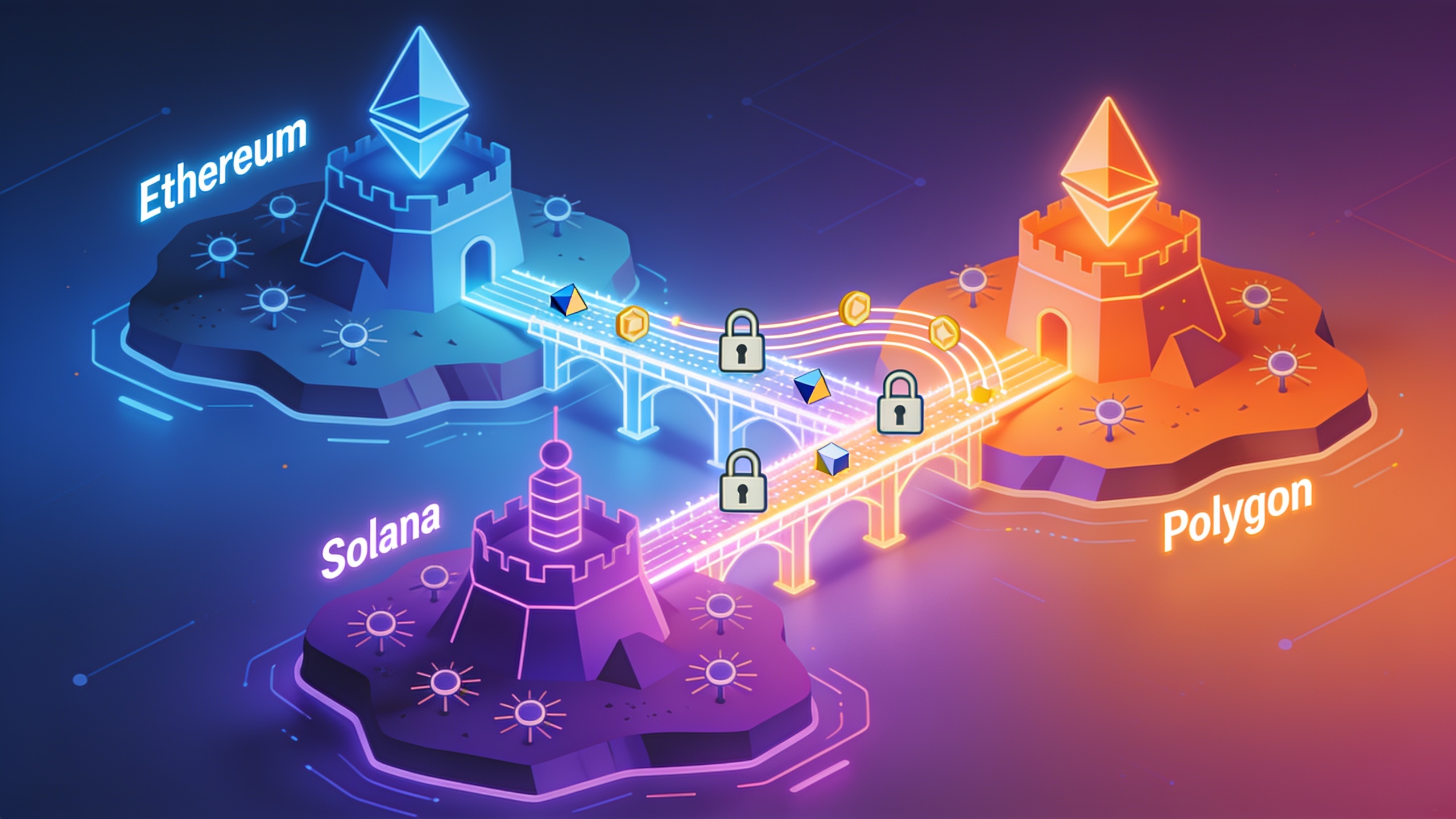
Ethereum, Solana, Polygon. All of them got built as their own little islands, each with its own rules, tokens, and validators. None of them were designed to talk to each other. A cross-chain bridge is the thing that fixes that. It's the piece of plumbing that lets assets and data hop between these otherwise disconnected networks, so you can do things like use Bitcoin inside an Ethereum app, or shuffle USDC from Ethereum over to Polygon without selling everything on an exchange and rebuying it on the other side.
And as DeFi spread out across dozens of chains, bridges became one of the most-used pieces of crypto infrastructure out there. They also became one of the most attacked, which is a big part of why we're writing this. So let's actually get into how these things work, why anyone bothered building them, the different flavors that exist, and the security stuff you really need to know before you send money across a chain.
Table of Contents
- What Is a Cross-Chain Bridge?
- Why Blockchain Interoperability Matters
- How Do Cross-Chain Bridges Actually Work?
- Types of Cross-Chain Bridges
- Popular Cross-Chain Bridges by Network
- What Are the Risks of Using a Cross-Chain Bridge?
- How to Use a Cross-Chain Bridge Safely
- The Future of Blockchain Interoperability
- FAQ
What Is a Cross-Chain Bridge?
A cross-chain bridge is a protocol that lets tokens, data, or messages travel from one blockchain to another, even though the two networks were never built to communicate in the first place. In practice, what usually happens is that an asset gets locked or burned on the chain you're leaving, and an equivalent version of it gets issued on the chain you're moving to.
Here's a concrete example. Say you want to use your Bitcoin inside some Ethereum DeFi protocol. You can't just send BTC to an Ethereum address and call it a day, because Bitcoin's blockchain and Ethereum's blockchain don't share a ledger, or a smart contract layer, or really anything at all. So a bridge steps in. It locks your original BTC in a vault or smart contract, then mints a "wrapped" version, Wrapped Bitcoin (WBTC), on Ethereum that tracks the locked asset's value one-to-one. Want your real BTC back later? You burn the wrapped token, the bridge unlocks the original coins, done.
Same idea whether the bridge connects Ethereum to Solana, Polygon, Arbitrum, Avalanche, or any of the dozens of other networks out there. Every blockchain is its own sovereign little kingdom with its own consensus rules, so the bridge is basically the translator and settlement clerk standing between them.
Why Blockchain Interoperability Matters
Blockchain interoperability is just the ability of separate networks to swap data and value without needing a centralized middleman, and it matters because crypto has splintered into dozens of chains that each hold their own liquidity, users, and apps. Without a way to connect them, your money and your activity get stuck on whatever chain you happened to start on. That's a real problem, both for regular users and for anyone trying to build something.
Ethereum is still the king of smart contract platforms by total value locked, no argument there. But when the network gets congested and fees go through the roof, people bolt. They head to Solana, which pushes way more transactions per second, or Polygon, which was purpose-built as a scaling layer for Ethereum. So you end up with this multi-chain reality where a single trader might be juggling assets across three or four networks at once, chasing the best yields, the lowest fees, or an app that only lives on one particular chain.
Bridges are the connective tissue that keeps this whole messy setup functional. They let liquidity flow to wherever it's actually needed instead of sitting trapped on one chain. They let developers build apps that pull assets or data from multiple ecosystems. And they let you spread your exposure across networks without constantly cashing out to fiat or routing everything through a centralized exchange like it's 2017.
If you want to understand how scaling solutions like Polygon and Arbitrum ease Ethereum's congestion in the first place, the breakdown on Layer 2 blockchain solutions and how they scale Ethereum digs into the rollup and sidechain mechanics that a lot of these bridges plug into.
How Do Cross-Chain Bridges Actually Work?
Technically speaking, a cross-chain bridge works by stitching together a smart contract on the source chain, another on the destination chain, and some kind of mechanism in the middle (validators, oracles, or relayers) that watches what happened on one chain and reports it to the other. Because blockchains genuinely can't "see" each other, that verification step is the hard part. It's the engineering problem every single bridge design has to wrestle with.
The Lock-and-Mint Process
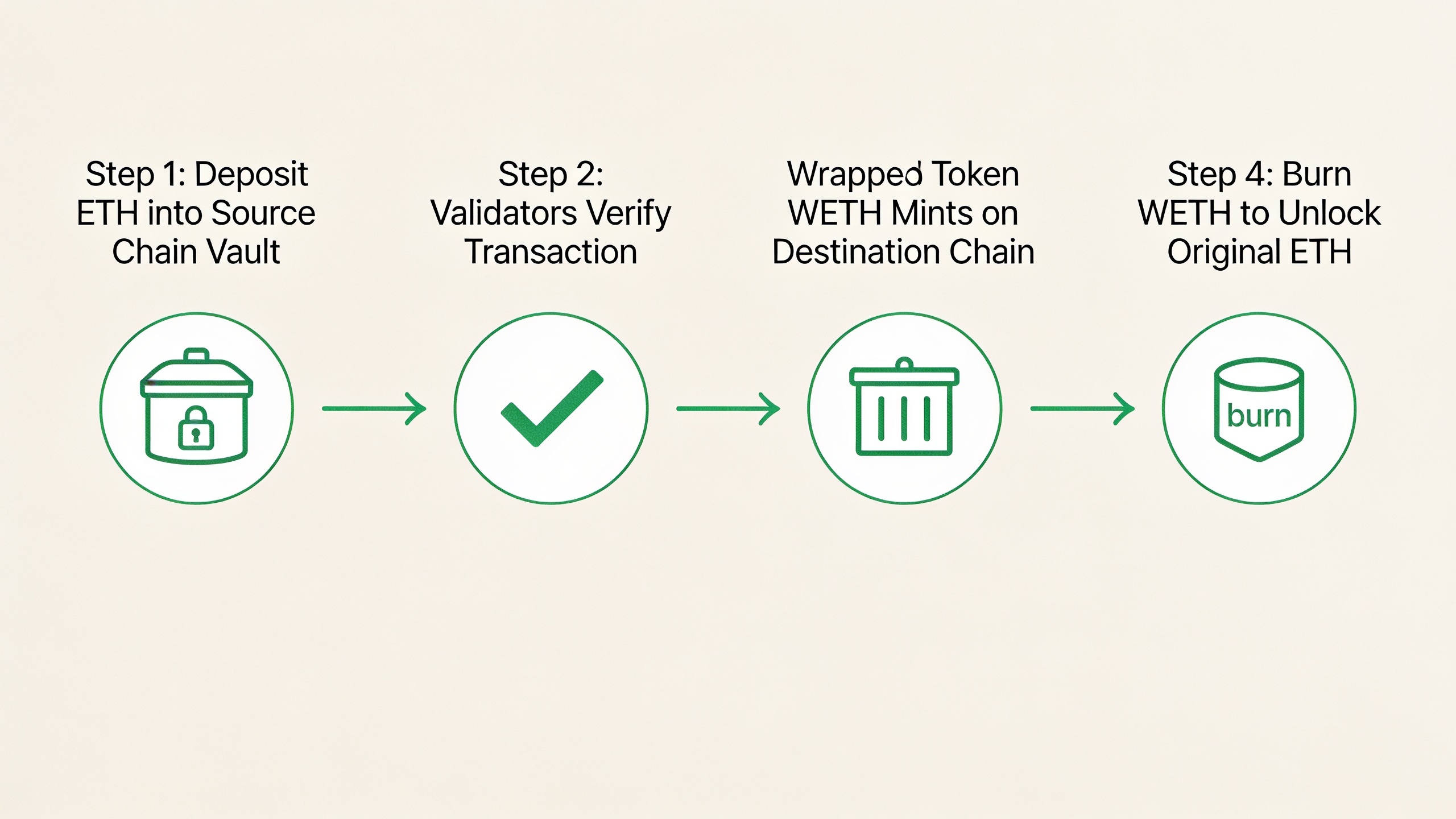
The most common model runs through four steps. First, you deposit your original asset, say ETH, into a smart contract or vault on the source chain. Then a set of validators, a multisig committee, or an oracle network confirms the deposit actually happened and wasn't reversed or double-spent somewhere. Once that checks out, an equivalent wrapped token gets minted on the destination chain and lands in your wallet there. And when you want to go home, you burn the wrapped token on the destination side, which triggers the release of your original locked asset back on the source chain.
That's it. Deposit, verify, mint, and eventually burn-and-release for the return trip.
Liquidity Pool Bridges
Some bridges skip the whole lock-and-mint dance entirely. Instead of creating a wrapped token, they keep pre-funded pools of assets sitting on both chains. Deposit something on Chain A, and the bridge just pays you the equivalent out of its existing pool on Chain B. No new token gets minted. Protocols like Stargate work this way, and the upside is speed, since nobody's waiting around for a wrapped token to appear. The catch? It only works as long as the bridge keeps enough liquidity stocked on every chain it touches.
Message-Passing and Oracle-Based Bridges
The fancier bridges don't just shuffle tokens around. They pass actual messages between chains, so a smart contract on Polygon could, for example, trigger some action over on Ethereum. These general message-passing bridges (think LayerZero, or Wormhole's messaging layer) lean on relayers to carry the data and oracles or validator networks to independently vouch that the data is legit before the destination chain acts on it.
Honestly, all of this is a lot easier to grasp once you can read the underlying transaction data yourself. The guide on reading blockchain data like a pro through on-chain analytics walks through how every locked deposit, every minted token, and every validator signature leaves a permanent, public trail that analysts use to audit what a bridge is really doing.
Types of Cross-Chain Bridges
Bridges usually get sorted by how much trust they force you to hand over to a third party, running the gamut from fully trustless setups to bridges basically babysat by a tiny group of custodians. This trust spectrum is one of the single most important things to weigh, because it maps almost directly onto how much risk you're taking on.
| Bridge Type | How It Verifies Transfers | Trust Required | Typical Speed | Example Use Case |
|---|---|---|---|---|
| Trusted/Custodial Bridge | A centralized entity or small multisig holds custody of locked funds | High — relies on operator honesty | Fast | Exchange-operated bridges, some wrapped-asset issuers |
| Federated/Multisig Bridge | A fixed group of validators must reach consensus to approve transfers | Medium — relies on validator set integrity | Moderate | Many early cross-chain token bridges |
| Liquidity Pool Bridge | Pre-funded pools on each chain pay out equivalent assets | Medium — relies on pool solvency and code security | Fast | Stargate-style asset swaps |
| Light-Client/Trustless Bridge | Destination chain independently verifies source-chain proofs via light clients | Low — minimizes reliance on external validators | Slower, more computation-heavy | IBC (Cosmos ecosystem) transfers |
| Oracle/Relayer Bridge | External oracle networks and relayers attest to cross-chain events | Medium — relies on oracle network security | Fast | General message-passing protocols |
There's no universal "best" design here, and anyone who tells you otherwise is selling something. Trustless light-client bridges cut down on your reliance on outsiders, but they're genuinely hard to build between chains that are architecturally nothing alike, like Ethereum and Solana. Federated and liquidity-pool bridges are much quicker to spin up across a bunch of chains, but they cram all the risk into a validator set or the security of a pile of pooled funds. Pick your poison.
Popular Cross-Chain Bridges by Network
Every blockchain ecosystem has basically grown its own go-to bridging solution shaped around its architecture. Ethereum-Polygon transfers, for instance, usually go through the official Polygon Bridge, which uses a plasma or PoS-checkpoint mechanism to move assets across. Ethereum-Solana transfers, on the other hand, tend to route through third-party bridges like Wormhole, which relies on a network of "guardian" validators to attest to messages jumping between the chains.
Avalanche, Arbitrum, and Optimism each run their own native bridges tuned to their specific rollup or subnet setup, while the big multi-chain aggregator bridges try to support dozens of networks at once through a shared messaging layer. The tradeoff is pretty simple, really. Native, chain-specific bridges are usually simpler and hug their chain's security model more tightly. Broad multi-chain bridges give you convenience and reach, but at the cost of way more complexity in their validation logic. And that complexity, as we're about to get into, has been a favorite hunting ground for attackers.
What Are the Risks of Using a Cross-Chain Bridge?
The single biggest risk with any cross-chain bridge is smart contract or validator compromise, because bridges tend to sit on enormous piles of locked collateral in one spot, which makes them irresistible targets. Bridges have collectively racked up some of the largest hacks in crypto history, and to understand why, you have to look at where the trust and the code complexity actually live.
Smart Contract Exploits
Bridges are seriously complicated software. They have to correctly interpret events across two or more totally different blockchain codebases, which is not a forgiving job. One flaw in how a contract verifies a deposit or a signature, and an attacker can mint unlimited wrapped tokens without ever putting up a cent of real collateral. That's not hypothetical. The Wormhole bridge connecting Solana and Ethereum got drained for roughly $325 million in February 2022 after an attacker figured out how to forge signature verification and mint wrapped ETH out of thin air, no backing collateral required.

Validator or Multisig Compromise
A bridge that leans on a small validator set or a multisig wallet is only ever as secure as that set. Which brings us to the Ronin Bridge, the one connecting the Ronin sidechain (Axie Infinity's home) to Ethereum. It got hit in March 2022 for around $625 million after attackers grabbed control of a majority of the validator signatures needed to approve withdrawals. At the time, that was one of the largest crypto hacks ever recorded. Ouch.
Economic and Liquidity Risk
You don't even need a hack to run into trouble. Liquidity pool bridges can hit situations where one side of a pool gets drained faster than it refills, leaving you with painful slippage or, worse, no way to withdraw for a while. Wrapped assets carry a quieter risk too: their value hangs entirely on the bridge's ability to honor redemptions. If the collateral behind them gets compromised, the wrapped token can basically turn into worthless paper even while it's still merrily trading on exchanges.
Centralization Risk
Plenty of bridges love to call themselves decentralized when, in reality, a handful of entities control the upgrade keys, the multisig signers, or the oracle nodes. That's a governance risk, plain and simple. A compromised admin key or one malicious insider can blow right past the bridge's normal security assumptions. That's roughly what went down in the Poly Network incident in August 2021, where an attacker exploited a contract vulnerability to move around $611 million across multiple chains, before, in a genuinely bizarre twist, giving most of it back.
How to Use a Cross-Chain Bridge Safely
Cutting down on bridge risk starts with treating every transfer like a security decision, not just another click. Bridges vary wildly in design and track record, so a few habits go a long way.
Check the bridge's audit and incident history first. A protocol that's been independently audited and has run for years without an exploit is a completely different animal from some brand-new, unaudited thing dangling suspiciously fat incentives in your face. When you can, lean on official or native bridges. The one built and maintained by the destination chain's own core team (the official Arbitrum or Polygon bridge, say) usually gets more scrutiny and integrates more tightly than the random third-party alternatives nobody's heard of.
Don't dump an enormous chunk of your holdings through a single bridge either. Splitting big transfers up, or spreading them across different bridges, limits how badly you get burned if one gets compromised. It's worth glancing at validator and TVL concentration too. A bridge secured by just a few validators, or one holding a wildly outsized share of value relative to its actual track record, is a juicier target and you should treat it that way.
And please, confirm contract addresses straight from the official project docs, not from search results or some link a stranger dropped in a Telegram group. Phishing sites cloning bridge interfaces are everywhere, and they're good at it.
If you'd rather verify a bridge's activity yourself instead of just trusting its own shiny dashboard, the same investigation techniques from the on-chain analytics guide let you check how much collateral a bridge actually holds against how many wrapped tokens it's issued. That gap is often where the story is.
The Future of Blockchain Interoperability
The whole trajectory of blockchain interoperability is drifting away from isolated, one-off bridges and toward shared messaging standards that lots of chains and apps can build on top of. Instead of every chain needing a bespoke bridge to every other chain (which is exactly the fragmented mess we have now), protocols like Cosmos's Inter-Blockchain Communication (IBC) standard and the general message-passing frameworks are trying to create a common language any compliant chain can speak securely.
Why should you care? Because it could replace this hack-prone patchwork of custom bridges with standardized, far more heavily audited infrastructure. Meanwhile, the rise of Layer 2 networks built directly on Ethereum, many of which inherit a chunk of Ethereum's own security guarantees rather than trusting some external bridge validator set, is quietly changing how much bridging risk you even need to take on in the first place. If you want the deeper mechanics of how those Layer 2 systems shrink the need for external bridges, they're covered in the guide to Layer 2 blockchain solutions scaling Ethereum.
FAQ
Wait, isn't a cross-chain bridge just a crypto exchange?
Nope, different beast. A centralized exchange lets you swap one asset for another inside its own custodial walls. A bridge actually moves an asset (or a wrapped stand-in for it) from one independent blockchain to another. Some exchanges bolt on bridging features, sure, but the underlying machinery is nothing like a normal trade.
What actually happens to my original tokens when I bridge?
In a lock-and-mint bridge, your original tokens get locked up in a smart contract or vault on the source chain while a wrapped equivalent is minted on the destination chain. They're not destroyed. They just sit there locked until you bridge back and burn the wrapped version, which springs them loose.
Why do bridges keep getting hacked?
Because they pile up huge amounts of locked value in a single smart contract or validator set, and then they need seriously complex code to correctly verify what's happening across two totally different blockchain systems. High-value target plus complicated, less battle-tested code equals a magnet for attackers. The receipts are ugly: the Ronin Bridge hack (~$625 million, March 2022), the Wormhole hack (~$325 million, February 2022), and the Poly Network exploit (~$611 million, August 2021).
Is a wrapped token like WBTC as safe as holding the real thing?
That depends entirely on whether the bridge or custodian is actually backing it with real, verifiable collateral, and on how secure the smart contracts managing that collateral are. If the bridge underneath gets compromised or turns out to be under-collateralized, the wrapped token can lose its peg no matter how well the original asset is doing. The wrapper is only as good as what's behind it.
Do I even need a bridge to use DeFi on other chains?
Usually, yeah, unless you already hold native assets on that chain or you use a centralized exchange to withdraw funds straight to the target network. Bridges are still the main way to move existing on-chain assets between ecosystems like Ethereum, Solana, and Polygon without handing everything to a centralized middleman.
Bridges have become essential infrastructure for a crypto industry that never picked one blockchain and stuck with it. But they're also one of the most technically demanding and most exploited pieces of the whole stack. Getting a handle on the mechanics (lock-and-mint, liquidity pools, validator verification) and treating every single bridge transaction with the same paranoia you'd bring to any other security-sensitive move, that's the difference between informed cross-chain activity and just handing your money to whoever hacks the bridge next.