Blockchain Technology Explained: How It Powers Crypto
Ever wonder how Bitcoin transactions get verified without a bank sitting in the middle? Or how an Ethereum smart contract just... executes itself, no lawyer required? Both of those questions are...


Ever wonder how Bitcoin transactions get verified without a bank sitting in the middle? Or how an Ethereum smart contract just... executes itself, no lawyer required? Both of those questions are really the same question wearing different hats: how does this blockchain thing actually work?
That's what I want to unpack here. Not the marketing-brochure version where every sentence ends with "revolutionizing the future," but the actual mechanics. The stuff underneath the hype. Whether you're an investor trying to figure out what you're really buying, or you're just a curious person who's tired of nodding along at dinner parties, this should give you enough to hold your own.
Because blockchain isn't just a word bolted onto Bitcoin. It's a way of building a database that solves a problem people have been wrestling with forever: how do you get a bunch of strangers to trust the same set of records without appointing one boss to keep them? By the time you finish reading, you'll get the core mechanics, the main consensus models (yes, there's more than one, and no, they're not all the same), and where the whole thing seems to be heading.
Table of Contents
- What Is Blockchain Technology?
- How Blockchain Works: The Technical Foundations
- Decentralization: Why It Matters
- Consensus Mechanisms Explained
- How Blockchain Powers Cryptocurrencies
- Real-World Applications Beyond Crypto
- Challenges and Limitations of Blockchain
- The Future of Blockchain Technology
- Frequently Asked Questions
What Is Blockchain Technology, Really?
Strip away the jargon and a blockchain is just a shared ledger. A record of transactions that lives on a bunch of computers at once instead of on one company's server. Your bank keeps its records in a private database that you have to trust. Blockchain flips that. Thousands of independent machines around the world each hold an identical copy, and they constantly check each other's work.
Here's the "block" part. Transactions get bundled together into a batch, stamped with a time, and given a cryptographic fingerprint (a hash) that also references the fingerprint of the block before it. String enough of these together and you get a chain where every link points back to the last one. That's why tampering is such a nightmare. Change one old block and its fingerprint changes, which breaks the link to the next block, which breaks the next... you'd basically have to rewrite the entire chain across most of the network at the same time. Good luck with that.
The whole idea went mainstream in 2008, when someone (or some group) using the name Satoshi Nakamoto dropped a whitepaper describing Bitcoin as "a peer-to-peer electronic cash system." But the cryptographic bones of it? Researchers were kicking around the concept of linking timestamped blocks as far back as 1991. What Nakamoto actually pulled off was gluing that structure to economic incentives and a decentralized network, and in doing so, cracking the "double-spending problem" nobody had solved without a middleman.
Fast forward to now and there are well over a thousand active blockchain networks floating around, per the usual trackers like CoinMarketCap and CoinGecko. Some are dead simple payment ledgers. Others are full-blown programmable platforms. And a lot of them, honestly, are junk. But that's a different article.
How Blockchain Works: The Technical Foundations
If you want to actually understand how blockchain works, it helps to break it into four moving parts: blocks, nodes, hashing, and keys. None of them are that complicated on their own. It's how they fit together that's clever.
Blocks and chains. Every transaction waits in a kind of holding pen until it gets scooped into a block along with a bunch of other pending ones. Bitcoin blocks max out somewhere around 1 to 4 MB depending on the transaction types crammed inside. Once a block is full and validated, it gets bolted onto the chain permanently, carrying a reference to the block before it. And that's the chain part. Not exactly rocket science, but the sequencing is what makes the whole thing tamper-evident.
Nodes. A node is just a computer running the network's software. The heavy-duty ones, full nodes, store the entire history of the ledger going all the way back. As of 2024 Bitcoin had somewhere north of 15,000 reachable full nodes scattered across pretty much every country on earth. That's the part people underestimate. There's no plug to pull. No single server room to raid. To kill the network you'd have to knock out thousands of machines at once, everywhere, simultaneously.
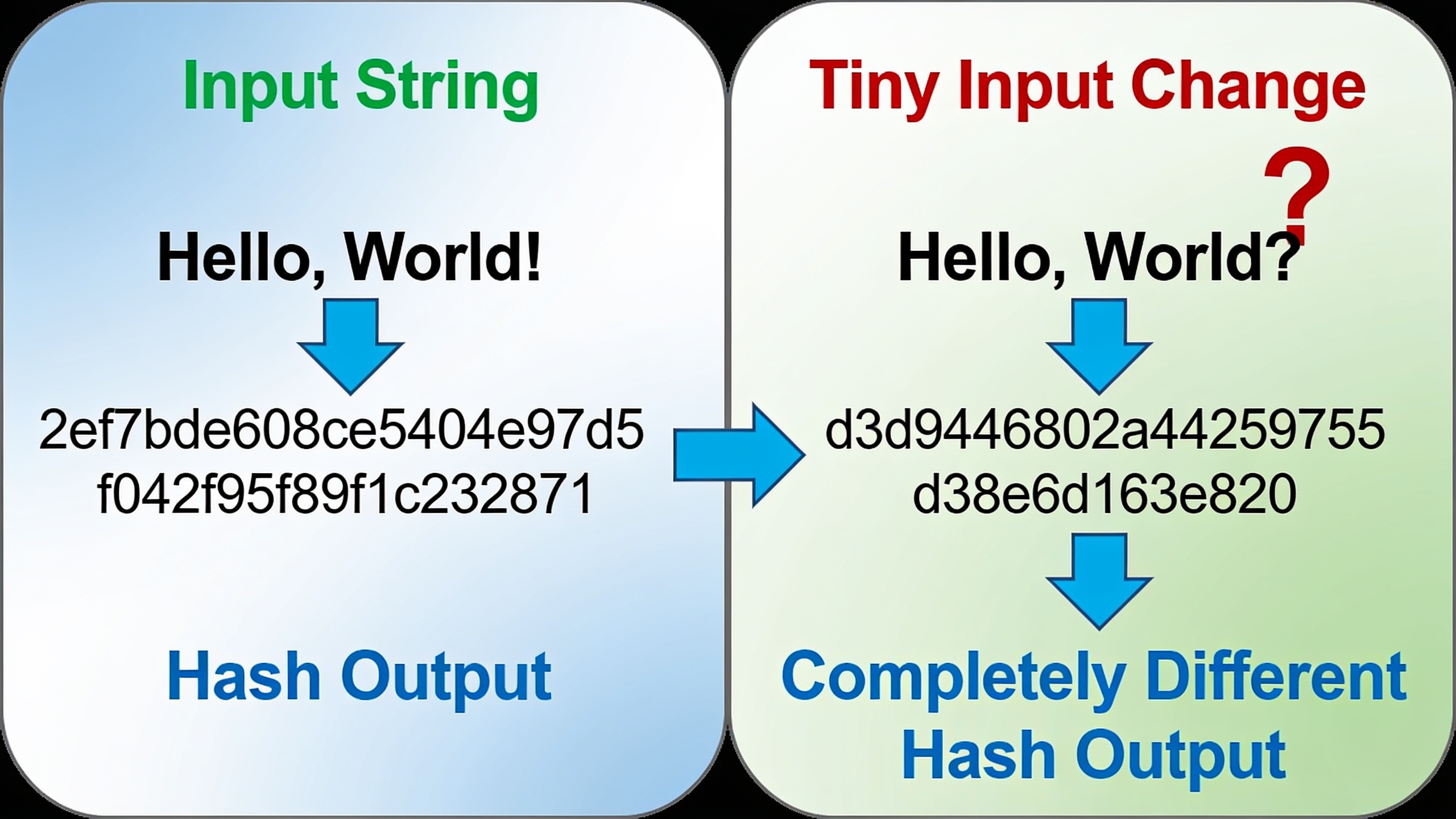
Then there's the cryptography, which is where it gets genuinely elegant. Hashing algorithms like Bitcoin's SHA-256 take any input, a word, a whole book, a transaction, and spit out a fixed-length string of characters. The magic is that even a microscopic change to the input produces a completely different output. So if some clever crook tries to quietly edit an old transaction, the hash changes, the chain breaks, and the network notices instantly. Tampering isn't just hard. It announces itself.
And finally, keys. Every user has a public key (think of it as your account address, fine to share) and a private key (basically your password, guard it with your life). You sign transactions with your private key, and everyone else verifies them with your public key. It's asymmetric cryptography doing the work, and the upshot is that only the rightful owner can move their coins. Lose that private key, though, and your funds are gone forever. No customer service line. That trips up a lot of newcomers.
Decentralization: Why It Matters
Decentralization is the whole point. It's the reason blockchain exists in the first place. Instead of trusting a bank or a government or some corporation to be the referee, control gets spread across everyone participating in the network. Nobody's in charge, which sounds chaotic but is actually the feature, not the bug.
Why does that matter in practice? A few reasons. There's censorship resistance, which is a fancy way of saying no single entity can freeze your account or block your transaction on a whim. That's not a hypothetical perk either. It's exactly why blockchain caught on fast in places with shaky banking systems or aggressive capital controls. There's also the fact that you're not putting all your eggs in one basket. Traditional centralized databases are a single juicy target, and when one gets breached it's expensive. IBM Security pegged the average cost of a data breach at $4.45 million back in 2023. Spread the data across thousands of nodes and there's no single door to kick in.
Oh, and transparency. On public chains like Bitcoin and Ethereum, anyone can audit the transaction history in real time. That kind of open-book accounting is basically unheard of in traditional finance.
But I don't want to oversell it. Decentralization isn't a yes-or-no switch, it's a slider. Some networks are wildly decentralized, others are decentralized in name only. And where a project sits on that slider directly affects its security, its speed, and who really calls the shots. Developers even have a name for the tug-of-war: the "blockchain trilemma," the frustrating reality that you can optimize for decentralization, security, or scalability, but nailing all three at once is really, really hard.
| Blockchain Type | Decentralization Level | Speed | Common Use Case |
|---|---|---|---|
| Bitcoin | Very High | Slow (~7 TPS) | Store of value, payments |
| Ethereum | High | Moderate (~15-30 TPS) | Smart contracts, DeFi |
| Solana | Moderate | Fast (~2,000-3,000 TPS) | High-speed trading, NFTs |
| Private/Enterprise Blockchains | Low | Very Fast | Supply chain, internal records |
Consensus Mechanisms Explained
Okay, so if there's no boss verifying transactions, how does the network agree on what's true? This is where consensus mechanisms come in, and honestly it's the most brilliant part of the whole design. These are the rules that let a pile of computers that don't know or trust each other still arrive at the same answer.
There are two big ones you need to know, plus a handful of variations.
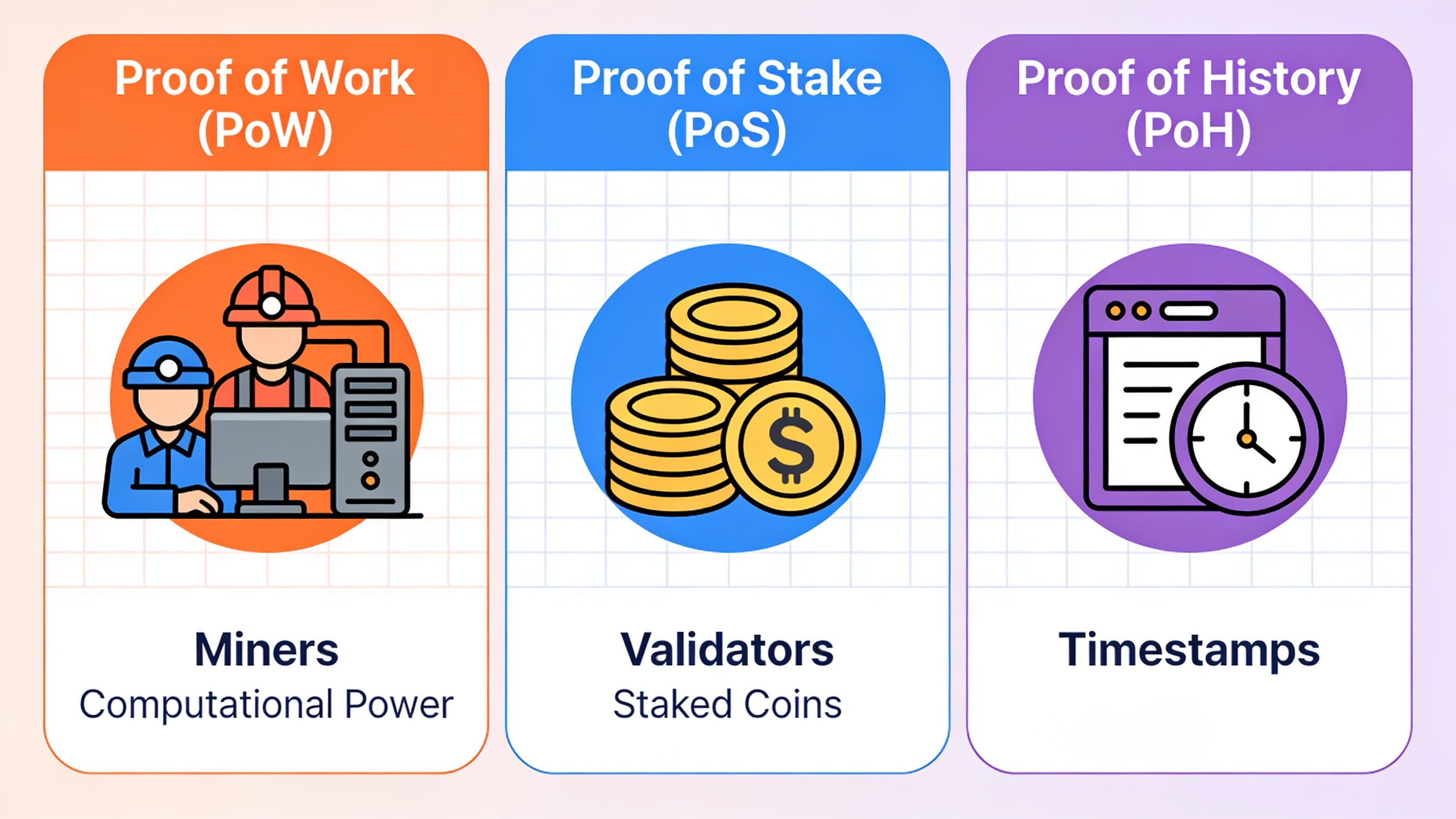
Proof of Work is the OG, the one Bitcoin uses. Miners burn through computational power racing to solve a fiendishly hard math puzzle. Whoever cracks it first gets to validate the block and pockets a reward, currently 3.125 BTC per block after the 2024 halving, plus whatever transaction fees are attached. The catch is that all this puzzle-solving eats an absurd amount of electricity. The Cambridge Bitcoin Electricity Consumption Index puts Bitcoin's annual usage somewhere around 120 to 150 terawatt-hours, which is in the same ballpark as a mid-sized country. So yeah, PoW is battle-tested and ridiculously secure. It's also slow and a power hog. Pick your tradeoff.
Proof of Stake takes a totally different route. Ethereum famously switched from PoW to PoS in September 2022, an event everyone called "The Merge," and it slashed the network's energy use by something like 99.95% according to the Ethereum Foundation. That's not a typo. Instead of burning electricity, validators lock up their own crypto as collateral. The network randomly picks who gets to confirm the next block, and if a validator tries to cheat, they lose their staked money. Slashing, it's called. Brutal but effective. PoS is faster and vastly greener, though critics point out it can tilt power toward whoever already holds the most coins. The rich get more validating power, which rubs some people the wrong way. I get the concern, though in practice it hasn't been the disaster some predicted.
There are other flavors too. Delegated Proof of Stake (used by networks like EOS) lets token holders vote for delegates who validate on their behalf, kind of like electing representatives. Solana runs something called Proof of History, which timestamps transactions before consensus even happens and lets it hit ridiculous speeds. And in the enterprise world you'll find Practical Byzantine Fault Tolerance, which trades away full decentralization for raw speed. Different tools for different jobs.
How Blockchain Powers Cryptocurrencies
Cryptocurrencies are basically apps running on blockchain rails. That's the relationship in one sentence. The coin is the software, the blockchain is the operating system underneath.
Say you send some Bitcoin to a friend. What actually happens is roughly this. You sign the transaction with your private key. It gets broadcast out to the network of nodes. Miners (or validators, depending on the chain) scoop it into a candidate block. The consensus mechanism decides which block gets added next. Once it's confirmed, it becomes a permanent part of the ledger. And then your balance updates across every full node on the planet, usually within about ten minutes for Bitcoin, or a few seconds on faster chains like Solana.
Notice what's missing from that list? A bank. There's no intermediary verifying and settling things, no correspondent banks passing your money down a chain and skimming fees at each stop, no three-day wait for an international transfer to clear. That's the part that felt like magic to people the first time they used it.
Then Ethereum came along and raised the stakes with smart contracts. These are little programs that live on the blockchain and run exactly as written, no downtime, no censorship, no third party able to reach in and mess with them. That one idea spawned entire universes. Decentralized finance (DeFi) had over $50 billion locked up as of early 2025 per DeFiLlama. NFTs happened. So did DAOs, organizations run by token-holder voting instead of a boardroom. Some of it is genuinely useful. Some of it was a bubble. But the underlying tech is real.
Real-World Applications Beyond Crypto
People forget that crypto is just the most visible use of blockchain, not the only one. The plumbing works for all kinds of things that have nothing to do with coins.
Take supply chains. Walmart and Maersk have both built blockchain tracking systems to follow products from origin to shelf. My favorite example is IBM's Food Trust experiment: during a pilot, tracing a package of mangoes from farm to store dropped from seven days to 2.2 seconds. Seven days to two seconds. When there's a contamination scare and you need to find the source now, that difference is enormous.
Healthcare is another one. Fragmented, siloed patient records cost the system billions every year (a 2022 study in the Journal of Medical Internet Research dug into this), and blockchain offers a way to make records secure and shareable across providers without turning privacy into swiss cheese. It's promising, though I'll admit adoption here has been slower than the pitch decks suggested.
Voting has been tried too. West Virginia ran a blockchain-based mobile voting pilot back in 2018 for overseas military personnel, aiming for transparency and fraud resistance while keeping ballots anonymous. Real estate folks are looking at it for recording property history and cutting down on title fraud, which could shave layers of paperwork off closings. And creatives, musicians, artists, writers, are using it to timestamp original work and automate royalty payments through smart contracts, so they actually get paid when their stuff sells instead of waiting months for some label's accounting department to cut a check.
Do all of these need a blockchain? Honestly, no. Some of these projects could've used a regular database and saved themselves the trouble. But the ones where trust between multiple parties really matters? That's where it earns its keep.
The Annoying Parts (And How People Are Dealing With Them)
I'd be doing you a disservice if I only talked up the good stuff. Blockchain has real problems, and anyone serious about investing or building should know them.
Scalability is the big one. Public chains are slow compared to the centralized systems we're used to. Visa handles something like 24,000 transactions per second. Bitcoin does about 7. That's a chasm. The fix everyone's betting on is Layer-2 solutions, things like Bitcoin's Lightning Network and Ethereum's rollups (Arbitrum, Optimism, that crowd), which process transactions off the main chain and then settle them back. They're getting better, but it's still a work in progress.
Energy is another sore spot, at least for Proof of Work. The environmental criticism is fair, though the shift toward PoS and renewable-powered mining is chipping away at it. Then there's regulation, which is a mess. Governments are still scrambling to figure out how to handle all this. The EU's MiCA framework, fully in effect by the end of 2024, is one of the more serious attempts, while U.S. rules remain scattered across a tangle of agencies (the SEC and CFTC keep tripping over each other). And user experience? Ugh. Managing private keys, decoding gas fees, figuring out which wallet won't lose your money, it's still genuinely intimidating for normal people, and that friction slows everything down.
Last thing: interoperability. Different blockchains mostly can't talk to each other natively, so you get these walled-off islands. Cross-chain bridges try to connect them, but they've been a hacker's playground. Chainalysis reported over $2 billion stolen from bridge exploits between 2021 and 2023. That's not a rounding error. It's one of the ugliest ongoing problems in the space.
The Future of Blockchain Technology
So where's all this going? A few things stand out.
Big money is showing up. The SEC approved spot Bitcoin ETFs in January 2024, and they pulled in over $35 billion in net inflows in their first year according to Bloomberg. Whatever you think of ETFs, that's Wall Street voting with its wallet. Meanwhile Layer-2 scaling keeps maturing, slowly solving the throughput problem that's kept blockchain from being practical for everyday coffee-buying payments.
The one I find most interesting is tokenizing real-world assets, taking physical things like real estate, bonds, and commodities and representing them as tokens on-chain. Boston Consulting Group thinks that could balloon into a $16 trillion market by 2030. Even if they're off by half, that's a staggering number. And central banks aren't sitting still either. Over 130 countries are researching or piloting Central Bank Digital Currencies, per the Atlantic Council's tracker, which is a fascinating (and slightly ironic) twist given that crypto started as a rebellion against central banks.
For anyone following along on platforms like Cryptocoinsjournal, keeping up with this stuff isn't just trivia. It's how you avoid making dumb decisions in a world that's getting more blockchain-shaped by the year.
Frequently Asked Questions
Wait, is blockchain the same thing as cryptocurrency?
Nope, and this trips up a lot of people. Blockchain is the underlying tech, the distributed ledger. Cryptocurrency is just one thing built on top of it. The same tech also powers supply chain tracking, medical records, voting pilots, and more.
Can someone reverse or hack my blockchain transaction?
Once it's confirmed and locked into the chain, reversing it is extremely difficult thanks to the cryptographic linking and network consensus. There's a theoretical exploit called a "51% attack," where one party controls a majority of the network's power, but pulling that off on a giant like Bitcoin would cost more than you'd ever gain. On tiny obscure chains? Different story.
Why do some transactions take forever and others clear instantly?
Comes down to the consensus mechanism, how congested the network is, and block size limits. Bitcoin averages about ten minutes per block. Solana confirms in under a second. Different design philosophies, different speeds.
Do I actually need to understand blockchain to invest in crypto?
Strictly speaking, no. Plenty of people ape in without a clue. But understanding how it works lets you actually evaluate a project, its decentralization, its security tradeoffs, whether it does anything useful, instead of just gambling on price charts. I'd argue it's the difference between investing and guessing.
What's the deal with public versus private blockchains?
Public ones (Bitcoin, Ethereum) are open to anyone. Join, watch, validate, whatever. Private or "permissioned" blockchains lock things down to approved participants, which companies like because they get speed without the messiness of full decentralization.
---
Blockchain went from a weird cryptography experiment to actual infrastructure reshaping finance, supply chains, healthcare, and even how we might vote someday. Once you understand the core pieces, decentralization, consensus, and the cryptography holding it all together, you stop being at the mercy of hype cycles and Twitter hot takes. And as the money keeps pouring in and the tech keeps creeping into more industries, that understanding is only going to matter more.
You Might Also Find Useful
- Cryptocoinsjournal - Stay updated with in-depth news, market analysis, and educational content on cryptocurrencies and blockchain technology.
- Viviendalista - Browse comprehensive real estate listings and tools to help you find your next home purchase or rental.
- LauDib - Learn realistic pencil portrait drawing step by step or commission a personalized custom portrait through this creative art brand.