Blockchain Technology Explained: How It Powers Crypto
Blockchain went from being this obscure computer science idea that basically nobody outside of a few forums cared about to becoming the foundation of a multi-trillion-dollar industry. And if you're...


Blockchain went from being this obscure computer science idea that basically nobody outside of a few forums cared about to becoming the foundation of a multi-trillion-dollar industry. And if you're trying to understand why Bitcoin (or any of the thousands of other coins out there) actually works, you kind of have to understand blockchain first. There's no way around it.
The thing people miss is that blockchain isn't just crypto marketing fluff. It's a genuinely clever way to record, verify, and move value around without needing a bank or a government sitting in the middle taking a cut and telling you what you can and can't do with your own money.
The numbers back this up, too. Grand View Research pegged the global blockchain market at over $17 billion back in 2023, and they're projecting it'll grow more than 85% a year through 2030. That's absurd growth, honestly. And it's not just crypto driving it. Finance, supply chains, healthcare, all of it is starting to lean on this stuff. So let's actually get into how it works, why it matters if you're putting money into crypto, and where the whole thing might be headed.
Table of Contents
- What Is Blockchain Technology?
- How Blockchain Works: The Core Mechanics
- Blockchain and Cryptocurrency: The Symbiotic Relationship
- Types of Blockchain Networks
- Consensus Mechanisms Explained
- Real-World Applications Beyond Crypto
- Challenges and Limitations of Blockchain Technology
- The Future of Blockchain Technology
- Frequently Asked Questions
So What Actually Is Blockchain?
Strip away the jargon and blockchain is basically a shared digital ledger. A record of transactions that lives across a whole network of computers instead of on one company's server. Regular databases have an owner, some entity that controls everything and can change whatever they want. A blockchain doesn't work like that. Copies of the ledger get spread across thousands (sometimes millions) of computers, called nodes, all over the world.
Each "block" is just a batch of verified transactions. When a block fills up, it gets cryptographically chained to the block before it, forming this continuous chronological record. That's where the name comes from, and it's also where the magic is. Because once something's recorded and the network confirms it, changing it would mean rewriting every block that came after it, across a majority of nodes, all at the same time. On any established blockchain, that's just not happening. The math makes it practically impossible.
This whole idea showed up in 2008, when someone (or some group) calling themselves Satoshi Nakamoto dropped the Bitcoin whitepaper. Nobody knows who they really are, which is its own rabbit hole. But that paper cracked a problem people had been stuck on for years: how do you stop someone from spending the same digital dollar twice without a central authority checking the books? Blockchain solved it.
What Makes It Different From a Regular Database
A few traits set blockchain apart, and they all sort of feed into each other. There's decentralization, which just means no single party runs the show. There's transparency, since most public blockchains let anyone poke around and view transaction history whenever they want. There's immutability, the fact that recorded data is really hard to alter or delete. And there's the security that comes from cryptography protecting both the data and people's identities.
Put those together and you get what folks call a "trustless" system. Which sounds ominous but actually means the opposite. You don't have to trust the other person or some middleman. You just trust the protocol and the math. And math doesn't play favorites.
How Blockchain Actually Works, Step by Step
The cryptography under the hood can get genuinely hairy, but the overall flow? Pretty intuitive once you see it walked through. Let me lay it out.
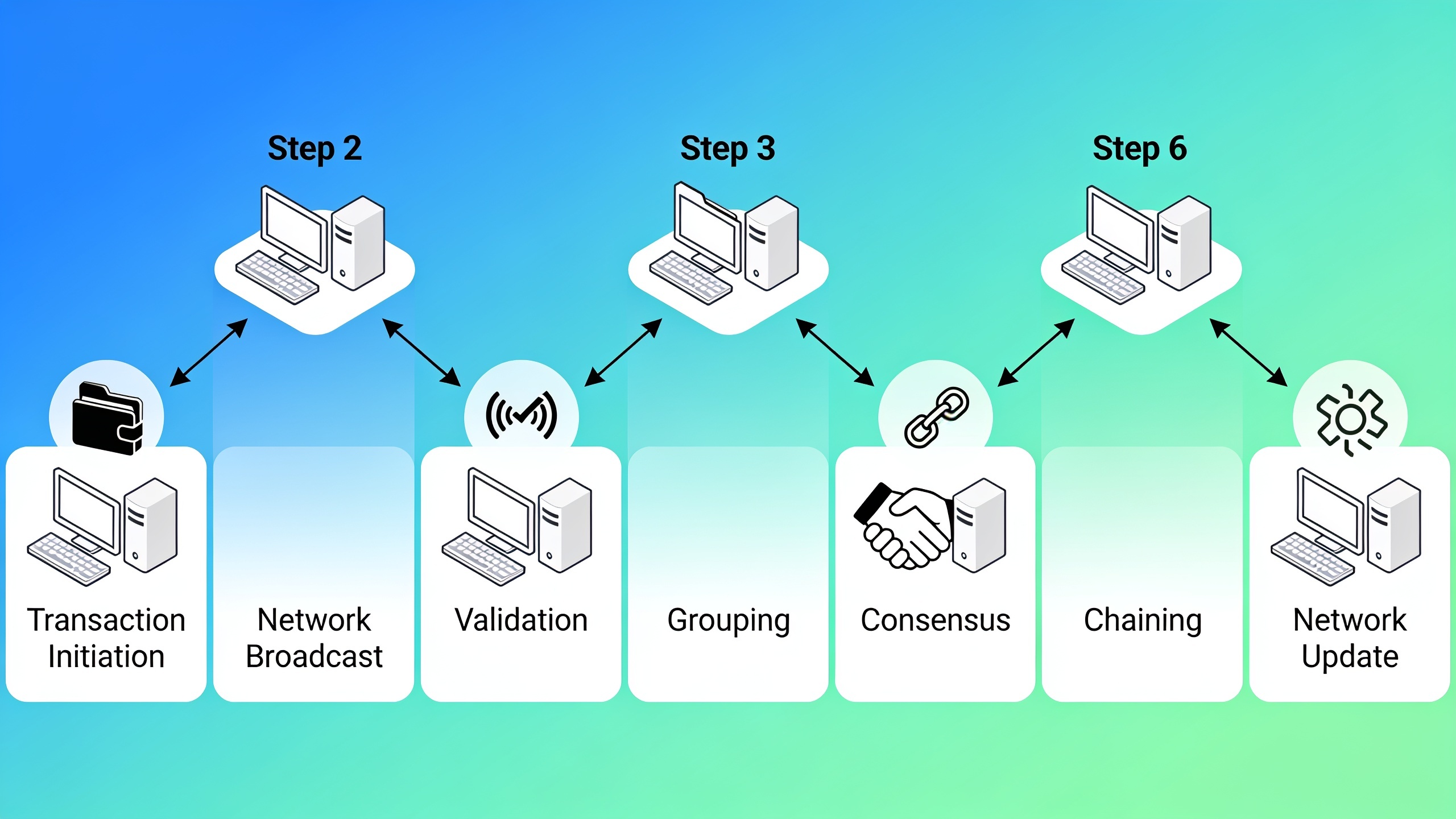
Step 1: You start a transaction. Say you're sending Bitcoin to someone. Your transaction bundles up your address, their address, the amount, and a digital signature you create with your private key.
Step 2: It gets broadcast to the network. Your transaction goes out to a peer-to-peer web of nodes, which are just computers running the blockchain software and keeping copies of the ledger.
Step 3: Validation. The nodes check your transaction against the protocol's rules. Do you actually own the funds? Is your signature legit? If something's off, the transaction gets tossed. No appeals.
Step 4: Grouping. Valid transactions get bundled into a block by miners or validators, depending on how that particular blockchain does things.
Step 5: Consensus. Before that block joins the chain, the network has to agree it's legit. This is where consensus mechanisms come in, and I'll get to those in a minute because they're honestly the most interesting part.
Step 6: Chaining it up. Once everyone agrees, the new block gets cryptographically linked to the previous one using a hash function, which is basically a math algorithm that squishes any data into a fixed-length string of characters. Each block carries the hash of the block before it. That's the "chain" part.
Step 7: Everyone updates. The new ledger gets pushed out to every node, so the whole network stays in sync.
How long does all this take? Depends. Bitcoin cranks out a new block roughly every 10 minutes, which feels glacial by modern standards. Solana, on the other hand, can wrap up a transaction in under a second. Big spread.
Blockchain and Crypto: They Kind of Need Each Other
Cryptocurrencies wouldn't exist in the form we know them without blockchain. And weirdly, blockchains often wouldn't survive without crypto either. It's a two-way street.
Here's the deal. Blockchain is the infrastructure, the public record-keeping machine. Cryptocurrency is the native asset that bribes people (in a good way) to keep that machine running. When miners or validators do the work of processing transactions and adding blocks, they get paid in freshly minted coins or transaction fees. That reward loop is what keeps the lights on without any central bank or corporation footing the bill. Elegant, when you think about it.
Bitcoin came first, but the tech didn't sit still. Ethereum launched in 2015 and brought smart contracts to the party. Those are little self-executing programs that live on the blockchain and enforce agreements automatically, no lawyer or escrow agent required. That single idea cracked open the whole world of DeFi, NFTs, and thousands of decentralized apps. Some people love that stuff, some think half of it is nonsense. Probably both are right.
As of 2024, CoinMarketCap tracks north of 23,000 cryptocurrencies. Most run on some flavor of blockchain. Some have their own independent chains (Bitcoin, Ethereum), while a ton of others are just tokens riding on top of an existing chain, like all those ERC-20 tokens built on Ethereum.
If you're following sites like Cryptocoinsjournal and trying to make sense of the market, this connection matters more than people realize. The health of the underlying blockchain, how well it scales, how many people actually use it, tends to track pretty closely with whether the coin on top of it is worth anything long-term.
Not All Blockchains Are the Same
Depending on what a blockchain is built for, it'll fall into one of a few buckets. The main difference comes down to who's allowed in and who's calling the shots.
| Blockchain Type | Access | Control | Common Use Cases |
|---|---|---|---|
| Public Blockchain | Open to anyone | Decentralized, no single owner | Bitcoin, Ethereum, cryptocurrency transactions |
| Private Blockchain | Restricted, invite-only | Controlled by one organization | Internal enterprise record-keeping |
| Consortium Blockchain | Restricted to a group | Shared control among select organizations | Banking consortiums, supply chain partners |
| Hybrid Blockchain | Mixed public/private access | Combination of centralized and decentralized elements | Government records with selective transparency |
Public blockchains are the permissionless ones. Anyone can join, watch transactions, help validate. Bitcoin and Ethereum are the big dogs here, and they account for the bulk of trading volume in the market.
Private blockchains flip that. Access is locked down to authorized people only, usually inside a single company. You trade away some decentralization for speed, privacy, and control. Handy for internal business stuff, but honestly kind of misses the whole point of crypto's rebel spirit. And then consortium blockchains sit right in the middle, run by a handful of organizations instead of just one. Banks sometimes use these for settling payments between each other.
Consensus Mechanisms (This Is the Cool Part)
Consensus mechanisms are the rules that let a bunch of strangers' computers agree on what's true without anyone in charge. This is arguably the whole ballgame. It's the piece that solves the trust problem in a system where nobody trusts anybody.
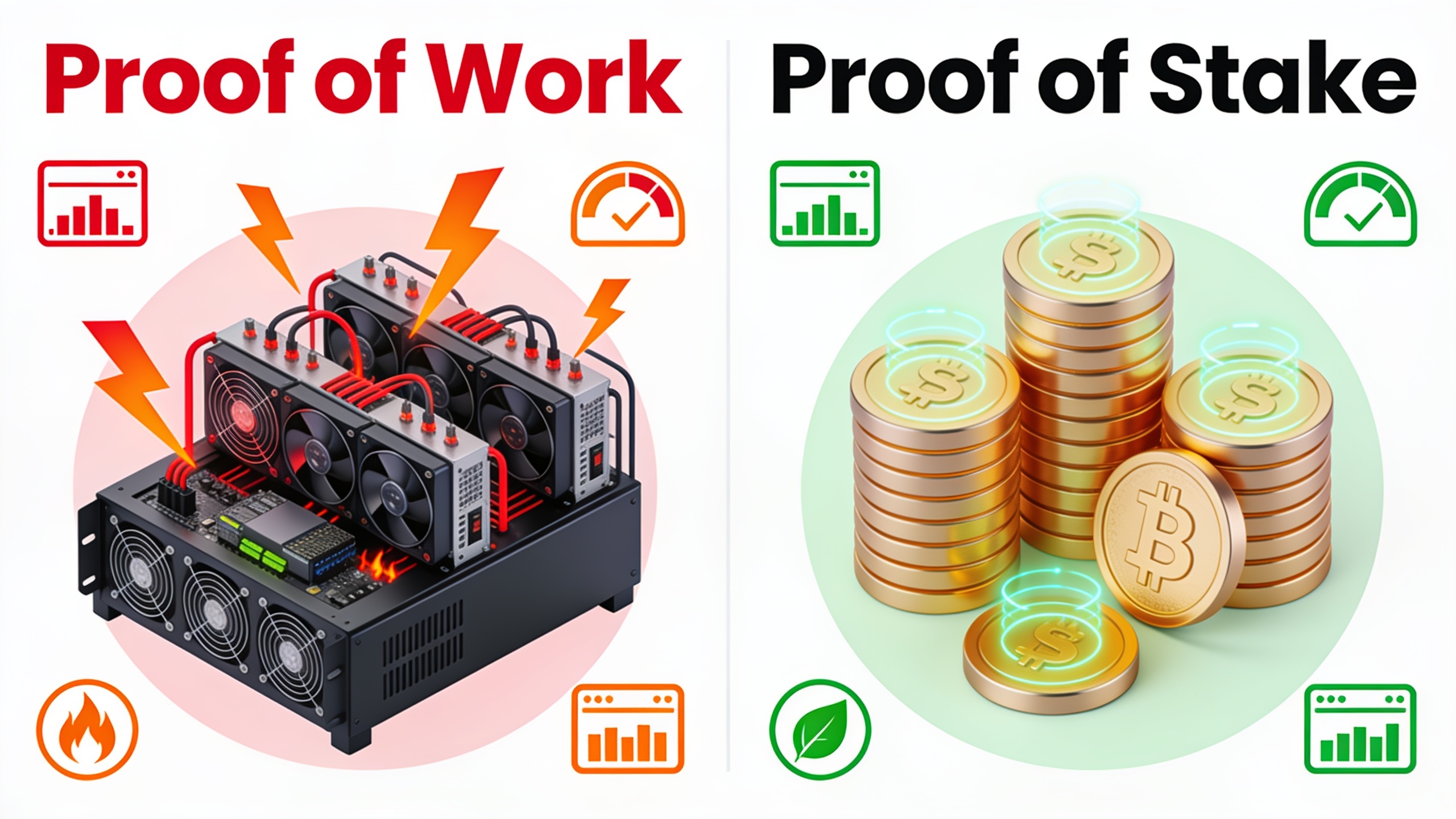
Proof of Work is what Bitcoin uses. Miners burn through computational power racing to solve complex math puzzles, and whoever cracks it first gets to add the next block and pocket the reward. It's incredibly secure. It's also an energy hog. Bitcoin's network alone chews through an estimated 150-plus terawatt-hours a year, according to the Cambridge Bitcoin Electricity Consumption Index. That's more electricity than some entire countries use, which... yeah, it's a fair thing to criticize.
Proof of Stake is the leaner cousin. Ethereum famously switched over from PoW to PoS in September 2022 in an event everyone called "The Merge." Instead of burning electricity, validators get picked to create blocks based on how much crypto they've locked up as collateral, their "stake." The result? Ethereum slashed its energy use by about 99.95%, per the Ethereum Foundation. That's not a typo. Ninety-nine point nine five percent.
There are others worth knowing about, too:
- Delegated Proof of Stake (DPoS), used by networks like EOS, where token holders vote for delegates to do the validating.
- Proof of History (PoH), Solana's clever trick of timestamping transactions to crank up speed.
- Practical Byzantine Fault Tolerance (PBFT), common in private and consortium chains where the participants already know each other.
Every one of these is a compromise between decentralization, security, and scalability. You basically can't max out all three at once, which is why people call it the "blockchain trilemma." Pick two, sacrifice a bit of the third. That's the game.
Where Blockchain Shows Up Outside of Crypto
Crypto gets all the headlines, but the tech has crept into a bunch of other places, some of which actually make a lot of sense.
Take supply chains. Walmart and Maersk have both built blockchain systems to track goods from the source all the way to the shelf. IBM's Food Trust platform uses it to trace food products, and it cut the time to figure out where a product came from from days down to seconds. When there's a contamination scare, that speed genuinely matters.
Healthcare is another one, at least in theory. Blockchain could store patient records securely and let people actually control who gets to peek at their medical history, while keeping the data consistent across different providers. In practice it's messier, but the promise is real.
Voting has been floated too, with a handful of pilot programs testing blockchain-based elections to cut fraud and boost transparency. It hasn't gone mainstream though, and honestly I'm skeptical it will anytime soon. Scalability and privacy concerns keep tripping it up. Then there's real estate, where digitizing title deeds could slash paperwork and cut out expensive middlemen. And digital identity, where blockchain-based systems let you hold onto your own personal data instead of parking it in some centralized database that hackers love to raid.
The Annoying Parts Nobody Puts in the Brochure
Blockchain is genuinely impressive, but let's not pretend it's flawless. There are some real problems, and if you're investing you should know about them.
Scalability is the big one. Bitcoin handles about 7 transactions per second. Visa? Over 24,000. That's not even close. Ethereum has hit its own congestion walls too. There are fixes in the works, like the Lightning Network and Ethereum's rollups, but "in the works" is doing some heavy lifting there.
Energy use, as I mentioned, is a legitimate knock against Proof of Work systems specifically. It's a big reason newer chains have pivoted hard toward Proof of Stake.
Then there's regulation, which is a mess pretty much everywhere. Governments are still scrambling to figure out how to handle blockchain-based assets, and that uncertainty can whip prices around and make life stressful for investors. Staying plugged into reliable news sources helps, but nobody has a crystal ball here.
Security is worth being careful about, too. The blockchain itself is rock solid, but the stuff built on top of it (exchanges, wallets, smart contracts) is where people actually get burned. Chainalysis reported over $1.7 billion lost to crypto hacks and exploits in 2023 alone. That's real money, gone.
And finally, the one that catches beginners off guard: irreversibility. Blockchain transactions are permanent. Send your funds to the wrong address? Tough luck. There's no support line, no chargeback, no undo button. It puts a lot of weight on you to triple-check everything before you hit send. I know people who've learned this the expensive way.
Where This Is All Headed
Blockchain's clearly not going anywhere, and a few trends are shaping what comes next.
Interoperability is a hot topic right now. Projects like Polkadot and Cosmos are trying to get separate blockchains talking to each other and sharing data, which would fix one of the more frustrating limitations of the current setup where every chain is kind of its own walled garden.
Institutional money keeps pouring in, too. BlackRock, Fidelity, and other giants have launched or filed for spot Bitcoin ETFs, which is a pretty loud signal that the suits are finally taking this seriously after years of dismissing it.
Governments are getting in on it as well. Central Bank Digital Currencies, or CBDCs, are being explored or piloted by more than 130 countries according to the Atlantic Council's tracker. It's a bit ironic, honestly. State-controlled digital money borrowing ideas from a technology that was invented to escape state control. But here we are.
And tokenization of real-world assets is picking up steam, with real estate, art, even government bonds getting represented as digital tokens. The pitch is that it could unlock liquidity for stuff that's traditionally been a pain to buy and sell.
As all this shakes out, keeping up with solid crypto and blockchain news will matter more, not less. There's a lot of genuine innovation and a whole lot of hype, and telling them apart is half the battle.
Frequently Asked Questions
Wait, is blockchain the same thing as cryptocurrency?
Nope. Blockchain is the underlying infrastructure, the distributed ledger. Cryptocurrency is a digital asset that usually runs on top of a blockchain. They're related but not the same, and blockchain has plenty of uses that have nothing to do with crypto, from supply chain tracking to healthcare records.
Can someone reverse or hack my blockchain transaction?
Once it's confirmed, reversing it is extremely difficult thanks to the decentralized validation process. The blockchain protocol itself is very secure. The weak spots are the things built around it, like exchanges and wallets, which absolutely can get hacked if they're not locked down properly.
How is it secure if there's no one in charge?
It leans on cryptographic hashing, digital signatures, and consensus mechanisms like Proof of Work or Proof of Stake to validate transactions across the whole network. No trusted middleman needed, because the system's design and the math do that job instead.
Why do some blockchains eat so much electricity?
That's mostly a Proof of Work thing. Bitcoin and chains like it need serious computing power to solve the puzzles that keep the network safe from attacks. That heavy energy use is actually part of what makes it secure, but it's drawn a lot of flak, which is exactly why so many newer projects went with Proof of Stake instead.
What's the actual difference between public and private blockchains?
Public ones are open to everybody, no permission required. Anyone can join and view the transaction history, like on Bitcoin and Ethereum. Private ones lock access down to approved participants, usually businesses that want blockchain's structure without going fully decentralized.
Blockchain has genuinely changed how we think about trust, ownership, and moving value around. It powers the biggest cryptocurrencies, it's reshaping supply chains, and it's poking at financial systems that haven't changed much in decades. For anyone with money in this space, or even just curiosity, understanding how it works isn't some academic exercise. It's the foundation you need to navigate all of this without getting lost or burned.
You Might Also Find Useful
- Cryptocoinsjournal - A digital publication covering cryptocurrency news, market analysis, and blockchain insights for investors and enthusiasts.
- fullboys - Explore additional content and resources at fullboys.
- Swappahome - A platform connecting people looking to swap homes or properties for cost-effective, unique travel and relocation experiences.