What Is Cryptocurrency? A Beginner's Guide for 2025
So you keep seeing headlines about Bitcoin smashing records or Ethereum doing something-or-other with "the next wave of finance," and you've quietly wondered what any of it actually means. Welcome to...


So you keep seeing headlines about Bitcoin smashing records or Ethereum doing something-or-other with "the next wave of finance," and you've quietly wondered what any of it actually means. Welcome to the club. You're definitely not the only one nodding along in meetings while having zero idea what's being discussed.
Here's where things stand: the whole crypto market is worth somewhere around $2.5 trillion right now, and more than 420 million people worldwide own some form of it (that number comes from Triple-A, if you want to fact-check me). Which is to say, this stuff isn't a fringe hobby for basement-dwelling tech nerds anymore. It's basically become a chunk of financial literacy you can't really skip.
What I want to do here is walk you through the whole thing without the jargon soup. How blockchain works, the different flavors of coins, how to actually buy some without getting rekt, and the risks nobody wants to talk about at crypto conferences. Whether you're thinking about investing, just curious, or sick of feeling lost when your coworker won't shut up about his "bags," this should sort you out.
Table of Contents
- What Is Cryptocurrency? The Basics Explained
- How Does Cryptocurrency Actually Work?
- Types of Cryptocurrencies You Should Know
- Why Cryptocurrency Matters in 2025
- How to Buy and Store Cryptocurrency Safely
- Risks and Challenges Every Beginner Should Understand
- Getting Started: Practical Tips for Crypto for Beginners
- Frequently Asked Questions
So What Actually Is It?
Cryptocurrency is digital money that's locked down with cryptography, which is a fancy way of saying it's basically impossible to fake or spend twice. That's the whole point. Regular money (the dollars and euros governments print, called fiat currency) runs through banks and central authorities. Most crypto doesn't. It lives on decentralized networks powered by something called blockchain, which is essentially a giant shared record book maintained by a scattered network of computers instead of a single company or government.
The name itself is a mashup: "crypto" from cryptography (the science of scrambling and unscrambling information) plus "currency." Which honestly tells you everything about what the original creators wanted. A secure, verifiable way to move money around that doesn't need a bank's permission.
Bitcoin kicked the whole thing off back in 2009, created by someone (or some group) using the name Satoshi Nakamoto. Nobody actually knows who that is, which is kind of wild when you think about it. Since then, thousands of other coins have popped up. People call them "altcoins," and they range from genuinely useful projects to complete garbage. More on that later.
What Makes It Different From Regular Money
A few things really set crypto apart. It's decentralized, meaning no single company or government pulls the strings. A whole network of computers (nodes) verifies transactions instead of one central bank. Most blockchains are also weirdly transparent. Anyone can peek at the transaction history, even though the wallet identities stay pseudonymous, so you see the money moving but not necessarily who's behind it.
Then there's the immutability thing. Once a transaction gets confirmed and baked into the blockchain, good luck changing or reversing it. That's a feature and a curse, as you'll find out.
And scarcity matters here too. Bitcoin, for example, will only ever have 21 million coins. That's it. Ever. It's designed to work a bit like gold, where the limited supply is supposed to hold value. Oh, and one more thing: you can send crypto anywhere on the planet without middlemen, often faster and cheaper than a traditional wire transfer that takes three business days and charges you $45 for the privilege.
How Does This Thing Actually Work?
To really get crypto, you've gotta understand the engine underneath it. Blockchain. Picture a ledger book, except instead of one copy sitting in some accountant's drawer, thousands of identical copies exist on computers all over the world. Every time someone sends or receives crypto, that transaction gets bundled up with a bunch of others into a "block," which then gets verified and permanently locked onto the chain.

Here's roughly how a single transaction plays out. You decide to send, say, 0.5 Bitcoin to a friend's wallet. That request gets broadcast out to the network of nodes. Then miners or validators check it over using something called a consensus mechanism (we'll get to that). Once they confirm it's legit, your transaction gets grouped with others into a block, and that block gets stapled onto the existing chain forever, complete with a timestamp. Done. Irreversible.
Proof of Work vs. Proof of Stake (Don't Zone Out, This Matters)
There are two main ways these networks keep themselves honest, and they're genuinely different beasts.
Proof of Work is the original, and it's what Bitcoin uses. Miners compete to solve absurdly complicated math puzzles using raw computing power. Whoever cracks it first gets to add the next block and earns some freshly minted coins as a reward. It's secure as hell, but it guzzles electricity. Bitcoin mining alone burned through something like 120 to 150 terawatt-hours a year as of 2024, according to Cambridge's tracking index. That's more juice than some entire countries use, which is exactly why people get so heated about crypto's environmental footprint.
Proof of Stake takes a totally different approach. Ethereum switched to it in 2022 with an upgrade they called "the Merge." Instead of burning energy on puzzles, validators get picked based on how many coins they've "staked," basically locked up as a security deposit. The kicker? It uses roughly 99.9% less energy. Ethereum went from environmental villain to relatively clean almost overnight. Pretty remarkable, honestly.
Wallets, and Why "Not Your Keys" Is a Thing
To hold and use crypto, you need a wallet. It stores your private keys, which are essentially the master password to your funds. Lose them and you're toast. There's no "forgot password" button.
Wallets basically come in two types. Hot wallets stay connected to the internet (think mobile apps or browser extensions), and they're super convenient but more exposed to hackers. Cold wallets are offline hardware devices, like a Ledger or Trezor, and they're way safer for anything you're planning to hold long-term. Think of a hot wallet as the cash in your pocket and a cold wallet as the safe bolted to your floor.
The Different Flavors of Crypto
Not every coin is trying to do the same thing, and lumping them all together is a rookie mistake. Here's how the major categories break down:
| Category | Purpose | Examples | Key Feature |
|---|---|---|---|
| Payment Coins | Digital cash for transactions | Bitcoin, Litecoin | Store of value, peer-to-peer payments |
| Smart Contract Platforms | Support decentralized apps | Ethereum, Solana, Cardano | Programmable blockchain functionality |
| Stablecoins | Price stability pegged to fiat | USDT, USDC, DAI | Minimal volatility, used for trading |
| Utility Tokens | Access specific platform services | BNB, LINK | Powers ecosystem functions |
| Meme Coins | Community-driven, speculative | Dogecoin, Shiba Inu | High volatility, cultural relevance |
| Privacy Coins | Enhanced transaction anonymity | Monero, Zcash | Obscured transaction details |
The risk levels here are all over the map. Stablecoins are the boring, sensible option, pegged to something like the US dollar so they barely move, which makes them great for trading and sending money across borders. Meme coins? Pure chaos. They can double or crater within a single afternoon based on nothing more than a celebrity tweet. Some people have gotten rich off them. Way more people have lost their shirts. Just know what you're playing with.
Why This All Matters Right Now
Crypto has come a long way from being an experiment among a handful of cypherpunks. A few things that happened in 2024 and 2025 really shoved digital assets into the financial mainstream, whether the old guard liked it or not.
The big one was spot Bitcoin ETFs getting approved in the US in January 2024. Suddenly, regular investors could get Bitcoin exposure right through their normal brokerage accounts, without messing around with wallets or private keys. And people jumped in fast. By late 2024, those ETFs had pulled in over $30 billion in net inflows (Bloomberg's numbers). That's a serious vote of confidence from institutional money.
What's funny is watching the same Wall Street firms that mocked crypto a few years ago scramble to offer it. BlackRock, Fidelity, JPMorgan, they're all in the game now. These are companies whose executives were calling Bitcoin a scam not that long ago. Awkward.
But it's not all speculation and price charts. Crypto's actually getting used for real stuff. Companies now settle international payments with stablecoins in minutes instead of days, for pennies compared to traditional wire fees. There's also this whole world of Decentralized Finance (DeFi) where you can lend, borrow, and earn interest without a bank anywhere in sight. The DeFi sector was sitting on over $100 billion in total value locked as of early 2025. And people are increasingly turning real-world assets like real estate, art, even company shares into digital tokens, which makes it easier for smaller investors to get a piece of things that used to be locked away.
On the rules front, governments are finally catching up. The EU rolled out its MiCA regulation, fully live by late 2024, which lays out clear rules for crypto companies across all member states. Meanwhile the US Congress keeps chewing on stablecoin bills and broader market rules. It's slow and messy, but clearer regulation usually brings in more players, both big institutions and everyday folks. So this is probably a good sign, even if it doesn't feel exciting.
How to Actually Buy and Store It Without Getting Burned
Okay, theory's nice, but let's talk about doing it.
For most beginners, centralized exchanges are the on-ramp. Coinbase, Kraken, Binance, that sort of thing. When you're picking one, a handful of things actually matter. Does it legally operate where you live? Has it been hacked before (and how did it handle it)? What are the fees, which usually run anywhere from 0.1% to 1.5% per trade? Does it even offer the coins you want? And is the interface something you can navigate without a computer science degree?
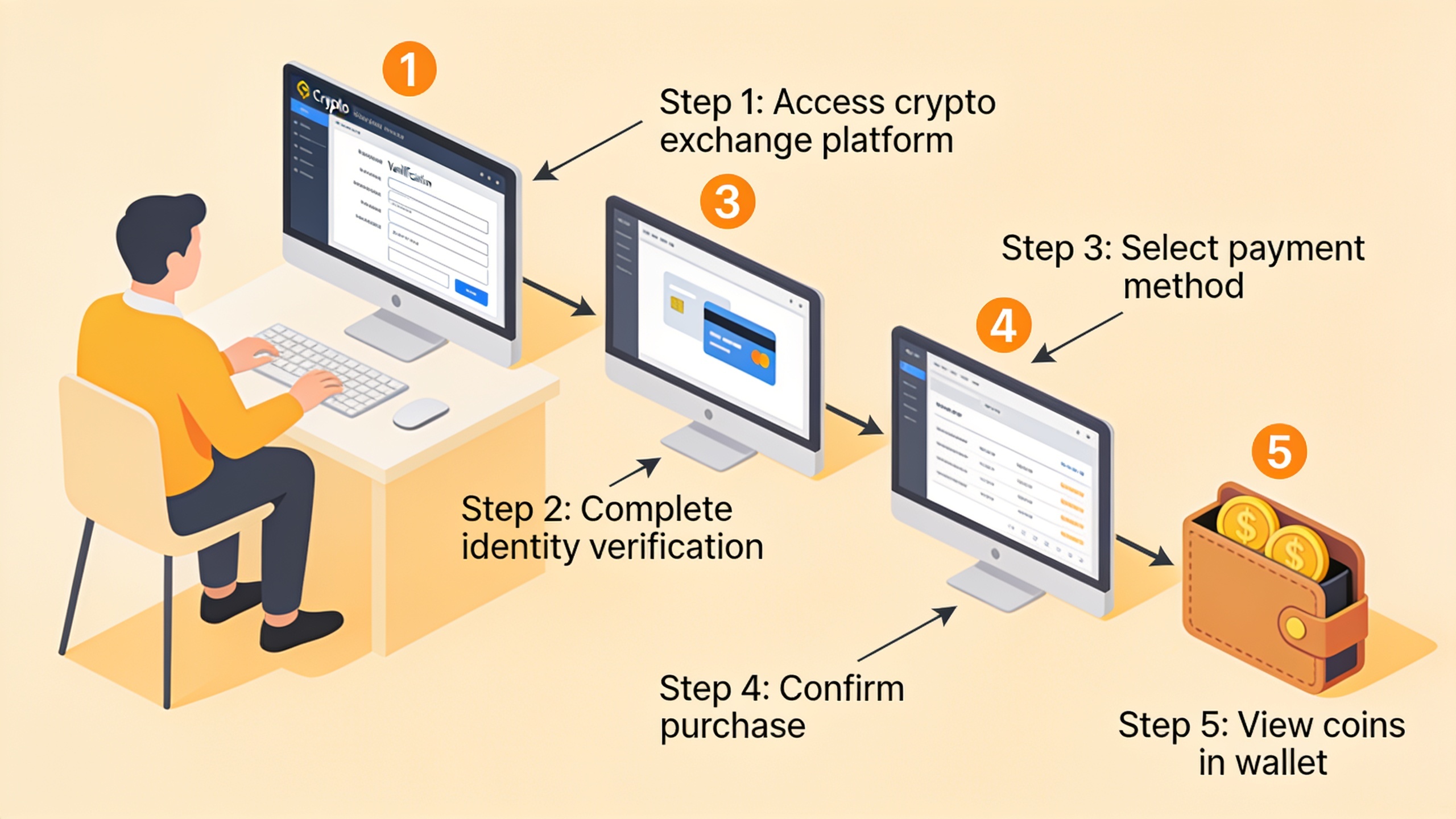
The buying process itself is pretty painless. You sign up and do the identity verification dance (they call it KYC, "Know Your Customer"). Then you link a payment method, whether that's a bank transfer, debit card, or wire. Deposit some funds, place an order (a market order buys instantly, a limit order waits for a price you set), and boom, you own crypto.
Now here's the part beginners skip and later regret. There's a saying in crypto: "Not your keys, not your coins." What it means is that leaving a pile of money sitting on an exchange puts you at their mercy. If they get hacked or go bankrupt, your funds can vanish. This isn't hypothetical. When FTX collapsed in 2022, over a million people got burned. Poof, gone. So for anything you're not actively trading, move it to your own wallet. And for serious long-term holdings, a hardware wallet keeps your keys completely offline where no hacker can touch them.
The Stuff That Can Go Wrong
I'm not going to sugarcoat this, because plenty of guides do and it drives me nuts.
Volatility is the obvious one. Crypto prices whip around violently. Even Bitcoin, the grandaddy of them all, has crashed more than 70% from its peaks multiple times over its life. And the smaller altcoins? They can be way, way worse. You need a stomach of steel or you'll panic-sell at the worst possible moment.
Then there are the scams, which are everywhere. Phishing attempts, fake exchanges, malware that quietly drains your wallet. Chainalysis pegged illicit crypto transactions at roughly $24.2 billion in 2023. Sounds terrifying until you realize that's less than 1% of total volume, but still, it's enough that you should stay paranoid.
Regulation is another wildcard. Even though things are getting clearer, the rules still change country to country and can shift with barely any warning. Tax treatment, trading limits, whether something's even legal, all of it can flip on you.
And I really want to hammer this last one home: crypto transactions can't be undone. Send money to the wrong address? Gone. Get scammed? Gone. Lose your private keys? Also gone. There's no fraud department to call, no chargeback, no refund. It's just... over. That permanence catches a lot of newcomers completely off guard.
Getting Started Without Doing Something Dumb
If you're ready to actually dip a toe in, here's my honest advice.
Start small. Like, embarrassingly small. Only put in money you'd genuinely be fine losing, especially in your first few months while you're still figuring things out. Crypto trades 24/7, and there's a real learning curve to wallets, transaction fees (called "gas fees" on Ethereum, and they can sting), and how projects actually work under the hood. No rush.
When it comes to what to buy, don't dump everything into some random coin your cousin swears is going "to the moon." Most experienced people I know keep the bulk of their crypto in established stuff like Bitcoin and Ethereum, then set aside a small slice for the riskier bets. Play the lottery with money you're okay losing, not the rent.
A strategy that takes a lot of the stress out of it is dollar-cost averaging, or DCA. Instead of trying to nail the perfect entry point (spoiler: you won't), you just invest a fixed amount at regular intervals no matter what the price is doing. It smooths out the volatility and saves you from staring at charts at 3am wondering if now's the moment. It rarely is.
Stay curious too. This space moves fast, and there's an ocean of noise out there. Following legit news sources helps you tell real developments apart from hype and outright scams. And please, keep records of everything from day one. Because here's the annoying reality: in most places, including the US, crypto is taxable. Selling, trading, even buying a coffee with it can trigger capital gains. Future-you will be very grateful when tax season rolls around and you're not frantically piecing together a year of transactions from memory.
Frequently Asked Questions
Wait, is cryptocurrency the same thing as blockchain?
Nope, though people mix them up constantly. Blockchain is the underlying tech, the distributed digital ledger. Cryptocurrency is just one thing you can build on top of it. Blockchain also powers smart contracts, NFTs, and supply chain tracking, none of which have anything to do with currency.
Can I actually lose all my money doing this?
Yes. One hundred percent yes. Crypto is volatile and mostly unregulated compared to stocks. Prices can nosedive on regulatory news, a hack, shifting mood, or a project just collapsing. I'll say it again: don't put in anything you can't afford to wave goodbye to.
Do I need a ton of cash to get started?
Not at all. Most exchanges let you buy fractions of a coin, so you can start with ten or twenty bucks. That low barrier is a big reason crypto pulled in such a wide range of people compared to traditional investing, where you often need serious money to even get in the door.
How does the tax thing work?
Depends where you live, but in a lot of places (the US included), crypto is treated as property. That means selling, trading, or spending it can create capital gains or losses you have to report. I'm not a tax pro, and honestly you should talk to one who actually knows crypto in your country, because getting this wrong is expensive.
What's the real difference between Bitcoin and everything else?
Bitcoin was first, and it's mostly focused on being a decentralized store of value and payment network. The other coins (altcoins) do different jobs. Ethereum runs smart contracts and apps. Stablecoins stay pegged to keep prices steady. Each one has its own tech, its own use, and its own risk level, so don't treat them as interchangeable.
---
Look, cryptocurrency is genuinely one of the more interesting financial shifts of the last couple decades. It's changed how a lot of people think about money, ownership, and who gets to control the whole system. The tech is still evolving, the rules are still catching up, and there's plenty of nonsense to wade through. But if you understand the basics, how blockchain works, what the different coins are for, and where the landmines are buried, you're way ahead of most people diving in blind. Take it slow, keep learning, and stay a little skeptical. That'll serve you far better than chasing whatever's pumping on Twitter this week.
You Might Also Find Useful
- Cryptocoinsjournal - A digital publication offering news, analysis, and educational insights on cryptocurrency markets and blockchain technology for investors and enthusiasts.
- Vivienda Lista - A comprehensive platform helping individuals find their ideal home through curated listings, property comparisons, and expert real estate advice.
- Vidbox - An Indonesian social media portal offering games, films, forums, blogs, and marketplace features for online community engagement and business learning.