Best Crypto Debit Cards for Everyday Spending in 2025
You know the drill: you've got some crypto sitting in a wallet, and you want to actually use it. Not sell it, wire the cash to your bank, wait two days, and then buy groceries. Just... buy the...

You know the drill: you've got some crypto sitting in a wallet, and you want to actually use it. Not sell it, wire the cash to your bank, wait two days, and then buy groceries. Just... buy the groceries. That's the whole pitch behind crypto debit cards. You tap, swipe, or insert a card at checkout, and while the merchant gets paid in regular money, your balance behind the scenes is Bitcoin, Ethereum, a stablecoin, whatever. The card does the conversion so you don't have to think about it.
And honestly, in 2025 this stuff has grown up. A few years ago these cards felt like a gimmick. Now you've got exchanges, fintech startups, and the big card networks all elbowing each other for a spot in your wallet.
So this guide is about how these cards actually work, what to look at before you sign up, and the trade-offs between the different types out there. One thing I'm not going to do is quote you a bunch of cashback percentages and fee numbers, because issuers change those constantly and set them all differently. Anything I told you today would probably be wrong by next quarter. Instead I'll point you at the stuff you should personally check on each provider's terms page before you hand over any money.
Table of Contents
- What Are Crypto Debit Cards, and How Do They Let You Spend Cryptocurrency?
- Why Crypto Debit Cards Are Gaining Traction in 2025
- How to Compare Crypto Debit Cards: The Criteria That Actually Matter
- Types of Crypto Debit Cards Available Today
- What Are the Best Crypto Debit Cards for Everyday Spending in 2025?
- How Much Does It Cost to Use a Crypto Debit Card?
- Risks and Considerations Before You Apply
- Frequently Asked Questions
What Are Crypto Debit Cards, and How Do They Let You Spend Cryptocurrency? {#what-are-crypto-debit-cards}
A crypto debit card is a payment card, usually branded Visa or Mastercard, that pulls from a crypto balance and converts it to regular currency the instant you pay, so the merchant gets paid like normal. You never have to log into an exchange and manually sell your tokens first. The conversion just happens, either right at the register or through a fiat sub-balance the app tops up from your crypto ahead of time.
Think of it as something living halfway between a prepaid debit card and a crypto wallet. You fund it from an exchange account, a self-custody wallet, or an in-app balance, and the issuer's payment processor deals with the messy part: converting your coins and settling up with the merchant's bank.
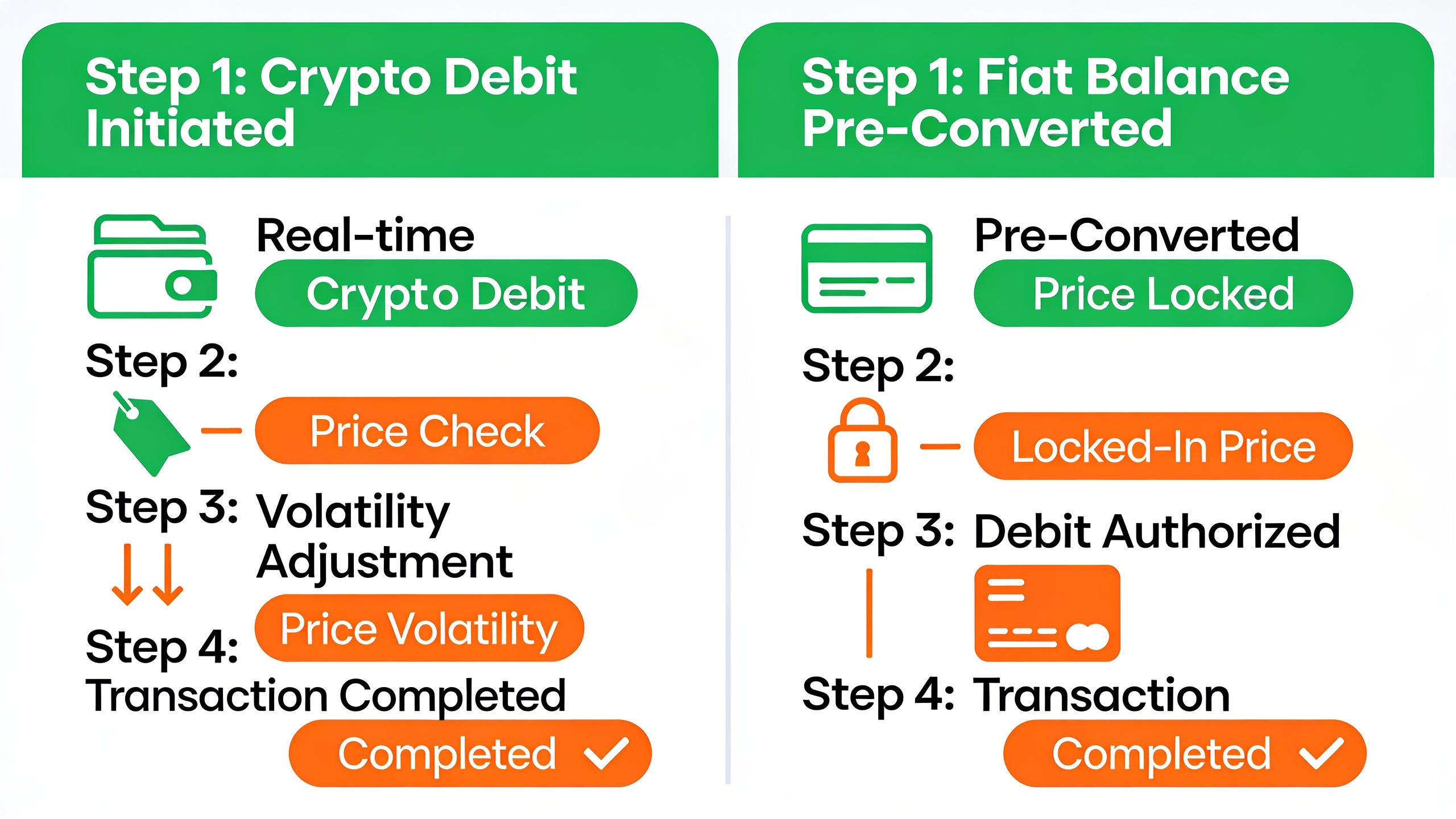
Now here's where the two models actually differ, and it matters. Some cards deduct crypto in real time on every single swipe. Others make you convert a chunk of your holdings into a fiat-backed balance beforehand, then you spend from that like a regular prepaid card. Why should you care? Because it changes how much price volatility you're exposed to between the moment you load the card and the moment you buy something. Real-time deduction means the price could move on you mid-transaction. The pre-converted model locks it in. Small detail, big consequences.
Why Crypto Debit Cards Are Gaining Traction in 2025 {#why-gaining-traction}
These cards are catching on because they fix the single most annoying thing about spending crypto: merchants still want fiat, not tokens. Almost all of them. So without a card, your only option is the whole tedious off-ramp dance. Move crypto to an exchange, sell it, withdraw to your bank, wait, then finally pay with a normal card. A crypto debit card squashes all of that into one tap.
And that convenience matters more every year, because the crowd holding crypto for reasons other than "number go up" keeps getting bigger. People are earning tokens through staking, trading, even play-to-earn games, and they want to actually do something with those balances instead of leaving them parked in a wallet like a museum piece. This hits home especially for anyone into blockchain gaming, where rewards and tokens from titles we covered in our roundup of Top 8 Web3 Gaming Titles Merging Blockchain and Gameplay in 2025 can, depending on the game and the token, eventually get routed toward a linked spending balance rather than gathering dust.
There's also this shift among the fintech-obsessed crowd who want their credit-card-style perks (cashback, points, tiers) but paid out in crypto instead of airline miles nobody uses. Issuers noticed. So they built loyalty programs around holding or staking their native tokens. Which, by the way, is exactly why you need to look past the headline cashback number and actually read how the rewards work. More on that in a second.
How to Compare Crypto Debit Cards: The Criteria That Actually Matter {#how-to-compare}
The right card for you comes down to five things, and none of them are the flashy marketing line: cashback structure, supported currencies, fee transparency, where it's actually available, and who holds your crypto. And since issuers rewrite their terms without much warning, treat any number you see in an ad (or in some old blog post) as a starting point to double-check, not gospel.
Cashback and Rewards Structures
Nearly every card waves a cashback percentage at you. What that number hides is the part that actually determines what you pocket. Is the cashback paid in the card's native token or a stablecoin? Do you need to hold or stake a minimum stack of tokens to unlock the good tier? Is it capped monthly?
Here's the trap. A card advertising a juicy top-tier rate that makes you lock up a fat token balance for months isn't automatically better for a casual spender than a plain flat-rate card with zero lockup. Depends entirely on how you'll use it. Always pull up the current tier table on the issuer's own site, not a percentage somebody quoted secondhand, because these programs get tweaked all the time.
Supported Cryptocurrencies and Conversion Method
Not every card lets you pay with whatever token you happen to own. Some limit spending balances to a short list of the majors (Bitcoin, Ethereum, a few stablecoins) and convert everything else into one of those before it lands on your card. Others let you hold a broader mix but slap a spread or conversion fee on you at checkout. So if you're planning to spend crypto you picked up from smaller-cap tokens, airdrops, or some niche DeFi position, confirm the card actually supports converting those specific assets. Otherwise you'll be swapping them into a supported coin on an exchange first, which kind of defeats the point.
Fee Structures to Watch
Fees generally come in a handful of flavors: an issuance or shipping charge for the physical card, monthly or annual maintenance, ATM withdrawal fees (usually a free monthly allowance and then a percentage), foreign exchange fees when you spend in a currency other than your card's base, and inactivity fees if the account goes dormant. These vary wildly between issuers and get restructured constantly, so the only trustworthy move is to read the current fee schedule the provider publishes directly. Not a summary from a review site. Not this article. Theirs.
Geographic Availability and Regulatory Status
Availability is honestly the most slept-on filter, and it'll ruin your day if you ignore it. A card can look perfect in every review and still be completely un-issuable where you live. These programs run on top of local banking and payment licenses, so an issuer might cover the European Economic Area, the UK, and bits of Asia-Pacific while shutting out the US, or the exact reverse. And that footprint shifts as regulators change the rules. Before you fall in love with a rewards program, go to the provider's site and confirm the card is currently issuable and legally usable in your country of residence.
Security and Custody Model
Cards split into two camps here: self-custodied, where you control the private keys right up until conversion, and custodial, where the issuer holds your crypto for you (basically the same way an exchange holds your trading balance). Custodial is simpler for daily spending, no question. But it means you're trusting that company's security and, frankly, its solvency.
If you're moving funds from a self-custody wallet to load a card, treat that transfer as carefully as you would any wallet interaction, including being thoughtful about where those funds came from in the first place. If some of your spending money started life as an airdrop, our guide on How to Find and Claim Crypto Airdrops Safely in 2025 walks through how to vet a campaign before connecting a wallet. Worth a read before you link that same wallet to a spending card.
Types of Crypto Debit Cards Available Today {#types-of-cards}
Broadly, crypto debit cards fall into three buckets, and just knowing which bucket a card sits in tells you a lot about how it'll behave before you even glance at its fee schedule. The table below compares them in general terms, since the exact rates and conditions are set by each issuer and shift over time.
| Card Category | How It's Typically Funded | Reward Model | Best Suited For | Availability Note |
|---|---|---|---|---|
| Exchange-issued card | Balance held directly on a crypto exchange account | Often tiered, sometimes based on holding or staking the exchange's native token | Active traders who already keep significant funds on that exchange | Availability varies significantly by country and by exchange license |
| Wallet-linked prepaid card | Self-custody wallet or in-app crypto balance loaded onto a prepaid fiat sub-balance | Varies by provider; some offer flat cashback, others none | Users who prioritize retaining control of their private keys | Often more geographically restricted than exchange cards |
| Bank-partnered crypto card | A crypto account linked to a card issued in partnership with a licensed bank or payment processor | Reward structures set by the banking partner, often modest | Users who want traditional consumer banking protections alongside crypto | Depends heavily on the partner bank's regulatory footprint |

So the practical upshot? "Best" is completely context-dependent. A trader who already keeps most of their stack on a big exchange will probably get the most out of that exchange's own card, purely because there's no extra transfer step to fumble with. Meanwhile someone who deliberately keeps their coins off exchanges in a self-custody wallet will lean toward a wallet-linked card, even if the advertised rewards look a little less shiny. Different people, different right answers.
What Are the Best Crypto Debit Cards for Everyday Spending in 2025? {#best-cards}
The best crypto debit card for everyday spending is whichever one whose supported currencies, fees, and country availability actually line up with your situation. There's no single card that objectively beats every other one for everybody, and anyone who tells you otherwise is probably selling something.
When you start digging in 2025, you'll keep bumping into the same familiar names. Exchange-affiliated programs from Crypto.com, Coinbase, and Binance, plus dedicated crypto payment providers like Wirex. Each runs a card built on one of the categories above (exchange-issued, wallet-linked, or some hybrid), but the specific cashback tiers, supported token lists, and country eligibility are all set and updated by the companies themselves, and they can change with barely any public heads-up.
I'm deliberately not throwing numbers at you here, because they'd likely be stale or flat-out wrong by the time you read this. The smarter play is to shortlist two or three providers whose general model fits how you spend (an exchange card if you already trade heavily on that platform, a wallet-linked card if you hold your own keys) and then compare their live terms side by side on their actual websites. Pay close attention to the tier you'd realistically qualify for, not the top one they splash across the ad, and confirm the card actually works for point-of-sale and ATM use in your country.
Oh, and one more thing. If your crypto is scattered across a bunch of sources (trading profits, staking rewards, tokens from those Web3 games I mentioned earlier), check whether a candidate card can convert each of those specific assets directly. Otherwise you'll be consolidating everything into a supported stablecoin first before you can spend a cent of it.
How Much Does It Cost to Use a Crypto Debit Card? {#how-much-does-it-cost}
The cost depends on the issuer's specific fee schedule, but the categories of cost are pretty consistent across the whole industry. You've got possible issuance or shipping charges for a physical card, maybe monthly or annual maintenance, ATM fees once you blow past any free allowance, foreign exchange fees when you spend outside your card's base currency, and then the sneaky one: the cost of volatility between when you fund the card and when you spend.
That last one trips people up. If your card debits crypto in real time at checkout, a sudden price swing in the underlying asset between authorization and settlement can mean you effectively pay a slightly different amount than the number you saw on the register. Cards that make you pre-convert into a fiat-pegged or stablecoin balance mostly dodge this. You trade a little convenience for a lot more predictability. Not a bad deal, honestly, if you hate surprises.
Since none of these figures are standardized (not the ATM caps, not the FX percentages, not the maintenance fees) the only way to know what you'll actually pay is to open the current fee page for any card you're seriously eyeing. Yeah, I keep saying that. It's because it keeps being true.
Risks and Considerations Before You Apply {#risks}
The three big risks are custodial risk, volatility exposure, and regulatory/availability changes. Weigh all three before you apply and you'll dodge most of the nasty surprises.
Custodial risk shows up any time the issuer holds your crypto instead of you controlling it yourself. In that setup, your funds are exactly as safe as that company's security and solvency, no more. Volatility exposure mostly bites cards that debit crypto directly at the register rather than from a pre-converted balance, because a market swing can quietly change what a purchase really cost you after the fact. And regulatory and availability risk is about the card program itself. Issuers add, restrict, or pull service in specific countries as licensing rules evolve, so a card you depend on today isn't guaranteed to stick around in your region forever.
The practical way to keep all this in check is boring but effective. Don't leave more crypto loaded on the card than you plan to spend soon. Treat the card as a spending tool, not a place to store wealth. And every so often, actually re-read the issuer's terms page for changes to fees, supported assets, or country eligibility, because these programs get updated way more often than most people bother to notice.
Frequently Asked Questions {#faq}
Can I use a crypto debit card anywhere a normal debit card works?
Pretty much, yeah. Most crypto debit cards run on the regular Visa or Mastercard networks, so they're accepted anywhere those are. The crypto-to-fiat conversion happens on the issuer's side, invisibly, so as far as the merchant's concerned it looks like any other card payment.
Do these cards charge a fee every single time I spend?
Depends entirely on the issuer and the card tier. Some advertise no per-transaction fee on standard purchases but do charge for ATM withdrawals past a free allowance, foreign currency transactions, or account maintenance. Because fee schedules are all over the map and change over time, check the specific card's current published terms rather than assuming one rule covers the whole industry.
Is it safe to keep a big crypto balance loaded on a debit card?
Generally, no, or at least it's smarter not to. Load only what you plan to spend soon. Custodial card balances carry the same risks as any centralized platform sitting on your assets, and real-time debit models can also expose you to price swings between loading and spending. Treat the card as a transaction tool, not a savings account, and you're playing it safe.
Which crypto debit card is actually available where I live?
No universal answer, sorry. It comes down to each company's banking and payment licenses in your jurisdiction. The only reliable way to know is to check the "availability" or "supported countries" section on the specific provider's own website before you apply. Don't skip this step.
Do I owe taxes when I spend crypto through a debit card?
In a lot of places, converting crypto to fiat, even automatically through a card transaction, gets treated as a taxable disposal, basically the same as selling the asset. But tax rules vary hugely by country and by your personal situation, so this is genuinely a question for a qualified tax professional who knows the crypto rules where you live. Don't take general guidance (including this) as the final word.
At the end of it, picking a crypto debit card in 2025 is really about matching a card's structure, fees, and availability to how you actually spend day to day, not chasing whatever cashback number is screaming the loudest in the ad. Spend a few minutes verifying the current terms directly with each issuer, keep only spending-ready balances on the card, and you'll get real, genuine everyday use out of the crypto you already own. Which, when you think about it, was the whole point.