Bitcoin Halving 2025: What It Means for Price and Miners
So here's what trips people up. "Bitcoin halving 2025" is one of the most searched crypto phrases right now, and yet the halving everyone's obsessing over actually happened back in April 2024. Not...


So here's what trips people up. "Bitcoin halving 2025" is one of the most searched crypto phrases right now, and yet the halving everyone's obsessing over actually happened back in April 2024. Not 2025. The event itself is done. But the fallout from it (miners making less money, less new supply hitting the market, everyone second-guessing where the cycle goes next) is still very much unfolding, and it'll probably keep shaping prices right into the next cycle. So the search phrase isn't wrong, exactly. It's just a year off from where most people think it is.
What I love about the halving, honestly, is that nobody can mess with it. It's baked straight into Bitcoin's code, and you can't change it without breaking consensus and forking the whole network. That's why it carries so much weight when people analyze the market. And getting the mechanics down (not just the hype) is really the whole game here. It's the difference between panicking at every headline and actually knowing where you sit in the cycle.
Table of Contents
- What Is Bitcoin Halving?
- Bitcoin Halving History: From 2012 to Today
- The Halving Effect on Price: What History Actually Shows
- What Happens to Bitcoin Miners After a Halving?
- Is Bitcoin Halving 2025 Still Relevant to Watch?
- How Should Investors Prepare for the Next Halving Cycle?
- FAQ: Bitcoin Halving Explained
What Is Bitcoin Halving?
Bitcoin halving is a pre-programmed event that happens roughly every four years and cuts the reward miners get for confirming a new block in half. That's the whole thing in one sentence. It's the mechanism that controls how fast new bitcoins get created, and it's the main reason Bitcoin is built to be disinflationary with a hard ceiling of 21 million coins.
Now the actual mechanics. Bitcoin's blockchain adds a fresh block about every 10 minutes, and whoever mines it gets a "block reward," which is a chunk of newly minted bitcoin plus whatever transaction fees are attached. Every 210,000 blocks (roughly four years, given those 10-minute intervals) that base reward gets sliced in half. When Bitcoin launched back in January 2009, miners pocketed 50 BTC per block. Four halvings later, we're down to 3.125 BTC, following the April 2024 cut.
And here's the part I think matters most: nobody decides this. There's no company, no central bank, no foundation flipping a switch. It's enforced by the software running on every full node in the network. Miners either play by the reduced-reward rules or the rest of the network just rejects their blocks. Simple as that. That hardcoded scarcity is exactly what sets Bitcoin apart from regular currencies, where a central bank can print more whenever it feels like it. It's also why investors go a little wild around halvings, all of them trying to guess the price impact before it fully shows up.
Bitcoin Halving History: From 2012 to Today
Bitcoin's had four halvings so far, and each one cut the yearly rate of new coins in half and got followed by a serious price run. Though the percentage gains have gotten smaller every time as the market grew up. Looking at the whole pattern gives you a decent sense of where the "bitcoin halving 2025" chatter actually fits in.
| Halving Event | Date | Block Reward Before | Block Reward After | Approx. BTC Price at Halving |
|---|---|---|---|---|
| First Halving | November 28, 2012 | 50 BTC | 25 BTC | Around $12 |
| Second Halving | July 9, 2016 | 25 BTC | 12.5 BTC | Around $650 |
| Third Halving | May 11, 2020 | 12.5 BTC | 6.25 BTC | Around $8,700 |
| Fourth Halving | April 19-20, 2024 | 6.25 BTC | 3.125 BTC | Around $63,900 |
| Fifth Halving (projected) | Around 2028 | 3.125 BTC | 1.5625 BTC | Unknown |
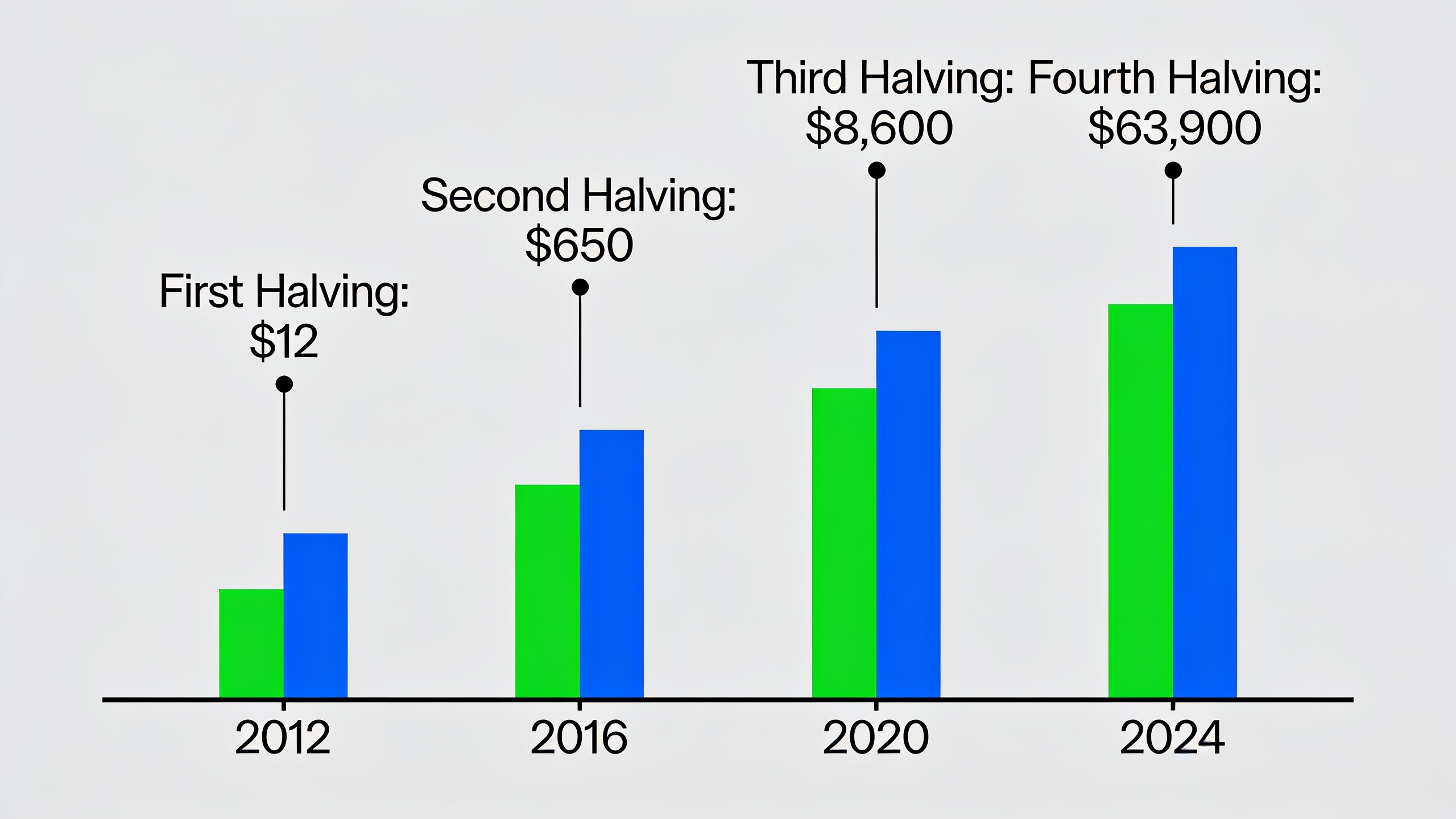
Couple things jump out from that table. The dollar value of the reward keeps climbing over time even though the coin count keeps dropping, so miners take home fewer coins but those coins have historically been worth a whole lot more. The gap between halvings isn't nailed down at exactly four years either, since it depends on how fast blocks actually get produced, which wobbles a bit with hash rate and mining difficulty. And the supply curve is asymptotic, not a straight line. Bitcoin caps out at 21 million coins, and we've already mined more than 19.8 million of them, which means over 94% of every Bitcoin that will ever exist is already floating around out there (that's from on-chain data tracked on places like Blockchain.com and Glassnode).
So that next halving, the one people keep folding into the "bitcoin halving 2025" conversation because that's when its aftermath is getting picked apart, isn't actually due until around 2028. What 2025 really is? The middle of the current post-halving cycle. Which is exactly the window analysts have always watched closest for the delayed effects of the April 2024 cut.
The Halving Effect on Price: What History Actually Shows
The halving effect on price is Bitcoin's habit of ripping into a strong bull market in the 12 to 18 months after a halving, driven by less new supply meeting steady-or-growing demand. It's held up across all three earlier cycles. But the gains have shrunk each time as Bitcoin's market cap ballooned and the asset matured.
Let me walk through it. After 2012, Bitcoin went from roughly $12 to over $1,000 in about a year. An absurd gain, but the market was tiny and illiquid back then, so a little money moved the needle a lot. After 2016, it climbed from around $650 to nearly $20,000 by December 2017, though that one rode the ICO mania that was dumping speculative cash into crypto everywhere. After 2020, Bitcoin ran from about $8,700 to an all-time high near $69,000 in November 2021, juiced by institutional money, pandemic-era stimulus, and the first Bitcoin futures ETFs. And after April 2024? It set fresh highs above $73,000 that same spring, then blew past $100,000 for the first time in December 2024, per the price data reported all over the major exchanges and trackers like CoinMarketCap.
But I want to be careful here, because treating this like magic is how people lose money. A lot of it is just supply and demand doing supply and demand things: when the flow of new coins gets halved overnight and demand holds or grows, the reduced sell pressure from miners (who usually dump a slice of their rewards to pay the bills) can prop prices up, all else equal. The catch is that everybody knows the halving is coming. It's on a schedule. So anticipatory buying tends to kick off well before the actual date, and plenty of analysts think this "priced in" effect gets stronger every cycle as more people understand the mechanics ahead of time.
And please don't overstate the causation. Every one of Bitcoin's big bull runs happened to line up with other macro tailwinds too. Low rates in 2020-2021, ETF approvals in 2024, better custody infrastructure, softening regulatory attitudes. The correlation between halving dates and rallies is well documented, sure, but pinning the whole move on the halving ignores everything else going on at the time. If you'd rather trade around these cycles without actually holding spot Bitcoin, it's worth getting a handle on how futures and perpetual swaps function first. There's a solid primer on crypto derivatives, including futures, options, and perpetual swaps that walks through the tools traders increasingly lean on to position for the volatility halving years tend to bring.
What Happens to Bitcoin Miners After a Halving?
Bitcoin miners watch their block-reward revenue get chopped in half overnight when a halving hits, which crushes profit margins immediately unless Bitcoin's price jumps enough (or their costs drop enough) to make up the difference. This is the most direct consequence of any halving, and miners feel it long before any price rally shows up to save them.
Why Halvings Hit Miner Economics Hard
Mining profit is dead simple math: revenue from block rewards and fees, minus the cost of electricity, hardware, and running the operation. When the reward drops from, say, 6.25 BTC to 3.125 BTC, a miner's BTC revenue falls 50% in an instant, while the power bill and the hardware note stay exactly where they were. Unless Bitcoin's dollar price roughly doubles around the same time, or difficulty drops enough to offset the hit, margins get squeezed hard and fast.
That's why halvings have always kicked off waves of consolidation in mining. The less efficient operators, the folks running older-gen ASICs or paying too much for power, suddenly go underwater and get forced to power down, dump equipment, or just quit. We saw exactly this after 2020, when a bunch of older rigs stopped making sense and hash rate briefly dipped before recovering once the newer, more efficient hardware came online.
The Difficulty Adjustment Safety Valve
Bitcoin has a self-correcting mechanism built in called the difficulty adjustment, and it recalibrates how hard it is to mine a block about every two weeks (every 2,016 blocks) based on how fast blocks got found in the prior stretch. So if miners drop offline in droves after a halving because it's no longer worth it, the network's total hash rate falls, blocks start taking longer, and difficulty adjusts down to make mining easier again. It won't restore anyone's revenue to pre-halving levels. But it does help the survivors stay competitive and keeps blocks coming out roughly on schedule.
Which Miners Survive a Halving
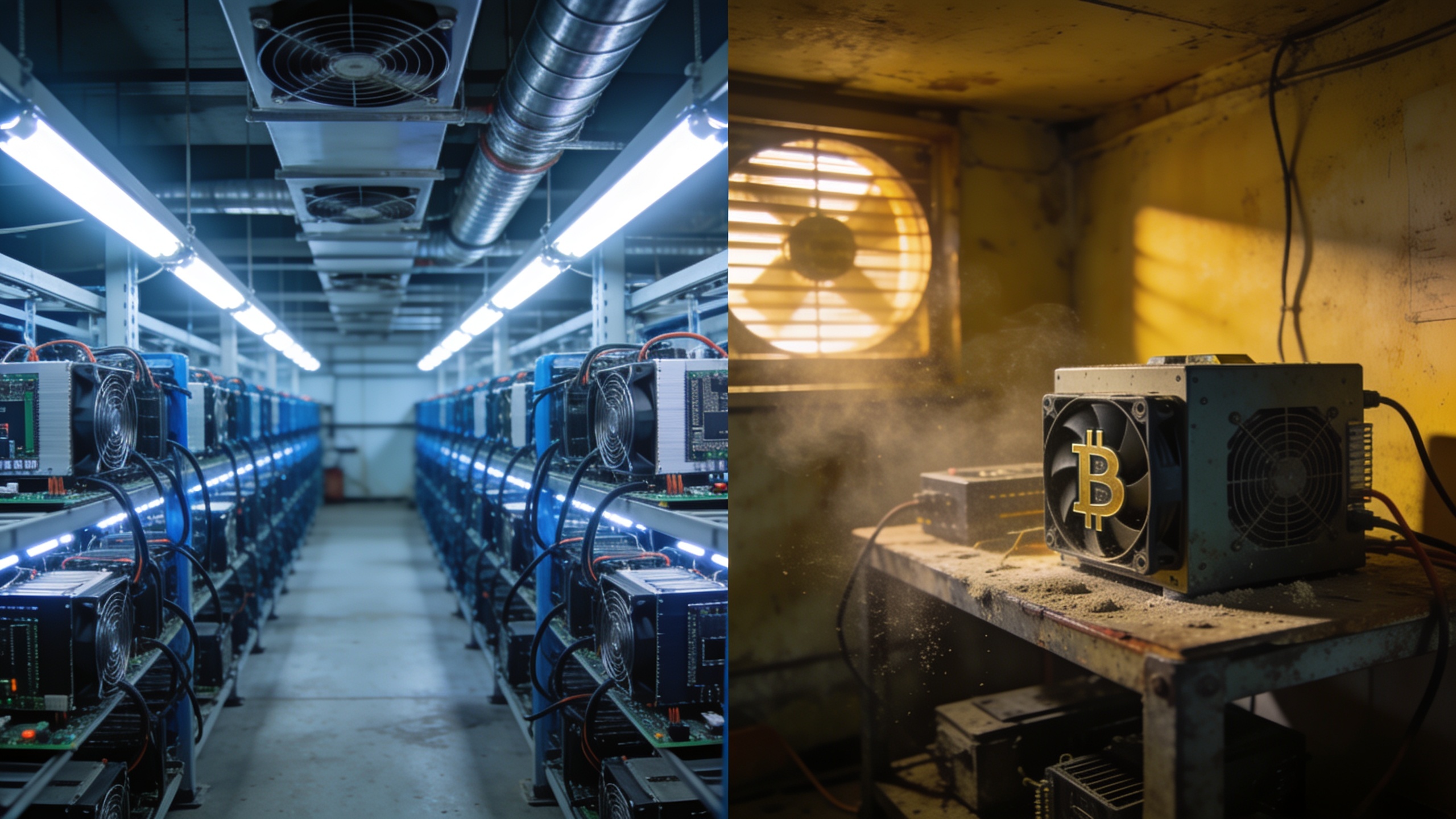
The miners who make it through a halving tend to share a few traits. They've got cheap electricity (often below $0.05 per kilowatt-hour), modern high-efficiency ASICs, and enough cash reserves or credit to ride out a rough patch without fire-selling their gear. The big publicly traded miners with diversified energy contracts and newer fleets have generally handled these squeezes way better than the smaller, thinly capitalized operations. If you're eyeing hardware around a halving, pay way more attention to efficiency (joules per terahash) than to raw hash rate. That distinction gets covered properly in this guide to the best Bitcoin ASIC miners and which rigs deliver the strongest ROI, and honestly, efficiency becomes the whole ballgame once the block reward shrinks.
| Factor | Miner Advantage | Miner Disadvantage |
|---|---|---|
| Electricity cost | Below $0.05/kWh, often via renewable or stranded energy | Above $0.10/kWh, retail-rate power |
| Hardware generation | Latest-generation ASICs with high efficiency (low J/TH) | Older ASICs approaching end of profitable life |
| Capital position | Strong cash reserves, low debt | Highly leveraged, reliant on selling mined BTC immediately |
| Operational scale | Large-scale industrial mining with negotiated power deals | Small-scale or hobbyist mining at retail electricity rates |
Is Bitcoin Halving 2025 Still Relevant to Watch?
Yes, 2025 is still a big deal for halving analysis even though the event itself went down in April 2024, because a halving's market and mining effects usually take 12 to 24 months to fully play out, not a single day. That's the whole reason "bitcoin halving 2025" keeps getting searched. A lot of the real-world impact on price, hash rate, and miner profitability was still getting digested well after the reward cut happened.
By 2025, the industry had already been through the first round of post-halving miner shakeout from April 2024, and hash rate had mostly steadied and started growing again as newer hardware rolled in and Bitcoin punched past $100,000 in late 2024. A handful of things stayed on the watch list through 2025. Whether fee revenue (sometimes goosed by stuff like Bitcoin inscriptions and Layer 2 settlement) could actually make a dent in the reduced subsidy for miners. How difficulty and hash rate trended as old rigs got retired and new ones came online. Whether institutional demand, especially through the spot Bitcoin ETFs that launched in the US in January 2024, kept soaking up new supply faster than issuance dropped. And whether the classic four-year cycle would rhyme again, with some analysts eyeing a possible cyclical top and drawdown, the same boom-and-correction rhythm we got after the 2013, 2017, and 2021 peaks.
None of that means the next few years will copy the old cycles perfectly. Bitcoin's market has changed structurally since 2020. Way more institutional players, regulated derivatives, ETF flows that simply didn't exist before. Some analysts think all that smooths out the violent boom-bust swings of the early days. Others reckon the fundamental supply shock keeps driving the same cyclical behavior no matter who's in the room. I genuinely don't know which camp is right, and I'd be suspicious of anyone who claims they do.
How Should Investors Prepare for the Next Halving Cycle?
If you're getting ready for Bitcoin's next halving cycle (expected around 2028), focus on understanding supply dynamics instead of trying to time one exact event, because halvings are scheduled years out and most of their impact gets priced in gradually rather than exploding on the halving date itself. The date is not a starting gun. That's the mental trap.
A few things I'd actually do here.
Track on-chain supply metrics, not just the price chart. Stuff like the stock-to-flow ratio (existing supply versus new issuance), miner reserve balances, and exchange outflows can flash early warnings about shifting supply pressure before price catches up.
Watch miner behavior specifically. Miners are often forced sellers just to keep the lights on, so changes in how they're selling around and after a halving can tip you off to price pressure before it hits.
And keep in mind that derivatives play a much bigger role in price discovery now than they did in 2012 or 2016. Futures open interest, options positioning, perpetual swap funding rates, they all tell you something about how leveraged traders are set up heading into and out of halvings. If any of that sounds like alphabet soup, the mechanics get broken down in more depth in this guide to futures, options, and perpetual swaps in crypto derivatives markets.
Last thing, and it's the one people ignore at their own expense: four cycles of past performance guarantee you nothing. The shrinking percentage returns each cycle? That's a documented pattern too, and it makes sense. Bitcoin's market cap keeps growing, so it takes exponentially more money pouring in to produce the same percentage move that pocket change could pull off in the early years.
FAQ: Bitcoin Halving Explained
When's the next Bitcoin halving after 2024?
Around 2028, assuming the network keeps cranking out blocks roughly every 10 minutes and the halving stays set at every 210,000 blocks. The exact date can drift a few days or weeks either way depending on how fast blocks actually get produced in the run-up.
Why does the halving affect price at all?
Because it cuts new coin issuance by 50%, which means less fresh supply coming from miners. If demand holds or grows while supply shrinks, basic economics points to upward price pressure, and that's held (with wildly different magnitudes) across all four halvings so far. But other macro and market factors push on price during those same windows too, so the halving is one ingredient, not the whole recipe.
Do miners actually lose money after a halving?
Not automatically, no. But their revenue per block gets halved instantly, which squeezes anyone on less efficient hardware or expensive power. Historically that triggers a consolidation wave where the weak operators shut down and difficulty adjusts down to compensate, while the well-capitalized miners with cheap power and modern gear tend to stay in the black.
Is bitcoin halving 2025 a real event, or did it already happen?
The last halving was April 2024, not 2025. People search "bitcoin halving 2025" because 2025 landed inside that 12-to-24-month window when the 2024 halving's effects were still actively working through the market. There was no separate halving that year.
How can I tell if a bull run's being driven by the halving or by something else?
Honestly, you usually can't isolate one cause cleanly, since halvings tend to overlap with ETF approvals, macro shifts, regulatory changes, all of it. What works better is comparing on-chain supply signals (falling exchange balances, shrinking miner sell pressure) against the broader catalysts happening at the same moment, rather than just assuming the halving explains every green candle.
Whatever else you take from this, the halving remains one of the most predictable, transparent monetary policies of any major asset out there. Hardcoded, publicly scheduled, immune to any single company or government's mood. Whether you're still chewing on the 2024 event's lingering effects through 2025 or looking ahead to the next cut around 2028, actually understanding block rewards, miner economics, and how price has behaved historically gives you a much steadier footing than just reacting to whatever the headlines are screaming that day.