Could Quantum Computing Break Bitcoin's Encryption? Examining the Real Quantum Computing Threat
Bitcoin has outlived exchange collapses, regulatory crackdowns, and roughly a dozen breathless "Bitcoin is dead" headlines since 2011. But the newest thing keeping some people up at night isn't about...

Bitcoin has outlived exchange collapses, regulatory crackdowns, and roughly a dozen breathless "Bitcoin is dead" headlines since 2011. But the newest thing keeping some people up at night isn't about markets or governments at all. It's about math. Specifically, whether a powerful enough quantum computer could someday unravel the cryptography protecting Bitcoin's private keys, and with them, hundreds of billions of dollars in digital assets.
So let me be clear up front: the quantum threat is real, in the sense that the physics and the math are genuinely understood and genuinely dangerous. But it's not happening tomorrow. Based on where the hardware actually stands right now (and I'll get into the specifics), most cryptographers put a working code-breaking quantum machine somewhere in the 2030s at the earliest. A 2025 research paper muddied that a bit by suggesting the timeline could shrink if error-correction keeps improving at its recent pace. More on that later.
What follows is the honest version of this story. What quantum computers actually do to cryptography, how far the tech has really come (spoiler: not as far as the hype suggests), which parts of Bitcoin carry actual risk, and what developers are already quietly building so the network is ready before the storm hits instead of after.
Table of Contents
- What Is the Quantum Computing Threat to Bitcoin, Exactly?
- How Close Are We to a Quantum Computer That Could Crack Bitcoin?
- Understanding Bitcoin Encryption Risk: Which Parts Are Actually Vulnerable?
- Bitcoin's Cryptography vs. Quantum Attack Methods
- What Are Developers Doing to Future-Proof Blockchain Security?
- Should Crypto Investors Worry About the Quantum Computing Threat Right Now?
- How Does This Compare to Other Crypto Risks?
- FAQ
What Is the Quantum Computing Threat to Bitcoin, Exactly?
The quantum threat to Bitcoin boils down to this: a future quantum computer could use specialized algorithms to work backward from your public key to your private key, then forge signatures and drain your funds. This isn't a bug someone forgot to patch. It's a mathematical weakness baked into the kind of cryptography that basically every blockchain runs on today.
Bitcoin leans on two main cryptographic tools. There's the Elliptic Curve Digital Signature Algorithm, or ECDSA, which is what proves you own your coins and lets you authorize transactions. And there's SHA-256, a hashing algorithm used both in mining and in generating your wallet address. Now, a classical computer can't reverse ECDSA's math in any practical way. Deriving a private key from a public key with today's machines would take longer than the universe has existed. That's not an exaggeration, it's just how the numbers shake out.
That whole assumption falls apart with quantum computers running Shor's algorithm. Peter Shor, a mathematician, figured this out back in 1994, which tells you how long we've known this was coming. His algorithm cracks the "discrete logarithm problem" that ECDSA depends on, and it does so exponentially faster than any classical method. In theory, a big enough fault-tolerant quantum machine could pull a Bitcoin private key out of an exposed public key in a matter of hours instead of eons.
Here's where a lot of the scary coverage gets sloppy, though. There's a second quantum algorithm, Grover's, that also threatens cryptography, but it only gives a quadratic speedup rather than an exponential one. And that difference is everything. SHA-256 falls into the category Grover's attacks. An exponential threat means you have to rip out the whole scheme and replace it. A quadratic threat? You can often just double your key or hash length and call it a day. Which is exactly why serious analysts treat Bitcoin's signature scheme (ECDSA) as the real long-term problem and its hashing (SHA-256) as almost an afterthought.
How Close Are We to a Quantum Computer That Could Crack Bitcoin?
Not close. Nothing that exists today comes remotely near breaking Bitcoin's encryption, and most experts think we've got at least another decade before that changes. The gap between the machines we have and a "cryptographically relevant quantum computer" (CRQC, if you want the acronym) has almost nothing to do with the qubit-count numbers that make headlines. It's about error correction. And that problem is nowhere near solved at scale.
Where the Hardware Actually Stands
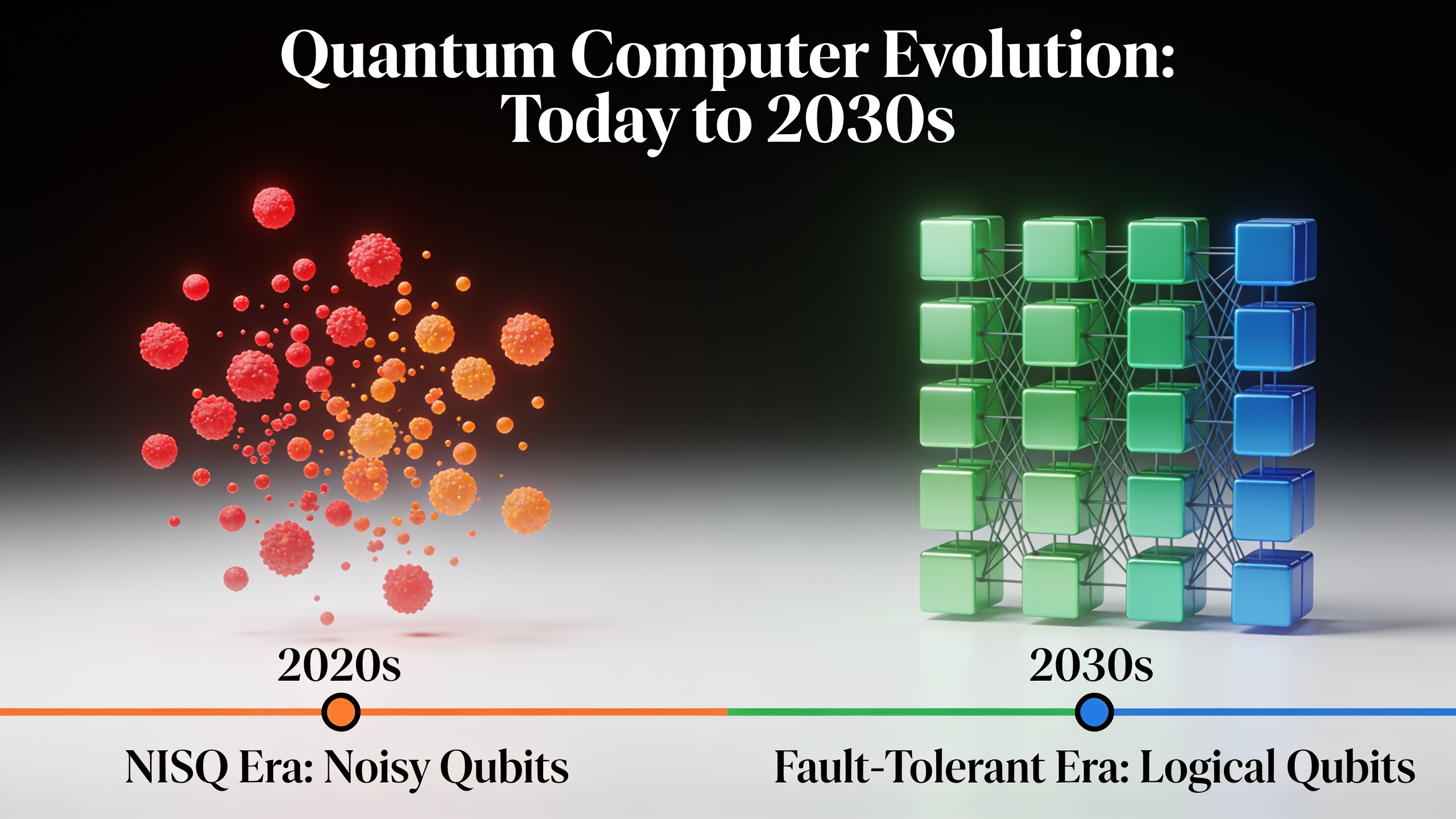
Today's quantum chips live in what researchers call the NISQ era, which stands for Noisy Intermediate-Scale Quantum. Fancy name for a simple truth: these chips have real qubits, but the qubits are twitchy and error-prone, and they lose their quantum state ("decohere") way too fast to run the long, delicate calculations Shor's algorithm demands. To actually break ECDSA-256, the curve Bitcoin uses, you need a fault-tolerant quantum computer. That means thousands of noisy physical qubits ganged together with quantum error correction to produce a much smaller number of rock-solid "logical qubits." Nobody has built one of those with enough logical qubits to threaten anything real. And building it is widely considered one of the hardest engineering problems in the history of computing. Not one of. One of the hardest, period.
Google's Willow, IBM's Roadmap, and Those Shrinking Estimates
That said, the field is moving, and moving in ways that keep this conversation from going stale. In December 2024, Google showed off its Willow chip, a 105-qubit processor that pulled off something researchers had been chasing for nearly thirty years. As you add more qubits to the error-correction system, the error rate actually goes down. That's the "below threshold" milestone, and it's a genuinely big deal. Willow can't break encryption (it can't come close), but it proves the engineering approach that could eventually get us to fault tolerance actually works.
IBM, for its part, has put out a public roadmap for a large-scale fault-tolerant system it's calling IBM Quantum Starling, targeting somewhere around 2029. Take that date with appropriate salt. It's a target, not a promise. And on the theory side, Google researcher Craig Gidney dropped an updated analysis in 2025 suggesting that factoring a 2,048-bit RSA key might take fewer than 1 million noisy qubits. That's a massive cut from the roughly 20 million qubits he and Martin Ekerå had estimated together back in 2019. Since ECDSA and RSA rest on related hard math problems, that kind of efficiency jump matters directly for Bitcoin. And honestly, it's the single biggest reason cryptographers have started quietly nudging their timelines earlier instead of later.
| Milestone | Year | What It Demonstrated | Relevance to Bitcoin |
|---|---|---|---|
| Shor's algorithm published | 1994 | Theoretical proof that quantum computers can break RSA/ECC-style cryptography | Establishes the mathematical basis of the long-term threat |
| Gidney & Ekerå qubit estimate | 2019 | ~20 million noisy qubits needed to factor RSA-2048 | Set the original "far away" timeline for classical public-key crypto |
| NIST post-quantum standards finalized | 2024 | First official replacement algorithms for RSA/ECC | Gives blockchains a standardized migration path |
| Google Willow chip | Dec. 2024 | Below-threshold quantum error correction at 105 qubits | Key engineering step toward fault tolerance, still far from attack-capable |
| Gidney updated qubit estimate | 2025 | Under 1 million noisy qubits now estimated for RSA-2048 | Suggests the threat timeline could be shorter than previously assumed |
| IBM Quantum Starling target | ~2029 (roadmap) | Planned large-scale fault-tolerant system | Represents an industry target date, not a guarantee |
Understanding Bitcoin Encryption Risk: Which Parts Are Actually Vulnerable?
The risk isn't spread evenly across the network. Some coins and transaction types are structurally way more exposed than others, and it mostly comes down to one thing: whether a wallet's public key has ever been shown on-chain. If you take away one technical detail from this entire article, make it this one. It's the thing the sensational coverage almost always skips.
The Public Key Exposure Problem
When you receive Bitcoin to a standard modern address (something like P2WPKH or P2TR), the network only stores a hash of your public key. Not the key itself. Your actual public key doesn't get revealed until the moment you spend from that address, at which point it's broadcast so other nodes can verify your signature. That opens a narrow window, the time between broadcasting and confirmation, where a quantum-equipped attacker could in theory grab your public key, crack the private key, and try to spend your funds before you do. It's a legitimate theoretical risk. But it only matters once fault-tolerant quantum computers exist and are fast enough to do all that inside a roughly ten-minute confirmation window. That's a much taller order than just "breaking ECDSA" in a vacuum.
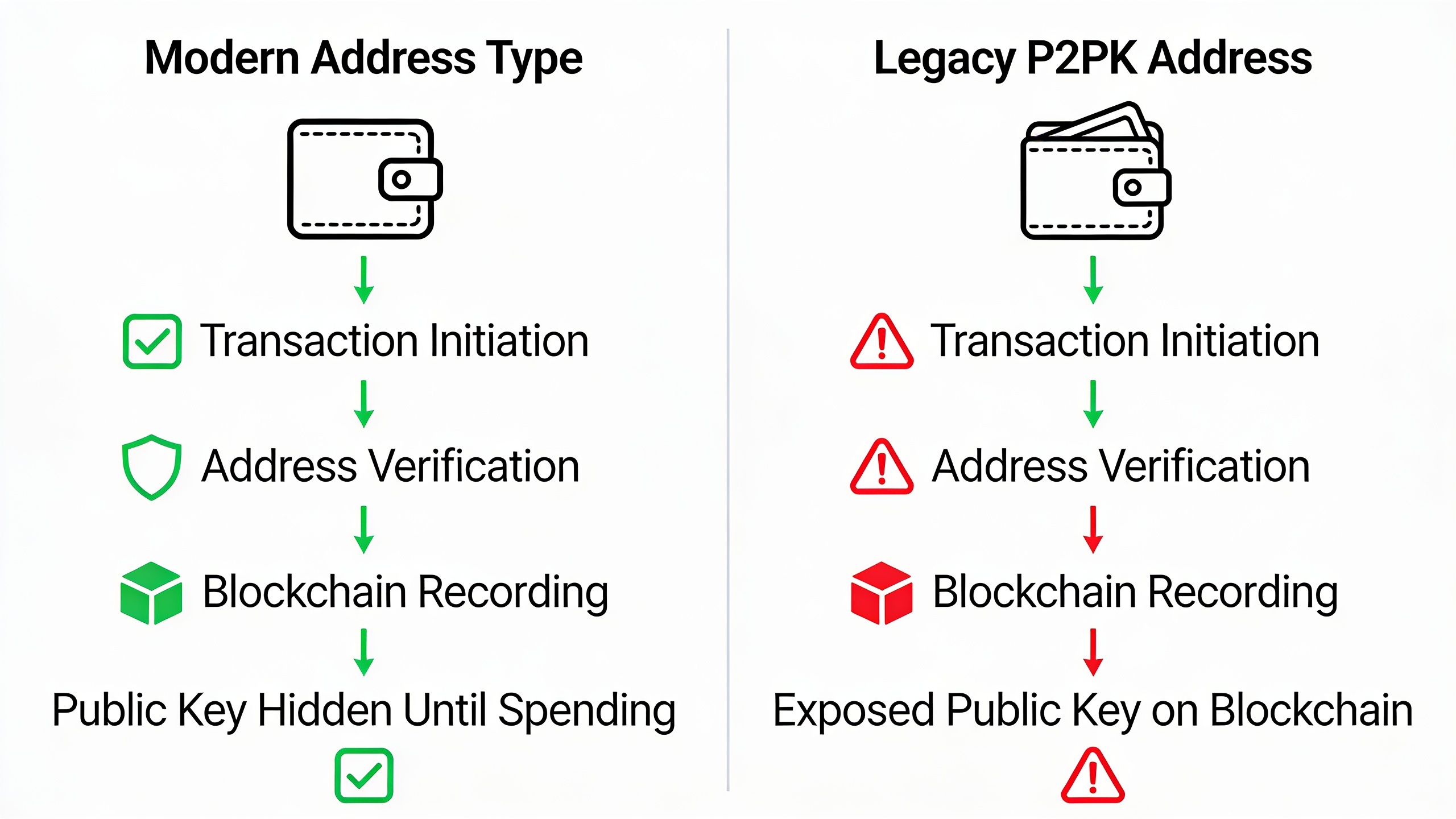
The scarier exposure sits with old coins. In Bitcoin's earliest days, it used a script format called Pay-to-Public-Key (P2PK), where the full public key just sits in the blockchain forever, no hash hiding it. Any coins parked in those legacy addresses (including a big chunk of the very first coins ever mined) have their public keys permanently out in the open, ready for offline analysis. No interception window needed. A 2024 analysis from Deloitte estimated that roughly 25% of all bitcoin in circulation, on the order of 4 million BTC, sits in wallet types that could be considered vulnerable if a cryptographically relevant quantum computer ever showed up, mostly because of exposed or reused public keys. That number is why this isn't purely an academic parlor game. A meaningful slice of the total supply carries more risk than a freshly generated wallet does.
What About Mining and SHA-256?
Mining and address hashing run on SHA-256, and like I mentioned earlier, this layer is far tougher against quantum attacks than ECDSA. Grover's algorithm only offers that quadratic speedup, which effectively knocks a 256-bit hash down to something like 128-bit strength. Still an astronomically huge number, well beyond anything foreseeable hardware could brute-force. Most cryptographers file mining security under "secondary concern" and move on. So will I.
Bitcoin's Cryptography vs. Quantum Attack Methods
| Bitcoin Component | Cryptographic Basis | Quantum Attack | Type of Speedup | Practical Risk Level |
|---|---|---|---|---|
| Transaction signatures | ECDSA (secp256k1) | Shor's algorithm | Exponential | High — the primary long-term concern |
| Wallet addresses (hashed, unspent) | SHA-256 / RIPEMD-160 hash of public key | Requires public key exposure first | N/A until spent | Low, as long as address hasn't been used |
| Legacy P2PK / reused addresses | Exposed raw public key | Shor's algorithm | Exponential | High — already exposed, no interception needed |
| Mining (Proof-of-Work) | SHA-256 hashing | Grover's algorithm | Quadratic | Low — mitigated by existing hash length |
| In-flight transactions (mempool) | ECDSA, briefly exposed public key | Shor's algorithm + fast execution | Exponential, but time-constrained | Currently theoretical — requires near-instant quantum computation |
What Are Developers Doing to Future-Proof Blockchain Security?
Plenty, actually, and they started long before any quantum machine posed a real threat. The strategy has a name in the crypto world: "crypto-agility." The idea is to have the replacement algorithms sitting on the shelf, ready to go, well before you actually need them. Because swapping out an entire network's cryptographic guts is slow, coordination-heavy work. You don't want to be starting that project the day the threat becomes real.
NIST's Post-Quantum Standards
In August 2024, the U.S. National Institute of Standards and Technology (NIST) finalized its first batch of post-quantum cryptography standards, capping off roughly eight years of public review. These include FIPS 203 (ML-KEM, built on the CRYSTALS-Kyber algorithm) for encryption key exchange, plus FIPS 204 (ML-DSA, from CRYSTALS-Dilithium) and FIPS 205 (SLH-DSA, from SPHINCS+) for digital signatures. They're designed to hold up against both classical and quantum attacks, and they're already rolling out across browsers, VPNs, and government systems. For blockchain developers, they're essentially the reference toolkit for building quantum-resistant replacements for ECDSA.
Bitcoin's Own Proposals
Within Bitcoin's developer community, there've been draft proposals kicking around, sometimes discussed under names like "Pay to Quantum-Resistant Hash" (P2QRH), for a new address and signature type built on those post-quantum algorithms. The idea is to give people a way to migrate funds into quantum-safe wallets before there's any actual threat to run from. Worth stressing, though: these are still in the discussion-and-drafting phase. Nothing's live on the real Bitcoin network. And any real implementation would have to survive the same slow, consensus-driven review that every Bitcoin protocol change goes through, which is by design a grind. Other chains are on similar paths, weighing hash-based and lattice-based signature schemes as long-term replacements for elliptic curve crypto.
The takeaway for anyone following this stuff isn't panic. It's that this is a methodical, years-long engineering effort running alongside the hardware development, not scrambling to catch up behind it.
Should Crypto Investors Worry About the Quantum Computing Threat Right Now?
For most people holding crypto today, this is a long-term planning question, not a reason to check your portfolio in a cold sweat. No quantum computer that exists can break ECDSA, and the leading roadmaps (IBM's ~2029 fault-tolerant target included) put a cryptographically relevant machine years out even under optimistic assumptions.
But "years away" and "never" are not the same thing, and that 2025 drop in estimated qubit requirements is a good reminder that quantum timelines have a nasty habit of compressing faster than anyone expected. So here's what a practical person can actually do today, without waiting on any protocol change: don't reuse Bitcoin addresses, move funds out of any old P2PK-style addresses you might be holding, and keep half an eye on your wallet software for quantum-resistant address formats as they show up. None of this involves panic-selling or bailing on your position. It's closer to flossing than to a fire drill.
And look, Bitcoin isn't special here. Pretty much every blockchain (Ethereum, Solana, all of them) runs on the same family of elliptic curve cryptography, which means the quantum threat is an industry-wide thing, not some unique Bitcoin flaw. If you're weighing risk across different assets, it's worth reading up on altcoins vs. Bitcoin and how their risk profiles compare, because cryptographic risk is just one ingredient in the stew, alongside liquidity, developer activity, regulatory exposure, and everything else that separates one coin from the next.
How Does This Compare to Other Crypto Risks?
Stack it against the stuff crypto investors deal with constantly, and the quantum threat ranks low on probability but high on long-term severity. Lower odds, bigger consequences. A quantum attack, if it ever became real, could in theory shatter trust in the whole asset class overnight. Compare that to short-term stuff like market corrections or Bitcoin trading in lockstep with the S&P. Those happen constantly, but they're rarely existential.
That contrast actually matters for how you spend your worry budget. Market risks are well documented already. Recent analysis of crypto and stock market correlation data shows just how tightly Bitcoin and equities have moved together during macro stress, and that has nothing to do with cryptography and everything to do with investor nerves. Quantum risk is the opposite kind of animal: slow-moving, deeply technical, and being actively defused by developers years ahead of schedule. Smart portfolio thinking keeps them in separate boxes. One's a near-term dynamic you trade around. The other's a long-horizon tech risk you monitor, not something you react to every week.
FAQ
Can quantum computers hack Bitcoin today?
No. Nothing in existence has the scale or the error correction to break Bitcoin's ECDSA signatures. Today's machines, Google's 105-qubit Willow chip included, are stuck in the noisy intermediate-scale quantum (NISQ) era. They're still a long way from the fault-tolerant systems, with maybe over a million reliable logical qubits, that experts think you'd need to threaten real cryptography.
Which Bitcoin wallets are most at risk from quantum computing?
The ones that have exposed their raw public key on-chain. That mainly means legacy Pay-to-Public-Key (P2PK) addresses from Bitcoin's early days, plus any address that has reused a public key. Standard modern addresses that have never spent funds only reveal their public key at the moment of a transaction, which shrinks (though doesn't totally kill) this category of risk.
What is Shor's algorithm and why does it matter for Bitcoin?
It's a quantum computing method Peter Shor came up with in 1994 that solves the math behind RSA and elliptic curve cryptography exponentially faster than any classical computer can. Since Bitcoin's ECDSA signatures rest on one of those problems (the elliptic curve discrete logarithm problem), a big enough fault-tolerant quantum machine running Shor's could, in theory, derive a private key from an exposed public key.
Are developers actually building quantum-resistant cryptocurrency solutions?
Yep. NIST finalized its first post-quantum cryptography standards (FIPS 203, 204, and 205) in August 2024, and Bitcoin developers have floated draft proposals, sometimes called P2QRH, for quantum-resistant address and signature formats. Those are still in the discussion phase and haven't been deployed on Bitcoin's live network.
Should I sell my Bitcoin because of the quantum computing threat?
Most cryptographers and hardware roadmaps put a cryptographically relevant quantum computer years away, so no, this isn't an immediate reason to exit. The saner move is basic wallet hygiene, avoiding address reuse and staying in the loop on quantum-resistant upgrades, rather than making investment calls over a threat that hasn't shown up yet.
---
Bottom line: the quantum threat to Bitcoin is a real long-term engineering challenge, not a countdown clock ticking toward zero. We've understood the math behind Shor's algorithm for three decades. The hardware is advancing in documented, incremental steps. And both the wider cryptography world and Bitcoin's own developers are already building the replacement tools to stay ahead of it. For investors, the useful mindset isn't fear, it's awareness. Know which wallet types carry more exposure, watch how post-quantum standards get adopted across the ecosystem, and treat this as one more thing to keep an eye on in a market that's never exactly short on those.