Crypto Estate Planning: How to Protect Your Digital Inheritance
Crypto estate planning is the process of documenting, securing, and legally structuring your cryptocurrency so it actually reaches the people you want it to reach after you die or become...


Crypto estate planning is the process of documenting, securing, and legally structuring your cryptocurrency so it actually reaches the people you want it to reach after you die or become incapacitated. And here's what makes it different from everything else in your estate: there's no customer service line your family can call to recover a lost Bitcoin wallet. No "forgot password" link that magically restores your self-custodied Ethereum. No government registry quietly keeping track of who owns what. If you don't plan for this, your crypto can just... disappear the moment something happens to you. Not because of hackers. Not because the market crashed. Because nobody else knew the seed phrase existed.
So this guide is the practical version. How to write a will that doesn't accidentally torch your privacy, how to think about multisig versus custodial setups, what the tax and legal side actually looks like, and the mistakes that quietly send inherited crypto into the void forever.
Table of Contents
- What Is Crypto Estate Planning and Why Should You Care?
- How Do You Write a Will That Actually Covers Crypto?
- Multisig Wallets and Custody Options for Passing Crypto Down
- Comparing Your Options: A Side-by-Side Look
- The Legal and Tax Stuff Nobody Warns You About
- A Step-by-Step Way to Build Your Plan
- The Mistakes That Get Crypto Lost Forever
- Questions People Actually Ask
What Is Crypto Estate Planning and Why Should You Care?
Crypto estate planning is building a documented, legally sound system that lets your heirs find, access, and legally claim your digital assets without needing to guess your passwords or somehow read your mind about where the seed phrase lives. It's traditional estate planning (wills, trusts, powers of attorney) welded onto the crypto-specific stuff: seed phrases, multisig wallets, hardware devices.
The problem here is structural, not bad luck. Crypto ownership is defined entirely by cryptographic control. Whoever holds the private key controls the asset. That's it. That's the whole rule. There's no bank manager who can verify your identity and reissue access the way they'd reissue a lost debit card. Blockchain analytics firms have pointed out for years that a serious chunk of all mined bitcoin is sitting in wallets that are basically unreachable, thanks to lost keys, forgotten passwords, and dead hardware with no backup. And that's not some edge case. That's the default outcome for anyone who doesn't plan for what happens to their keys when they're gone.
This gets messier the more diverse your holdings are. People today aren't just holding coins. They've got NFTs, DeFi positions, staked tokens, even virtual land, which is the kind of thing I dug into over in Metaverse Real Estate Investment: Smart Bet or Digital Bubble?. All of it lives on-chain, and all of it needs the same private-key access as a plain Bitcoin wallet. Without a plan, these assets don't get fought over in probate court. There's nothing to fight over. They simply vanish, because nobody can prove ownership or open the wallet.
How Do You Write a Will That Actually Covers Crypto?
A crypto-inclusive will is a legal document that names your digital assets, identifies who gets them, and points your executor toward instructions for accessing them, all without dumping your private keys or seed phrase into the will itself. That last part matters enormously. Wills often become part of the public probate record once a court gets hold of them, so writing your seed phrase into the document is one of the most common and genuinely disastrous mistakes people make. You'd be publishing the keys to your kingdom.
Keep the Legal Stuff and the Actual Keys Separate
Your will (or a letter it points to) should say a few things. Which platforms and wallets hold assets, described in general terms, like "a self-custody hardware wallet" or "an account with a centralized exchange." Do not list exact balances, because those change constantly and can spark tax and valuation headaches. It should also say who gets what, and in what proportion. And it should say where the keys, seed phrases, or PINs actually live, whether that's a bank safe deposit box, an attorney's office, or split across a multisig setup, without ever printing the credentials themselves inside the public-facing document.
Pick an Executor Who Won't Be Totally Lost
Most traditional executors know their way around bank accounts, real estate, and brokerage statements. Ask them to locate a hardware wallet or verify a 24-word seed phrase and you'll get a blank stare. So either name a tech-literate executor, add a co-executor specifically for the digital stuff, or work with an attorney who's actually handled digital asset inheritance before. Otherwise your carefully written instructions get misread, and misread instructions are almost as bad as no instructions.
Write a Letter of Instruction
A letter of instruction is a private document, not filed with any court, that fills in the operational details your will can't safely hold: wallet types, where the backups are, which email is tied to which exchange account, the step-by-step recovery walk-through. Because it never goes public, it can be as detailed as you want. Just keep it somewhere secure (a safe, a vault, your attorney's files) and reference it in your will rather than reproducing it. Think of the will as the map that says "the treasure exists, and here's who should look for it," while the letter is the treasure map itself.
Multisig Wallets and Custody Options for Passing Crypto Down
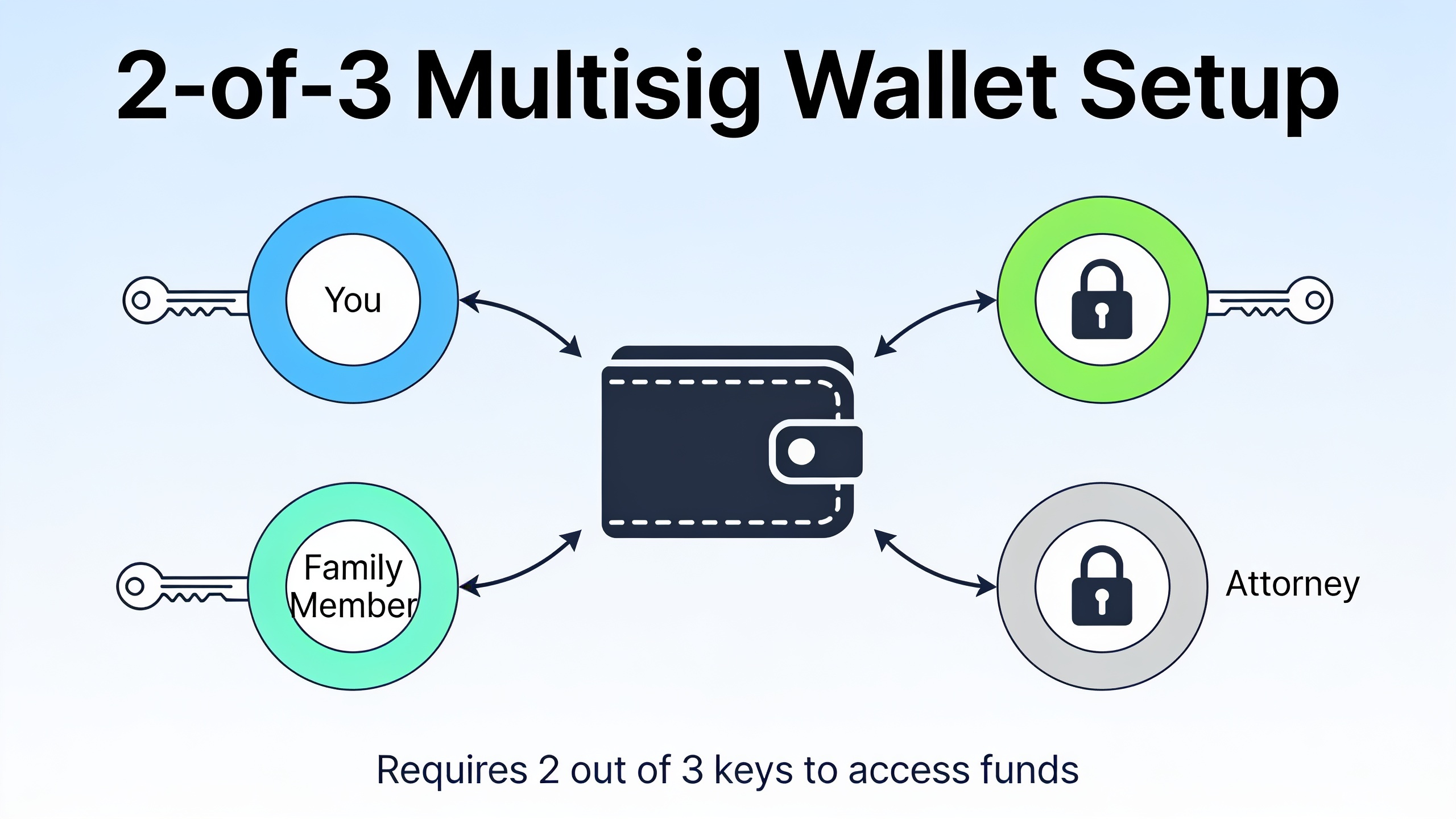
Multisig wallets are one of the best tools for crypto estate planning because they kill the single point of failure that a lone private key creates. A multisig (multi-signature) wallet needs a set number of separate keys to approve any transaction. Two out of three. Three out of five. Whatever you configure. Nobody holds total, exclusive control. Access gets spread out.
Why Multisig Is So Good for This
A common estate-planning setup is a 2-of-3 multisig. You hold one key. A trusted family member or heir holds one. And an attorney, corporate trustee, or specialized inheritance service holds the third. While you're alive, you can sign transactions with your key plus one other signer, or set things up so you can still transact solo, depending on how the wallet's configured. After you're gone, the two remaining keyholders combine their keys and move the funds to your heirs. No need for your original key at all. And no catastrophe if one of the backup keys gets lost or destroyed along the way.
This quietly solves the two nightmare scenarios of self-custody at once. Total loss, where the only key gets destroyed and the money's gone for good. And premature access, where you share a backup key too early and someone helps themselves before you've actually passed. Multisig spreads out both the risk of losing everything and the risk of getting robbed. Honestly, for anyone with a meaningful stack, it's hard to beat.
Custodial Solutions and the Catch
Custodial solutions, meaning platforms where a third party holds the keys for you (centralized exchanges, mostly), give you a totally different inheritance path. Since the exchange controls the keys, not you, your heirs can potentially get access through the platform's official account-recovery and probate process, kind of like how a bank handles a dead customer's account. They'll usually need a death certificate, the will, and whatever other documentation the platform demands.
The catch is that custodial holdings drag counterparty risk back into the picture. You're trusting the platform's solvency and security instead of controlling your own keys. That same tension runs through the whole market, which I got into in Crypto Stock Market Correlation: What Recent Data Shows. Digital assets don't float free of the broader financial system or the platforms holding them, and that's worth chewing on when you're deciding how much of your estate to park in someone else's custody versus keeping under your own control.
The Dead Man's Switch Services
There's a newer breed of service aimed squarely at digital inheritance: dead man's switch platforms and crypto-specific inheritance protocols. The basic idea is you "check in" on some schedule, weekly, monthly, quarterly. Miss enough check-ins and the service assumes something's happened to you, then triggers a pre-programmed release of encrypted instructions or keys to your beneficiaries. Neat concept. But since these are third-party services, you really need to vet them hard. What's their security track record? Do they hold any key material themselves? And what happens if the service dies before you do? That last one keeps me up at night a little, because you're essentially betting a startup outlives you.
Comparing Your Options: A Side-by-Side Look
There's no single "best" way to pass on crypto. It comes down to how big your portfolio is, how technical you are, and how many trustworthy people you've got to hold keys. Here's how the main approaches stack up on the things that actually matter.
| Solution | How Access Works | Main Advantage | Main Risk | Best Suited For |
|---|---|---|---|---|
| Single hardware wallet + will reference | One seed phrase stored securely, referenced (not printed) in the will | Simple, full self-custody control | Total loss if the single backup is destroyed or misplaced | Smaller holdings, single beneficiary |
| Multisig wallet (e.g., 2-of-3) | Multiple keyholders must combine signatures to move funds | No single point of failure; theft and loss both mitigated | More setup complexity; requires cooperative, trusted keyholders | Larger holdings, multiple heirs, tech-comfortable families |
| Centralized exchange custody | Exchange controls keys; heirs go through the platform's estate/probate process | Familiar process similar to traditional bank inheritance | Counterparty risk; dependent on the exchange's policies and solvency | Investors already using exchanges for most holdings |
| Dead man's switch / inheritance service | Automated release of instructions after missed check-ins | Doesn't require heirs to understand crypto beforehand | Relies on a third-party service remaining operational and secure | Owners without a reliably available co-signer |
| Attorney-held instructions with safe deposit box | Attorney holds sealed instructions; box holds physical key backups | Combines legal oversight with physical security | Slower access; dependent on attorney's own continuity | Owners who want traditional legal structure around the process |
The Legal and Tax Stuff Nobody Warns You About
In most places, cryptocurrency counts as property for estate and tax purposes, which means it generally flows through the same probate and estate tax machinery as stocks, real estate, or any other capital asset. But with extra headaches around valuation, access, and jurisdiction. Since crypto trades 24/7 and swings hard, the value on the date of death (usually the number that matters for estate tax) can look wildly different from the value even a few days later. Which is exactly why timestamped, accurate documentation is worth the effort.
Probate and the Jurisdiction Mess
If your will only references crypto in general terms, without forcing anyone to publish wallet addresses or balances, probate can roll along much like it would for any other asset. The complication is that blockchains don't respect borders, and your exchange might be headquartered in a completely different country than you lived in. So cross-border inheritance can raise the question of whose laws even apply, especially for holdings on offshore exchanges or wallets not clearly tied to one legal home. This is genuinely not the place to wing it. An estate attorney who understands digital assets in your specific jurisdiction isn't a nice-to-have here, it's the whole ballgame.
Trusts, If a Plain Will Isn't Enough
A trust is a legal arrangement where a trustee holds and manages assets for your named beneficiaries, usually following conditions you set up ahead of time. For crypto specifically, a trust can pull off a few things a simple will can't. Assets in a trust generally skip the public probate process, so your holdings and beneficiaries stay private. You can hand the trustee explicit technical instructions for wallet access instead of leaning on a probate court that's never touched crypto in its life. And you can stagger distributions over time, which is honestly a smart move if an heir isn't ready to responsibly manage a big lump of a volatile asset all at once.
What Heirs Need to Know About Taxes
When crypto gets inherited, most tax systems apply a "step-up" (or step-adjustment) in cost basis to the value on the date of death. In plain English, your heir's future capital gains get calculated from that new value, not what you originally paid. So heirs should nail down a clear record of the date-of-death valuation, because crypto's price swings can make that number seriously different from where it sat a week earlier or later. Tax rules differ by country and keep changing, so this is one area where you want a real tax pro confirming current requirements before the estate gets settled, not a random guide on the internet. Including this one.
A Step-by-Step Way to Build Your Plan
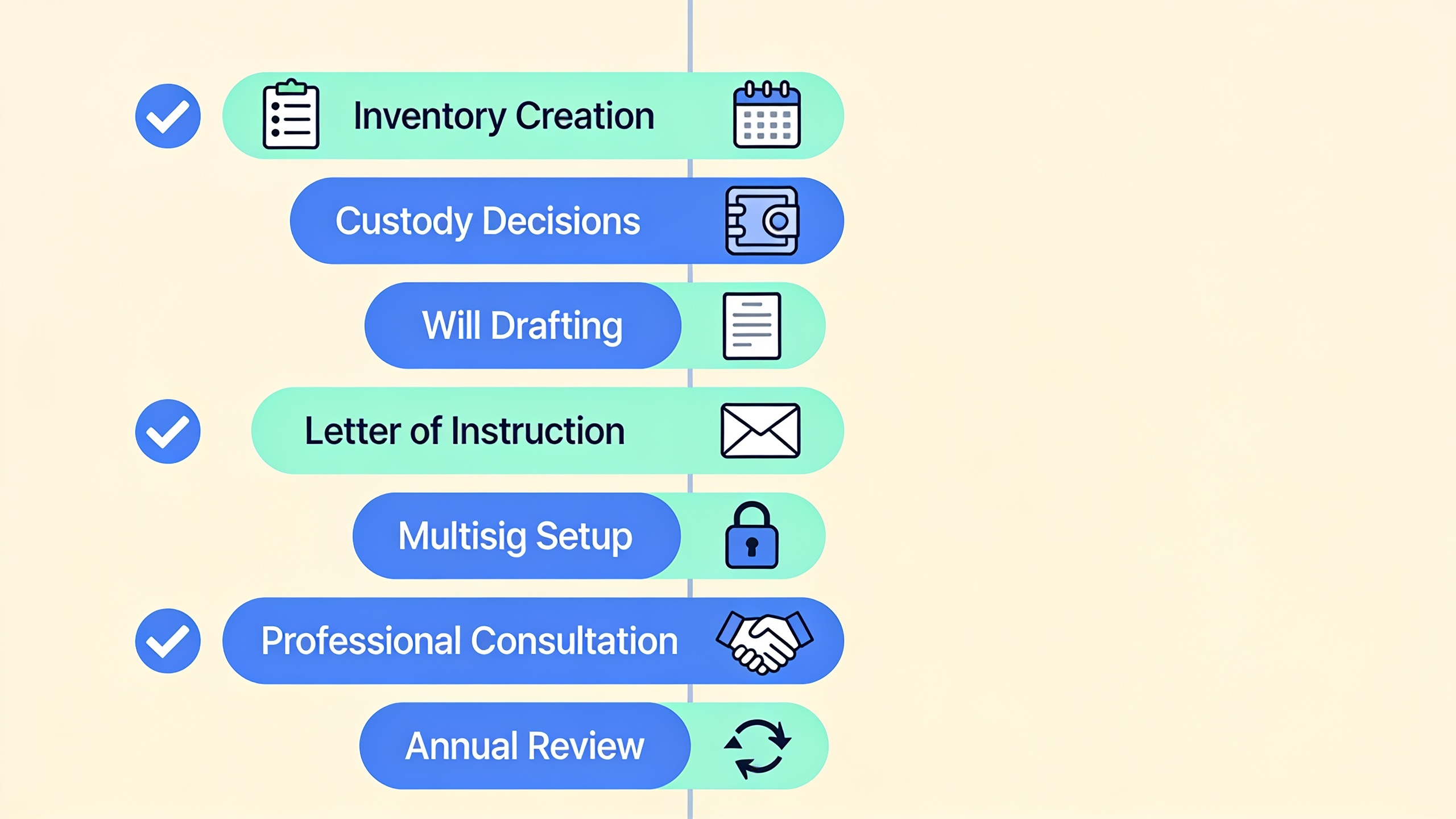
Building a crypto estate plan isn't about producing one perfect document. It's about layering things: legal authority in one place, technical access in another, human trust holding it together. Here's a sequence that works.
Start by taking inventory of every single holding. Every wallet, every exchange account, every staking position, every NFT collection, with the platform or wallet type noted for each. Just don't write down any private keys in this master list.
Then decide on a custody structure, asset by asset. Does self-custody, multisig, or exchange custody make the most sense for this particular thing, given how big it is and how tech-savvy your heirs are? A tiny position and a mega-stack don't need the same treatment.
Next, draft or update your will. Reference the digital assets generally, name your beneficiaries, and pick an executor (or co-executor) who's got either the technical chops or the professional backup to handle crypto. Then write that separate letter of instruction with the detailed, step-by-step access walk-through, store it somewhere secure and non-public, and make sure your executor and one trusted family member know where to find it.
If you've got larger holdings, this is where you'd set up multisig or a dead man's switch, spreading signing authority across trusted people or configuring an inheritance service with periodic check-ins. Then loop in the professionals, an estate attorney and a tax advisor who've actually dealt with digital asset inheritance, since generic estate templates tend to whiff on crypto entirely.
And review it every year. Update your inventory and instructions whenever you open new accounts, move wallets around, or your portfolio shifts in a big way. An outdated instruction set is nearly as dangerous as having none, because it confidently points your heirs at the wrong place.
The Mistakes That Get Crypto Lost Forever
Most stories of lost crypto inheritance don't involve some brilliant hacker. They come down to a short list of avoidable screw-ups. Recognizing these is honestly more useful than any single fancy tool.
Writing seed phrases directly into a will is the big one. Wills often become public record during probate, so you've either turned your private key into public information or created a document you can't safely file at all. Right up there with it is telling nobody anything. A plan that exists only in your head dies with you, full stop. Even a trusted spouse or adult kid needs to know the crypto exists and roughly where the instructions live.
Then there's the single point of failure trap. One seed phrase, on one piece of paper, in one drawer, is one house fire or flood or careless move away from gone forever. People also love to ignore platform-specific recovery processes. Centralized exchanges have their own procedures for verifying a deceased account holder's estate, and if you never documented the account emails, usernames, or two-factor backups, even legitimate heirs can get blocked or stuck in limbo.
A couple more that quietly wreck plans:
- Never updating anything. Portfolios move. New wallets, new exchanges, new NFT collections, new categories like tokenized real-world assets. A three-year-old instruction set might send your heirs to accounts that hold nothing anymore.
- Treating crypto as its own separate island. Your digital assets should live inside the same will, trust, and tax strategy as everything else, not bolted on as an afterthought that never talks to the rest of the plan.
Questions People Actually Ask
Do I really need a lawyer for this, or can I just write my own instructions?
You can absolutely document instructions yourself, and you should. But for the legal will and trust pieces, a lawyer who knows digital asset inheritance is strongly worth it. Probate courts, tax authorities, and cross-border rules all vary, and a generic will template tends to completely miss the crypto-specific access issues.
What actually happens to my crypto if I die with no plan?
Your heirs would have to independently figure out the assets even exist, track down the private keys or seed phrases, and prove they're legally entitled to them. That process fails a lot, especially with self-custodied wallets where there's no company or institution to call for help. Usually it just means the money stays locked away forever.
Is multisig overkill for a small portfolio?
For modest holdings, yeah, probably. A single hardware wallet with a securely stored backup and a referenced letter of instruction is often plenty. Multisig adds complexity that really earns its keep with larger portfolios or situations where several heirs need shared, verifiable access.
Can't I just leave my exchange password to a family member?
Risky, and often not enough. Most exchanges have specific legal processes for transferring a dead user's account, usually needing a death certificate and probate docs. Just logging in with a shared password can violate the platform's terms of service or set off security holds that freeze everything anyway.
How does crypto's volatility mess with estate taxes?
Since most jurisdictions value inherited property as of the date of death, and crypto can lurch around dramatically in a short window, the exact valuation date and source (say, a specific exchange price at a specific time) really matters for clean tax reporting. Get a tax professional to help you document it precisely.
Crypto estate planning isn't a one-and-done chore you check off and forget. It's more of an ongoing habit that has to keep up with how your portfolio changes, whether that's a growing multisig setup, a fresh NFT collection, or exposure to newer stuff like tokenized real estate. The people who actually manage to protect their digital inheritance are the ones who treat their keys with the same seriousness as their will. Documented, spread out, reviewed on a schedule. So that everything they built doesn't quietly evaporate the second they're no longer around to unlock it.