Metaverse Real Estate Investment: Smart Bet or Digital Bubble?
So here's the deal with metaverse real estate: you're buying a parcel of virtual land, usually as an NFT, on a blockchain platform like Decentraland or The Sandbox, and you're betting it'll either go...

So here's the deal with metaverse real estate: you're buying a parcel of virtual land, usually as an NFT, on a blockchain platform like Decentraland or The Sandbox, and you're betting it'll either go up in value or make you money somehow. That's it. That's the whole pitch. It blew up as a serious topic in late 2021 when a few eye-watering transactions pushed some plots of pixels into the millions.
Three years on, though, the question people are asking has changed completely. Nobody's really wondering "how do I get in?" anymore. Now it's more like: "Was there ever any actual value here, or did we all just watch a bubble inflate and pop in slow motion?" That's what I want to dig into. The real transactions, how this stuff supposedly gains value, and what you'd actually want to think about before dropping crypto on digital dirt.
Table of Contents
- What Is Metaverse Real Estate Investment, Exactly?
- The 2021 Land Rush: How Decentraland and The Sandbox Became Investment Targets
- Decentraland vs. The Sandbox: Comparing the Two Leading Virtual Land Markets
- Is Metaverse Real Estate Investment Still Profitable in 2024?
- What Actually Drives Virtual Land Value?
- How Does Metaverse Property Compare to Traditional Assets?
- Warning Signs of a Digital Bubble
- How to Evaluate a Metaverse Real Estate Investment Before Buying
- FAQ
What Is Metaverse Real Estate Investment, Exactly?
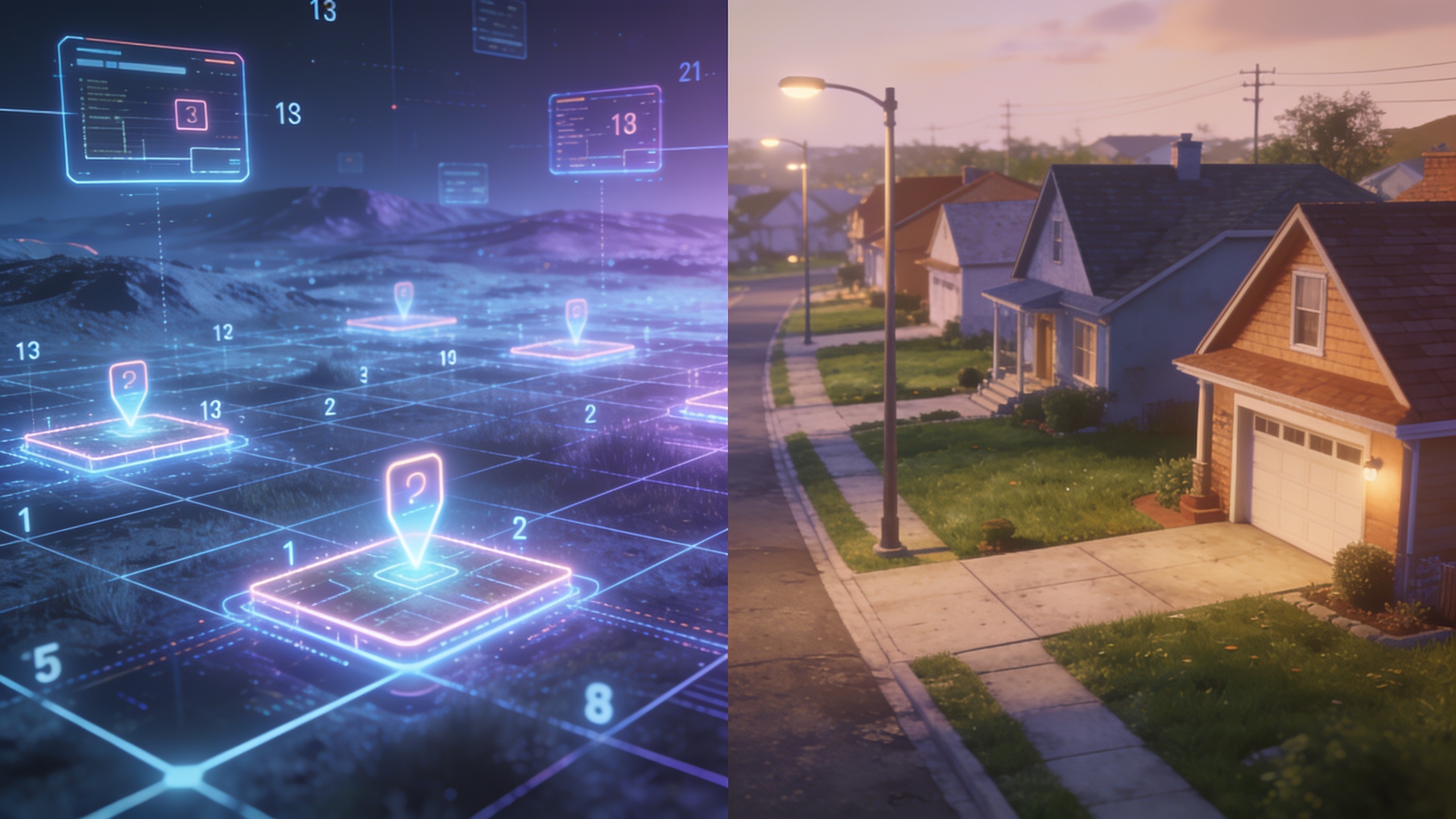
Metaverse real estate investment means buying a non-fungible token (an NFT) that represents ownership of a specific coordinate, or "parcel," inside a blockchain-based virtual world. There's no dirt. No deed office. No physical scarcity at all. The scarcity is coded into the smart contract, which basically decides how many parcels can ever exist and then locks that number in forever.
On Decentraland, which was launched by the Decentraland Foundation, the land parcels (they call them LAND) are ERC-721 tokens living on Ethereum, sitting on a fixed grid. The Sandbox is a competing voxel-based world, and it works pretty much the same way, a capped map of LAND parcels bought and sold in its own SAND token. Once you own a parcel you can, in theory, build stuff on it. Games, galleries, event spaces, little virtual storefronts, whatever. Then you monetize that activity, or you just sit on the land and flip it later for more than you paid. Which, honestly, is the exact same logic that drives people to buy empty lots of physical land and do nothing with them.
But here's the part that keeps me up at night about the whole idea. Metaverse land has zero utility outside the platform it lives on. If Decentraland or The Sandbox loses its users, that token has nothing to fall back on. No rental market. No farmland value. No zoning. Nothing. It just becomes a receipt for a spot in a ghost town. And that single fact is basically the foundation of every serious argument against treating this as a real asset class.
The 2021 Land Rush: How Decentraland and The Sandbox Became Investment Targets
The whole boom really kicked off when Facebook announced in October 2021 that it was rebranding as Meta Platforms. Overnight, "metaverse" went from a nerdy sci-fi word to something your uncle was asking about at Thanksgiving. And within weeks, all that money sitting on the edge of the 2021 crypto bull run came flooding into virtual land. Prices spiked to levels that looked less like speculative crypto tokens and more like actual Manhattan office space.
Republic Realm's $4.3 Million Sandbox Purchase
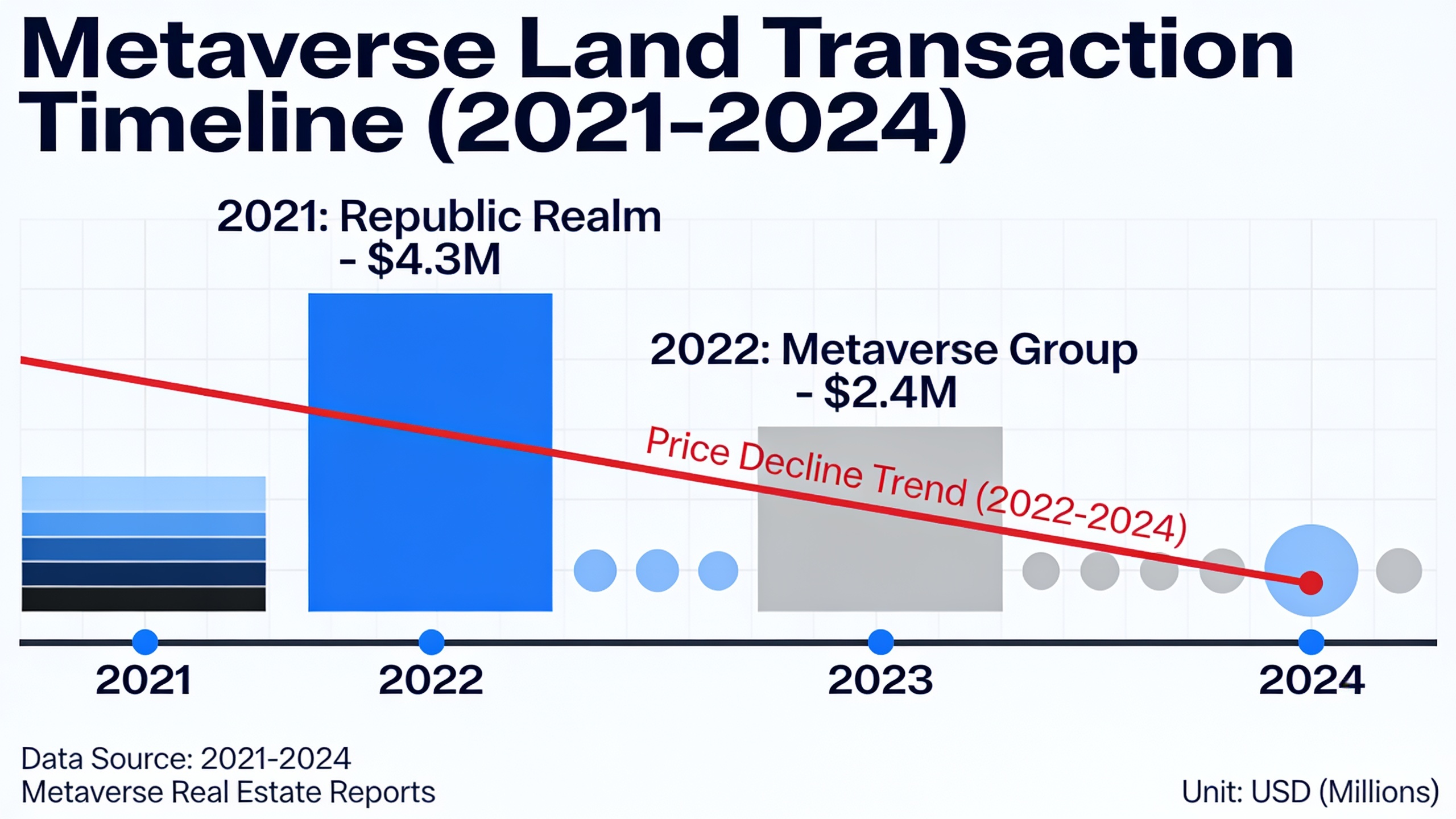
In November 2021, Republic Realm, a firm built entirely around metaverse real estate, bought a portfolio of virtual land in The Sandbox for $4.3 million, according to Reuters. At the time it was the biggest metaverse land purchase anyone had recorded, and it became the go-to headline for "look how serious the money is getting." Their whole plan was to develop, lease, and monetize the parcels the way a physical developer treats a commercial land bank. The bet was that grabbing "prime" spots near popular hubs early would compound in value as more people and brands showed up.
Metaverse Group's Decentraland Deal Near Snoop Dogg's Estate
Right around the same time, Metaverse Group (a subsidiary of the publicly traded Tokens.com) picked up a Decentraland parcel for roughly $2.4 million, also per Reuters. What made this plot worth that much? Its location. It sat near a virtual estate tied to Snoop Dogg, who'd set up shop in Decentraland. So basically, the same "nice to live next to a celebrity" premium that inflates real house prices... except the celebrity mansion is made of blocks and the neighborhood doesn't physically exist.
These two deals became the reference point for basically every "metaverse real estate is the future" article that followed. What most of that coverage conveniently skipped over is that both buyers were specialized, heavily funded companies making strategic plays at peak market hype. These weren't regular people buying a plot and expecting rent checks.
Decentraland vs. The Sandbox: Comparing the Two Leading Virtual Land Markets
Decentraland and The Sandbox are the two names that come up in literally every metaverse land conversation, but they're not identical. They differ in governance, token setup, and how ownership actually works inside each world.
| Feature | Decentraland | The Sandbox |
|---|---|---|
| Native token | MANA | SAND |
| Land token standard | LAND (ERC-721 on Ethereum) | LAND (ERC-721 on Ethereum, Polygon-linked features) |
| Governance | Decentraland DAO votes on platform decisions | Governed by The Sandbox company with a DAO/governance layer for community input |
| Total land supply | Fixed grid of parcels (finite, publicly documented map) | Fixed grid of parcels (finite, publicly documented map) |
| Notable 2021 transaction | ~$2.4 million parcel purchase by Metaverse Group (Reuters) | $4.3 million portfolio purchase by Republic Realm (Reuters) |
| Primary value drivers | Proximity to popular districts, brand/celebrity neighbors, event hosting | Proximity to game hubs, partner-branded experiences, developer activity |
| Underlying utility | User-built experiences, virtual events, galleries, social spaces | Voxel-based games and experiences built with The Sandbox's game-creation tools |
Both platforms lean on the same core promise: the land is scarce because the code says so, and its worth depends entirely on how many people actually bother to show up around it. And here's a thing that bugs a lot of analysts. Neither platform has put out independently audited daily-user numbers that you could stack against a mainstream gaming platform. That gap is exactly why skeptics keep asking whether there's real demand underneath all this, or whether it's mostly existing token holders trading parcels back and forth among themselves.
Is Metaverse Real Estate Investment Still Profitable in 2024?
Honestly? It depends almost entirely on when you got in, and most people who bought near the November 2021 peak are still waiting for those prices to come back. Metaverse land basically moved in lockstep with the wider crypto market. It rode up with Bitcoin and Ethereum through 2021, then got hammered in the 2022 bear market, which also crushed MANA and SAND (both of which, remember, are publicly traded cryptocurrencies exposed to the exact same macro forces as everything else in crypto).
Blockchain analytics platforms like DappRadar have tracked a big pullback in NFT and metaverse-related trading volume since that 2021 peak, right in line with the broader collapse of speculative crypto assets through 2022. And that pattern really matters if you're sizing this up as an investment. It didn't behave like uncorrelated real estate at all. It behaved like a high-beta crypto asset, cranking up the gains on the way up and the losses on the way down. If you're weighing this against how digital assets behave generally, it's worth knowing that crypto-linked stuff has shown more and more correlation with speculative market cycles over time. Good context before you throw money at virtual land specifically.
So for someone thinking about buying today, the real question isn't "did land go up in 2021." It obviously did, at least for a handful of headline deals. The question is whether today's parcel prices reflect actual sustainable demand or just leftover speculative pricing from a market that's since gone cold. And because neither Decentraland nor The Sandbox publishes audited, independently verified usage figures (at least in the materials I looked at for this), that demand question is genuinely tough to answer with any confidence from the outside.
What Actually Drives Virtual Land Value?
Virtual land value comes down to a few things: how close a parcel is to a busy district, whether it's associated with a brand or celebrity, how active the platform's users are, and the mood of the wider crypto market. Notice what's not on that list. Anything physical. There's no soil, no view, no square footage. It's coordinates on a blockchain map. Wrapping your head around that is the single most important step toward understanding whether this stuff behaves like real estate or like a crypto derivative in a real estate costume.
In practice, four forces really move the needle.
There's the proximity effect, which we saw with that Metaverse Group parcel near Snoop's estate. Land near recognizable landmarks or celebrity builds fetches a premium, same as physical property in a desirable neighborhood.
Then there's platform activity, and this one's the big one. A parcel is only worth as much as the number of avatars likely to wander past it, attend an event on it, or interact with whatever you've built there. But without audited user metrics from the platforms, you're mostly relying on self-reported or third-party guesses to judge this. Which is... not great.
Third, token price correlation. Since land is priced and often denominated in MANA or SAND, and the transactions usually route through Ethereum, your parcel's dollar value is directly hooked to the price swings of those coins. Meaning your land can lose value even if its location and reputation inside the world haven't budged one bit. That's a weird thing to accept.
And finally, plain old speculation and media cycles. The Facebook-to-Meta rebrand in October 2021 is the cleanest example you'll ever find of a single outside event dragging an entire asset class up with it. When the metaverse headlines dried up, so did the volume and the prices. Funny how that works.
How Does Metaverse Property Compare to Traditional Assets?
Metaverse land is way more volatile and way less liquid than either traditional real estate or an established crypto like Bitcoin, and that's because it manages to combine the worst of both. You get the illiquidity of a one-of-a-kind asset stacked on top of the price volatility of a speculative crypto market. Traditional real estate is illiquid too, sure, but at least it's backed by the fact that people need somewhere to live and work, plus a few centuries of legal and appraisal infrastructure. Metaverse land has none of that.
And compared to just buying MANA or SAND outright, a specific parcel is even harder to unload, because you don't just need a buyer who likes the platform. You need a buyer who wants that exact coordinate. That's a real structural problem. A fungible token sells in seconds on an exchange. A unique NFT parcel might sit there for months waiting for the right person to come along. Anyway, if you're going to buy the tokens you need to transact in these worlds, you'll eventually have to decide where to get them, and going through a centralized platform versus dealing directly with another person comes with its own tradeoffs around control, speed, and verification. That's covered in more depth over in P2P Crypto Trading vs Centralized Exchanges: Which One's Right for You?.
Oh, and there's a longer-term security thing that regular property investors never have to lose sleep over. Your ownership of virtual land depends entirely on the cryptographic integrity of the blockchain it's recorded on. If the encryption standards protecting these ledgers ever got seriously broken, the ownership records themselves could get called into question. That's a scenario picked apart in Could Quantum Computing Break Bitcoin's Encryption? Examining the Real Quantum Computing Threat, and it's relevant to any asset (NFT land very much included) that's counting on blockchain security holding up for decades.
Warning Signs of a Digital Bubble
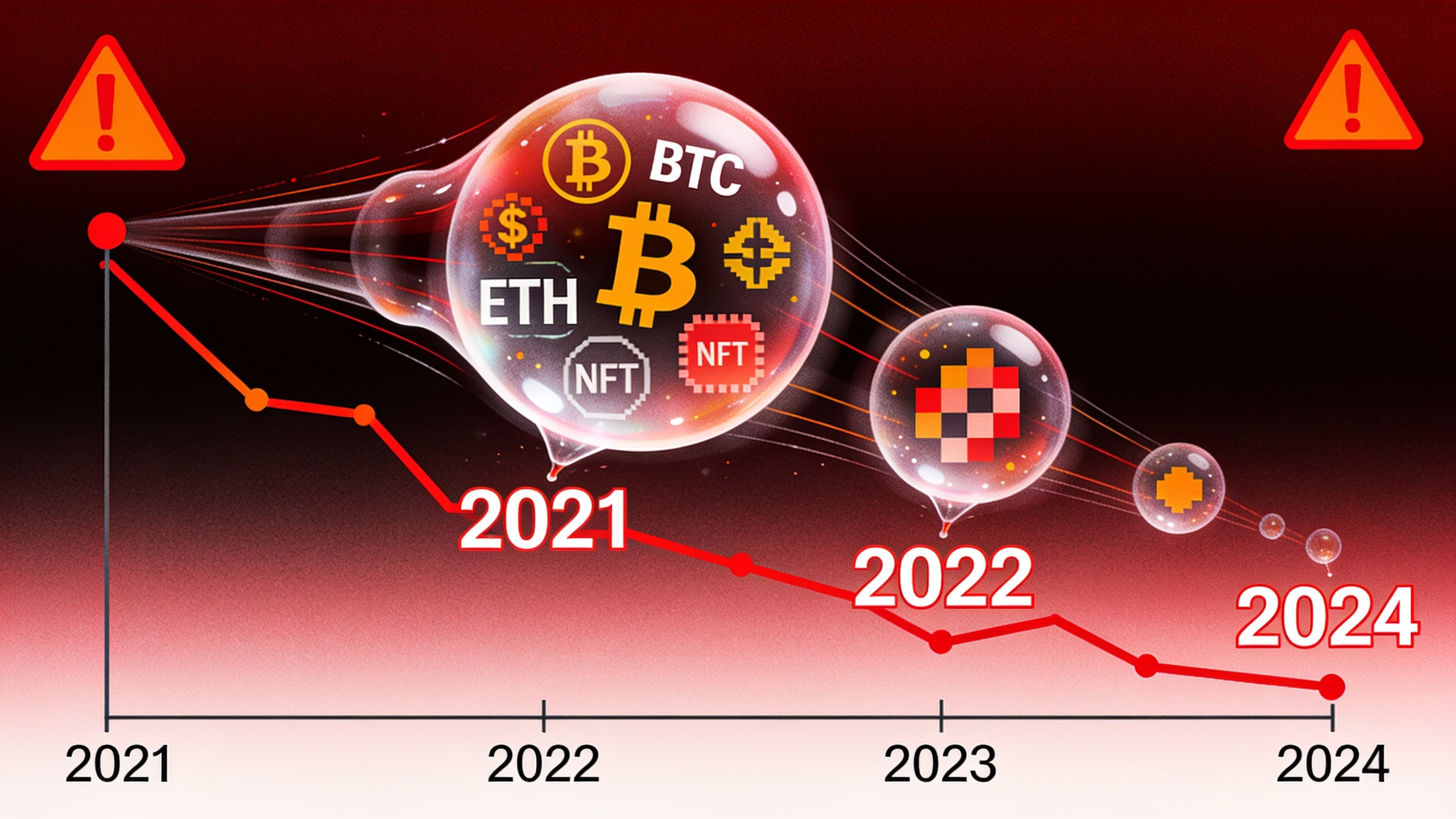
Here's the strongest case for the bubble crowd, and it's a pretty good one. The two transactions that basically hold up the entire "this is a legit asset class" argument, the $4.3 million Sandbox deal and the $2.4 million Decentraland deal, both happened within the same few weeks of late 2021, driven by the same news cycle, and nothing comparable in size and reporting has come along since. When a whole asset class leans its credibility on a couple of headline deals from one narrow window of pure hype, that's not proof of a durable market. That's a warning label.
A few other red flags worth saying out loud:
- It's chained to token prices. Land is priced in MANA and SAND, so if those tanks, the dollar value of every parcel drops mechanically, no matter what you've built on it.
- The usage data is thin and unaudited. Neither platform in the material I reviewed has put out independently verified daily active user numbers, which makes it really hard to tell genuine engagement apart from wallet-level speculation.
- The big buyers were specialists. The largest documented purchases came from firms like Republic Realm and Metaverse Group, companies literally built around metaverse asset strategy. Not a broad base of everyday buyers with steady demand.
- The resale market is narrow. A unique parcel needs a specific matching buyer, unlike a fungible token, which chokes your liquidity right when you might want out.
Now, none of this proves metaverse land is worthless. Both Decentraland and The Sandbox are still running and still hosting stuff people build. But it does make me think the "real estate" label is doing more marketing work than economic work. Calling something "digital real estate" borrows the trust of a centuries-old asset class and slaps it onto a product that's only existed, in this form, for a few years. That's a neat trick, and I don't fully buy it.
How to Evaluate a Metaverse Real Estate Investment Before Buying
If you're still tempted, my advice is to treat this as a high-risk, illiquid crypto bet, not a real estate purchase, and size your position like you might lose the whole thing. A few concrete moves make the whole evaluation less of a leap of faith:
- Actually check the parcel's spot on the platform's public map, not just the seller's marketing deck, so you can confirm those "close to the hub" or "next to a famous neighbor" claims.
- Price it in both the native token and real dollars, then stress-test it. What happens to your fiat value if MANA or SAND drops 50%? That's not hypothetical. It's already happened once in this market's short life.
- Hunt for signs of real usage. Events hosted nearby, visitor counts, active builds. Don't lean only on resale price history, because price can just reflect people speculating, not actual demand.
- Figure out how you'll buy and store the tokens before you commit, since it usually means holding Ethereum-based crypto in a self-custodied or exchange wallet. That part matters just as much as picking the right parcel.
- Assume you'll struggle to sell. Unlike a coin you can dump on an exchange, a unique land NFT might take ages to move at a decent price. So treat whatever you put in as locked up for who-knows-how-long.
Frequently Asked Questions
Should a beginner crypto investor try metaverse real estate?
Probably not as a starting point. It's a high-risk, speculative play that mashes crypto volatility together with the illiquidity of unique digital assets. And since neither Decentraland nor The Sandbox has published independently audited usage data, a newcomer has no easy way to verify whether the demand is actually there before buying.
What does virtual land in Decentraland or The Sandbox actually cost?
It varies enormously depending on location and market conditions. Both platforms saw prices go vertical around the November 2021 land rush. Republic Realm's $4.3 million Sandbox portfolio and Metaverse Group's roughly $2.4 million Decentraland parcel (both reported by Reuters) are the classic examples. Prices have generally cooled since that peak alongside the wider crypto correction, so check the current figures directly on each platform's marketplace rather than trusting 2021 headlines.
Can you actually earn passive income from metaverse land?
In theory, yeah. You can lease parcels, host paid events, or build things people pay to use. In practice, all of that hinges on getting visitors to your specific parcel, which is never guaranteed, and neither platform publishes verified data telling you how likely that is.
What happened to prices after the 2021 peak?
They fell hard alongside the 2022 crypto bear market, as trading volume across NFT and metaverse markets dropped, per data tracked by analytics platforms like DappRadar. That mirrored the slide in MANA and SAND token prices over the same stretch, which just goes to show how tightly virtual land value is bolted to overall crypto sentiment.
Is metaverse property basically the same as owning an NFT?
Yes. A metaverse land parcel is an NFT (usually an ERC-721 token) that records who owns a specific coordinate on the platform's map. Owning the land means owning that unique token, with all the same custody, security, and resale headaches that come with any other NFT.
Metaverse real estate sits in this strange spot where real estate psychology meets crypto market mechanics, and the honest 2024 read is that it's behaved far more like a jittery, thinly traded crypto asset than like property. Those 2021 headline deals from Republic Realm and Metaverse Group proved serious money was willing to bet on the idea. But three years of market cycles since have shown that virtual land rises and falls with the same forces that move all of crypto, not with any demand you can actually verify. If you get that risk profile and size your bet accordingly, fine, it's a legitimate if speculative corner of the digital asset world. But if you're expecting anything resembling real-estate stability, everything I've seen points more toward bubble than durable asset.