Crypto Lending Platforms Compared: Rates, Risks, and Rewards
Crypto lending platforms let you earn interest on crypto that's just sitting there, or borrow cash and stablecoins against your holdings without actually selling them. If you've got Bitcoin,...


Crypto lending platforms let you earn interest on crypto that's just sitting there, or borrow cash and stablecoins against your holdings without actually selling them. If you've got Bitcoin, Ethereum, or a pile of stablecoins gathering digital dust in a wallet, these platforms have become one of the more tempting ways to put that idle capital to work. Some still throw off annual yields that make your bank's savings account look like a bad joke. But they're not all the same, and if you needed proof that a shiny APY means nothing on its own, the Celsius and BlockFi meltdowns in 2022 delivered it.
So let's go through how this actually works, what the leading platforms charge and pay, and the risks you'd be foolish to ignore before parking a single satoshi anywhere.
Table of Contents
- What Are Crypto Lending Platforms and How Do They Work?
- Centralized vs. Decentralized Lending Platforms
- Where Can You Find the Best Crypto Lending Rates?
- Collateral Requirements Explained
- How Safe Are Crypto Lending Platforms?
- Weighing the Rewards Against the Risks
- How to Choose the Right Platform for Your Goals
- Frequently Asked Questions
What Are Crypto Lending Platforms and How Do They Work?
Crypto lending platforms connect people who want to lend out their crypto with people who need to borrow, either through a company sitting in the middle or through automated smart contracts running on a blockchain. Lend your assets, earn interest. Borrow, and you post collateral (usually crypto) worth more than the loan itself.
The mechanics aren't complicated. You deposit, say, some USDC or ETH. The platform pools everyone's deposits and lends them out to borrowers who pledge collateral, typically at loan-to-value ratios somewhere between 25% and 70%. Interest ticks up daily or per block, and most of the time you can pull your money out whenever you want. Though some platforms dangle higher yields if you're willing to lock funds up in a "fixed term" product. Borrowers use these loans for all sorts of reasons: covering a short-term cash crunch without selling and triggering taxes, leveraging a trade, or just getting liquidity while staying bullish long term.
This is a very different animal from a bank loan. No credit checks, usually. Approval can take minutes because the whole thing is secured by digital collateral rather than your income or a FICO score. That's the appeal, sure, but it also means the entire arrangement leans hard on the platform actually knowing what it's doing with collateral, liquidity, and counterparty risk. And as everyone found out in 2022, that competence isn't a given.
Centralized vs. Decentralized Lending Platforms
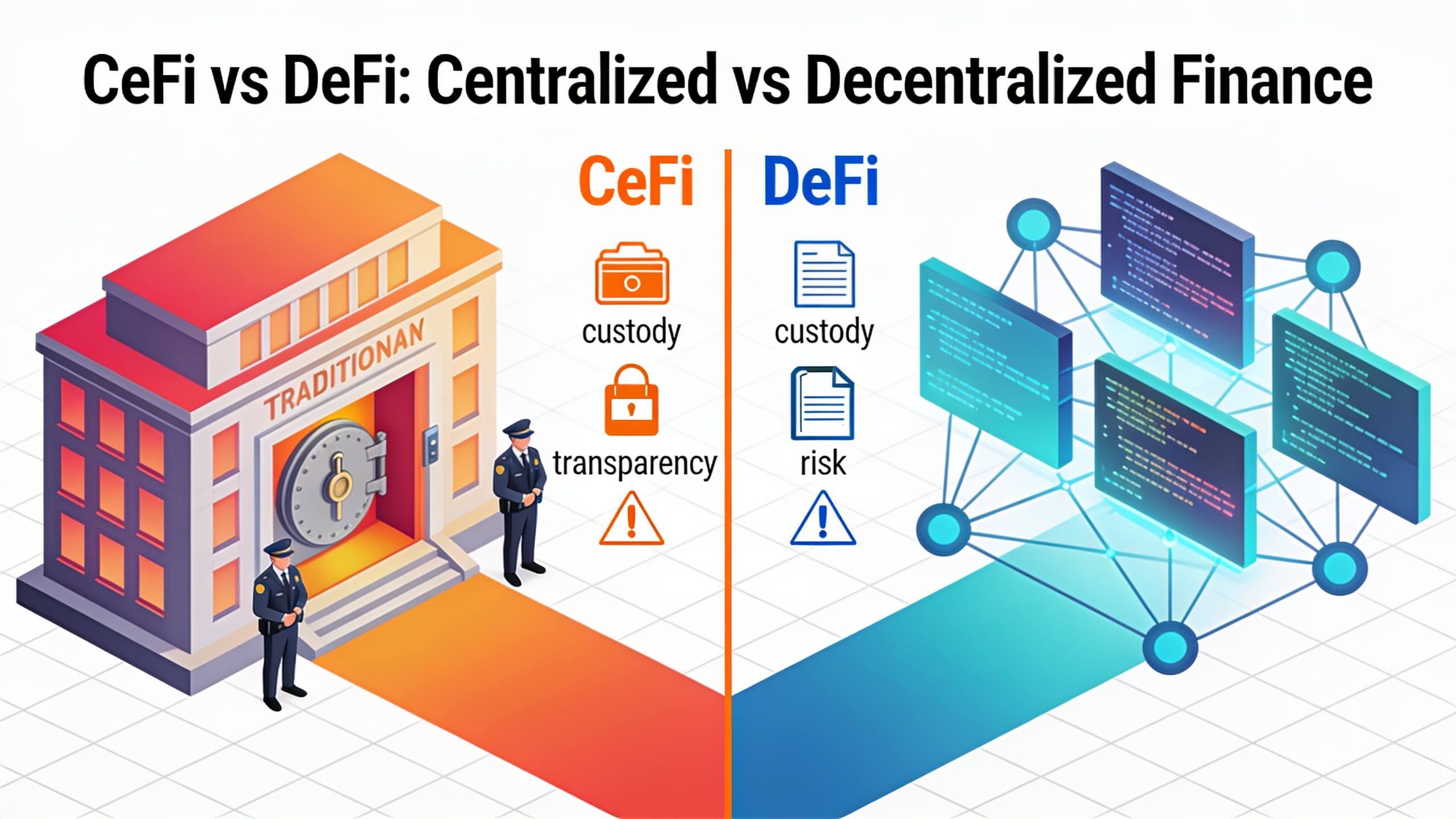
There are two big camps here: centralized finance (CeFi) platforms, run by a company that holds your assets for you, and decentralized finance (DeFi) protocols, which use smart contracts to handle everything without a custodian in the picture. They come with genuinely different risk profiles, so this isn't a "pick whichever" situation.
CeFi platforms like Nexo and Ledn feel a lot like regular fintech apps. Easier signup, actual customer support, insured cold storage, sometimes even proper lending licenses in certain places. The catch is custodial risk: you don't hold the keys to your deposited coins, so you're basically betting on the company staying solvent and running its risk desk responsibly. That's the exact weak point that torched Celsius Network depositors when the company filed for Chapter 11 in July 2022, owing users roughly $4.7 billion according to court filings cited by Reuters. Not a rounding error.
DeFi protocols like Aave and Compound work differently. You interact straight with a smart contract and keep custody of your keys right up until the funds hit the protocol. Rates float algorithmically based on live supply and demand in each asset pool, and everything (collateral ratios, liquidations, all of it) is right there on-chain for anyone to see. That transparency is a real edge. But DeFi has its own gremlins: smart contract bugs, oracle manipulation, and the brutal reality that a poorly collateralized position can get liquidated instantly and permanently in a crash. No phone call, no grace, just gone.
| Feature | CeFi Platforms (e.g., Nexo, Ledn) | DeFi Protocols (e.g., Aave, Compound) |
|---|---|---|
| Custody of funds | Platform holds assets | User retains wallet control until deposit |
| Rate structure | Often fixed or tiered | Algorithmic, floats with supply/demand |
| Onboarding | KYC/AML, account-based | Wallet connection, largely permissionless |
| Transparency | Limited to company disclosures | Fully on-chain and auditable |
| Main risk | Company insolvency, mismanagement | Smart contract exploits, liquidation risk |
| Regulatory oversight | Varies by jurisdiction, increasing | Minimal to none in most regions |
If you already shop around before deciding where to buy or sell your crypto (and you should, which is why we put together this guide to the best crypto exchanges compared for fees, security, and features), apply that same energy to lending platforms. The custody and operational differences between CeFi and DeFi can matter every bit as much as the yield they're advertising.
Where Can You Find the Best Crypto Lending Rates?
The best crypto lending rates in 2024 mostly land between about 2% and 8% APY on big assets like Bitcoin and Ethereum, and can push to 10% or higher on stablecoins when borrowing demand runs hot. These numbers move constantly, though, and shift with each platform's lock-up terms and loyalty tiers. Stablecoins almost always pay more than volatile coins, simply because borrowers usually want cash-equivalent liquidity, not more BTC or ETH exposure.
Nexo, for instance, advertises up to 16% APY on certain stablecoin deposits, but there's fine print: you've got to take your interest in its native NEXO token and climb into the higher loyalty tiers. The flexible, no-strings rates are a lot lower. Ledn leans heavily into Bitcoin-backed lending and has historically paid Bitcoin savings rates in the low single digits, with more competitive numbers on stablecoins. Over on the DeFi side, Aave's stablecoin pools like USDC and USDT tend to bounce between roughly 3% and 12% APY depending on how heavily a pool is being borrowed against. The rate automatically climbs when borrowed capital creeps toward the supply ceiling. That's by design.
| Platform | Type | Typical Stablecoin APY Range | Typical BTC/ETH APY Range | Withdrawal Flexibility |
|---|---|---|---|---|
| Nexo | CeFi | 4%–16% | 1%–6% | Instant (flexible tier lower yield) |
| Ledn | CeFi | 3%–9% | 0.5%–3% | Instant on flexible products |
| Aave | DeFi | 3%–12% (variable) | 0.1%–3% | Instant, subject to pool liquidity |
| Compound | DeFi | 2%–10% (variable) | 0.1%–2% | Instant, subject to pool liquidity |
| YouHodler | CeFi | 3%–12% | 1%–4% | Varies by lock-up term |
Chasing the fattest APY without asking why it's so fat is probably the single most common rookie mistake. When a platform is paying way above what everyone else offers, it's almost always paying you for extra risk you can't see: thinner collateral cushions, a sketchier borrower base, or a reliance on its own token to prop up the returns. My rule of thumb? If a rate looks too good next to the rest of the market, that's a reason to dig, not to deposit.
Collateral Requirements Explained
Collateral requirements decide how much crypto a borrower has to pledge relative to what they're borrowing, and honestly, they're the single biggest thing standing between lenders and default losses. Most platforms boil it down to the loan-to-value (LTV) ratio: the loan amount divided by the value of the collateral behind it.
A conservative LTV of 25% to 40% means the borrower is posting $2.50 to $4 for every $1 they borrow. That's a big fat buffer if prices drop before the platform can liquidate. More aggressive platforms let you go to 50% or even 70%, which is great for the borrower's capital efficiency and terrible for the margin of error when the market turns ugly. Ledn, for one, has typically capped its Bitcoin-backed loans around 50% LTV, while some DeFi protocols basically let you pick your own risk level by choosing how much extra collateral to pile on above the minimum.
Liquidation is the safety valve. Platforms set a liquidation threshold, usually a few points above the max LTV, and if your collateral's price falls enough to cross it, the system dumps some (or all) of it to pay off the loan. On DeFi protocols this can happen in minutes, no mercy. CeFi platforms might involve a bit more manual handling, though "manual" can also mean slower, which sometimes means losses pile up further before anyone acts. And here's the thing about margin calls: plenty of platforms will ping you or give you a window to top up collateral before they auto-liquidate. Just don't lean on that window during a real crash. Network congestion or an overwhelmed company can eat right through your response time, and then you're liquidated anyway.
Oh, and collateral type matters too. Bitcoin and Ether get accepted almost everywhere because they're liquid and have long price histories. Some platforms take a wider menu of altcoins or even tokenized real-world assets, but usually at stingier LTVs, because they're less liquid and bounce around more.
How Safe Are Crypto Lending Platforms?
Crypto lending platforms carry real counterparty, liquidity, and smart contract risk, and how safe any one of them is varies wildly. There's no FDIC-style deposit insurance on most crypto lending accounts in the US. This is not a small footnote. It's a fundamental difference from your bank savings account, and you need to sit with that before depositing anything serious.
The classic horror story is still the 2022 implosion of Celsius Network and Voyager Digital. Both froze customer withdrawals and then filed for bankruptcy after making risky, under-collateralized bets that blew up when the market rolled over. According to the SEC's 2023 enforcement action against Celsius's former CEO, the company had been lying to depositors about how safe its lending program was for years. Those blowups got regulators, state securities agencies and the SEC alike, looking hard at yield-bearing crypto products, and a bunch of CeFi platforms have since trimmed their offerings or just quit the US retail lending market entirely.
DeFi's risks are more technical than corporate. Smart contract exploits, oracle failures that feed bad prices into the system, governance attacks. Aave has been through multiple third-party audits and runs a Safety Module, essentially a pool of staked tokens that can cover a shortfall if the protocol runs a deficit, which is a big reason it gets called one of the more battle-tested lending protocols out there. That said, DeFi Llama and other trackers have logged hundreds of millions of dollars lost to smart contract exploits across DeFi since 2020. "Decentralized" and "risk-free" are not the same word.
Before you deposit anywhere, do the homework. A few things I'd actually check:
- Whether the platform publishes proof-of-reserves audits or third-party attestations of what it holds.
- Whether the smart contracts have been audited by firms with a reputation to protect, and whether there've been past exploits or bug bounty payouts.
- What the terms of service actually say about rehypothecation (fancy word for whether they re-lend your deposits to someone else).
- What regulatory registrations, if any, the platform holds where you live.

And don't forget the taxman. Lending income is taxable almost everywhere, and in the US the IRS treats crypto interest as ordinary income the year you receive it, so it's worth reading our crypto tax guide covering trading and reporting requirements before you assume that headline APY is anything close to what you'll actually keep.
Weighing the Rewards Against the Risks
The reward is simple enough: crypto lending turns idle assets into passive income, often at yields that leave traditional fixed-income products in the dust, and it lets borrowers grab liquidity without selling and setting off a taxable event. If you're a long-term holder who has no plans to trade your BTC or ETH anytime soon, lending it out can feel like finally making your "dead capital" do something.
But the risk side is just as real, and it cuts both ways. Beyond the platform going under or a contract getting exploited, borrowers face market risk: a sharp collateral drop can trigger a liquidation that locks in losses at the absolute worst moment. Lenders face liquidity risk on platforms with withdrawal queues or lock-ups, meaning your money might be stuck exactly when you need it. That nightmare got very real in June 2022 when Celsius froze withdrawals for everyone at once.
Diversification is one of the best defenses you've got. Just like a smart traveler compares a few providers before locking in coverage, the way someone researching Super Visa Insurance Calgary options from Punjab Insurance would shop around to find a policy that actually fits their parents' or grandparents' visit to Canada, a crypto lender should spread capital across a few platforms instead of dumping it all in one. Splitting deposits across two or three providers with different custody setups (one CeFi, one DeFi, say) means a single point of failure can't wipe you out completely.
How to Choose the Right Platform for Your Goals
The right platform mostly comes down to one question: are you optimizing for yield, custody safety, or quick liquidity? Because no single platform nails all three at once. Figure out which one actually matters most for your situation, then choose accordingly.
If you're purely hunting the best stablecoin rates, compare flexible versus fixed-term products across a few platforms. Fixed-term deposits usually pay noticeably more, but you're giving up access to your funds for the whole term, so decide if that trade is worth it. If custody risk keeps you up at night, lean toward DeFi protocols with strong audit records and multi-year track records like Aave, while accepting that gas fees and blockchain congestion can occasionally turn a simple transaction into a headache during peak demand. And if you just need cash fast without selling appreciated crypto, prioritize platforms with quick approvals, transparent liquidation terms, and a decent history of handling margin calls sensibly during past chaos (think the crashes of 2022 and early 2020).
It's also worth zooming out to your whole portfolio. Nobody building a serious crypto strategy relies on lending yield alone. They research where to actually buy and trade in the first place, which is exactly why reading about lending platforms alongside our breakdown of leading crypto exchanges by fees, security, and features gives you a fuller sense of where your money should really live.
Funny enough, this habit of comparing options carefully goes way beyond finance. Anyone planning a trip abroad wins by doing the same thing, whether it's digging through a detailed resource like E2Japan to compare thousands of landmarks and hotels before booking, or a hungry local scoping out dinner at Palate Garden in Saginaw, Texas, instead of gambling on which restaurant will actually deliver on food and atmosphere. Same underlying instinct: compare verified details rather than swallowing marketing claims. That's more or less the whole difference between the cautious crypto lender and the one who gets burned by an APY that was never going to last.
Creators and platforms in the crypto space run into their own version of this comparison problem when they're trying to reach the right audience with information people can actually trust. Tools like RobinRank, an AI platform built to automate SEO content writing, publishing, and verified community backlink exchange, show how even researching and publishing comparisons like this one is getting more automated. Which, if anything, makes it more important for you to lean on primary sources, audited data, and regulatory filings instead of unverified marketing copy when you're weighing a lending platform's promises.
Frequently Asked Questions
Is crypto lending actually safe in 2024?
Safer than it was during the wild, unregulated boom of 2021, mostly because a lot of the shaky platforms already blew up and the survivors are under way more scrutiny now. But safe isn't the same as risk-free. There's no FDIC-style insurance on most crypto lending products, so you're exposed to platform solvency risk, smart contract risk, and market swings depending on which type of platform you use.
What APY should I realistically expect?
Realistically, somewhere between 2% and 10% for major assets and stablecoins, with the occasional promo rate or loyalty tier pushing higher for a while. Rates above that range aren't automatically scams, but they usually reflect extra risk (thinner collateral cushions, reliance on a native token) and deserve a good hard look before you commit anything.
What happens if my collateral drops after I take a crypto-backed loan?
If your collateral slides close to the liquidation threshold, the platform will usually hit you with a margin call asking for more collateral, and if you don't add it in time, it'll sell enough of what you posted to cover the loan. This can move fast during a sharp downturn, so borrow with a comfortable buffer above the minimum ratio rather than maxing out your LTV and praying.
CeFi or DeFi, which should I pick?
Depends what you value. CeFi tends to be simpler with actual support, but you're trusting a company to hold your funds. DeFi lets you keep more control through smart contracts but hands you technical risks like bugs and oracle failures instead. Plenty of experienced users just diversify across both rather than betting everything on one model.
How is crypto lending interest taxed?
In the US, the IRS generally treats it as ordinary income, reported at its fair market value on the day you received it, separate from any capital gains you'd owe later if you sell the underlying asset. Tax rules vary by country and change as new guidance drops, so if you're earning lending income regularly, reading up on crypto tax reporting before you file is genuinely worth your time.
Crypto lending is a real way to earn yield or unlock liquidity from your digital assets. But that enormous gap between the platforms that thrived and the ones that flamed out in 2022 is the whole lesson: the rate is only part of the story. Compare the collateral requirements, the custody models, and the security track records before you deposit, and you've got a real shot at capturing the upside without becoming somebody's cautionary tale.