Crypto Payment Gateway Comparison: BitPay vs Coinbase Commerce
So you run an online store and you're thinking about accepting crypto. Good news and bad news. The good news is you've probably already figured out that BitPay and Coinbase Commerce are the two names...

So you run an online store and you're thinking about accepting crypto. Good news and bad news. The good news is you've probably already figured out that BitPay and Coinbase Commerce are the two names that keep coming up. The bad news is that most of what's written comparing them online is either outdated, vague, or written by someone who's never actually set up a merchant account. This piece is my attempt to fix that. We'll get into how the two are positioned, what actually matters when you're choosing, and where the real trade-offs live: fees, coins, settlement speed, and how much of a headache the integration is going to be.
One thing up front, and I want to be honest about it. Pricing, supported coins, and the technical fine print for these processors change constantly, and the companies love to update their terms quietly without telling anyone. So instead of quoting exact percentages that'll be wrong by next quarter, I'm going to hand you the framework you actually need to evaluate BitPay, Coinbase Commerce, or frankly any gateway. Where I couldn't independently confirm a specific detail, I'll just say so. You're making a payments decision for your business. You deserve accuracy over confident-sounding guesses.
Table of Contents
- What Is a Crypto Payment Gateway?
- BitPay vs Coinbase Commerce: How They're Generally Positioned
- Transaction Fees: What to Actually Compare
- Supported Coins and Currencies
- Settlement Speed and Volatility Risk
- Integration Ease for Online Businesses
- How to Choose the Right Gateway for Your Business
- Frequently Asked Questions
What Is a Crypto Payment Gateway?
A crypto payment gateway is a service that lets your business accept digital currency from customers and, usually, turn that value into something you can actually use, whether that's the original coin, a stablecoin, or plain old US dollars. Think of it as the crypto version of Stripe or PayPal. It runs the checkout, confirms the transaction on whatever blockchain it happened on, and pings your system to say "hey, this person paid."
The whole point is that the gateway eats the technical mess for you. You don't have to sit there refreshing a blockchain explorer wondering if a payment cleared. You get a dashboard, an API, and usually a plugin that drops into whatever ecommerce platform you're already running. That's exactly the lane BitPay and Coinbase Commerce operate in, and it's why they end up in every side-by-side comparison aimed at online sellers.
Worth saying too: accepting crypto as a business is a totally different animal from holding crypto as an investment. As a merchant, you care about checkout conversion, what the fees do to your margin, and whether the money shows up reliably. You're not sitting there hoping Bitcoin moons before Tuesday. If it's the investment side you're actually chewing on, we've got a separate piece on crypto ETF investing vs direct coin ownership that goes deeper on that.
BitPay vs Coinbase Commerce: How They're Generally Positioned
Both of these are big, recognizable names, but they come from pretty different places and end up attracting slightly different merchants. BitPay is a dedicated crypto payment processor. Payments are the whole business, not a bolt-on feature. Coinbase Commerce, on the other hand, is a Coinbase product, and Coinbase is one of the largest exchanges on the planet. So its merchant tools live inside a much bigger world of exchange, custody, and wallet stuff.
That difference actually matters in practice. A standalone processor like BitPay is laser-focused on one thing: invoicing, checkout flows, getting merchants settled. That's it. An exchange-run gateway like Coinbase Commerce can lean on the parent company, tighter integration with an existing Coinbase account, wallet infrastructure, a user base that already knows and trusts the brand. Neither approach is automatically better. It just depends on what you're already using and where your customers already have accounts.
Now, here's where I have to be straight with you again. The exact current fee schedules, coin lists, and settlement terms for both platforms weren't something I could independently verify, and they shift around anyway. So I'm not going to throw numbers at you and pretend they're gospel. What I can do is tell you exactly which questions to ask and where to look. That's coming up.
What Are the Transaction Fees for Crypto Payment Gateways?
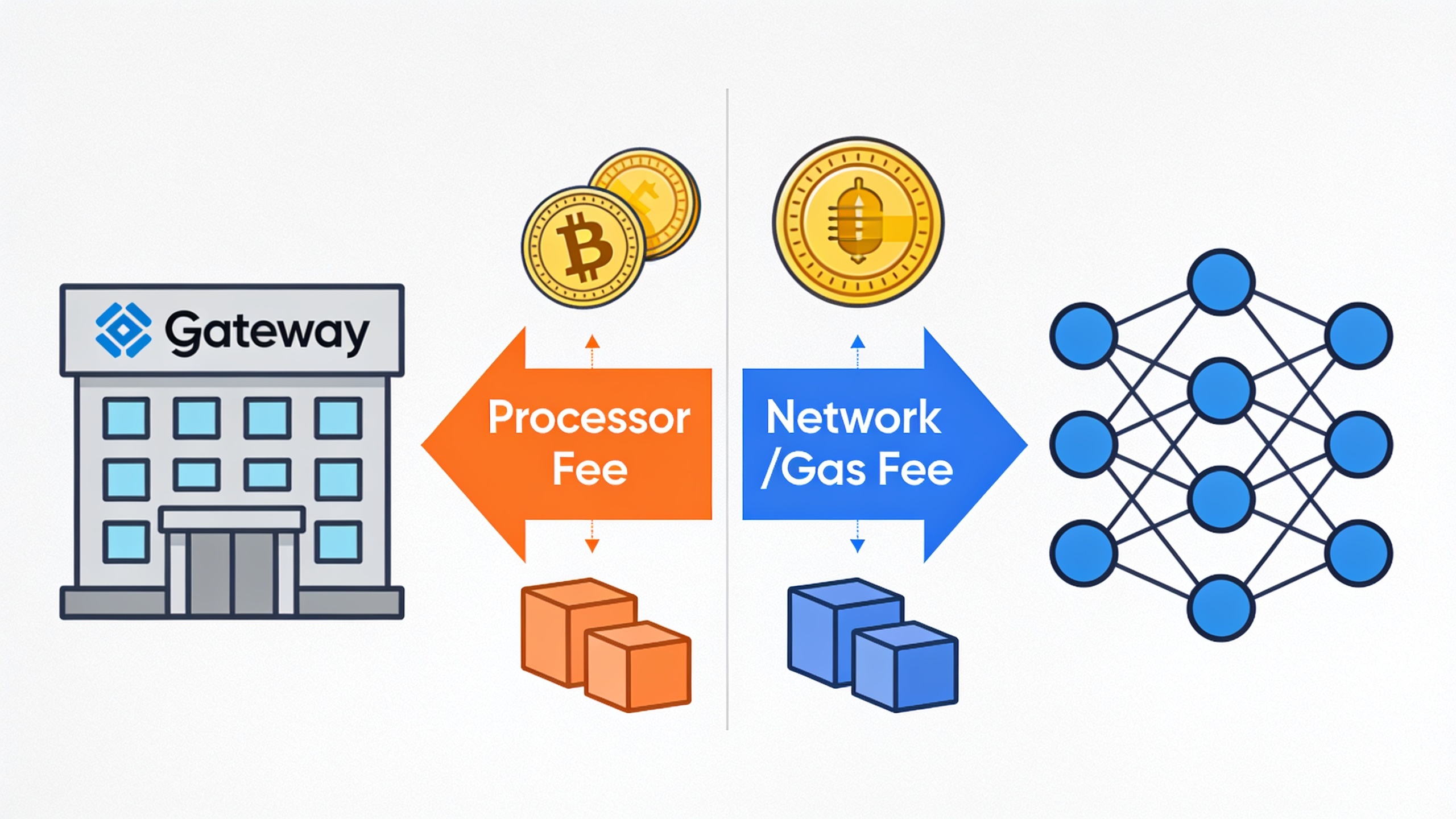
Crypto gateway fees come from two totally separate places: the processor's own service fee, and the network fee the blockchain itself charges. Getting your head around that split is way more useful than obsessing over a single advertised percentage, because your real cost per transaction depends on both.
The processor's service fee is the one you'd compare to a card-processing rate. It's what the gateway takes for converting, settling, and reporting the payment. The network fee (people call it a "miner fee" or "gas fee") goes to the blockchain to confirm the transaction and has nothing to do with the gateway's pricing. It bounces around with network congestion and swings wildly depending on the coin. A Bitcoin payment during a busy stretch on the network can cost a completely different network fee than the same payment on some cheaper token. That's not the gateway gouging you. That's just how the underlying chain works.
When you're actually comparing BitPay and Coinbase Commerce, do yourself a favor and ask each one for their current, written fee schedule. Don't trust marketing pages, and definitely don't trust third-party summaries (including, honestly, older versions of articles like this one). Neither company's exact current pricing was confirmed in my research, so verify it at the source. A few questions worth pinning down before you commit:
- Is the processing fee a flat percentage, or does it change depending on whether you settle in crypto, a stablecoin, or fiat?
- Are there separate fees for refunds or dispute-type situations?
- Who eats the blockchain network fee, you or the customer?
- Are there monthly minimums, subscription tiers, or discounts once you hit a certain volume?
| Fee Dimension | What to Ask BitPay | What to Ask Coinbase Commerce |
|---|---|---|
| Processing fee structure | Confirm current published rate directly on BitPay's merchant pricing page | Confirm current published rate directly on Coinbase Commerce's merchant pricing page |
| Network/gas fees | Ask whether network fees are passed through to the customer or absorbed | Ask whether network fees are passed through to the customer or absorbed |
| Settlement currency fees | Ask if converting to fiat or a stablecoin changes the fee | Ask if converting to fiat or a stablecoin changes the fee |
| Refund handling | Ask how refunds are processed and whether fees are returned | Ask how refunds are processed and whether fees are returned |
| Volume discounts | Ask about tiered or enterprise pricing for high transaction volume | Ask about tiered or enterprise pricing for high transaction volume |
The exact current percentage rates for either platform weren't something I could confirm, so if you see a specific number floating around out there, treat it as a starting point to verify, not a fact.
Which Coins Does Each Gateway Support?
Coin support matters more than people think, because it decides how many of your customers can actually pay you without jumping through hoops first. If a gateway only takes Bitcoin, you're quietly telling everyone who holds Ethereum, stablecoins, or anything else "sorry, go convert first." And a chunk of them just won't bother.
Generally, the established processors support a mix: the big names (Bitcoin and Ethereum, usually), the popular stablecoins (the USD-pegged ones), and sometimes a longer tail of altcoins depending on where the provider's roadmap is going. The exact, current, complete coin lists for BitPay and Coinbase Commerce weren't part of what I could verify, so whatever list you find online, treat it as a snapshot that could be stale. Check the live supported-asset list in each provider's official docs before you build your checkout around it. Seriously. Building around a coin they've since dropped is a bad afternoon.
Three questions worth bringing to that docs review:
- Do they support stablecoins, and which ones? Stablecoin settlement is your best friend for dodging the volatility mess I'm about to describe.
- Are the supported coins the same everywhere, or does it change by country because of local rules?
- Can you choose to accept only some of the supported coins, or is it all-or-nothing?
And if you're the kind of merchant who also holds a diversified bag of crypto personally, and now you've got customer payments landing in three or four different coins on top of that, things get messy fast. Might be worth a look at how to choose the best crypto portfolio tracker, because trying to eyeball incoming business payments across a pile of wallets is a recipe for losing track.
How Fast Do Crypto Payments Settle?
Settlement speed runs on two separate clocks: how long the blockchain takes to confirm, and how long the gateway takes to actually pay you out. Here's the part that trips people up. A customer's payment can confirm on-chain in a few minutes, but you might not see usable money in your account until the gateway runs its own batching and payout cycle. Those are not the same thing.
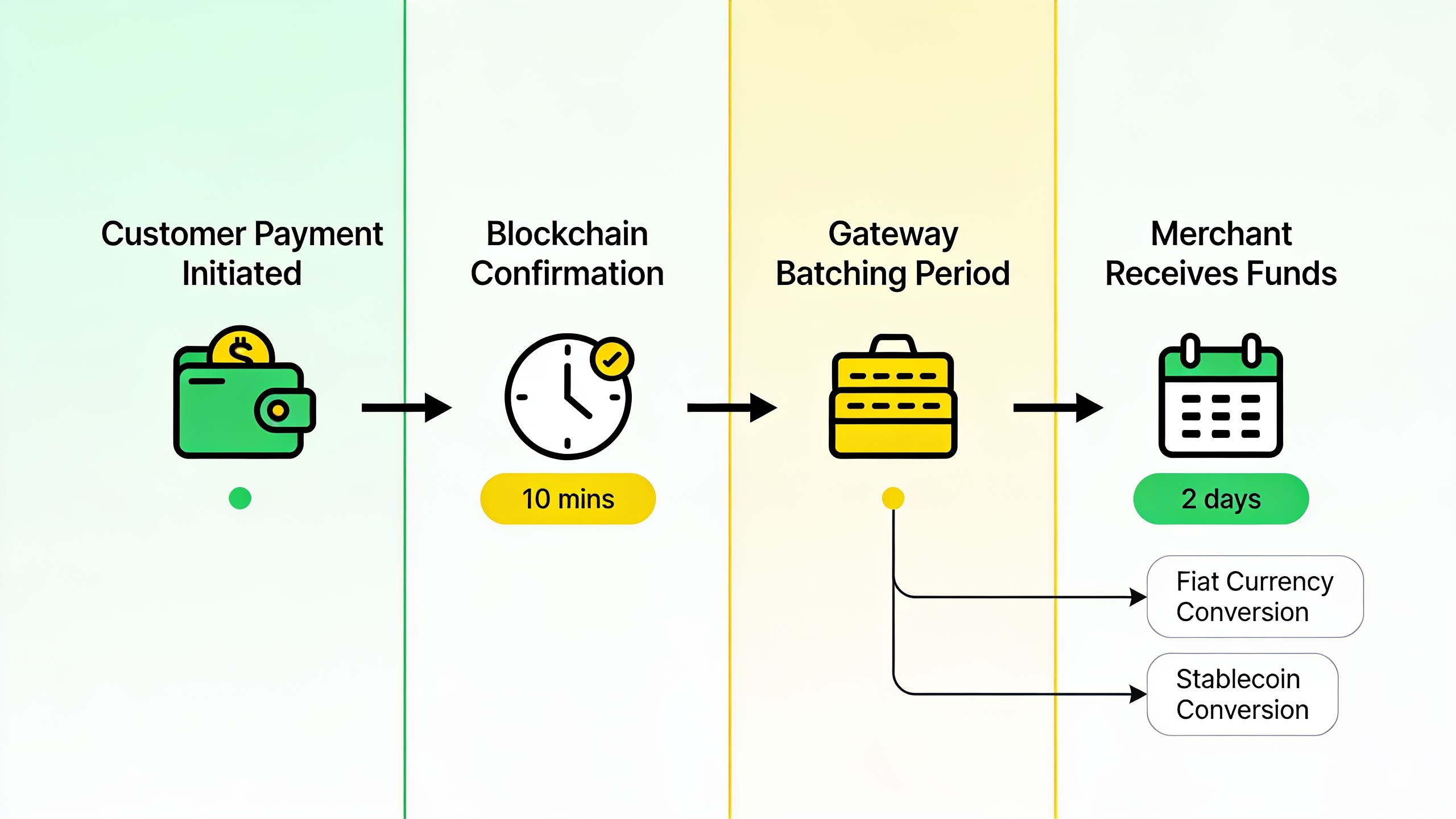
Confirmation time depends entirely on the network. Bitcoin usually wants several block confirmations before anyone calls it final, which takes longer than newer chains built for fast finality. That's a property of the blockchain, not the gateway, so it applies no matter which processor you pick.
And this is where speed collides with volatility risk, which is the part I'd actually lose sleep over. If a gateway pays you out in the original cryptocurrency instead of converting to fiat or a stablecoin right away, you're exposed to whatever the price does between the moment the customer pays and the moment you can spend or convert it. In a calm market, no big deal. In a wild week? That's your margin evaporating while you wait. Merchants who don't want that headache go looking for a gateway that offers immediate or same-day conversion to fiat or a stablecoin as part of settlement.
Since the specific settlement timelines and payout schedules for BitPay and Coinbase Commerce weren't confirmed in my research, ask each one directly:
- Once a transaction confirms on-chain, how long until I actually receive settled funds?
- Can I choose to be paid in fiat, a stablecoin, or the original crypto?
- Is there a daily cutoff after which payments roll into the next settlement batch?
How Easy Is It to Integrate a Crypto Payment Gateway?
Integration difficulty really boils down to three things: whether they've got ready-made plugins for common platforms, whether there's a decent documented API for custom builds, and how much hand-holding you get during setup. If you're a small shop on WooCommerce or Shopify, a solid plugin can have you live by dinner. If you've got a custom-built checkout, the plugin doesn't matter and the API docs become everything.
When you're sizing up any gateway for integration (BitPay, Coinbase Commerce, whoever), here's what I'd actually look at:
- Plugin availability. Do they have an official, maintained plugin for your platform specifically, or just generic API access?
- Documentation quality. Is the developer documentation clear and current with real code samples, or does it read like it hasn't been touched since 2019?
- Webhooks. Can your system get real-time payment-confirmation events pushed to it, or are you stuck polling for status like it's the dark ages?
- Testing environment. Is there a sandbox so your dev can validate the whole flow before real money is on the line?
- Support. When something breaks mid-transaction (and eventually something will), what can you reach? Email, chat, an actual human account manager?
The exact current plugin ecosystems and API feature sets for both weren't part of what I could verify here, so honestly, the most reliable move is dead simple: grab a sandbox account from each provider and have your developer spend an afternoon actually testing the flow. A real test will tell you more in one afternoon than any marketing page will tell you in a year.
How to Choose the Right Gateway for Your Business
The right gateway for you has almost nothing to do with which name you recognize and everything to do with how well the fees, coin support, and settlement options fit how you actually run. A high-volume store on thin margins is going to obsess over transaction fees, and rightly so. A business terrified of price swings will care most about stablecoin settlement and fast payouts. A business with a custom stack will judge everything by the quality of the API. Different priorities, different winner.
Here's the process I'd actually run:
- Write down your must-have coins. If a real chunk of your customers want to pay in a specific stablecoin or altcoin, confirm it's currently supported before you even look at anything else. No point loving a gateway that can't take the coin your buyers hold.
- Get the written, current fee schedules from each one, not the cached marketing page, and do the math at your actual expected volume. A rate that looks fine on paper can bite at scale.
- Nail down settlement currency and timing in writing. Ask flat out whether you can settle in fiat or a stablecoin and how long it takes to land.
- Run a sandbox test with your real platform or checkout before you sign anything.
- Check regional availability, because crypto payment rules and supported services vary by country and might quietly lock out some of your customers.
Fee structures, supported assets, settlement terms, they all drift over time for every provider in this space. So treat this whole comparison as a framework for your own homework, not a final verdict. The genuinely smart move before signing a merchant agreement with either one is to pull their current official docs and confirm every single detail that actually matters to your business.
Frequently Asked Questions
Is it actually safe for a small business to accept crypto?
Going through an established gateway takes a lot of the technical risk off your plate, since the provider handles the wallet infrastructure and transaction confirmation, not you. But you should still dig into each provider's security practices, how reliably they settle, and how fast their support responds. Security certifications and guarantees differ, so get them confirmed in writing rather than just assuming they've got it covered.
Do my customers pay extra fees when they use a crypto gateway?
Depends on how you set up checkout and how the gateway handles network fees. Sometimes the network fee is baked into what the customer sends. Sometimes you eat it. Since the defaults vary by provider, confirm this setting directly with BitPay or Coinbase Commerce before you launch. Don't assume it works the way some other platform did.
Can I accept crypto without ever holding crypto myself?
Yep, and honestly that's exactly why a lot of merchants use these gateways. You settle in fiat or a stablecoin so customer payments convert automatically and you never sit on the volatility. Whether that's available, and how fast the conversion happens, comes down to each provider's settlement terms, so confirm it rather than assume.
How do refunds work with crypto payments?
More manual than card refunds, plain and simple, because blockchain transactions can't be reversed the way a card chargeback can. Each provider has its own refund workflow, so ask specifically how refunds get processed, whether the original fees come back to you, and how currency conversion is handled on a refunded order. This one catches people off guard, so ask early.
BitPay or Coinbase Commerce for a first-time crypto merchant?
It depends on what you care about most: a dedicated payments-only shop versus one wired into a bigger exchange ecosystem, plus your required coins and your existing tech stack. Since the exact current pricing, coin support, and integration options for both should be confirmed directly anyway, the most reliable move for a newcomer is to grab sandbox access from both, test the real checkout flow, and lay the written fee schedules side by side before you pick.
At the end of it, choosing between BitPay and Coinbase Commerce is about matching a provider's fees, coins, settlement options, and integration model to how your business actually operates, not about which logo you've seen more often. Pull the current docs from both, run a real sandbox test, and let the actual numbers at your transaction volume make the call. Reputation is nice. Your margins are nicer.