Crypto Venture Capital 2025: Where Smart Money Is Flowing
Crypto VC grew up in 2025. The speculative token bets that defined the last cycle have mostly given way to something more boring and, frankly, more useful: infrastructure, compliance tooling, and...


Crypto VC grew up in 2025. The speculative token bets that defined the last cycle have mostly given way to something more boring and, frankly, more useful: infrastructure, compliance tooling, and real-world asset platforms that a fund partner can actually explain to their investment committee without wincing.
It's been a slog getting here. After FTX blew up in November 2022, professional investors basically went quiet for two years. Now they're back, but they're writing checks differently than they did in 2021. These days it's revenue, regulatory clarity, and defensible tech that gets people excited, not a slick deck and a good story.
Why should you care? Because venture funding is one of the earliest signals of where crypto is actually heading. Long before a token ever hits a major exchange, the VCs have already done the diligence, haggled over terms, and placed their bets. Watch where their money goes and you're basically getting a 12-to-24-month sneak peek at which sectors are going to dominate the conversation.
Table of Contents
- What Is Crypto Venture Capital and How Does It Work in 2025?
- How Is Blockchain Startup Funding Trending in 2025?
- Which Sectors Are Winning the Fight for Blockchain Startup Funding?
- Who Is Driving VC Crypto Trends in 2025?
- Seed vs. Growth: How Deal Stages Reveal Investor Confidence
- What Do These Crypto Venture Capital Patterns Signal for the Broader Market?
- What Risks Do Blockchain Startups Face When Raising VC in 2025?
- How Should Everyday Investors Respond to These Trends?
- FAQ
What Is Crypto Venture Capital and How Does It Work in 2025?
Crypto venture capital is when professional investment firms put money into blockchain, crypto, and Web3 startups early on, in exchange for equity, tokens, or some mix of both. The key difference from just trading crypto on an exchange? These deals happen privately, often months or even years before a project's token shows up anywhere you can buy it.
And the whole thing has gotten a lot more grown-up since the early days. In 2025, deal structures look a lot like regular startup investing: priced equity rounds, SAFE notes (Simple Agreement for Future Equity), and token warrants that convert once a network hits some agreed-upon milestone. That's a far cry from the pure SAFT (Simple Agreement for Future Tokens) contracts that ran the 2017-2018 ICO circus, the ones regulators later crawled all over.
Diligence has also become the norm rather than the exception. Firms now actually look at smart contract audits, regulatory exposure across different countries, and whether the token economics make any sense before wiring money. That kind of scrutiny? Mostly skipped during the frothy days of 2021. The EU's Markets in Crypto-Assets framework (MiCA), which became fully applicable through 2024, helped here too, giving investors a real compliance benchmark to underwrite against when they back startups with European operations.
One thing that makes crypto VC weird compared to regular tech VC: the corporate venture arms tied to exchanges and infrastructure players. They're everywhere, and they've got a dual motive. They want the startup to win commercially, sure, but they also want it to feed their parent company's ecosystem. It's a strategic play as much as a financial one, and it colors a lot of the deals you see.
How Is Blockchain Startup Funding Trending in 2025?
Blockchain startup funding in 2025 looks like a market that's found its feet again after the brutal 2022-2023 pullback, except now the money is going into fewer, more disciplined rounds instead of the everybody-gets-a-check-at-any-valuation chaos of the last cycle. The investors who ghosted through the bear market are coming back, but they want to see fundamentals first.
A few things lit the fuse. When the SEC approved spot Bitcoin ETFs in January 2024, it handed institutional allocators a regulated way in, and that comfort trickled into private markets too. Pension funds, endowments, family offices, they're all warming up to crypto-focused venture funds in a way they simply weren't before. Then Circle went public in 2025, which quietly did a lot of heavy lifting for the narrative. It showed crypto-native companies can actually meet the disclosure and governance bar that public markets demand, and VCs read that as a good omen for future exits.
But let's not oversell it. The environment is picky, not euphoric. The giant late-stage mega-rounds that made headlines in 2021 are much rarer now, and down rounds (where a startup raises new money at a lower valuation than last time) haven't gone extinct. Investors keep calling it a "flight to quality," which is a polite way of saying: if you've got a working product, real users, and your regulatory ducks in a row, you can raise on good terms. If you're peddling a pure concept? Good luck. That split is honestly one of the defining VC crypto trends 2025 has served up so far. Capital isn't spread around evenly. It's piling into startups solving actual infrastructure or compliance headaches.
Which Sectors Are Winning the Fight for Blockchain Startup Funding?
Three sectors are hoovering up most of the crypto venture money in 2025: tokenized real-world assets, stablecoin and payments infrastructure, and the crossover between AI and blockchain. What ties them together is simple. They all plug crypto into something tangible and revenue-generating instead of leaning on the hope that a token goes up.
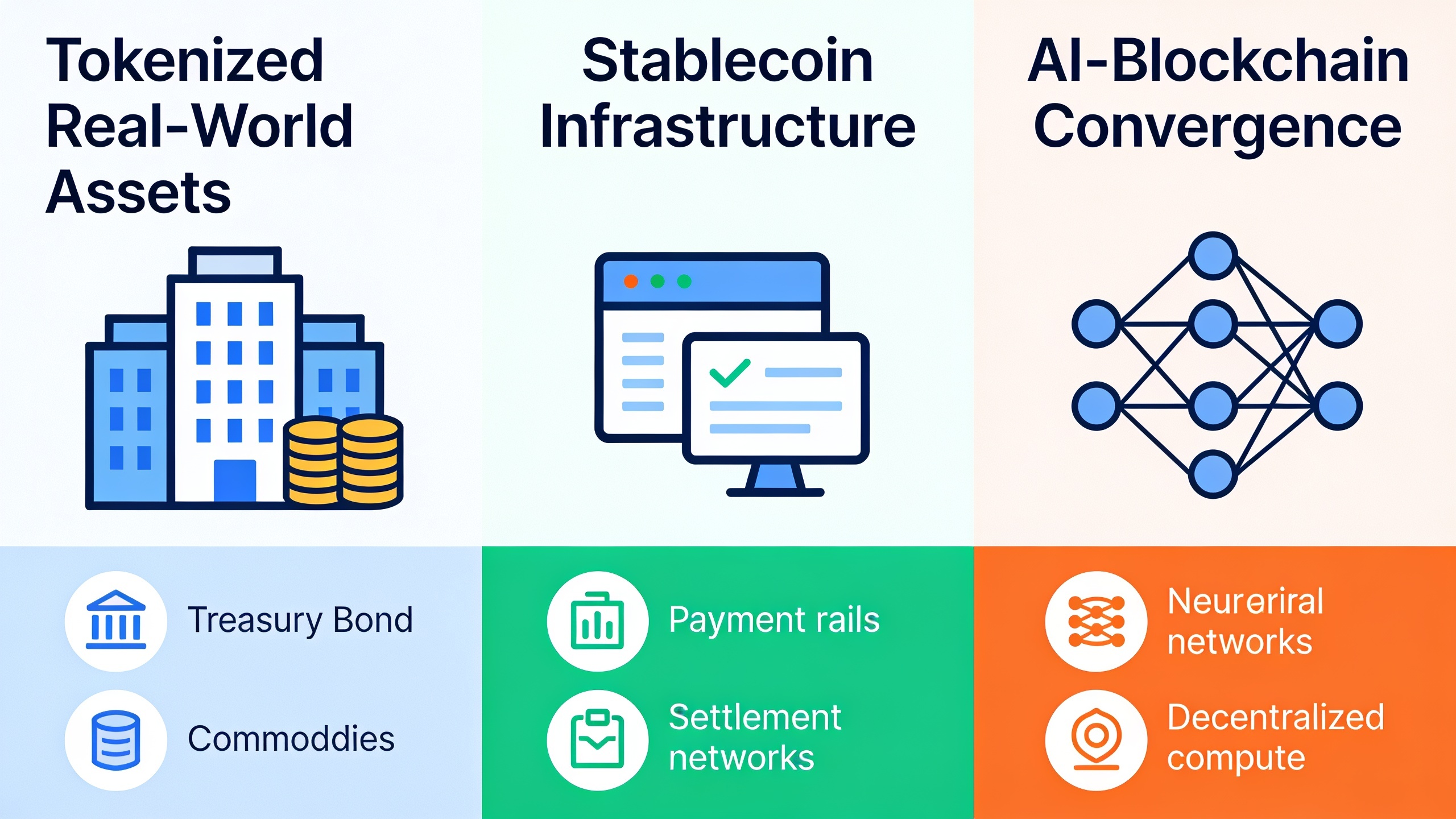
Tokenized real-world assets (RWAs) are traditional financial instruments, things like treasury bills, private credit, real estate, and commodities, wrapped up as blockchain tokens. VCs love this one because it's a bridge between regulated finance and on-chain settlement. Institutional money gets blockchain's efficiency without having to abandon the asset classes it already understands. That's an easy sell.
Then there's stablecoin infrastructure, which is basically the compliance tooling, payment rails, and settlement networks behind dollar-pegged tokens like USDC and USDT. As stablecoins quietly become a global payments layer, the startups building the plumbing (issuance, redemption, cross-border settlement) have turned into juicy targets for growth-stage cash.
The AI-blockchain crossover is the newer, shinier one. These startups build decentralized compute networks, verifiable AI agent frameworks, and on-chain data provenance tools. Investors like it because it lets them ride the giant AI investment wave through a crypto lens, often at valuations that look downright reasonable next to pure-play AI startups.
Beyond those three, there's a steady trickle of smaller checks going into Layer 2 scaling networks, decentralized physical infrastructure (DePIN), and on-chain identity and compliance software. What's telling, though, is how little institutional money flows to meme-driven projects compared to the retail trading volume they generate. If you're figuring out where to park your own money, that gap matters. It's a distinction dug into in Memecoin Investing in 2025: Are Dogecoin & Shiba Inu Still Worth It?, which gets into why meme tokens run on community momentum rather than the kind of diligence driving venture allocations.
Who Is Driving VC Crypto Trends in 2025?
The people steering VC crypto trends in 2025 are a blend: crypto-native funds, traditional venture firms that spun up dedicated digital asset teams, and corporate venture arms tied to big exchanges. That mix gives the sector both deep technical chops and a pipe into much larger institutional money pools.
The crypto-native crowd, Paradigm, Pantera Capital, Polychain Capital, has been at this since earlier cycles and is still among the most active, usually leading rounds in protocol-layer and DeFi-adjacent startups. And a16z crypto, Andreessen Horowitz's dedicated crypto arm, remains one of the biggest single pots of money aimed at the space, with fingers in consumer apps, infrastructure, and gaming alike.
The corporate arms are where it gets strategic. Coinbase Ventures, the investment arm of the publicly traded exchange, backs startups that slot into the wider Coinbase ecosystem, and exchange-affiliated funds elsewhere keep funding projects that boost liquidity and expand product lineups on their platforms. These investors bring more than cash to the table. Their portfolio companies often get listing pathways, technical integrations, and distribution that a purely financial investor just can't hand you.
Rounding out the specialist bench you've got Multicoin Capital, Electric Capital, and Framework Ventures, all known for grinding through deep technical diligence, especially on Layer 1 and Layer 2 infrastructure. And here's the interesting part: generalist tech VCs that used to run screaming from crypto are increasingly co-investing alongside these specialists now. That's a sign digital assets have crept further into mainstream venture, not staying stuck in some niche corner.
If you're thinking about jumping into this side of the industry yourself, knowing who the active dealmakers are doubles as career intel. That's covered in Launching a Crypto Career: Top Jobs, Skills & Salary Guide, which lays out the roles, from investment analyst to protocol engineer, that these funds and their portfolio companies are actually hiring for.
Seed vs. Growth: How Deal Stages Reveal Investor Confidence
Where the money lands, by stage, tells you almost everything about how confident investors feel right now. Early seed deals signal experimentation and long-term conviction. Growth-stage rounds signal that investors think a specific business model is ready to scale, like, immediately.
In 2025, seed activity has held up surprisingly well, mostly because entry valuations are lower and the checks are smaller, so funds can spread their bets across a lot of teams and hope a couple hit. Growth and late-stage rounds, though? Much more concentrated. The bigger checks are being saved for startups that already show product-market fit, regulatory clarity, or a believable shot at going public.
| Deal Stage | Typical Focus in 2025 | Investor Priority | Relative Deal Volume |
|---|---|---|---|
| Pre-seed / Seed | New protocols, AI-blockchain tools, DePIN experiments | Founding team quality, novel technology | High (many small checks) |
| Series A | Proven early traction, initial revenue or active users | Unit economics, regulatory positioning | Moderate |
| Series B and beyond (growth) | RWA platforms, stablecoin infrastructure, exchange-adjacent tools | Scalability, compliance readiness, exit potential | Lower but larger checks |
| Strategic / Corporate rounds | Ecosystem-aligned startups (DeFi, custody, payments) | Strategic fit with investor's existing platform | Selective, deal-by-deal |
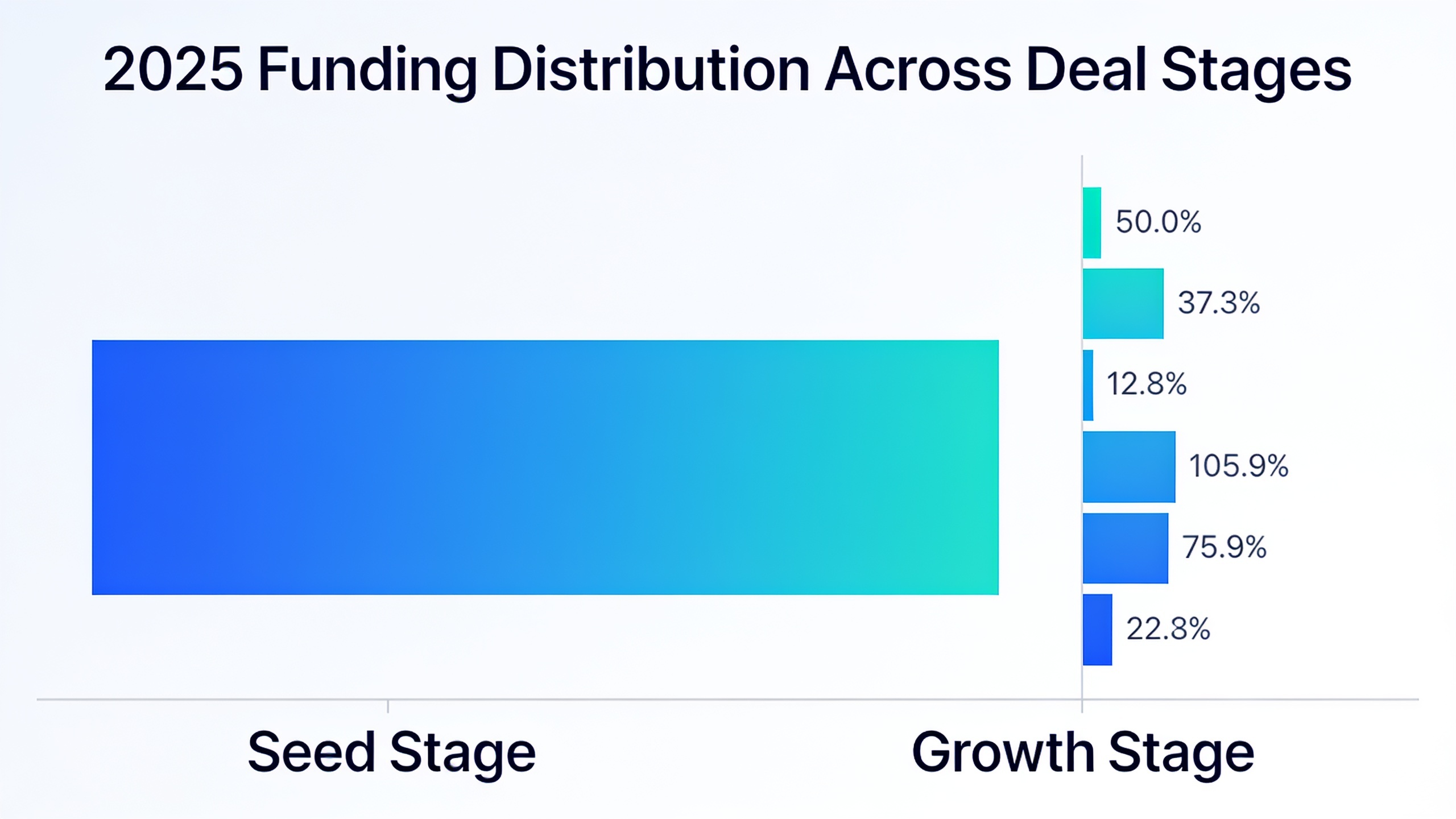
It's a barbell, basically. Strong at the earliest stage, cautious at the growth stage. What that tells you is investors are happy to take technology risk on unproven ideas but don't want to pay a premium until a business model is fully de-risked. Which is also why those headline-grabbing mega-rounds are so much rarer than in 2021, even though the overall mood toward the sector has clearly warmed up.
What Do These Crypto Venture Capital Patterns Signal for the Broader Market?
The 2025 crypto VC patterns tell you that professional investors expect the next phase of blockchain adoption to run on infrastructure, compliance, and real-world financial integration, not on speculative token trading. That's a real shift from past cycles, when consumer apps and NFT platforms often grabbed the biggest slice of venture attention.
Because VC tends to run a year or more ahead of retail and public markets, all that money flowing into tokenized real-world assets and stablecoin infrastructure is a decent tell about which categories will produce the most actual product launches, exchange listings, and institutional partnerships over the next 12 to 24 months. Traders who watch early funding announcements are, in a sense, getting an early look at what crypto Twitter and the financial press will be obsessing over next.
The lack of venture money flowing into meme tokens tells its own story too. Institutional capital and retail speculative capital are behaving like two totally different animals right now. Memecoins still throw off enormous trading volume and community energy, but that's retail-driven, not backed by structured diligence, which is exactly the point made in the site's own take on whether Dogecoin and Shiba Inu are still worth holding this cycle. If you're trying to sort durable infrastructure from short-term hype, watching where the pros actually commit money beats chasing wherever retail attention happens to spike.
And the growing presence of traditional finance players in these rounds? That wall between conventional VC and digital asset investing keeps crumbling. As more generalist funds allocate to blockchain startups alongside the crypto-native specialists, digital assets are being treated less like a weird speculative side quest and more like a normal part of the tech investment world.
What Risks Do Blockchain Startups Face When Raising VC in 2025?
Raising venture money as a blockchain startup in 2025 is harder than it used to be, with regulatory uncertainty, valuation resets, and drawn-out diligence timelines topping the list of headaches. Even well-liked teams are finding the road from pitch to signed term sheet is a lot longer than it was during the 2021 sugar rush.
Regulation is the big one, and it's fragmented. MiCA gave European-facing startups a clearer rulebook, but the picture in the U.S. and other major markets is still shifting under everyone's feet. So founders have to build legal flexibility into their token structures and corporate entities from day one, and investors increasingly want to see a credible regulatory strategy before they'll commit. That's a whole layer of diligence that barely existed a few cycles back.
Valuation resets sting too. Startups that raised at those inflated 2021 numbers can struggle to raise again without swallowing a down round, and down rounds trigger awkward conversations with early investors and with employees holding equity or token grants. Nobody enjoys those. It's pushed a lot of founders to stretch their existing runway, through cost cuts or actual revenue, rather than sprint back to market for a fresh round they might not like the terms of.
Then there's the attention problem. Even with fewer deals happening, competing for investor eyeballs has gotten fiercer. When money concentrates into fewer high-conviction bets, founders in crowded categories like Layer 2 infrastructure or DeFi protocols have to differentiate hard to get funded. Founders in newer, less-crowded spaces like AI-blockchain convergence have it a little easier, standing out just by showing up. At least until that space fills up too, which it will.
How Should Everyday Investors Respond to These Trends?
Treat VC funding patterns as a leading indicator worth watching, not as a buy signal, because private rounds and public token prices don't always move together. A startup landing a well-regarded venture round is a vote of confidence in its team and tech. It's not a promise that some future token, if one ever launches, will pump in public markets. Those are two different things, and conflating them will burn you.
Still, keeping tabs on which sectors are pulling in institutional dollars (tokenized real-world assets, stablecoin infrastructure, AI-blockchain convergence, per everything above) can help you spot emerging themes before they turn into full-blown narratives everyone's shouting about. That's especially handy if you're building a long-term thesis instead of trying to scalp the next candle.
And if you're more interested in working inside this ecosystem than betting on it, these same funding trends point straight at where the hiring is headed. Startups fresh off a big raise usually ramp up hiring across engineering, compliance, and business development within a few months of closing. That's exactly the kind of opening mapped out in the site's guide to breaking into the industry professionally rather than just as a trader.
One last thing worth keeping in the back of your mind: VC enthusiasm and retail sentiment can drift apart hard, which is exactly what's happening now between infrastructure funding and meme token volume. Keeping some awareness of which side of any given trade is driven by institutional diligence versus community hype is honestly one of the saner ways to navigate crypto in 2025.
FAQ
So what's the actual difference between crypto VC and just buying tokens on an exchange?
Crypto venture capital is professional investors putting private money into startups before their tokens or products ever hit the public market, usually for equity or token warrants negotiated straight with the founders. Buying tokens on an exchange means grabbing an already-listed asset on the open market, with zero direct connection to whatever terms the company raised on.
Which sectors are pulling in the most blockchain startup funding in 2025?
Right now it's tokenized real-world assets, stablecoin and payments infrastructure, and AI-blockchain convergence startups drawing the most sustained venture interest, mostly because they tie blockchain tech to concrete, revenue-generating use cases instead of pure token speculation.
Do VC funding trends actually predict crypto token prices?
Not directly, no. Venture funding reflects how confident pros are in a team, its tech, and its business model, but it doesn't guarantee a related token will do well once it's trading publicly. Use it as one input among many when you're forming a broader view, not as a standalone trading signal.
Why aren't memecoins pulling in serious venture money despite all that trading volume?
Because memecoins make their value through community and speculative momentum, not through a product, revenue, or defensible tech. That makes them a lousy fit for the structured diligence process VCs run before they commit institutional capital. There's just nothing to underwrite.
How do you actually land a job at a crypto VC firm or one of its portfolio companies?
Build relevant skills, blockchain development, regulatory compliance, financial analysis, and keep track of which firms and startups are raising and hiring. Those are the practical starting points. There's a detailed breakdown of in-demand roles and the skills they want in the site's crypto career guide.
The 2025 crypto venture landscape looks a lot less like a speculative gold rush and a lot more like a maturing asset class figuring out how to live inside traditional finance's guardrails. Infrastructure, compliance, and real-world asset integration are commanding the fattest checks, while the purely speculative stuff gets left to retail. Whether you're investing or job hunting, watching where the smart money actually goes, not where the loudest headlines point, is still about the sharpest way to stay ahead of whatever comes next.