Launching a Crypto Career: Top Jobs, Skills & Salary Guide
So you're thinking about working in crypto. Not trading it, not gambling your rent money on some token with a dog logo, but actually building a career in the industry. Good news: there's way more...


So you're thinking about working in crypto. Not trading it, not gambling your rent money on some token with a dog logo, but actually building a career in the industry. Good news: there's way more room here than most people assume. A crypto career is basically any job built around blockchain and digital assets, which these days runs the gamut from writing smart contracts to sitting in a compliance seat auditing an exchange for money-laundering risk. The trading-desk stereotype is long dead. Now the industry pulls in software engineers, compliance nerds, marketers, and lawyers, and the ways in are a lot more varied than newcomers expect.
I'm writing this mostly for two people. One is the tech professional wondering whether to jump into blockchain. The other is the finance or compliance person quietly wondering if digital assets are a real long-term specialty or just a fad they'll regret betting on. Either way, this covers the roles worth chasing, the skills that actually move the needle with employers, a salary section that won't lie to you with fake precise numbers, and where the real openings live.
Table of Contents
- What Is a Crypto Career, and Why Are Employers Hiring Now?
- Top Blockchain Jobs and Crypto Career Paths to Consider
- What Skills and Certifications Do You Need for a Crypto Career?
- How Much Do Crypto Jobs Pay? A Cryptocurrency Salary Guide
- Where to Find Crypto Job Openings
- How to Break Into a Crypto Career With No Prior Experience
- Common Mistakes That Slow Down a Crypto Career
- FAQ
What Is a Crypto Career, and Why Are Employers Hiring Now?
A crypto career means working for a company whose core business touches blockchain infrastructure or digital assets. Think exchanges, wallet providers, custody firms, stablecoin issuers, DeFi protocols, NFT platforms, plus the compliance and legal shops that serve all of them. And increasingly it means working inside plain old traditional finance too, because banks, asset managers, and payment companies now run dedicated digital-asset desks whether they admit to loving it or not.
Why are people hiring? Because the industry finally grew up a little. The "just ship something and see what sticks" era is over. Exchanges need compliance officers who genuinely understand anti-money-laundering (AML) rules. Protocols need auditors who can catch a smart contract bug before some hacker in a hoodie drains the treasury. And institutions that wouldn't touch crypto with a ten-foot pole five years ago are now building custody and trading products, which drags in risk managers, product people, and lawyers from the traditional world. That's exactly why a crypto career today looks less like "trader" and more like a slice of an entire tech-and-finance ecosystem.
One thing worth burning into your brain before you commit: this market is wildly cyclical. The same manic cycles that fuel retail interest in memecoin investing also drive hiring booms at exchanges and agencies during bull runs, then hiring freezes when the mood sours. Plan for it. Don't get blindsided by it.
Top Blockchain Jobs and Crypto Career Paths to Consider
Most crypto career paths land in one of four buckets: technical building, financial analysis, compliance and legal, and go-to-market work. Each pulls a different type of person, and each has its own ceiling.
Blockchain Developer and Smart Contract Engineer
Blockchain developers write the code behind decentralized apps, tokens, and the network protocols themselves. Within that world, smart contract engineers specialize in languages like Solidity (for Ethereum and EVM-compatible chains) or Rust (for Solana), building the self-executing agreements that power DeFi lending, token swaps, NFT minting, all of it. This is generally the most technically demanding role in the whole space, and also the most consistently in-demand. The reason is brutally simple: one coding mistake in a deployed contract can be irreversible and unbelievably expensive. There's no "oops, let me push a hotfix" when millions have already walked out the door.

Crypto/Blockchain Analyst
A crypto analyst studies on-chain data, market trends, and protocol fundamentals to guide trading, investment, or research calls. Some analysts sit at hedge funds and asset managers deciding whether to add digital assets to a portfolio. Others work at research firms or media outlets cranking out market commentary. It overlaps heavily with regular financial analysis, but you'll need extra fluency in blockchain-specific data like on-chain explorers and DEX volume trackers. It's finance, plus a whole second language.
Compliance Officer and AML/KYC Specialist
A crypto compliance officer makes sure an exchange, custodian, or fintech platform actually follows anti-money-laundering laws, know-your-customer (KYC) rules, and the licensing requirements of every jurisdiction it touches. Regulators in the US, the EU, and pretty much everywhere else have sharpened their focus on digital assets, so this has quietly become one of the fastest-growing corners of blockchain hiring, especially for folks coming out of banking compliance. This work also brushes up against the legal side of protecting assets. The same regulatory pressure shaping exchange compliance programs is part of why more investors are getting serious about crypto estate planning, making sure their holdings are documented, transferable, and actually defensible after they're gone.
Security Auditor and Penetration Tester
Security auditors comb through smart contract code and blockchain infrastructure hunting for vulnerabilities, usually before deployment and sometimes after (when it's too late to feel good about it). Given how many DeFi hacks trace straight back to exploitable contract code, firms that do nothing but audits have carved out a distinct, genuinely respected niche.
Product Manager, Marketing, and Business Development
Every protocol, exchange, and wallet provider still needs people who can manage a roadmap, explain the product to humans who don't code, and build partnerships that matter. These roles usually don't require you to write a line of Solidity. But you do need enough technical literacy to talk to engineers without embarrassing yourself, and enough market awareness to sense where the industry's story is heading next, whether that's institutional custody, stablecoins, or the more speculative retail stuff like NFTs and metaverse land.
Crypto Career Paths at a Glance
| Role | Core Focus | Typical Background | Technical Depth Needed | Relative Pay Tier* |
|---|---|---|---|---|
| Blockchain Developer / Smart Contract Engineer | Writing and deploying protocol or dApp code | Software engineering, CS degree or bootcamp | Very high | Highest |
| Security Auditor | Finding vulnerabilities in deployed code | Software security, penetration testing | Very high | Highest |
| Crypto/Blockchain Analyst | Market and on-chain research | Finance, economics, data analysis | Medium | Mid-to-high |
| Compliance Officer / AML-KYC Specialist | Regulatory adherence, licensing | Banking compliance, law | Low-to-medium | Mid-to-high |
| Product Manager | Roadmap, feature prioritization | Product/tech background | Medium | Mid |
| Marketing / Business Development | Growth, partnerships, community | Marketing, sales, comms | Low | Mid |
*Relative pay tiers reflect general industry positioning, not fixed dollar figures. See the salary section below for why exact numbers are basically impossible to pin down.
What Skills and Certifications Do You Need for a Crypto Career?
The single most transferable skill for any crypto career is genuinely understanding how blockchains work. Not buzzword-level. Working-level. Consensus mechanisms, wallets, gas fees, the difference between custodial and non-custodial systems. If you can't explain those over coffee, you're not ready yet. Past that baseline, the requirements split hard by role.
For developers, employers want proficiency in Solidity, Rust, or Go, plus the boring-but-essential engineering fundamentals: version control, testing, a basic grasp of cryptography. Honestly, a lot of the best blockchain engineers I've come across started in regular backend or systems programming and transitioned by building and shipping their own small projects. A public GitHub with real code usually carries more weight than a shiny resume line. Employers here want to see the thing, not read about it.
For analysts, the meat of it is financial modeling, statistics, and being genuinely comfortable with on-chain analytics tools that track wallet flows and exchange balances. A finance or economics degree opens doors, sure. But self-taught analysts who've built a public track record of commentary or research compete just fine, sometimes better.
For compliance officers, it's all about regulatory knowledge: AML frameworks, sanctions screening, and the jurisdiction-specific licensing maze (state-level money transmitter licenses in the US, the EU's Markets in Crypto-Assets framework, and so on). People crossing over from traditional banking compliance get hired all the time, because the underlying logic, customer due diligence, suspicious activity reporting, transfers almost cleanly. The asset class is new. The playbook mostly isn't.
Now, certifications. They can help signal credibility, especially if you're a career-changer with zero direct crypto experience to point to. You've got general blockchain fundamentals certificates from industry associations and universities, security-focused ones for auditors, and compliance credentials tied to AML and financial crime. But here's my honest take: the certification landscape shifts fast and varies wildly by provider, so treat any specific credential as a supplement, never a substitute. A working smart contract deployed on a testnet, a public research portfolio, a bit of hands-on compliance casework, that stuff beats a certificate every single time. Employers in this space consistently reward proof of applied ability over a piece of paper. Don't let anyone sell you otherwise.
How Much Do Crypto Jobs Pay? A Cryptocurrency Salary Guide
Crypto salaries swing enormously depending on role, company stage, and geography, but the shape of it is pretty consistent: technical and highly specialized people (developers, auditors) sit at the top, compliance and analysts land in the middle-to-upper range, and generalist marketing or support roles hover closer to normal tech-industry pay.
A few things drive this spread harder than they would in most industries. Company stage matters a ton. A well-funded exchange or a token project sitting on a fat treasury can pay right up there with (or above) traditional tech, while a scrappy early-stage startup might offer weaker cash and try to make it up with token allocations. Which, given how crypto prices behave, is its own kind of gamble.
That token-comp thing deserves its own warning, actually. Plenty of crypto employers pay part of your total package in the company's or protocol's native token. In a bull market that can inflate your comp beautifully. In a downturn it can quietly evaporate. That's a structural difference from a boring, reliable cash salary, and people forget it constantly.
Geography still counts, but less than in traditional finance. Because so much of the industry is remote-first, a developer or analyst in a lower cost-of-living area can often reach pay closer to major-market rates than they ever could in a conventional corporate job. And then there's cyclicality, which hits hiring budgets, not just headcount. During the speculative frenzies (the same waves that fuel retail obsession with Dogecoin and Shiba Inu, covered over in these memecoin investing trends), signing bonuses balloon and budgets loosen up. In a bear market? Same roles, slower postings, stingier offers.
I'm deliberately not throwing specific dollar figures at you, because they go stale in months and vary insanely by region. The reliable move is to pull up current listings on the job boards below for your exact role and location, compare a handful of similar postings, and build a realistic range before you ever start negotiating. Any number you see in a generic "average crypto salary" roundup, including implied ones floating around elsewhere online, is a rough starting point. Not a promise.
Where to Find Crypto Job Openings
The fastest way to find real crypto openings is to pair dedicated blockchain job boards with the careers pages of specific exchanges, protocols, and custody firms. Don't just camp on general job engines and hope.
The dedicated blockchain-focused boards are worth your time because they gather up postings from companies that barely register on mainstream sites, including early-stage protocols and DAOs (decentralized autonomous organizations) that hire contributors pretty informally. Meanwhile the big mainstream professional networks still earn their keep, especially for compliance, legal, and finance-adjacent roles, since larger institutions with digital-asset arms tend to post there right next to their traditional listings.
Here's roughly how I'd run the search:
- Start with company career pages for the major exchanges, custodians, and stablecoin issuers you already follow. A lot of them post there before syndicating anywhere else.
- Hit the blockchain-specific job boards to dig up smaller protocols and remote-first startups a general search would completely miss.
- Follow project communities directly. Tons of protocols announce contributor or grant-funded roles through their own channels, never through a formal posting.
- Network inside digital-asset communities. Referrals still fill a huge share of compliance and senior technical roles, because the industry's small enough that everyone kind of knows everyone.
- Set alerts for your specific skill combo ("AML compliance" plus "digital assets," or "Solidity" plus "DeFi") instead of searching generic junk like "crypto job," which mostly surfaces a swamp of low-quality and outright scam listings.
That last point? I can't stress it enough. Because crypto attracts speculators, it also attracts fraudulent job posts promising absurd pay for vague "crypto consultant" nonsense. Before you hand over any personal or financial info during an application, verify the company actually exists: real product, findable team, a website that works. If something feels off, it usually is.
How to Break Into a Crypto Career With No Prior Experience
You can absolutely break in with no direct industry experience, and the formula is pretty consistent: transfer skills from an adjacent field, then build a small chunk of visible, verifiable crypto-specific work before you apply. Employers here weight demonstrated initiative over formal credentials more than most established sectors do, mainly because the field's still young enough that almost nobody has "decades of crypto experience" to wave around anyway.
On the developer track, that usually means finishing a structured Solidity or Rust course, then building and deploying a small original project. A token, a simple decentralized app, a contribution to an open-source protocol, anything real. The point is that a hiring manager can open your code and judge it directly instead of just taking your word for it.
On the analyst track, publish research or commentary consistently, even informally, that shows you can read on-chain data or market trends accurately over time. A public track record, even a modest one, tends to beat a finance degree sitting alone on a resume.
Compliance is the easiest transfer of the bunch. If you're already doing AML work in banking or fintech, you're often the strongest candidate in the room, because the skillset ports over almost intact. The gap you need to close is the mechanics: how blockchain transactions work, wallet clustering, how illicit money actually moves through crypto rails versus the traditional banking system.
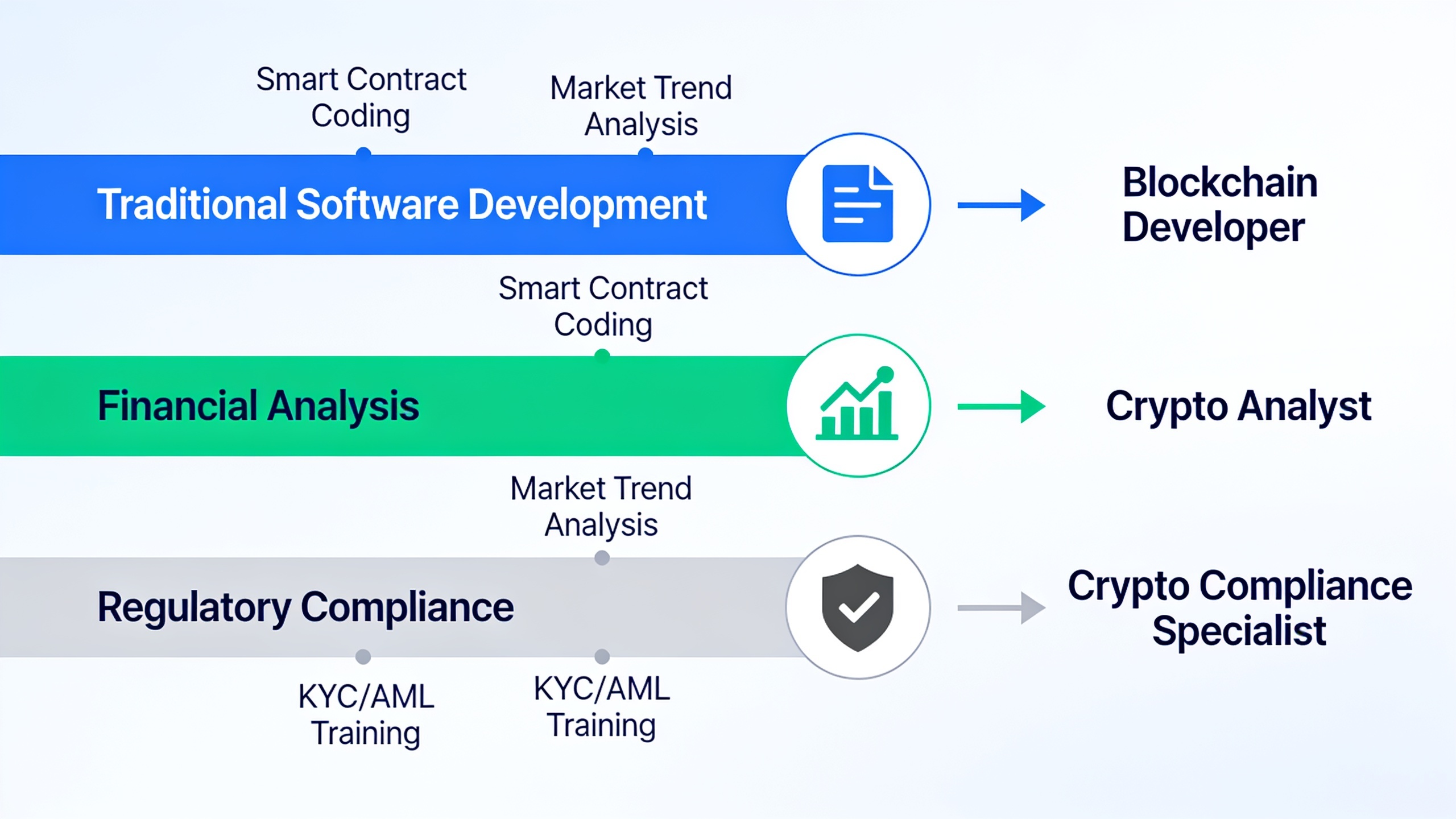
And for the non-technical roles, marketing, ops, business development, the fastest way in is honestly just showing up. Contribute to a protocol's Discord or governance forum, write about the space, freelance on smaller projects. You build a network and a portfolio at the same time, which is the whole game.
Common Mistakes That Slow Down a Crypto Career
The number one mistake people make is treating "crypto" like a single job category instead of an entire industry spanning dozens of distinct disciplines, each with its own requirements. If you apply everywhere with a generic "I'm passionate about digital assets" pitch, you get filtered out fast. Hiring managers here want evidence of a specific, applicable skill, developer, analyst, compliance, product, not vague enthusiasm. Enthusiasm is free. Nobody's short on it.
Second mistake: falling in love with token-based comp without doing the math on the risk. A package that looks generous on paper because of a fat token allocation can crater along with the token's price. So when you're weighing an offer, ask flat out what portion is cash versus token, and what the vesting schedule looks like. Don't be shy about it. It's your money.
Third, and this one bites even technical folks, is ignoring the legal and regulatory side entirely. Digital-asset regulation is still a moving target across jurisdictions, and professionals who grasp the compliance basics (even in a non-compliance role) come across as lower-risk hires. That matters a lot to bigger, cautious employers like banks standing up digital-asset divisions.
Last one. A lot of career-changers underestimate how directly crypto's price cycles steer hiring. If you time your big move for the top of a bull market, when competition and salary expectations are both puffed up, you're exposed the second hiring cools off in the next downturn. A steadier approach, building skills and a portfolio continuously instead of scrambling in only when the headlines look juicy, tends to produce a career that actually lasts.
Frequently Asked Questions
Do I need a computer science degree to start a crypto career?
Nope, not for every role. A CS background helps a lot for developer and security-auditor jobs. But analyst, compliance, marketing, and business development roles get filled all the time by people from finance, law, or communications who bolted blockchain-specific knowledge onto the expertise they already had.
Is a crypto career stable given how volatile the market is?
Crypto hiring is more cyclical than most established industries, ramping up in bull markets and shrinking in downturns. That said, roles tied to core infrastructure, security, compliance, and core protocol engineering, tend to weather the cycles better than roles hitched purely to retail trading hype or marketing budgets.
Which pays more: blockchain development or crypto compliance work?
Development and security-auditing roles generally sit at the very top, thanks to the scarcity of qualified engineers and the sky-high cost of code errors. Compliance usually lands in a solid mid-to-upper tier, comparable to or above equivalent compliance jobs in traditional finance. Exact figures swing wildly by company and region, so comparing current postings for your target role beats trusting any generic average.
Can I work in crypto remotely?
Yes, and a big chunk of blockchain jobs, especially development, analysis, and community-facing roles, are remote-first by default, since so many protocols and startups run as distributed teams from day one. Compliance and legal roles are a bit more likely to need a physical presence tied to a specific licensing jurisdiction.
How do I evaluate whether a crypto company is a legitimate employer?
Look for a real, functioning product, a findable team (ideally with public professional profiles), transparent funding or revenue info where it applies, and a comp offer that doesn't lean entirely on speculative token allocations with murky vesting terms. Any posting promising huge pay for vague responsibilities is a red flag, not your big break.
Getting Started
A crypto career isn't some fringe bet for early adopters anymore. It's a legitimate, if still fast-moving, path that stretches across software engineering, financial analysis, compliance, and product work. The most dependable way in hasn't changed: pick a specific lane that matches the skills you already have, build a small piece of visible, verifiable work in that lane, and stay clear-eyed about how the industry's cycles jerk hiring volume and pay around. Whether you're chasing a technical seat writing smart contracts or a compliance role keeping an exchange on the right side of the law, the fundamentals are identical. Specialize, prove your ability directly, and treat every salary figure you run into (including the ranges here) as the start of your own research, not a guarantee.