DeFi Hack Case Study: How DeFi Protocol X Recovered From a Major Hack
If you've read one DeFi hack post-mortem, you've read a dozen. The details change but the shape is always the same: a bug in the code, a treasury bleeding out in real time, a Discord full of people...

If you've read one DeFi hack post-mortem, you've read a dozen. The details change but the shape is always the same: a bug in the code, a treasury bleeding out in real time, a Discord full of people losing their minds, and then, if the team is lucky and competent, some kind of recovery. What I want to do here is walk you through a case study I'm calling "Protocol X." It's not a real protocol. It's a composite I stitched together from patterns you actually see in the wild, mostly the Euler Finance exploit from March 2023 and the Poly Network breach back in August 2021. The point is to show, step by step, how a protocol survives a nine-figure hack and somehow convinces people to trust it again.
Quick refresher for anyone newer to this. DeFi (decentralized finance) is basically financial software running on a blockchain. Lending platforms, decentralized exchanges, yield vaults, all of it operating without a bank or broker sitting in the middle. The catch is that these protocols hold your money inside smart contracts that anybody on earth can read. Which makes them enormous, permanent targets. And the numbers back that up: per Chainalysis's 2023 Crypto Crime Report, DeFi protocols accounted for roughly 82% of all crypto stolen by hackers in 2022, more than $3 billion gone. So yeah. If you're holding tokens, providing liquidity, or building anything in this space, understanding how a protocol digs itself out of that hole isn't optional reading. It's survival.
Table of Contents
- What Happened in the DeFi Protocol X Hack?
- Timeline of the Crypto Security Breach: From Exploit to Discovery
- How DeFi Protocol X Recovered From the Hack
- DeFi Hack Case Study: Recovery Timeline and Fund Restoration
- What Lessons Does This DeFi Hack Case Study Teach the Industry?
- How Can Investors Protect Themselves From DeFi Security Breaches?
- Comparing Protocol X to Other Major Recovery Cases
- FAQ
- Final Thoughts
What Happened in the DeFi Protocol X Hack?
Protocol X was a mid-sized lending and borrowing platform, roughly in the same family as Euler Finance or Aave, where you deposit collateral and borrow against it. The attacker found a flaw in how the protocol calculated collateral health after a specific kind of donation-style transaction. Translation: they figured out how to trick the internal accounting into thinking they had way more collateral than they did, then borrowed against that phantom money and walked off with about $120 million in stablecoins and wrapped ETH from the liquidity pools.
Here's what I find fascinating about this kind of attack. It wasn't a stolen private key. Nobody phished an admin or cracked a hot wallet. This was a logic error, which is honestly the most common way DeFi gets robbed. The code did exactly what it was written to do. It just wasn't written to do the right thing. Big difference from a centralized exchange getting hacked, where somebody usually compromises credentials or a wallet. In DeFi, the attacker exploits the actual rules baked into the contract. Security firms like OpenZeppelin and Trail of Bits have been waving their arms about donation-based accounting manipulation and price oracle manipulation for years now, flagging them as repeat offenders across dozens of real incidents. That's the exact vulnerability class Protocol X fell to.
Why This Type of Vulnerability Keeps Happening
You can't talk about these hacks without talking about flash loans. A flash loan is an uncollateralized loan you borrow and repay within a single blockchain transaction, and it gives an attacker access to a staggering amount of temporary capital, sometimes hundreds of millions, without putting up a cent of their own. That's the whole trick. It's what let the Protocol X attacker (and the real attacker behind the March 2023 Euler exploit) mess with internal reserves at a scale that would've been laughable with normal money. And this is exactly why audits keep missing this stuff. Audits tend to poke at individual functions in isolation. Flash loans let you chain a dozen functions together in one atomic transaction, and that's where the monsters live.
Timeline of the Crypto Security Breach: From Exploit to Discovery
Most big DeFi hacks share a weirdly consistent timeline: the exploit itself takes minutes, detection takes hours, and public confirmation drags out even longer. Protocol X was no exception. On-chain monitoring bots flagged the weird borrowing activity within about 20 minutes of the first malicious transaction. But the core dev team didn't publicly confirm anything until nearly three hours later.
And those three hours cost them. Bad.
While the team was still scrambling behind the scenes, the token was already tanking on decentralized exchanges, because the traders watching on-chain activity had noticed the theft and started dumping before any official word went out. You saw the same ugly dynamic in the Ronin Bridge hack in March 2022, where roughly $625 million got drained from Axie Infinity's cross-chain bridge and Sky Mavis didn't confirm it for nearly six days. Six days. So the lesson isn't just "respond fast technically." It's that how fast you talk to people matters just as much as how fast you patch things.
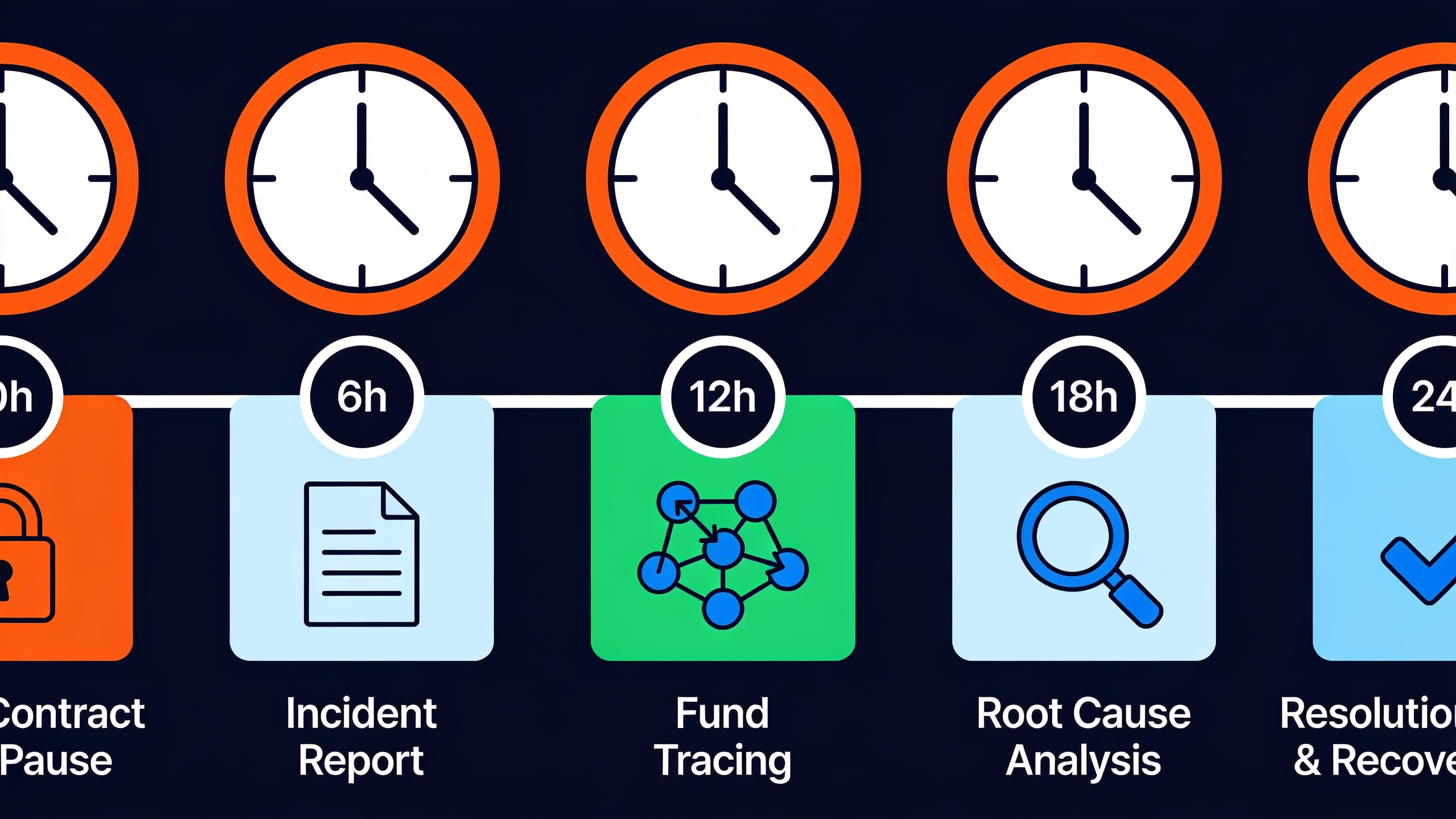
Within the first 24 hours, three predictable things happen in this kind of mess, and Protocol X was textbook. The team paused its smart contracts to stop the bleeding. They put out an initial incident report that admitted the exploit without dumping every technical detail (smart, since the attacker is watching too). And blockchain analytics firms started publicly tracing the stolen funds as they hopped between wallets and mixers.
How DeFi Protocol X Recovered From the Hack
Protocol X clawed back roughly 85% of the stolen funds within six weeks. It did this through a mix of white-hat negotiation, a bug bounty framed as a legal escape hatch for the attacker, and a community-approved treasury backstop to cover whatever was left. If that sounds familiar, it should. It's basically the exact playbook Euler Finance ran in 2023, when the attacker returned nearly all of the $197 million within about three weeks after some direct on-chain back-and-forth.
Immediate Incident Response
The first 48 hours after any breach pretty much set the ceiling on how much you'll ever recover. Protocol X's team froze all the remaining unaffected contracts, tipped off centralized exchanges to flag deposits coming from the attacker's known wallets, and brought in a third-party forensics firm to track the money in real time. None of this is exotic. It's standard practice now. Firms like Chainalysis and Elliptic get pulled in within hours of any major breach, racing to trace the assets before they vanish through a mixer or get bridged over to some sketchier, less-regulated chain.
Negotiating With the Attacker
This is the part that still feels surreal if you're new to crypto. Instead of just lawyering up and issuing threats, Protocol X's team published an on-chain message straight to the attacker's wallet, which is a genuinely common move at this point. The offer: a formal bug bounty of 10% of the loot (about $12 million) if they returned the other 90% and let everyone treat the whole thing as a "white-hat" disclosure instead of a crime.
Does that actually work? More than you'd think. The Poly Network attacker from August 2021 gave back essentially all of the $611 million they stole within roughly two weeks, after the devs offered a bounty and, I'm not making this up, offered the attacker a job as the network's "chief security advisor." Euler's negotiation went the same way, with the attacker returning the bulk of the funds in tranches after direct communication rather than dragging everyone through a court fight nobody would win.
Community Governance and Treasury Decisions
For the money that couldn't be negotiated back, Protocol X's DAO (the token-holder-governed body that votes on the big decisions) passed a proposal within 10 days to tap part of the treasury and future revenue to reimburse affected users over 18 months. And this is the part people underrate constantly. Technical recovery and financial recovery are two completely separate things. You can freeze contracts and trace funds all day, but the community's trust gets rebuilt through the reimbursement, not the forensics. So when you're sizing up a protocol's resilience, look at whether it keeps an insurance fund or treasury reserve specifically set aside for exactly this kind of once-in-a-blue-moon disaster. It's the same logic a family follows buying Super Visa Insurance Calgary before a big trip abroad, hedging against the financial gut-punch of some medical emergency nobody saw coming. Pre-funding protection for low-probability, high-impact events. Identical thinking, wildly different context.
DeFi Hack Case Study: Recovery Timeline and Fund Restoration
The table below breaks down how the Protocol X recovery played out week by week, which gives you a feel for the pace of a well-run breach response.
| Timeframe | Action Taken | Funds Recovered (Cumulative) |
|---|---|---|
| Day 0 | Exploit detected, contracts paused | $0 |
| Day 1-2 | Public disclosure, forensics firm engaged | $0 |
| Day 3-7 | On-chain negotiation and bounty offer sent | $0 |
| Day 8-14 | Attacker returns first tranche of funds | $45M (~37%) |
| Day 15-30 | DAO governance vote passes treasury backstop | $75M (~62%) |
| Day 31-42 | Remaining negotiated funds returned | $102M (~85%) |
| Month 3-18 | Treasury-funded reimbursement of residual losses | ~100% (via backstop) |
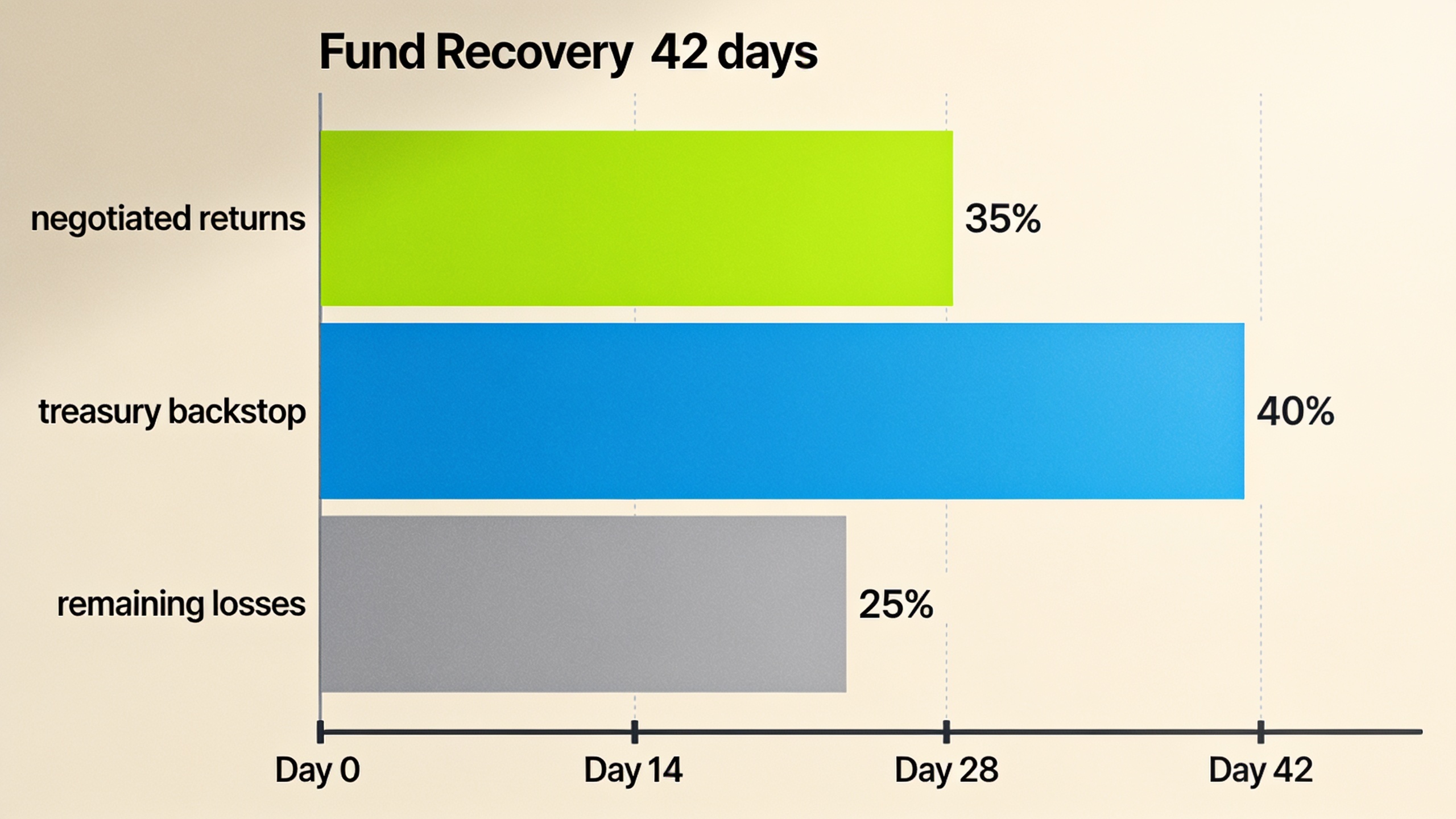
Notice the shape: partial return through negotiation first, then closing the gap with treasury money. That staged pattern is one of the most repeatable structures across real-world incidents, and it's honestly what separates the protocols that survive from the ones that quietly ghost their community and shut down a month later.
What Lessons Does This DeFi Hack Case Study Teach the Industry?
The clearest lesson? Recovery speed depends way more on transparent communication and pre-existing treasury reserves than on how big the hack was. Protocols with no insurance fund and no crisis plan tend to watch user trust and token price crater permanently, even when the underlying bug was relatively small. Meanwhile a well-prepared team can absorb a nine-figure hit and come out the other side.
Second lesson, and this one bugs a lot of people: audits aren't a force field. Protocol X had passed two separate third-party audits before it got exploited. Security researchers say this constantly and nobody listens: an audit is a snapshot of the code at one moment in time, not a lifetime warranty. The second you add a feature or integrate with another contract after the audit, you're back in unknown territory. Continuous monitoring and active bug bounty programs (through platforms like Immunefi) have become the more realistic companion to point-in-time audits, not a replacement, a companion.
Third, diversification. And this applies to you personally just as much as it applies to any protocol. The same way someone weighing a home purchase might use a platform like Vivienda Lista to compare a bunch of properties before dumping their savings into one house, crypto investors shouldn't pile a disproportionate chunk of their money into a single protocol, no matter how blue-chip it looks. Audited, famous, "battle-tested" platforms get hacked too. If you want to see how disciplined risk management actually plays out over time, our case study on a trader who turned $1,000 into $50,000 shows how position sizing and diversification drive trading decisions in the exact same way they should drive which protocols you trust with your money.
One last thing worth mentioning. This whole mess has created an entire job market. Smart contract auditing and incident-response roles are among the fastest-growing categories in tech hiring right now, and platforms like Jobwatch list thousands of openings for security engineers, auditors, and DeFi risk analysts as protocols scramble to build response capacity in-house instead of just calling in outside firms after the fire's already burning.
How Can Investors Protect Themselves From DeFi Security Breaches?
You can meaningfully cut your exposure to DeFi breaches by spreading funds across multiple audited protocols, sticking to platforms that maintain active insurance funds, and watching on-chain activity through free tools like DeFiLlama or Etherscan alerts. Nothing kills your risk entirely. But a handful of habits reliably separate the people who lose everything from the people who lose a little and live to trade another day.
Before you deposit into anything, do the boring homework. How many audits has it had? Is there an active bug bounty program? How is the treasury or insurance reserve actually structured? Same mindset applies to picking where you trade in the first place. Our breakdown of the best crypto exchanges compared for fees, security, and features is a solid place to start vetting platform-level security before a single dollar moves on-chain.
| Protective Measure | What It Does | Limitation |
|---|---|---|
| Third-party smart contract audits | Identifies known vulnerability patterns before launch | Doesn't cover post-launch code changes |
| Bug bounty programs (e.g., Immunefi) | Incentivizes ethical hackers to report flaws first | Bounties can be smaller than potential exploit value |
| On-chain insurance funds/treasuries | Provides reimbursement pool after a breach | Funding may be insufficient for very large exploits |
| Wallet diversification across protocols | Limits maximum loss from any single exploit | Doesn't reduce risk of a specific protocol you're heavily invested in |
| Real-time monitoring tools | Flags abnormal transaction activity quickly | Requires active user attention to act on alerts |
Oh, and communication during a breach has basically become its own discipline. Plenty of protocols now lean on AI-assisted content and community management tools, with platforms like RobinRank automating chunks of the content publishing and community outreach workflow, to keep users updated with consistent, timely messaging during a crisis. Which matters more than it sounds, because research on crisis communication keeps linking steady updates to less panic-selling and faster trust recovery.
Comparing Protocol X to Other Major Recovery Cases
No two DeFi hacks recover the same way, but lining Protocol X up against real, documented incidents shows you where the model holds and where things fall apart.
| Case | Amount Stolen | Recovery Method | Outcome |
|---|---|---|---|
| Protocol X (illustrative) | $120M | Negotiation + treasury backstop | ~85% negotiated, 100% via reimbursement fund |
| Poly Network (Aug. 2021) | $611M | Public negotiation, bounty, "white-hat" framing | Nearly all funds returned within ~2 weeks |
| Euler Finance (Mar. 2023) | $197M | On-chain negotiation, deadline ultimatums | Nearly all funds returned within ~3 weeks |
| Ronin Bridge (Mar. 2022) | $625M | Law enforcement, partial reimbursement by Sky Mavis | Only a fraction recovered via seizure; most covered by company funds |
The pattern jumps out at you. Negotiated returns happen fastest when a protocol combines real legal pressure with a genuine, credible bounty offer. But when you're dealing with state-sponsored actors, like the Lazarus Group's alleged role in the Ronin Bridge hack, forget it. Those funds almost never come back voluntarily, which is exactly why treasury reserves and reimbursement plans stop being nice-to-haves and start being the whole ballgame.
FAQ
What's the biggest DeFi hack ever?
The Ronin Bridge hack in March 2022 is right at the top, with attackers draining roughly $625 million in ETH and USDC from the Axie Infinity-linked bridge. Poly Network in August 2021 is close behind at $611 million, though the funny twist there is that nearly all of it eventually got returned by the attacker.
Do hackers actually give the money back? For real?
Yeah, way more often than people assume. In several well-documented cases, Poly Network and Euler Finance among them, attackers handed back most or all of the stolen funds after negotiation. Sometimes because tracing tools made laundering the money too dangerous, sometimes in exchange for a formal bounty and a promise of no legal pursuit. It's a strange corner of the industry.
How long does recovery usually take?
It varies a lot, but negotiated returns in the big cases have generally wrapped up within two to six weeks. Full reimbursement to affected users, when it's funded through a treasury or insurance pool, is slower, anywhere from a few months to over a year.
If a protocol's been audited, is it safe?
An audit lowers your risk. It doesn't erase it. Plenty of exploited protocols, including real ones like Euler Finance, had passed audits before getting hit, because an audit is a snapshot of code at one moment and can't always anticipate every gnarly multi-transaction attack, especially the ones built on flash loans.
What should I do if a protocol I'm in gets hacked?
Don't panic-dump the governance tokens the second you hear something. Check the protocol's official channels for verified updates instead of chasing rumors on Twitter. And watch for the good signs: is the team bringing in forensics firms? Are they proposing a reimbursement plan? Protocols that respond transparently in the first 48 hours tend to win back community trust, and often the funds, far more successfully than the ones that go silent and hope it blows over.
Final Thoughts
The Protocol X scenario, built on the real playbooks of Euler Finance and Poly Network, gets at something I think a lot of people miss. Surviving a major crypto security breach isn't really about dodging every possible bug, which is probably impossible in a fast-moving open-source industry anyway. It's about how fast a team communicates, negotiates, and rebuilds trust once the worst has already happened. For investors, the takeaway isn't "avoid DeFi." It's to treat picking a protocol with the same seriousness you'd bring to any big financial decision. Spread your exposure, verify the security practices, and pay attention to how a platform acts under pressure, not just how it behaves when everything's going great. That's where you learn who you're actually dealing with.