How Institutional Investors Are Reshaping the Crypto Market
Crypto used to be the domain of hobbyists, cypherpunks, and guys with laser eyes on Twitter. Not anymore. Hedge funds, banks, publicly traded corporations, and even pension funds now sit on billions...


Crypto used to be the domain of hobbyists, cypherpunks, and guys with laser eyes on Twitter. Not anymore. Hedge funds, banks, publicly traded corporations, and even pension funds now sit on billions of dollars worth of Bitcoin, Ethereum, and tokenized financial products, and that changes everything about how prices move, how liquidity behaves, and how the rest of us should think about risk. A 2024 report from Fidelity Digital Assets found that more than half of institutional investors surveyed across the US and Europe reported some exposure to digital assets, up from roughly a third just three years earlier. That's a big jump. And it matters, because institutional money doesn't just pad the trading volume. It rewires the market's plumbing, its volatility patterns, and the entire regulatory conversation.
So let's get into who these players are, how they're actually getting their money into crypto, and what it means for you if you're just an individual trader or a long-term holder trying to keep your bearings in a market that's growing up fast.
Table of Contents
- What Is Institutional Crypto Investment?
- Why Are Institutions Suddenly Piling Into Crypto?
- The Main Entry Points: How Institutions Actually Buy Crypto
- Institutional vs. Retail Behavior: A Market Structure Comparison
- How Institutional Money Changes Crypto Market Analysis
- The Ripple Effects on Retail Investors
- Risks and Criticisms of Institutional Dominance
- What's Next for Institutional Crypto Investment?
- FAQ
What Is Institutional Crypto Investment?
Institutional crypto investment is when big, professionally managed entities put capital into digital assets. Think hedge funds, investment banks, asset managers, pension funds, insurance companies, and public corporations, as opposed to some individual buying Bitcoin on an app during their lunch break. The difference isn't just the size of the wallet. Institutions deal with regulated custody, compliance frameworks, enormous trade sizes executed through over-the-counter (OTC) desks, and formal risk management. It's a whole apparatus.
The category exploded after the SEC approved spot Bitcoin exchange-traded funds (ETFs) in the United States in January 2024. In their first year of trading, US spot Bitcoin ETFs pulled in more than $35 billion in net inflows, according to data compiled by Bloomberg and multiple ETF issuers. BlackRock's iShares Bitcoin Trust (IBIT) alone blew past $50 billion in assets under management by mid-2025. You simply couldn't move that kind of capital through direct exchange purchases. It needed a regulated, familiar wrapper that a compliance department could actually sign off on without breaking into a cold sweat.
One thing worth flagging: institutional investment isn't the same as institutional interest. Banks were poking around blockchain tech as far back as 2015 through research labs and consortiums like R3. But actually putting crypto on the balance sheet? That's a much newer, much more consequential move.
Why Are Institutions Suddenly Piling Into Crypto?
The short version: clearer US regulation, the arrival of regulated products like spot ETFs, and clients who won't stop asking about crypto as a way to diversify. A few things lined up at roughly the same time, and the timing wasn't a coincidence.
The Fear of Getting Sued Went Away (Mostly)
For years, the number one excuse US financial institutions gave for staying out of crypto was regulatory uncertainty. Nobody wanted to be the firm that got made an example of. When the SEC approved spot Bitcoin ETFs in January 2024, then spot Ethereum ETFs that July, it sent a clear signal: regulators were willing to build structured pathways rather than just slam the door shut. That gave legal and compliance teams the cover they'd been quietly waiting for. Allocations that had been whispered about in meetings for years finally got the green light.
The Balance Sheet Play
Public companies did a lot of the heavy lifting here too. MicroStrategy, now rebranded as Strategy, started stacking Bitcoin in August 2020 and, by 2025, was holding more than 600,000 BTC. That strategy turned a mid-sized software company into one of the most obsessively watched Bitcoin proxies on the Nasdaq. Tesla and a handful of smaller firms have run their own versions of this treasury-allocation approach, treating Bitcoin less like a speculative gamble and more like a hedge against their cash slowly losing value.
Everybody's Client Is Asking About It
Wealth managers and private banks keep hearing the same thing: high-net-worth clients want to know about crypto allocation. And if your firm doesn't offer a regulated way to do it, that client takes their money to the firm across the street that does. That competitive pressure is real, and it's pushed even famously conservative players, including several large US pension funds and university endowments, to make small allocations, usually somewhere in the 1% to 5% range of total assets. Modest, but symbolically huge.
The Main Entry Points: How Institutions Actually Buy Crypto
Institutions almost never buy crypto the way you and I do. There's no thumb hovering over a "buy" button on some consumer app. Instead they lean on one of four channels: spot ETFs, OTC trading desks, futures and derivatives, or direct custody with a regulated custodian.
Spot ETFs have become the default on-ramp for asset managers who want exposure without the headache of holding private keys. These products trade on regular stock exchanges, settle through brokerage infrastructure everyone already uses, and slot neatly into existing compliance and reporting systems. Easy sell for a risk-averse committee.
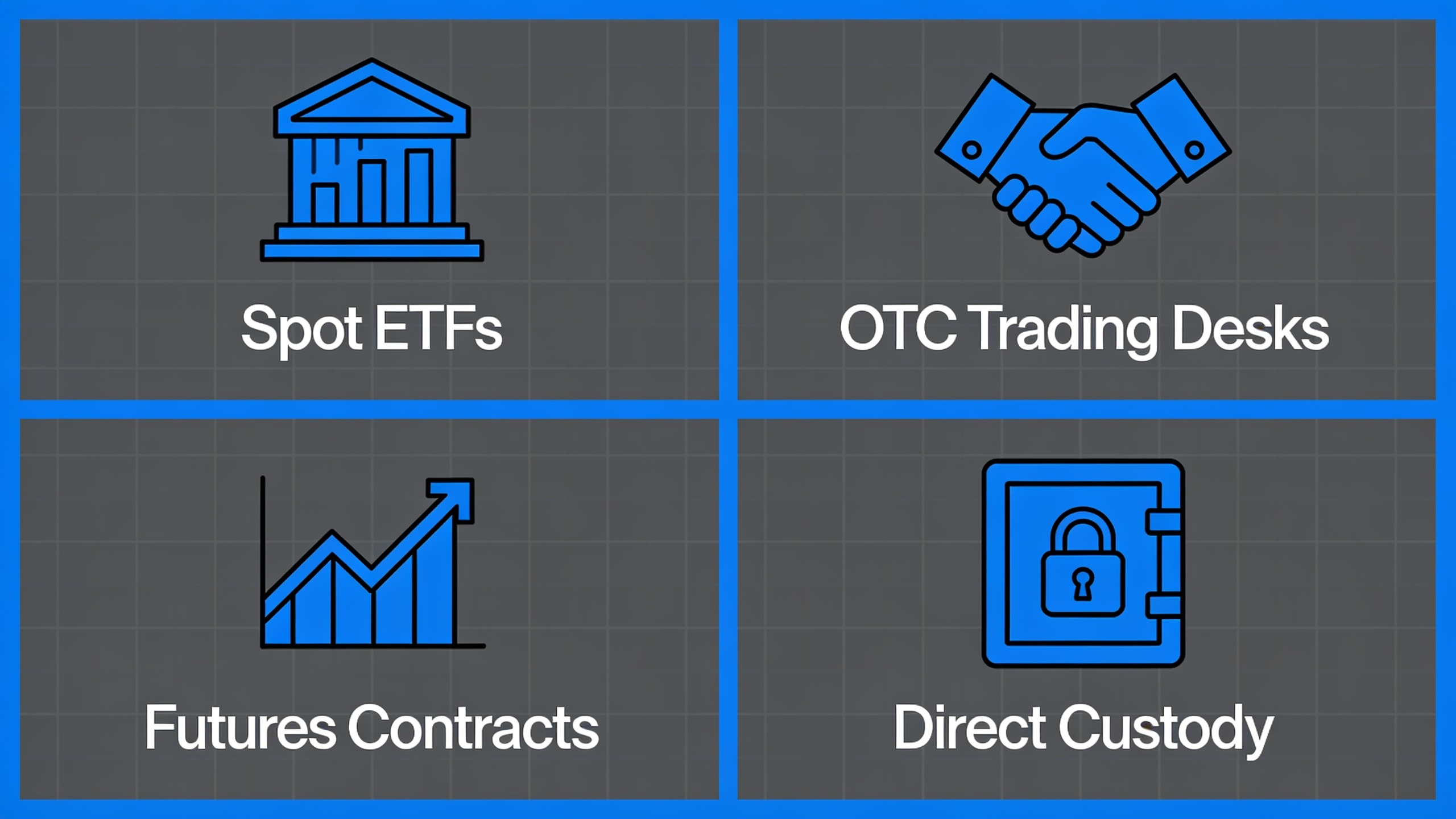
OTC desks are the quieter, more interesting one. Firms like Cumberland, Genesis (in its earlier form), and Galaxy Digital let big players execute trades off the public order book. Why does that matter? Because if a hedge fund tried to dump $200 million of Bitcoin straight onto an exchange, the price slippage would be brutal. OTC keeps that hidden. And here's the kicker for anyone staring at charts: those large trades don't always show up right away in visible order book data, which can seriously distort the picture retail traders think they're seeing.
Then there's futures and derivatives, especially CME Bitcoin and Ethereum futures, which let institutions gain or hedge exposure without ever touching the actual asset. CME futures open interest has repeatedly hit record highs since 2023, and pros watch it closely as a stand-in for institutional positioning.
Direct custody rounds things out. Providers like Coinbase Institutional, Fidelity Digital Assets, and Anchorage Digital hold the real thing for institutions that actually want to own the underlying asset, usually for long-term treasury reasons rather than active trading.
The infrastructure story reaches further than pure finance, too. Just as a local services business, say a firm like Dmplumbingheating offering plumbing and heating solutions, might one day look at accepting crypto payments once blockchain rails mature, institutional custody solutions are quietly laying the plumbing (pun fully intended) that could eventually make crypto payments as boring and routine as tapping a card.
Institutional vs. Retail Behavior: A Market Structure Comparison
Institutions and retail traders come at crypto with completely different time horizons, risk tolerances, and toolkits, and that produces measurably different market behavior. Here's the quick contrast.
| Factor | Institutional Investors | Retail Investors |
|---|---|---|
| Typical entry point | Spot ETFs, OTC desks, futures | Centralized/decentralized exchanges, apps |
| Average holding period | Months to years (treasury strategy) | Days to months, often shorter during volatility |
| Trade size | $1M–$500M+ per transaction | $50–$50,000 typical range |
| Risk management | Formal hedging, derivatives, compliance review | Often informal, driven by sentiment |
| Price impact per trade | High, but executed to minimize slippage | Low individually, high in aggregate during panics |
| Primary information source | Research desks, on-chain analytics firms | Social media, influencers, exchange apps |
| Regulatory oversight | Extensive (SEC, custody rules, audits) | Minimal beyond exchange KYC |
The takeaway for anyone doing serious crypto market analysis: institutional trades are bigger but slower and more deliberate, while retail activity is smaller per trade but capable of creating sharp, emotional swings when a whole crowd moves at once. Figuring out which group is actually driving a given price move is one of the more underrated skills a trader can develop. It pairs really well with the technical stuff in a trader's guide to reading crypto charts, which walks through how to spot the volume anomalies that often flag institutional accumulation or distribution.
How Institutional Money Changes Crypto Market Analysis
Institutional participation has made crypto analysis genuinely harder, because prices now react to macroeconomic data, ETF flow reports, and corporate earnings calls on top of the on-chain metrics that used to be the whole game. A decade ago, analyzing Bitcoin basically meant watching exchange order books, mining difficulty, and forum sentiment. Now? Professional analysts are also tracking a bunch of stuff that didn't matter back then.
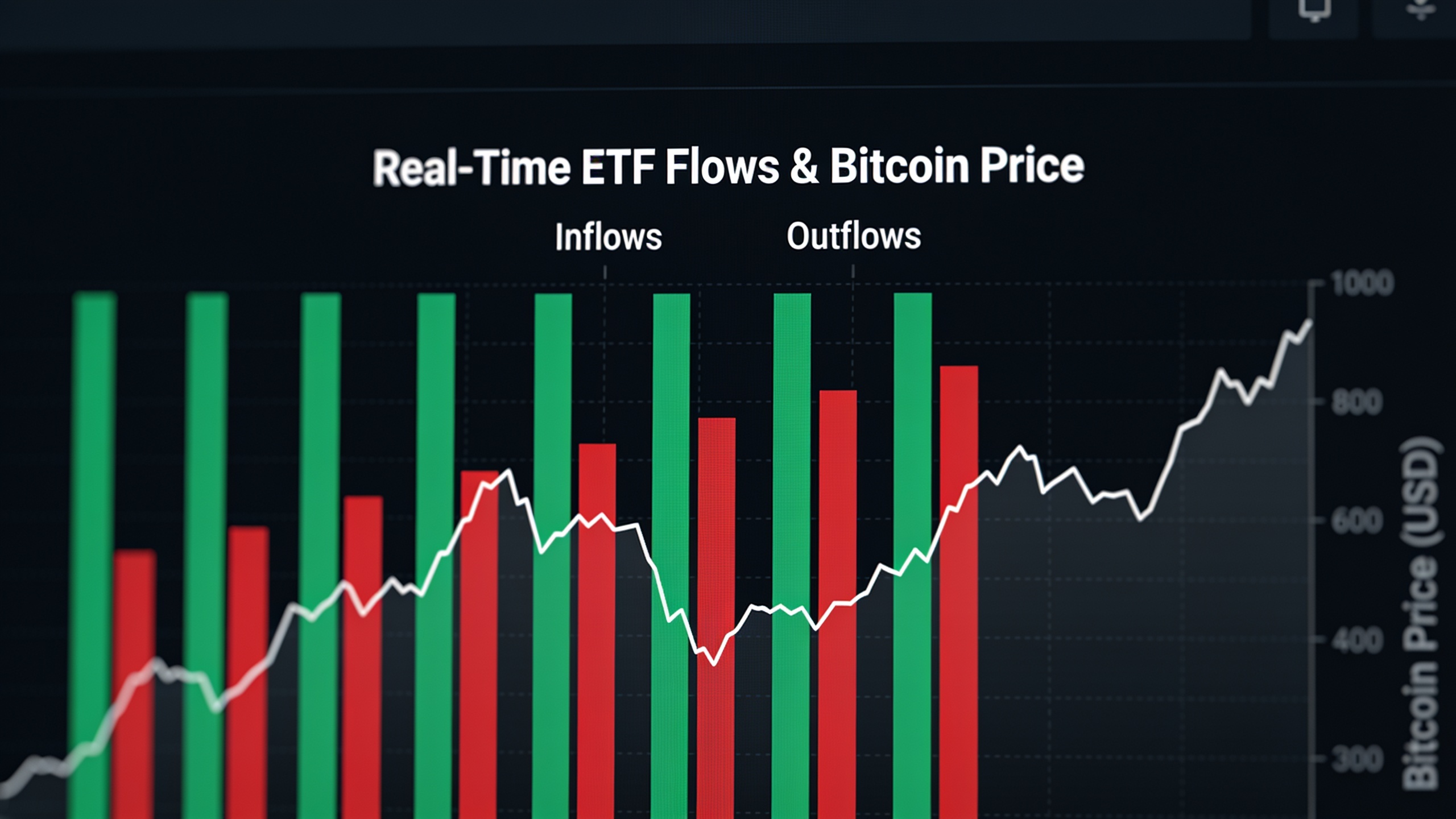
ETF net inflows and outflows, for one. Issuers publish them daily, and data providers like Farside Investors aggregate them, making these numbers a leading real-time gauge of institutional mood. A multi-day streak of outflows from spot Bitcoin ETFs has repeatedly come right before short-term price pullbacks in 2024 and 2025. It's become one of those signals you ignore at your peril.
There's also CME futures basis and open interest, which tell you whether institutions are betting on higher prices (contango) or hedging against a drop. And correlation with traditional markets has become a big deal. Bitcoin's correlation with the Nasdaq 100 climbed noticeably during 2022's rate-hiking cycle, according to data from Coin Metrics, which is a fancy way of saying institutional portfolios now often treat Bitcoin like a risk asset that moves in lockstep with tech stocks during macro stress, rather than the uncorrelated "digital gold" it was once sold as.
Oh, and corporate treasury disclosures matter now too. Companies like Strategy report their Bitcoin holdings in quarterly SEC filings, which hands analysts a transparent, verifiable data point that just didn't exist in earlier cycles.
Bottom line, anyone doing real crypto market analysis today has to blend traditional macro and equity-market literacy with crypto-native, on-chain research. That combined skill set barely existed before 2023. Serious coverage now looks a lot more like equity research than the forum-driven speculation of crypto's early days. Even adjacent asset classes reflect the shift. Look at how NFT market trends in 2025 get analyzed these days, with institutional liquidity and blue-chip collection metrics instead of pure hype.
The Ripple Effects on Retail Investors
For everyday investors, institutional money has generally smoothed out the wild multi-month swings, but it's also raised the price of entry and made the whole thing more complicated. A few effects really stand out.
Volatility is lower, but nobody should mistake that for calm. Bitcoin's 30-day realized volatility has trended down during periods of heavy ETF inflow compared to past cycles, though it's still way higher than traditional equities. Deep, professionally managed liquidity pools mean a single big retail sell order is far less likely to crater the price the way it might have in 2017 or 2018. But sharp moves still happen, usually around macro news, regulatory bombshells, or ETF flows suddenly reversing.
Access got easier and safer, and honestly retail benefits from this almost by accident. The custody standards, insurance requirements, and audit practices institutions demanded from exchanges and custodians ended up raising security standards across the board, even on the consumer-facing apps.
The flip side is that the market feels a lot more "macro" now. Because institutions hold crypto inside diversified portfolios, digital assets react harder to Federal Reserve rate decisions, jobs data, and general equity sentiment than they did when the investor base was almost entirely crypto-native. If you're a retail trader who never glances at the economic calendar, you're ignoring a genuine driver of short-term price action. That's not a lecture, just a heads up.
Some institutional strategies are also branching out beyond pure cryptocurrency into tokenized real-world assets, like tokenized real estate and money market funds. This echoes what's happening in other industries going digital. Much as a real estate platform such as Viviendalista helps buyers and renters navigate property listings online, institutional finance is figuring out how tokenization could eventually bring that same digital-first accessibility to fractional real estate investment.
And then there's the harder pill for active traders: as professional desks deploy algorithmic strategies and deep liquidity, a lot of the inefficiencies retail used to exploit have shrunk. Thin order books, wide spreads on smaller altcoins, cross-exchange arbitrage, those edges have narrowed on the big assets like Bitcoin and Ethereum. They still exist on smaller, less liquid tokens, but the easy money on the majors is mostly gone.
Risks and Criticisms of Institutional Dominance
Let's not pretend this is all upside. Institutional dominance brings its own baggage: tighter correlation with traditional markets during downturns, concentration risk around a handful of big custodians and issuers, and a nagging worry that crypto is losing the whole decentralization ethos it was built on. These deserve an honest look.
Concentration risk is probably the one that keeps purists up at night. A small number of custodians, including Coinbase, which acts as custodian for most US spot Bitcoin ETFs, now hold an outsized chunk of institutionally owned Bitcoin. Critics point out the obvious irony: this recreates exactly the single-point-of-failure risk that decentralized assets were supposed to eliminate.
Correlation risk cuts both ways. Sure, institutional adoption brought legitimacy and liquidity. But it also chained Bitcoin's price more tightly to equity sentiment, which undercuts its value as a true diversifier during broad risk-off moments, like the market stress of early 2022 and the tariff-related jitters in 2025. So much for the uncorrelated hedge narrative.
There's a philosophical tension too, and I don't think it ever fully goes away. Bitcoin was designed around individual custody and resistance to centralized control. Leaning heavily on ETFs, where you own shares rather than actual coins, arguably hands power back to the very financial intermediaries the technology was meant to route around. Expect this argument to keep resurfacing in crypto commentary for years.
Regulatory whiplash is the last one, and it's real. Policy can flip with a new administration or a new legislative session. Institutions that built entire strategies around one regulatory environment could wake up to changes in tax treatment, custody rules, or reporting requirements. Nobody's immune.
What's Next for Institutional Crypto Investment?
Institutional crypto investment is almost certainly going to keep growing, through tokenized funds, staking-enabled ETFs, and more corporate treasuries jumping in, though how fast will depend heavily on regulation and the broader macro picture. A few trends are already visible on the horizon.
Staking-enabled ETFs are under active regulatory review in the US right now. If approved, they'd let institutions earn yield on Ethereum holdings inside a regulated ETF wrapper instead of staking directly, and that could meaningfully juice institutional Ethereum demand.
Tokenization of traditional assets is picking up speed, with heavyweights like BlackRock and Franklin Templeton launching tokenized money market funds on public blockchains. This blurs the line between "crypto investment" and plain old asset management, and a lot of people expect it to be one of the fastest-growing corners of institutional finance for the rest of the decade.
Sovereign and state-level interest is bubbling up as well, with some countries exploring strategic Bitcoin reserves. That adds a geopolitical layer to institutional adoption that simply wasn't a factor in earlier cycles.
And the infrastructure around crypto keeps getting more professional at every layer, from custody to compliance to research and content. Even the way crypto news and analysis gets made is evolving. AI-driven platforms like RobinRank automate SEO content research and publishing workflows, helping financial media keep up with a market that now spits out institutional-grade data around the clock. Which is really the theme running through this whole shift: as institutional capital pours in, the tools, standards, and expectations around the asset class are getting rebuilt to match traditional finance.
You see the same pattern well beyond finance, honestly. Just as niche local service industries, from logistics operators coordinating travel like Ricaritranslombok in Lombok, Indonesia, to specialized trades, gradually pick up digital tools and payment infrastructure as they professionalize, crypto's institutional wave is dragging the entire asset class toward more standardized, transparent, and interoperable systems.
FAQ
Is institutional crypto investment the same as buying Bitcoin on an exchange?
Nope. Institutional investment usually runs through regulated vehicles like spot ETFs, OTC desks, futures contracts, or custody arrangements with licensed providers, not a quick tap on a consumer app. The underlying asset might be identical, but the execution, custody, reporting, and compliance requirements are worlds apart.
How much institutional money has actually flowed into crypto?
US spot Bitcoin ETFs alone attracted more than $35 billion in net inflows in their first year after launching in January 2024, according to data aggregated by Bloomberg and ETF issuers, with individual funds like BlackRock's IBIT clearing $50 billion in assets under management by mid-2025. And that's just the visible part. Corporate treasuries, pension allocations, and OTC volume pile on billions more that are tough to track precisely, since a lot of it happens off public exchanges.
Does institutional investment make crypto safer for retail investors?
It generally improves the plumbing, custody standards, and liquidity, which cuts down certain risks like exchange insolvency or brutal price slippage. But it doesn't kill volatility, and it ties crypto more tightly to traditional markets, so retail investors trade some old risks for a batch of new macro-driven ones.
Why do companies like Strategy hold Bitcoin on their balance sheet?
Companies that treat Bitcoin as a treasury asset usually frame it as a hedge against currency debasement and a long-term store of value, kind of like how firms used to hold gold or foreign currency reserves. Strategy (formerly MicroStrategy) is the poster child, holding more than 600,000 BTC by 2025 and effectively becoming a leveraged Bitcoin proxy for stock investors.
Will institutional dominance eventually push out retail investors?
Probably not, but the role is changing. Retail will stay a big part of crypto markets, just shifting from the main price driver to one player among many, alongside hedge funds, ETFs, and corporations. The retail traders who adapt, by getting comfortable with macro drivers, ETF flow data, and on-chain metrics instead of leaning purely on vibes and social media, tend to do a lot better in this more institutional market.
The arrival of hedge funds, banks, and corporations has permanently changed how Bitcoin, Ethereum, and the wider crypto market behave, trade, and get analyzed. For the rest of us, the practical takeaway isn't panic about getting crowded out. It's just accepting that the market now dances to two rhythms at once, crypto-native fundamentals and the old, familiar beat of traditional finance. Learn to hear both.