Inside a DAO: How DAO Governance Manages Million-Dollar Treasuries
A DAO (decentralized autonomous organization) is basically a member-owned collective that runs on blockchain voting and smart contracts instead of a boardroom full of executives. DAO governance is...

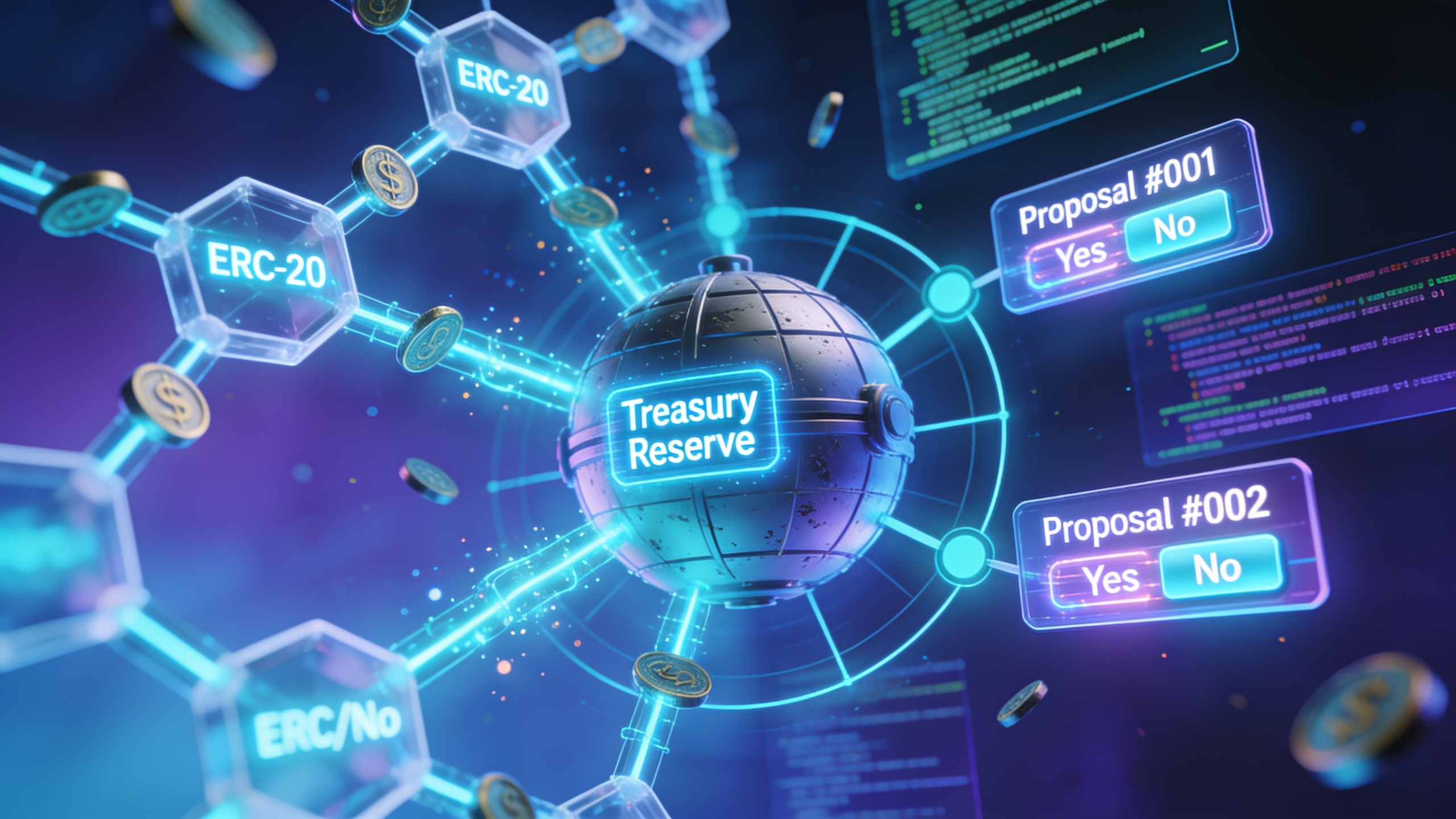
A DAO (decentralized autonomous organization) is basically a member-owned collective that runs on blockchain voting and smart contracts instead of a boardroom full of executives. DAO governance is the whole apparatus of rules, tokens, and voting that decides who gets to spend the shared money and how. And when a group is sitting on a treasury worth anywhere from tens of millions to over a billion dollars, that apparatus stops being an academic curiosity real fast. Get it right and you've got a resilient, transparent community fund. Get it wrong and you can watch value evaporate overnight. So let's actually walk through how a DAO structures its governance, how a proposal travels from a forum post to money moving on-chain, and what you should know before you throw your own tokens (and your reputation) behind a vote.
Table of Contents
- What Is a DAO and Why Does Governance Matter for Treasury Management?
- A DAO Case Study: How Treasury Governance Works in Practice
- How Does DAO Governance Actually Work, Step by Step?
- Where Does the Money Go? Treasury Allocation Categories
- Transparency and On-Chain Accountability
- What Are the Risks Baked Into DAO Governance?
- Governance Models Compared
- Lessons for Anyone Considering DAO Involvement
- FAQ
What Is a DAO and Why Does Governance Matter for Treasury Management?
A DAO is an internet-native organization where membership, voting rights, and the treasury all run through a token and get executed by smart contracts on a public blockchain, no board of directors required. Governance matters because it's genuinely the only thing standing between a pooled treasury and total chaos. Without clear rules about who can propose spending, who gets to vote, and how the money actually moves, a DAO treasury is just an unguarded pile of digital assets with a fancy name.
In practice, most DAOs build up their treasury through token sales, protocol fees, or community allocations at launch. Then the people holding the DAO's voting token use it to vote on everything from tiny grants to multimillion-dollar strategic bets. And because both the votes and the fund movements get recorded on a public ledger, anyone can (in theory) audit exactly where the money's going. That transparency is the whole pitch of the DAO model. It's also what makes DAOs such a good lens for understanding where decentralized finance actually collides with real organizational decisions, a topic that ties into broader crypto market shifts tracked across sites like Newsrum, which follows emerging trends across tech and digital culture.
A DAO Case Study: How Treasury Governance Works in Practice
The fastest way to get DAO governance is to watch how a real, on-chain governed protocol handles its treasury decisions instead of talking about governance in the abstract. Think MakerDAO, Uniswap, Arbitrum DAO. Each of them governs its treasury through token holder voting, and each has grown into a layered structure that keeps everyday operational spending separate from the big strategic allocations.
The basic setup goes like this: the DAO's native token (MKR for MakerDAO, UNI for Uniswap, ARB for Arbitrum) gives you voting power in proportion to how much you hold or how much has been delegated to you. Treasury sizes bounce around with token prices and protocol revenue, and depending on the market they've been publicly discussed as anywhere from tens of millions for the smaller DAOs to north of a billion dollars for the largest protocol treasuries. But instead of one central team deciding how all that gets spent, proposals get drafted out in the open, argued over on forums, then put to a vote (on-chain or off) before anything executes.
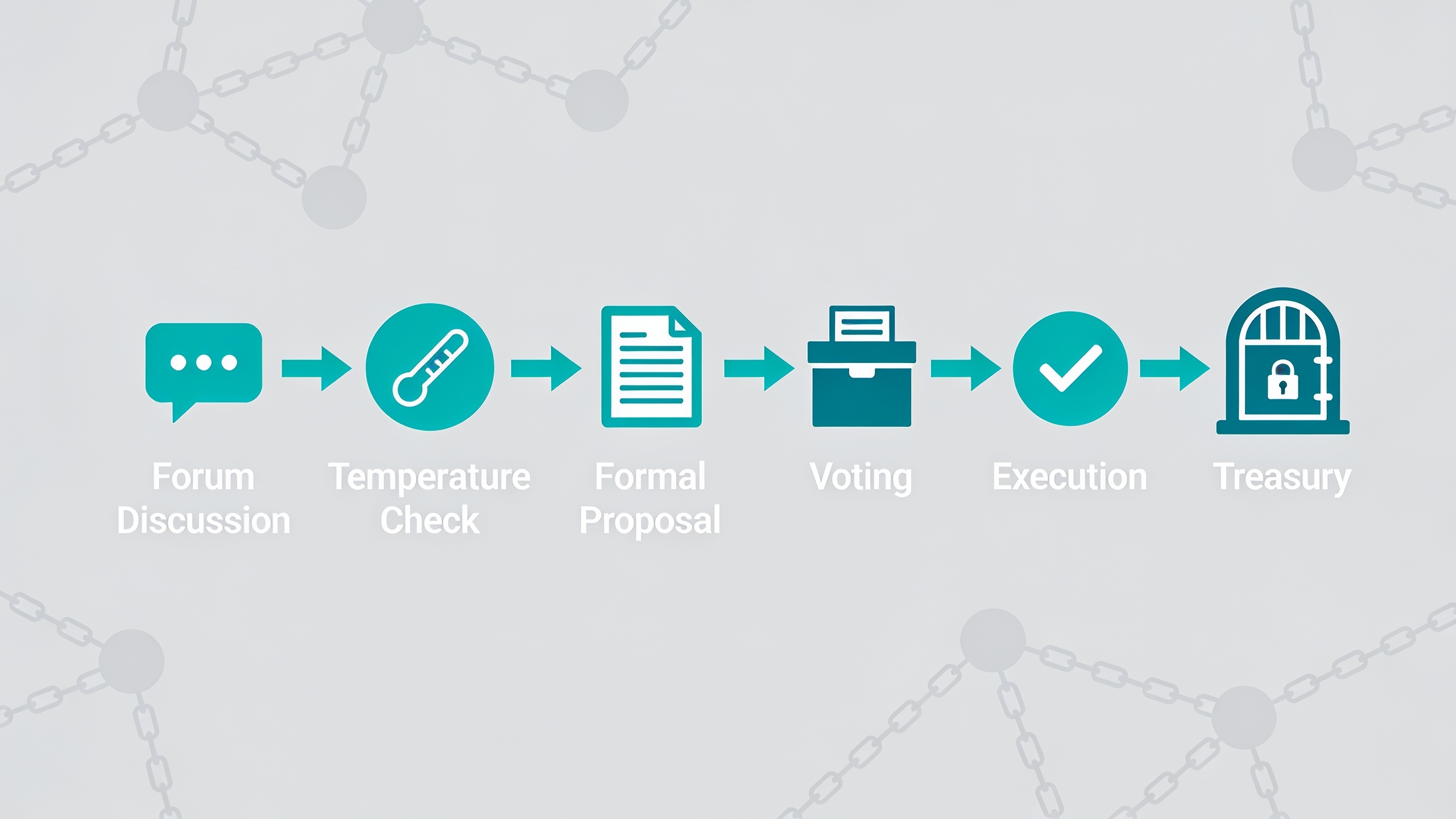
That layered flow, forum discussion then temperature check then formal proposal then binding vote then on-chain execution, is really what separates a functioning DAO from a token-voting popularity contest. It makes ideas survive scrutiny before actual money moves, and it leaves a paper trail anyone can dig through later. Honestly, that accountability loop reminds me a lot of how centralized platforms get forced to respond after a security breach, something explored in this site's DeFi hack case study on how a DeFi protocol recovered from a major exploit, where community governance and transparent communication did a lot of the heavy lifting in winning back user trust.
How Does DAO Governance Actually Work, Step by Step?
DAO governance runs on a repeatable proposal lifecycle: someone posts an idea publicly, the community argues about it, it gets refined into a formal proposal, token holders vote, and if it passes, it executes either automatically or through an authorized multisig wallet. Once you understand this loop, you understand how a DAO treasury actually gets touched.
Step 1: Forum Discussion and Temperature Checks
Most DAOs run a public forum (usually something like Discourse or Commonwealth) where any member can float an idea before it becomes anything official. People call this stage a "temperature check." It's a cheap way to read the room, usually through a quick non-binding poll, before anyone burns the time and gas fees needed to write a full proposal.
Step 2: Formal Proposal Drafting
If the early vibes are good, the proposer writes up a structured document laying out exactly what they want: how much treasury money, going to whom, over what timeframe, judged by what metrics. The serious DAOs won't even look at a proposal unless it comes with a rationale, a budget breakdown, and often a "sunset clause" that kills the funding automatically if the milestones don't get hit.
Step 3: Voting
Then it goes to a vote, with your voting power weighted by how many governance tokens you hold or have been delegated. Some DAOs vote entirely on-chain, so every single vote is a blockchain transaction. Others use gasless off-chain signaling tools and only put the most expensive step (moving the actual funds) on-chain, which saves everybody a fortune in transaction fees.
Step 4: Execution
Approved proposals execute either automatically through a smart contract or manually through a trusted multisig wallet, which just means a wallet that needs several designated signers to sign off before a transaction goes through. That multisig step adds a human checkpoint against bugs or malicious proposals slipping past a vote. Critics will tell you it also sneaks a bit of centralization back into a supposedly decentralized process, and, well, they're not wrong.
Where Does the Money Go? Treasury Allocation Categories
DAO treasuries generally get spread across a handful of recurring buckets: core protocol development, security and audits, grants for outside builders, liquidity or market-making programs, and paying the contributors. Once you see these categories, it clicks why a treasury that looks gigantic on paper is almost never just sitting there. Most of it's earmarked, streaming out, or already promised to a dozen ongoing initiatives.
Development funding pays the engineers building and maintaining the protocol's smart contracts. Security spending covers audits, bug bounties, and sometimes insurance-style reserves to backstop losses when things go sideways, a category that's ballooned across the industry as more protocols learn painful lessons from exploits (the exact kind of mess picked apart in that DeFi hack recovery case study). Grants fund outside developers, researchers, and community projects so the core team doesn't have to build every single thing themselves. Liquidity programs put treasury assets to work deepening the trading markets for the DAO's token. And contributor compensation pays the people doing the unglamorous ongoing work, the moderators, delegates, treasury managers, and community leads who actually keep the lights on.
| Treasury Category | Primary Purpose | Typical Decision Speed |
|---|---|---|
| Core development funding | Pay engineers building/maintaining protocol | Slow — often multi-month proposals |
| Security & audits | Smart contract audits, bug bounties, reserves | Fast-tracked when urgent |
| Grants programs | Fund outside builders and researchers | Medium — batch review cycles |
| Liquidity & market operations | Support trading depth for governance token | Medium to fast |
| Contributor compensation | Pay delegates, moderators, treasury managers | Slow — usually annual/quarterly votes |
Transparency and On-Chain Accountability
DAO treasuries are transparent by default because the wallets holding the money are public blockchain addresses that anyone can inspect with a block explorer, no permission from the DAO needed. This is one of the most concrete differences between a DAO and a regular nonprofit or corporate treasury, where you're lucky to get quarterly financial statements that were audited internally long before anyone outside ever laid eyes on them.
What that means in practice is that any community member, journalist, or nosy researcher can watch a DAO's treasury balance in near real time, follow a specific proposal-related transaction as it leaves the treasury wallet and hits a recipient, and match that movement back against the governance vote that authorized it. There are third-party dashboards built just for this, turning raw on-chain data into readable charts showing asset composition, runway estimates, spending history. For anyone weighing whether a project's governance token is worth holding, that kind of visibility is arguably more useful than anything traditional finance offers. It's a transparent, data-heavy environment that overlaps naturally with how traders read market moves, a discipline dug into in this site's case study of a trader turning $1,000 into $50,000, where obsessive tracking of on-chain and market data was the whole point.
But here's where I'd push back a little: transparency isn't the same thing as good judgment. A treasury can be perfectly visible on-chain and still get run into the ground if turnout is low, if a few whales dominate every vote, or if the proposals are technically clean but strategically dumb. Visibility hands the community the tools to hold governance accountable. It doesn't force anyone to actually pick them up.
What Are the Risks Baked Into DAO Governance?
The core risks in DAO governance are voter apathy, voting power concentrating in a few big hands, smart contract vulnerabilities, and painfully slow decisions during emergencies. Every one of these has played out in real DAOs, and every one directly affects how safely a treasury can actually be managed.
Voter apathy is probably the most common problem of all. Even in the big-name DAOs, a huge chunk of eligible governance tokens just sit there unused in any given vote, which means the outcome usually gets decided by a small, hyper-engaged minority rather than the whole community. That opens the door to concentration risk: if a handful of wallets (early investors, VC funds, or exchanges holding tokens for their users) control a big slice of the voting power, they can basically steer treasury decisions even when the broader community wants something else. Delegation systems, where passive holders hand their voting power to active delegates, are meant to fight this. They help. They don't fix it.
Smart contract risk is the second big one. Since treasury funds often live in contracts that execute governance decisions automatically, one bug in that code can be catastrophic. It's a lesson the whole DeFi sector keeps relearning, and it's laid out in detail in the DeFi protocol hack recovery case study, which shows both how fast funds can end up at risk and how the community's governance response afterward decides whether trust ever comes back. And finally, on-chain voting cycles that drag on for days or weeks can be a real liability in an emergency, say, an exploit that's actively draining funds right now. That's exactly why a lot of DAOs keep an emergency multisig or security council with narrower, faster powers to act before a full vote can even finish.
Governance Models Compared
Not every DAO governs its treasury the same way, and the model it picks has real consequences for speed, security, and how decentralized the thing actually is. Here's how the most common structures stack up.
| Governance Model | How Voting Power Works | Speed of Decisions | Main Trade-Off |
|---|---|---|---|
| Token-weighted voting | 1 token = 1 vote, direct on-chain votes | Slow to medium | Favors large holders ("whales") |
| Delegated voting | Holders assign voting power to chosen delegates | Medium | Relies on delegate competence and engagement |
| Multisig council | A small set of trusted signers approves transactions | Fast | Reintroduces centralization risk |
| Optimistic governance | Proposals execute automatically unless vetoed within a window | Fast | Requires strong monitoring to catch bad proposals in time |
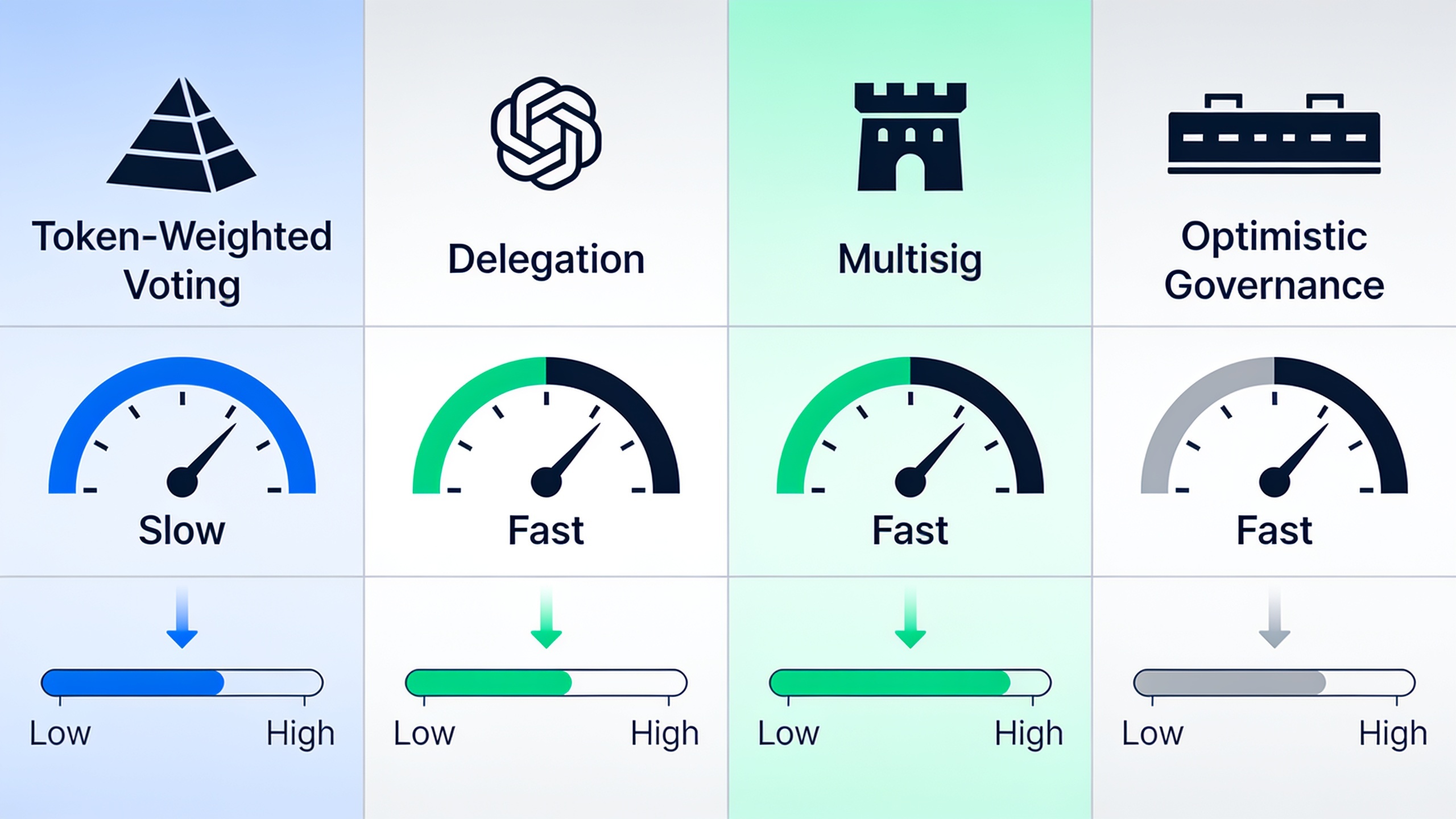
Each model is really just a different bet on the tug-of-war between speed and decentralization. Token-weighted voting is the most philosophically "pure" version of decentralization, and also the slowest and the most exposed to whale influence. Delegated voting tries to have it both ways, keeping participation broad while letting passive holders lean on engaged experts. Multisig councils trade away some decentralization for speed, so they usually get reserved for emergencies or smaller operational budgets rather than the big allocations. And optimistic governance, which some of the newer DAOs use, flips the whole default: instead of "nothing happens unless it's approved," it's "things happen unless someone objects." Faster for routine stuff, sure. But it puts a much heavier burden on the community to actually watch what's going through.
Lessons for Anyone Considering DAO Involvement
If you're thinking about getting into a DAO, whether as a token holder, delegate, or grant applicant, treat governance participation like due diligence on any other financial commitment: read before you vote, figure out where the treasury actually sits, and know who's voting next to you. DAO governance can hand you genuine influence over serious pools of money. That influence comes with real responsibility and real risk attached.
Before you jump in, go look at the DAO's public treasury dashboard and see what the assets actually are. Stablecoins, the DAO's own governance token, and other crypto holdings all carry wildly different risk. A treasury stuffed with its own volatile governance token behaves very differently in a downturn than one diversified into stablecoins. While you're at it, scroll through the recent proposal history. Are votes competitive and well-attended, or is it the same three people rubber-stamping everything? That tells you a lot about whether your own vote is going to matter. New participants should also check how the DAO handles security: has it done third-party audits, does it have an emergency response process, has it been burned before? That last part pairs nicely with wider reading on how DeFi protocols claw their way back from security failures.
One more thing for anyone eyeing a delegate or contributor role. Meaningful governance participation eats real time. Reading proposals critically, arguing in the forums, tracking treasury health, that's closer to a part-time analyst gig than a passive investment. If you're honestly more interested in timing the market and trading around governance tokens than in the governance itself, you'd probably get more mileage studying execution and risk management directly, the kind of discipline broken down in the $1,000 to $50,000 crypto trading case study, instead of pretending DAO voting is some passive income stream. It isn't.
FAQ
So what actually is DAO governance, in plain English?
It's the set of rules and voting processes a DAO uses to decide how to spend its treasury, upgrade its protocol, or change its own rules. Nobody's asking a CEO or a board. Holders of the DAO's governance token vote on proposals, and whatever passes gets executed through smart contracts or authorized multisig wallets.
How do DAOs technically control their treasuries?
Most DAO treasuries sit in smart contract-controlled wallets or multisig wallets on a public blockchain. The funds only move once a proposal has passed a vote and the required signers or smart contract conditions give the green light, and every single movement is visible on-chain for anyone to see.
Can a small token holder really sway a DAO's treasury decisions?
Yeah, though your influence roughly tracks how many tokens you hold or have delegated. Smaller holders often get more practical impact by delegating to an active, trusted delegate, or by jumping into the forum discussions where proposals actually get shaped long before they hit a formal vote.
What happens if a vote approves a bad or malicious proposal?
This is one of the scariest risks people bring up. Once a proposal passes and executes, unwinding it can be brutal, especially if the money's already left the treasury. That's exactly why a lot of DAOs bake in safeguards: time delays between a vote passing and executing, emergency veto powers held by a security council, or multisig checks that force a manual review before funds move.
Is participating in governance the same as investing in the token?
Not really. Holding the governance token is what gives you voting rights, so they're linked, but actually participating (reading proposals, voting, delegating, contributing) is a totally separate thing from just holding and hoping the price goes up. Plenty of holders never vote at all. Others treat governance like an ongoing responsibility that comes with the investment.
DAOs are one of the more ambitious experiments crypto has coughed up: pool a serious amount of capital and let a scattered community, not a corporate hierarchy, decide how it gets spent. The mechanics (forums, proposals, token-weighted votes, multisig execution) are still very much a work in progress, and the risks around apathy, whale concentration, and smart contract security aren't going anywhere. But for the people willing to do the reading and actually show up to vote, DAO governance offers something traditional finance basically never does: a fully transparent, on-chain record of exactly how a shared treasury gets built, argued over, and spent.