The Rise of Central Bank Digital Currencies (CBDCs) Explained
CBDCs used to be the kind of thing that lived in dense academic PDFs nobody outside a central bank actually read. Not anymore. They've jumped from theory to real pilot programs touching billions of...


CBDCs used to be the kind of thing that lived in dense academic PDFs nobody outside a central bank actually read. Not anymore. They've jumped from theory to real pilot programs touching billions of people, and if you have any money in crypto, this stuff is worth understanding. So let's sort out what these government-issued digital currencies really are, who's furthest along, and what any of it means for Bitcoin, stablecoins, and the rest of the ecosystem you probably care about.
Here's a number that surprised me: as of 2024, more than 130 countries representing 98% of global GDP were exploring some form of CBDC, according to the Atlantic Council's Central Bank Digital Currency Tracker. Back in 2020 that number was just 35. That's not a trend. That's a stampede.
And for anyone trading or holding crypto, this isn't some dry policy footnote. CBDCs could rewire how money moves, how banks operate, and where everything else, from stablecoins to fully decentralized coins, ends up fitting in over the next decade.
Table of Contents
- What Is a CBDC? (CBDC Explained)
- How CBDCs Actually Work
- CBDC Development Around the World
- CBDC Explained vs. Stablecoins and Cryptocurrencies
- Why Are Central Banks Racing to Launch CBDCs?
- What Are the Risks and Criticisms of CBDCs?
- How Might CBDCs Impact the Crypto Market?
- Frequently Asked Questions
What Is a CBDC? (CBDC Explained)
A central bank digital currency, or CBDC, is a digital version of a country's official money that's issued and backed directly by its central bank, not by a commercial bank or some private company. That last part is the whole ballgame. The digital dollars sitting in your checking account right now? Those are actually liabilities of a commercial bank. A CBDC is a direct liability of the central bank itself. Think of it as the digital equivalent of the cash in your wallet.
That difference sounds like nitpicking, but it's genuinely huge. When you hold cash, you're holding a claim on the central bank with basically zero counterparty risk. When you hold a bank deposit, you're holding a claim on a private institution that could, in theory, go under. A CBDC drags that risk-free, central-bank-backed status into the digital world, which is something ordinary people just don't have access to at scale right now.
Central banks usually split CBDCs into two flavors. Retail CBDCs are meant for regular people and businesses, for payments, savings, transfers, the everyday stuff. Basically a digital version of banknotes and coins that anyone can use. Wholesale CBDCs, on the other hand, are locked to financial institutions and used to settle the big interbank transactions, securities trades, and cross-border payments more efficiently than clunky legacy systems like SWIFT or Fedwire.
The Bahamas got there first, launching the world's first fully live retail CBDC, the Sand Dollar, back in October 2020. Nigeria's eNaira followed in October 2021, then Jamaica's JAM-DEX in 2022. These early movers basically became the world's guinea pigs, handing every other central bank real data on the messy problems, like merchants who don't want to bother accepting it and the need for offline functionality in places where the internet cuts out.
How CBDCs Actually Work
A CBDC works by letting a central bank issue digital money straight to citizens or financial institutions, running on infrastructure that can be anything from a permissioned blockchain to a bog-standard centralized database. The exact plumbing changes country to country, but most setups share one thing: a two-tier structure. The central bank issues the currency, and commercial banks and licensed payment providers handle the actual distribution, the wallets, and the customer relationships. The central bank stays out of your inbox, mostly.
The Technology Behind CBDCs
Contrary to what a lot of people assume, not every CBDC runs on a blockchain. This trips people up constantly. Some, like early versions of China's e-CNY, use a hybrid centralized ledger that borrows a few cryptographic tricks from distributed ledger tech without actually being a decentralized blockchain. Others, especially wholesale pilots like the European Central Bank's work with the Eurosystem, have played around with permissioned distributed ledgers to settle securities and interbank transfers. If you want the actual technical foundation for how any of this ledger stuff works, this breakdown of blockchain technology and how it powers crypto walks through the consensus mechanisms and cryptography that some (but definitely not all) CBDC systems have lifted from the crypto world.
Distribution and Access
Most retail pilots hand out the currency through banks you already use or approved wallet apps, rather than making you open an account directly with the central bank. It keeps the existing banking relationships intact while the central bank still holds the keys to issuance. India's e-Rupee pilot, which launched in December 2022, does exactly this, pushing digital rupees out through partner banks like State Bank of India, ICICI Bank, and Yes Bank instead of some central-bank app.
Then there's programmability, and honestly this is the feature that makes me a little uneasy. It means you can attach rules to how the money gets spent. Welfare payments that only work for groceries. Corporate funds that expire if you don't use them by a certain date. China's e-CNY has already tested this out, handing out time-limited digital currency as transit subsidies and spending vouchers during regional stimulus pushes. Useful? Sure. But you can probably already see where the criticism comes from.
CBDC Development Around the World
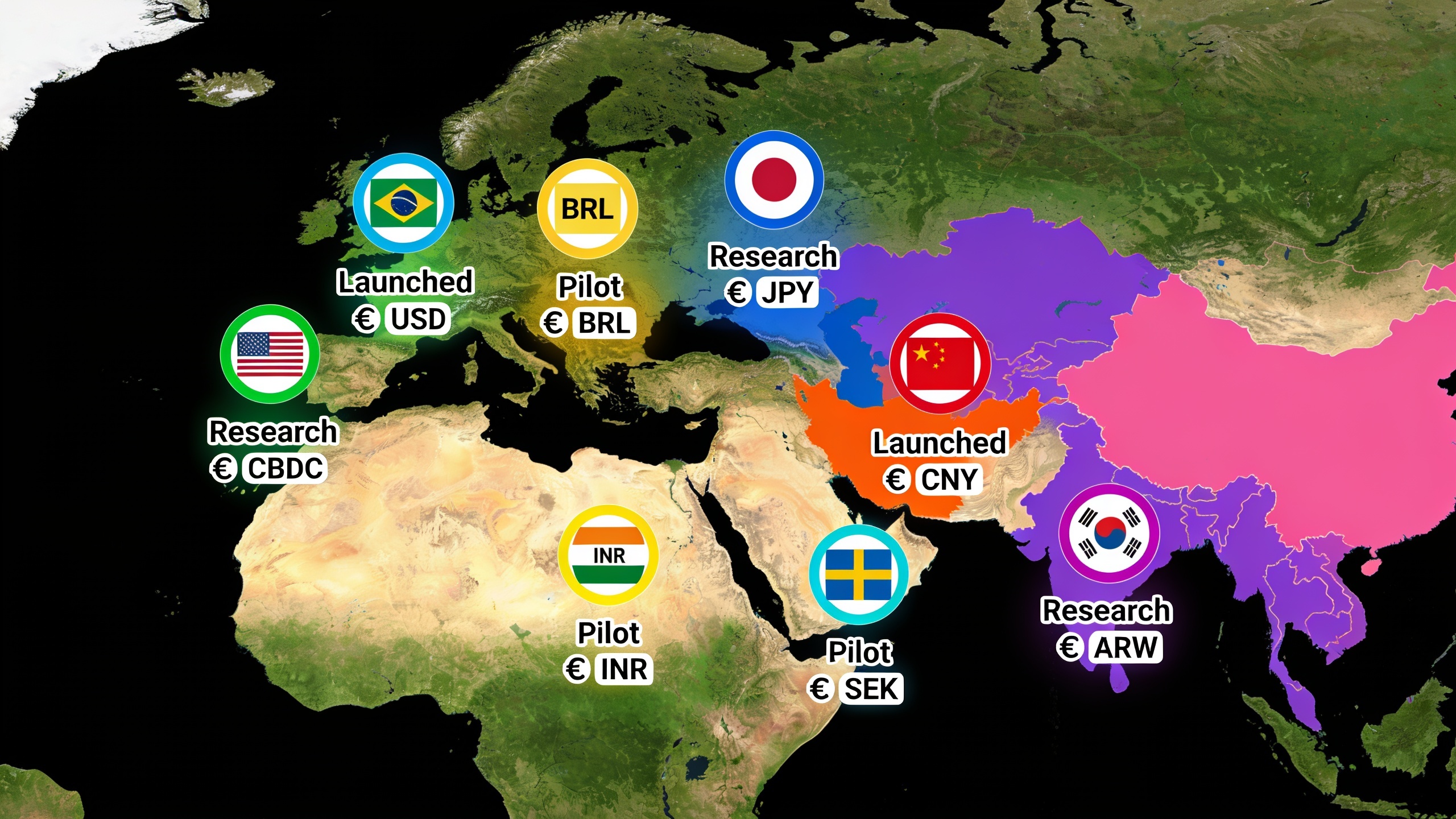
CBDC development is happening at wildly different speeds depending on where you look, from fully launched retail systems to countries still noodling around in the research phase. As of 2024, the Atlantic Council counted 3 countries with a fully launched retail CBDC, 36 running pilot programs, and dozens more still in research or development.
China's e-CNY (the digital yuan) is the giant here, the biggest CBDC pilot on the planet by transaction volume. The People's Bank of China said cumulative e-CNY transactions had blown past 1.8 trillion yuan, roughly $253 billion, by mid-2024, spread across pilots in more than 26 cities. It's baked into WeChat Pay and Alipay and has been used for everything from paying government salaries to buying stuff at the 2022 Beijing Winter Olympics venues.
Europe's a bit more deliberate. The ECB entered its "preparation phase" for a digital euro in November 2023, a stage that's supposed to run through at least October 2025 before anyone decides whether to actually issue the thing. ECB President Christine Lagarde and company have gone out of their way to stress that a digital euro would live alongside cash, not kill it off, and that it'd have offline payment capability so it still works when the internet doesn't.
The United States, meanwhile, is dragging its feet, and honestly that's not surprising. The Fed put out its "Money and Payments" discussion paper in January 2022 and has kept poking at the tech through projects like Hamilton (a collaboration with MIT), but Chair Jerome Powell has said over and over that the Fed won't move without clear backing from Congress and the White House. That caution only hardened through 2024 and 2025 as the politics got spicier, with some lawmakers introducing bills specifically to ban a retail CBDC on privacy grounds.
Australia's gone a different route entirely, focusing mostly on wholesale use cases through Project Acacia, looking at how tokenized money could smooth out settlement in wholesale markets. This kind of infrastructure-level work tends to bleed into neighboring industries, much like specialized software platforms such as Medinex have reshaped how Australian disability support providers handle payments, compliance, and workforce operations through tools built for one sector's specific headaches.
Here's how a handful of major economies stack up:
| Country/Region | CBDC Name | Status (as of 2024-2025) | Primary Focus |
|---|---|---|---|
| China | e-CNY (digital yuan) | Large-scale pilot, 26+ cities | Retail |
| Bahamas | Sand Dollar | Fully launched (2020) | Retail |
| Nigeria | eNaira | Fully launched (2021) | Retail |
| European Union | Digital Euro | Preparation phase | Retail |
| India | e-Rupee | Pilot phase | Retail & Wholesale |
| United States | None official | Research only | Undecided |
| Australia | N/A (Project Acacia) | Pilot/research | Wholesale |
| United Kingdom | "Digital Pound" (proposed) | Design phase | Retail |
CBDC Explained vs. Stablecoins and Cryptocurrencies
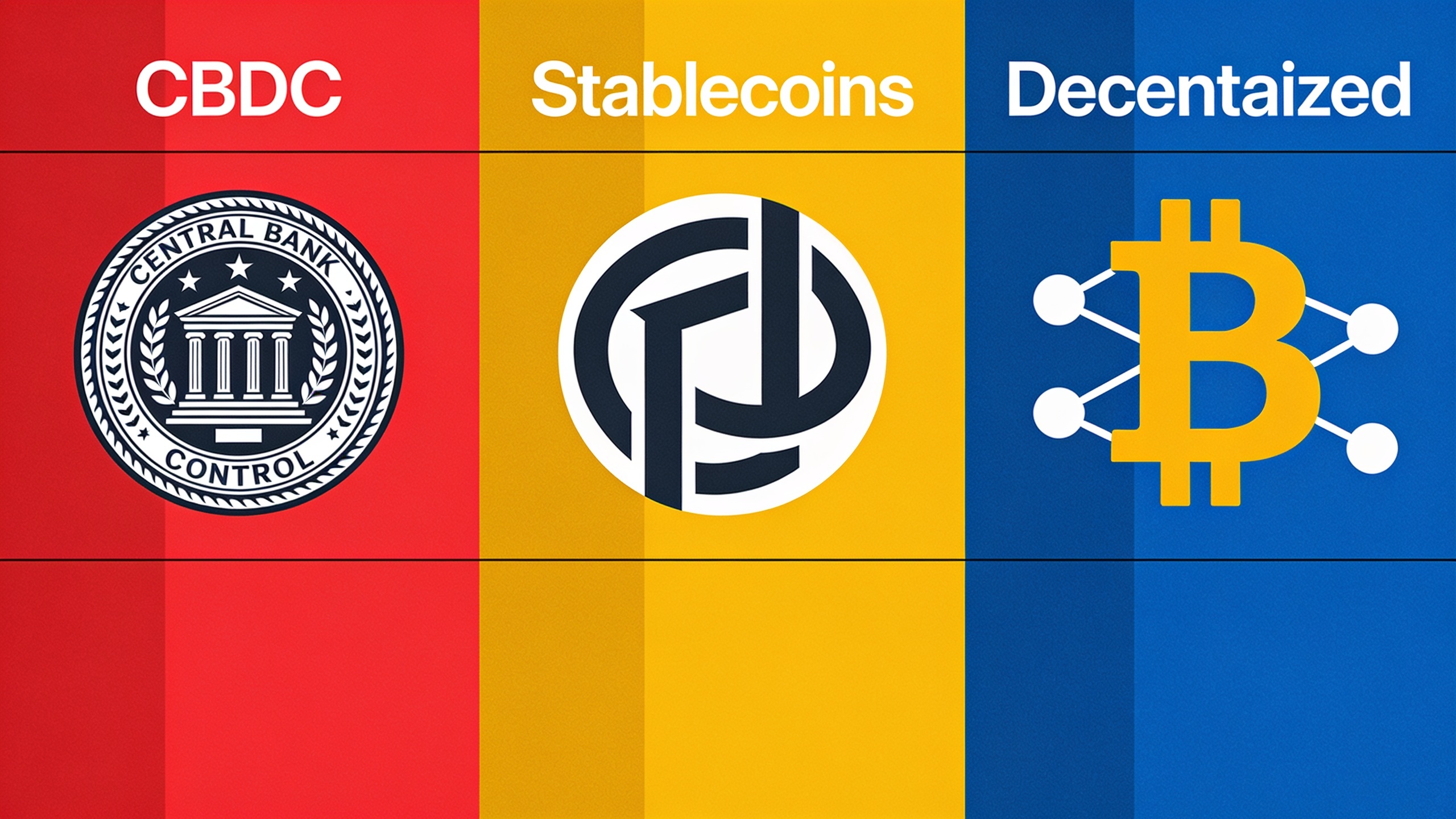
The core difference between a CBDC and every other digital currency comes down to who's in charge. A CBDC is issued and controlled by a central bank. Stablecoins are issued by private companies. And decentralized cryptocurrencies like Bitcoin have no central issuer at all. This is easily one of the most confusing parts for newcomers, because on the surface all three look identical. Digital tokens, moved around through an app or wallet. Same vibe, totally different guts.
Stablecoins like Tether (USDT), USD Coin (USDC), and DAI are built to hold a steady value, usually pegged 1:1 to the dollar, but they pull that off through private reserves, collateral, or algorithms, not direct central bank backing. If you want to understand how these three differ under the hood in terms of collateral and risk, this comparison of USDT, USDC, and DAI lays it out. Bitcoin and Ethereum go the whole way, ditching any single issuer and running instead on distributed networks of validators or miners.
Here's the irony I find kind of delicious. CBDCs sit at the exact opposite end of the spectrum from what Bitcoin was invented to fix. Satoshi Nakamoto's 2008 white paper straight-up framed Bitcoin as an escape hatch from a financial system that depends on trusted third parties, central banks very much included. CBDCs do the reverse. They shore up and modernize the central-bank-led system rather than replacing it. They're a response to decentralization, not an example of it.
Key Structural Differences
CBDCs are designed with no anonymity, more or less by default, because central banks want at least some window into where the money's going for anti-money-laundering and monetary policy reasons. Cryptocurrencies vary. Bitcoin gives you pseudonymity, Monero gives you real privacy. Stablecoins land somewhere in the middle, usually demanding identity checks (KYC) when you buy or cash out, while letting you move them around pseudonymously on-chain after that.
Volatility is the other big split. CBDCs and well-collateralized stablecoins are meant to sit still, holding a value equal to whatever currency they track. Bitcoin and Ethereum, on the other hand, can lurch double-digit percentages in a matter of days, jerked around by speculation, macro data, and whatever mood the market woke up in.
Why Are Central Banks Racing to Launch CBDCs?
Central banks are chasing CBDCs mostly for three reasons: to modernize creaky payment infrastructure, to hang onto monetary sovereignty as private digital currencies muscle in, and to pull unbanked people into the financial system. When the Bank for International Settlements surveyed central banks in 2023, the motivations that came up most were payment efficiency, financial stability, and financial inclusion, roughly in that order across both rich and emerging economies.
Financial inclusion is a really big deal in emerging markets specifically. Nigeria's eNaira and Jamaica's JAM-DEX were both partly about bringing unbanked citizens into the formal system without forcing them to open a traditional bank account, since a CBDC wallet can often be set up with just a phone number and some basic ID.
But there's a defensive angle too, and I'd argue it's the real motivator behind a lot of this. Plenty of central banks are quietly terrified that if they don't offer their own public digital currency, private stablecoins (especially dollar-pegged ones issued by companies based outside the US) could grab enough domestic market share to mess with monetary policy and chip away at faith in the local currency. That anxiety went into overdrive after Facebook announced its Libra project (later rebranded Diem) in 2019. Suddenly the idea of a trillion-user private global stablecoin felt very real, and central banks started publishing research citing exactly that threat.
For wholesale projects, cross-border payment speed is the headline. Project mBridge, a multi-CBDC platform involving the central banks of China, Hong Kong, Thailand, the UAE, and Saudi Arabia (which went from observer to full participant), has pulled off cross-border settlement in seconds instead of the days you'd normally wait through correspondent banking, according to BIS Innovation Hub reporting on the project's 2024 pilot results. Anyone who's ever sent an international wire and watched it vanish for three business days can appreciate why this matters.
What Are the Risks and Criticisms of CBDCs?
The biggest risks people worry about are privacy erosion, the disintermediation of commercial banks, and the government sticking its nose into how you spend your own money. These aren't fringe complaints either. They've made CBDCs one of the most politically radioactive topics in monetary policy, especially in democracies with a strong civil-liberties streak.
Privacy is the one that comes up most, and for good reason. A retail CBDC could, in theory, give a central bank a view of every single transaction you make. That's a level of surveillance that goes way beyond what's possible with cash or even a normal bank transfer. Designers know this is a problem, so most proposals (the ECB's digital euro included) bake in tiered privacy, letting you make small offline payments with cash-like anonymity while demanding ID for the bigger stuff. Whether that reassures the skeptics is another question entirely.
Then there's bank disintermediation, which is the one that keeps commercial bankers up at night. If people can hold digital currency directly with the central bank, they might yank their deposits out of commercial banks during a scary moment. Picture a "digital bank run," where everybody flees to the safe central-bank money at once, at the speed of a phone tap. The Bank of England has actually studied this and floated individual holding limits, reportedly somewhere between £10,000 and £20,000 per person, specifically to stop that kind of deposit flight into a digital pound.
And programmability, the same feature governments pitch as great for targeted stimulus or welfare, cuts the other way too. Critics worry it could be turned into a leash, blocking purchases of certain goods or slapping expiration dates on your funds. This fear has fueled real political pushback, including proposed US legislation trying to stop the Fed from issuing a retail CBDC without Congress signing off first. Personally? This is the part I'd want ironclad guarantees on before I ever touched one.
How Might CBDCs Impact the Crypto Market?
CBDCs probably won't kill off decentralized cryptocurrencies like Bitcoin, but they could seriously shake up the stablecoin market and speed up how comfortable regular people get with digital money overall. Because CBDCs and crypto serve genuinely different purposes, one props up state control, the other often exists to dodge it, most analysts figure they'll coexist rather than fight over the same turf.
That said, the knock-on effects could be real. For starters, widespread CBDC adoption could squeeze private stablecoin issuers hard, because a central-bank-backed digital currency offers all the stability of a stablecoin with none of the counterparty or reserve risk. If a digital euro or digital dollar got easy and ubiquitous, some of the transactional demand that USDT and USDC currently soak up inside their home markets could drift over to the sovereign option.
There's a subtler effect too. Rolling out a CBDC takes an enormous amount of public education and infrastructure spending, which quietly normalizes the whole idea of wallet-based digital money for people who'd never otherwise touch crypto. Millions in Nigeria, China, and India have now used a government-backed digital wallet for the very first time through these pilots. And once you've done that, the leap to trying a crypto wallet feels a lot smaller. That's a real gateway, even if central banks would hate to hear it framed that way.
And the technical research bankrolling CBDC work has, in some cases, directly helped blockchain infrastructure across the board. Central bank experiments with distributed ledgers, smart contracts, and tokenization, the stuff you see in mBridge and Project Acacia, all add to a growing pile of technical know-how and regulatory comfort with blockchain-based finance. Which can quietly boost the legitimacy of the wider crypto industry, even while regulators are simultaneously tightening the screws on private crypto markets. Funny how that works.
For fintech companies trying to keep up with this fast-moving mess, staying visible matters just as much as being technically ready. Firms building crypto- or CBDC-adjacent products usually need solid digital infrastructure to actually reach customers, and providers like Digital Fusion Hub that focus on web design, SEO, and digital marketing can help fintech startups build the professional online presence they'll need to compete as this space matures. On the same note, media outlets and crypto-adjacent businesses cranking out the sheer volume of explainer and news content this topic demands increasingly lean on AI-assisted platforms like RobinRank to keep publishing on schedule while holding onto SEO visibility in a very crowded field.
One last thing worth keeping in mind: CBDC adoption, like any big digital rollout, will spill into everyday commerce in ways that don't look financial at first. Just like e-commerce retailers, from electronics sellers to specialty furniture makers like Oak Castle Furniture, had to retool their checkouts for the rise of contactless and mobile payments over the last decade, merchants everywhere will eventually have to wire CBDC payment rails alongside their existing card and wallet options as pilots grow into full rollouts.
Frequently Asked Questions
Wait, is a CBDC just cryptocurrency with a government logo?
Not really, no. A CBDC is issued and controlled by a central bank and counts as a direct liability of that institution, basically like physical cash. Most cryptocurrencies, Bitcoin included, have no central issuer and run on decentralized networks where nobody's in charge of issuance or validating transactions. Same digital wrapper, completely different insides.
Which country's CBDC is actually the furthest along?
China's e-CNY (digital yuan) is generally seen as the most advanced large-economy CBDC by transaction volume and pilot scale, with cumulative transactions topping 1.8 trillion yuan by mid-2024 across more than 26 pilot cities, per People's Bank of China data. That said, smaller economies like the Bahamas and Nigeria were actually first to fully launch retail CBDCs, in 2020 and 2021.
Is the US ever going to launch a digital dollar?
As of 2025, the Fed hasn't committed to a retail digital dollar and keeps saying it won't move without clear authorization from Congress and the executive branch. Political opposition has only grown, with several bills floated to explicitly ban a retail CBDC over privacy worries. So a near-term launch looks pretty unlikely.
Could CBDCs wipe out cash completely?
Most central banks currently building CBDCs, the ECB and Bank of England among them, have flatly said a digital currency would complement cash, not replace it, at least for the foreseeable future. Actually killing off cash would take separate legislation and policy fights well beyond just issuing a CBDC.
Are CBDCs safe from hackers and fraud?
CBDC systems are usually built to bank-grade security standards or better, but let's be real, no digital payment system is bulletproof. That's exactly why most designs bake in offline functionality, encryption, and tiered access controls. Central banks have leaned on slow, phased pilots on purpose, to find and patch the holes before going nationwide.
Where This Leaves Investors and Crypto Watchers
The global CBDC push isn't a fringe experiment anymore. It's an active, multi-trillion-dollar-relevant shift in how money itself is being redefined at the state level. Keeping an eye on central bank digital currency news matters for anyone with skin in the crypto game, not because CBDCs are about to dethrone Bitcoin or Ethereum, but because their rollout is going to shape regulation, stablecoin demand, and public comfort with digital assets in ways that'll ripple across the whole industry for years. Ignore it at your own risk.