Yield Farming Strategies to Maximize Returns Across DeFi
There's a real difference between chasing those eye-popping APYs that vanish before your next coffee break and actually building something that pays you month after month. That difference is...


There's a real difference between chasing those eye-popping APYs that vanish before your next coffee break and actually building something that pays you month after month. That difference is strategy. Yield farming itself is simple enough to explain: you lend, stake, or supply liquidity to DeFi protocols, and in return you get paid, usually in the protocol's own token, a slice of trading fees, or some combination. But the real game isn't spotting the biggest number on a dashboard. It's knowing how liquidity pools actually work under the hood, pricing in impermanent loss before it bites you, and comparing protocols the way you'd size up any other investment.
So this guide is about the deeper end of the pool (pun intended). How to pick pools that generate returns you can count on, how to structure positions so impermanent loss doesn't quietly gut you, and how to look at protocol yields with a skeptical eye instead of just clicking "deposit."
Table of Contents
- What Is Yield Farming and Why Does Strategy Matter?
- How Do You Choose the Right Liquidity Pool for Yield Farming?
- Advanced Yield Farming Strategies for Experienced DeFi Investors
- How Can You Mitigate Impermanent Loss in Liquidity Pools?
- How Do You Compare Protocol Yields Before Committing Capital?
- Risk Management and Security in Yield Farming
- Building a Sustainable Yield Farming Routine
- Frequently Asked Questions
What Is Yield Farming and Why Does Strategy Matter?
Yield farming is putting your crypto to work inside DeFi protocols, usually as liquidity in a trading pool or as collateral in a lending market, so it earns a return from trading fees, interest, or token incentives. Strategy matters because the APY plastered across most farm dashboards is a gross, best-case number. It rarely accounts for token emissions diluting your rewards, impermanent loss, gas costs, or the ever-present risk that the smart contract itself blows up. Any one of those can quietly turn an advertised 40% APY into a real-world loss.
The space has grown up a lot since the "liquidity mining summer" of 2020, when Compound and yearn.finance kicked off the whole token-incentivized farming craze. Total value locked (TVL) across DeFi still swings with the market, but the farms that keep winning tend to have one thing in common: they earn real fees rather than just printing tokens. Honestly, that's the whole thing. A good farming approach treats every pool like a mini investment thesis. Where does the yield actually come from? How long can that source last? And what happens to your principal if the market turns on you?
Because DeFi yields ride right alongside overall market volatility, farmers who ignore what the underlying assets are doing get blindsided constantly. The same discipline you'd use trading spot applies here. A lot of the risk controls in 5 Crypto Trading Strategies for Volatile Markets carry over directly to how you size and exit farming positions.
How Do You Choose the Right Liquidity Pool for Yield Farming?
The right pool is the one where fees plus incentives genuinely pay you for the price risk and lock-up you're taking on. It is almost never the pool with the biggest headline number. A liquidity pool, if you need the refresher, is a smart-contract vault holding two or more tokens that traders swap against, and you (the liquidity provider) earn a cut of every trade for keeping it stocked.
Stablecoins vs. Volatile Pairs
Stablecoin-to-stablecoin pools like USDC/DAI barely touch impermanent loss, because both sides are pegged to the same value. Your returns come almost entirely from trading fees and whatever bonus tokens get thrown in. Volatile pairs, say ETH paired with some altcoin, dangle much fatter yields in front of you. But now you're exposed to both assets drifting apart in price, and that's exactly where impermanent loss stops being a textbook concept and starts costing you actual money.
Liquidity Depth and Trading Volume
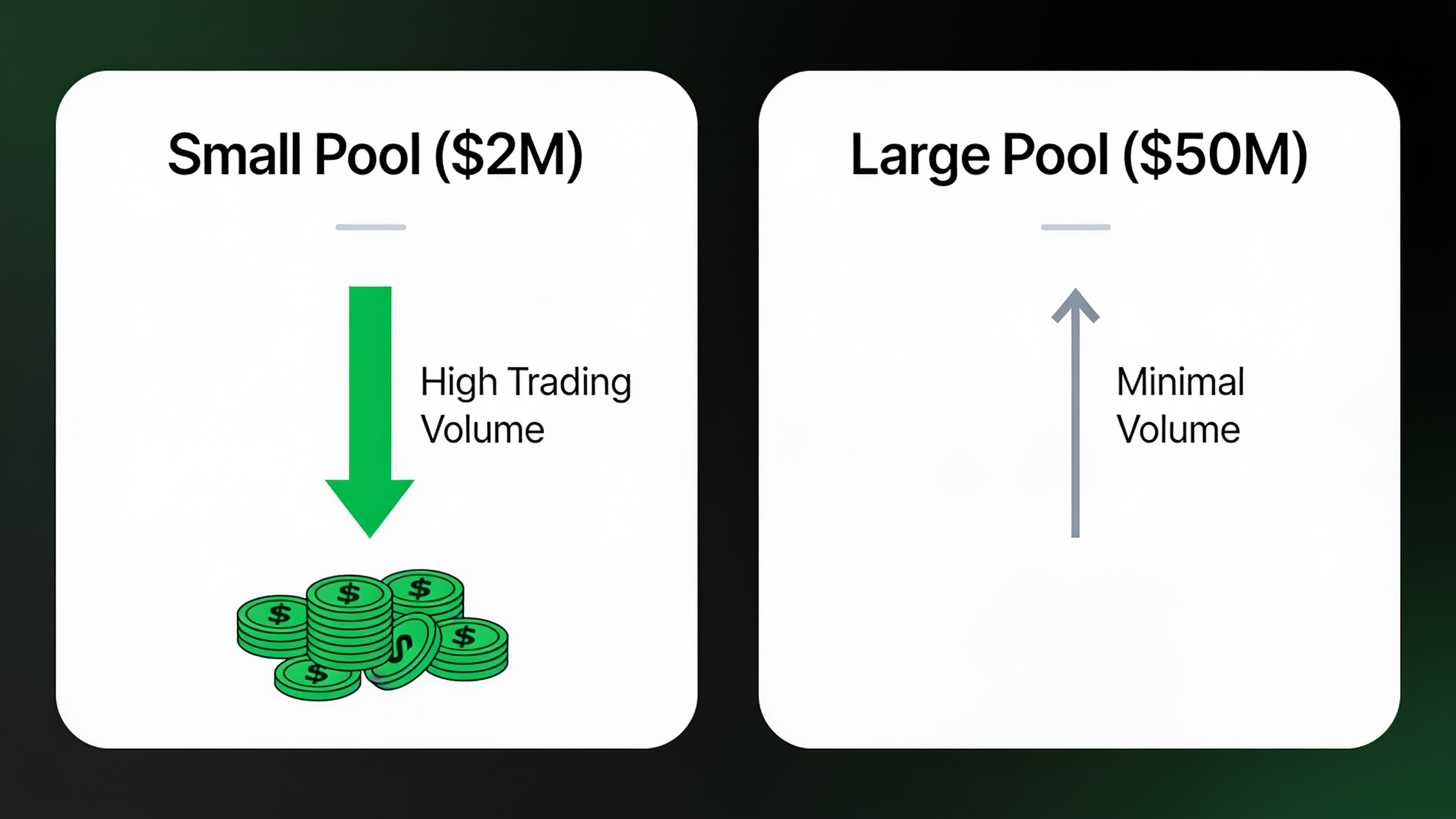
Here's something people miss: what drives your returns is the ratio of trading volume to total liquidity, not the raw size of the pool. A $2 million pool churning $4 million in daily volume will usually pay far better per dollar deposited than a $50 million pool limping along at $1 million a day. Before you deposit anything, pull up the protocol's analytics or a DeFi aggregator and check the 7-day and 30-day volume-to-TVL ratio. If it's consistently sitting above 0.2 to 0.3, you're probably looking at a pool that earns real fee income instead of just leaning on emissions.
Is the Emission Party Going to Last?
Loads of farms juice their APY with freshly minted governance tokens. That's not evil on its own. It only works long-term if the protocol has a credible way to turn token holders into actual stakeholders through buybacks, fee-sharing, or dialing back emissions over time. If a pool's yield is 90% emissions and 10% fees, you're not earning a fee-based return. You're betting the token price holds up. Know which one you're doing.
Advanced Yield Farming Strategies for Experienced DeFi Investors
The advanced stuff stacks multiple DeFi building blocks on top of each other, like auto-compounding vaults, leveraged liquidity, and cross-chain farming, to squeeze more return out of every dollar than a plain single-pool deposit ever could. It also demands more babysitting and a real grasp of liquidation and contract risk. This is how the serious players chase actual DeFi yield optimization instead of settling for base rates.
Auto-Compounding Vaults
Manually harvesting and reinvesting your rewards gets brutal fast, especially on Ethereum mainnet where gas can eat your gains alive. Auto-compounding vaults just do it for you at set intervals, turning a simple APR into a compounded APY. Bonus: they take away the very human risk of forgetting to reinvest during a hectic week when you've got a hundred other things going on.
Leveraged Liquidity Provision
Some money markets let you borrow against a deposited LP position to crank up your exposure to a pool's yield. It amplifies everything, including the pain. If your collateral drops relative to what you borrowed, you can get liquidated. I'd keep this strictly for deep, low-volatility pools, and size it so that even a full liquidation wouldn't put a serious dent in your overall portfolio. Leverage is fun until it isn't.
Cross-Chain and Multi-Protocol Farming
Gas and incentive programs vary wildly from chain to chain, so some of the best returns pop up on newer or less crowded networks running promo campaigns to bootstrap liquidity. Bridging capital around to catch those windows can absolutely work. But every bridge hop tacks on another layer of smart contract risk, so the extra yield has to clearly justify the extra exposure. Sometimes it does. Often it doesn't.
Delta-Neutral Farming
Delta-neutral strategies pair a long liquidity position with a short (usually a perpetual futures contract or a lending-market short) on the volatile asset in the pool. The idea is that price swings in the token cancel out while you still pocket the trading fees and incentives. It's one of the more capital-efficient ways to chase yield because it strips out the directional bet entirely. The catch? You're now watching two positions and managing funding rates on the hedge, which is more work than it sounds.
How Can You Mitigate Impermanent Loss in Liquidity Pools?
You keep impermanent loss in check by picking pools with correlated assets, using concentrated liquidity ranges thoughtfully, and sizing positions so fee income has a real shot at outpacing the price divergence between the two tokens. Quick definition, since it trips up so many people: impermanent loss (IL) is the gap between what your two assets would be worth just sitting in your wallet versus what they're worth stuck in the pool, and it happens because the automated market maker keeps rebalancing the ratio as prices move.
Pair Assets That Move Together
The single biggest thing you can do is pair assets that track each other. Stablecoin pairs, or something like staked-ETH against regular ETH, barely diverge, so the ratio stays tight and IL stays small. Toss a stablecoin in with a volatile altcoin and you've basically signed up for the maximum-divergence experience.
Use Concentrated Liquidity On Purpose
Protocols with concentrated liquidity let you park your capital in a specific price range instead of smearing it across the whole curve. Do it right and your fee income multiplies within that band. Get it wrong and your position stops earning the second price wanders out of range, plus your IL exposure gets more concentrated too. Tight ranges make sense for pairs you expect to chop sideways. Wider ranges suit pairs you think will get rowdy. You give up some fee density but stay "in range" longer. It's a tradeoff, not a free lunch.
Give It Time, Let the Fees Pile Up
Here's the thing people forget: IL is only real once you withdraw. If the fees and incentives you racked up over your holding period beat the IL at exit, you still came out ahead. That's exactly why the volume-to-liquidity ratio I keep harping on matters so much. High fee velocity gives your position a fighting chance to outrun price divergence.
Single-Sided and IL-Protected Pools
Some newer designs offer single-sided staking or built-in IL protection, where the protocol treasury or an insurance-style fund eats part of the loss in exchange for a slice of your yield. These can soften the downside, sure. But they're basically shifting the risk onto the protocol's own reserves, so I'd want to understand how that reserve gets funded and whether it could run dry in a long, ugly bear market. Because that's precisely when you'd need it.
How Do You Compare Protocol Yields Before Committing Capital?
Comparing yields properly means looking straight past the headline APY to the actual source of the yield, the TVL trend, the audit history, and how that number is even calculated. Two protocols both screaming "50% APY" can carry wildly different risk. This is the step where most farming strategies quietly live or die, because money allocated on APY alone tends to pile into the same emissions-driven pools that decay the fastest.
| Metric to Check | What It Tells You | Why It Matters for DeFi Yield Optimization |
|---|---|---|
| APY vs. APR breakdown | Whether the quoted rate assumes compounding and how often | A 40% APY compounded hourly looks very different from a 40% APR paid weekly; misreading this inflates expected returns |
| Fee-based yield vs. token incentive yield | The proportion of return coming from real trading activity vs. newly minted tokens | Fee-based yield tends to be more durable; incentive-heavy yield depends on token price holding steady |
| TVL trend (7-day, 30-day) | Whether capital is flowing into or out of the pool | Rapidly falling TVL can signal early withdrawals ahead of a yield cut or a loss of confidence |
| Volume-to-TVL ratio | Fee-generating efficiency of the pool | Higher ratios generally mean better liquidity pool returns per dollar deposited |
| Smart contract audit status | Whether independent security firms have reviewed the code | Unaudited or newly forked contracts carry materially higher risk of exploit |
| Historical yield volatility | How much the advertised rate has swung week to week | Highly unstable rates make it hard to plan reinvestment or exit timing |
When a yield looks abnormally juicy next to comparable pools, treat that as a reason to dig in, not a reason to rush your deposit. Cross-reference the token's emission schedule (usually buried in the docs or on a tokenomics page), check whether the liquidity is genuinely locked or if insiders can yank it, and see how the protocol held up during past drawdowns. This is also the moment to look at how a team has handled getting hit before. The case study on how a major DeFi protocol bounced back from a hack is a good gut-check for how transparently a team communicates and compensates users when things go sideways. Which, honestly, might matter more than the yield number itself.
Risk Management and Security in Yield Farming
Risk management here comes down to capping how much you keep in any single protocol, actually understanding smart contract and oracle risk, and treating a high yield as payment for a specific, identifiable risk rather than free money falling from the sky. Even the most battle-tested DeFi protocols are still exposed to contract bugs, oracle manipulation, and governance attacks. The sector's history is littered with exploits that drained pools in minutes. Not weeks. Minutes.
Spread It Out
Piling your whole farming stack into one protocol, even a gorgeously audited one, means a single exploit or governance mess can take out everything. Spreading across several protocols with different codebases and different underlying assets cuts the odds that one bad day wipes your entire allocation. Diversification is boring advice. It's also correct.
Learn Liquidation Mechanics Before You Touch Leverage
Any leveraged or borrowed position carries liquidation risk tied to collateral prices and, in fast markets, network congestion that can stop you from reacting in time. That volatility-driven planning the trading-market guides talk about? It applies just as hard to leveraged farming as it does to spot or derivatives. Maybe harder, because there's no "close" button when the network's clogged.
Size Positions by How Fast You Can Get Out
A rule a lot of experienced farmers swear by: size a position not just by its expected yield but by how quickly you could realistically exit if things changed, factoring in liquidity depth and any lock-ups. Pools with vesting schedules or timed withdrawal windows deserve smaller allocations than pools you can walk out of instantly, all else equal. Liquidity you can't access in a crisis isn't really yours yet.
Building a Sustainable Yield Farming Routine
A sustainable routine is one where you review positions on a fixed schedule, rebalance off data instead of feelings, and dodge the burnout that comes from refreshing dashboards every hour during a volatile stretch. Active farming does need real maintenance, harvesting rewards, watching pool ratios, keeping an eye on governance proposals that might change fee structures. But it doesn't have to swallow your whole day.
Most farmers I know who last carve out a block of time, once or twice a week, to go through dashboards, rebalance their concentrated ranges, and reassess whether a pool's fees are still beating IL. Turning that into a calm ritual instead of a panicked doom-scroll of price charts genuinely produces better calls. Some folks even set the mood with something dumb-simple like lighting a hand-poured soy candle at their desk, treating the review as a scheduled task rather than a reactive scramble. Sounds silly. Works, though. The point is consistency. DeFi yields shift constantly, and someone checking in with a clear process on a set cadence will out-decide the person who only shows up once a position's already underwater.
And every so often, step back and honestly compare your farming returns against the boring alternatives, like just holding the assets or single-asset staking somewhere. If your elaborate multi-pool contraption isn't clearly beating a simpler approach after gas, time, and IL, that's your cue to simplify. Not to bolt on more complexity because complexity feels productive.
Frequently Asked Questions
Is yield farming even worth it right now?
Depends entirely on the pool and the market, not the sector as a whole. Fee-based yields on high-volume stablecoin and blue-chip pools tend to stay steadier through the cycles, while emissions-heavy farms on newer protocols can look amazing for a minute before the yield compresses as more capital piles in or the token price sags.
How much money do I actually need to start?
No fixed minimum, but gas on networks like Ethereum mainnet can quietly wreck the returns on small positions, especially with strategies that need frequent harvesting or rebalancing. A lot of people start with small test positions on cheaper networks and scale up once they actually trust how a protocol behaves.
What's the difference between APY and APR here?
APR (annual percentage rate) is a simple, non-compounded annualized number. APY (annual percentage yield) bakes in compounding, assuming you reinvest at the stated frequency. Farms love advertising APY because it's the bigger, prettier number, so always check how often that compounding assumption actually holds up in real life.
Can impermanent loss ever be fully killed off?
Not completely, no. But you can shrink it a lot by pairing correlated assets, using protocols with IL-mitigation baked in, or shorting the volatile side to hedge. Stablecoin-only pools get closest to zero, since both assets are designed to hold the same value.
How do I tell if a protocol's actually been audited?
Legit protocols publish audit reports from recognized security firms right on their docs site or GitHub, complete with the date and scope of the review. Just remember an audit lowers risk, it doesn't erase it. It covers the code as it looked at one moment in time and won't necessarily catch every economic or governance-level exploit.
Yield farming pays off for people who treat every pool like its own investment case instead of a name on a leaderboard. Weigh fee-based yield against token incentives, actively manage your IL exposure, and compare protocols on TVL trends and audit history rather than whichever APY is shouting loudest. Do that, and you can build farming strategies that survive across market cycles instead of just riding the next incentive campaign until it dries up.